
MELC-203 · Lesson 10 of 12 · 19 min
Occupational health and safety law for electrical contractors
▶ Video coming soon A video version of this lesson is on the way.
The day Kowalchuk Electric hires its first worker, Ellie becomes an employer under Saskatchewan's occupational health and safety law, with duties that go well beyond wiring safely herself. She must provide a safe workplace, train and supervise her workers, involve them in safety, investigate and report incidents, and coordinate with other employers on shared sites. She must also register with the Workers' Compensation Board and report injuries on time. Electrical contractors face some of the most serious hazards in construction, so these duties are not paperwork. They are what keeps people alive.
Saskatchewan's occupational health and safety law is mainly in Part III of The Saskatchewan Employment Act and in The Occupational Health and Safety Regulations, 2020, administered by the province's occupational health and safety division. Workers compensation is governed by The Workers' Compensation Act, 2013 and administered by WCB. The two work together through the WorkSafe Saskatchewan prevention partnership. This lesson gives an overview of the duties most relevant to a small electrical contractor. It does not reproduce or replace the legislation; confirm the exact requirements in the current Act and regulations and in WCB guidance.
Ellie becomes an employer
Jayden's first day at Kowalchuk Electric starts with an orientation, not a toolbox. Ellie walks him through the company's safety policy, the hazards they will see that week, the lockout procedure, the arc flash rules, how to refuse unsafe work, how to report an injury, and where the first aid kit and fire extinguisher are in the truck. She has him sign the orientation record. Ron, watching, nods. In thirty years, he says, the contractors he saw get into real trouble were never the ones who spent too long on orientation.
General duties
Saskatchewan's OHS law sets general duties for everyone in the workplace. The details are in the legislation; the core ideas are these.
- Employers must ensure, as far as reasonably practicable, the health, safety and welfare of their workers: safe work, safe equipment, training, supervision, and the information workers need to work safely.
- Supervisors must ensure the workers they supervise work safely and follow the law and the employer's procedures.
- Workers must take reasonable care for their own safety and that of others, use protective equipment, and follow safe procedures.
- Contractors, owners and suppliers have duties too, including for equipment and for coordinating work at shared sites.
Ellie is all three of employer, supervisor and worker on most days. Curtis supervises when she is not on site, and she trains him for that role.
Workers' rights
Saskatchewan workers have three basic rights, and an employer must respect them.
- The right to know: to be informed about hazards and how to work safely.
- The right to participate: to take part in health and safety, including through committees and representatives.
- The right to refuse: to refuse work they have reasonable grounds to believe is unusually dangerous, without being disciplined for it, following the process the law sets out.
An employer may not take discriminatory action against a worker for exercising these rights. Ellie makes the right to refuse part of every orientation, because a new apprentice will not use it unless they know the boss means it.
Committees and representatives
Worker participation is organized through occupational health committees and representatives. In general terms, the legislation requires an occupational health committee at workplaces with 10 or more workers, and in some situations a representative at smaller workplaces, particularly in prescribed high-hazard industries. Check the current Act and regulations for the thresholds that apply to your workplace and industry. Kowalchuk Electric is small enough not to need a committee in its first year, but Ellie holds a short safety meeting every Monday and keeps minutes, which is good practice at any size.
Shared worksites and prime contractors
On construction sites with more than one employer, the law provides for a prime contractor or a similar coordinating role, responsible for coordinating health and safety among the employers on the site. On the dental office project, Prairie Ridge Construction is the prime contractor. It runs the site orientation, keeps the site hazard assessment, and coordinates the trades. Kowalchuk Electric still has full responsibility for its own workers and its own work: it must follow the site rules, share information about its hazards, and make sure its electrical work does not endanger other trades.
On a homeowner's renovation with no general contractor, the roles can be less clear, and Ellie may effectively be coordinating with a plumber and a drywaller herself. She makes a habit of talking to the other trades on every shared job.
Electrical hazards
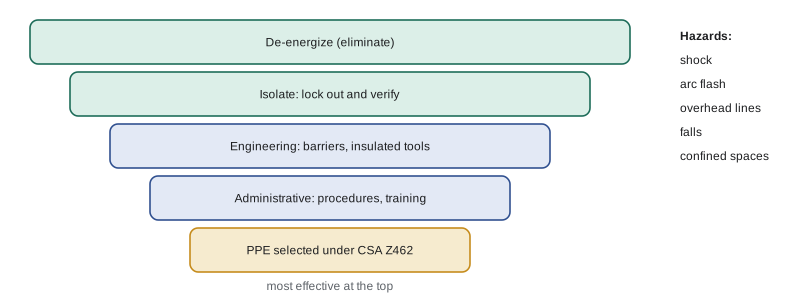
The OHS regulations contain specific requirements for electrical work, and the Saskatchewan interpretations and CSA standards add more. The main hazards for a small contractor are familiar, but familiarity is exactly what makes them dangerous.
- Working on energized equipment: the strong rule in practice is to de-energize, lock out and verify before work. Work on or near energized parts is allowed only in limited circumstances, with the right training, procedures and protective equipment.
- Lockout: equipment must be isolated and locked out under a written procedure before work, with each worker applying their own lock where the procedure requires it.
- Arc flash and shock: CSA Z462, the Canadian standard for workplace electrical safety, sets out the risk assessment, approach boundaries and protective equipment for electrical work. TSASK's scope of authority document requires CSA Z462 training for several restricted licence categories, a sign of how central the standard has become.
- Overhead power lines: the regulations set minimum approach distances to energized overhead lines, which depend on voltage, and require precautions such as contacting the utility, and using spotters, when equipment could come close. Many fatalities involve ladders, booms and dump trucks contacting lines.
- Falls, confined spaces and other construction hazards: electricians work on ladders, roofs and in crawl spaces, and the general construction requirements apply to them as much as to anyone.
Training, young workers and records
Employers must train workers for the work they do and keep records of that training. New and young workers need particular care. Saskatchewan has rules on the minimum age for some work and requires young workers to complete specified safety training before starting work in some circumstances; check the current requirements before hiring anyone under 18. Ellie keeps a training file for each worker: orientation, lockout, arc flash, fall protection, first aid and WHMIS.
WHMIS, the Workplace Hazardous Materials Information System, applies to the hazardous products electricians use, such as cleaners, solvents and some sealants. Workers must be trained, products must be labelled, and safety data sheets must be available.
Incidents and reporting
Several reporting duties can be triggered by the same event, and they go to different places.
- WCB: an employer must report a worker's injury to WCB within five days of learning about it, whether or not the worker loses time. The employer completes the Employer's Report of Injury (E1) and makes sure the worker can submit the Worker's Initial Report (W1). Reporting late can delay the worker's benefits.
- The OHS division: serious incidents, including serious injuries, deaths and specified dangerous occurrences, must be reported to the occupational health and safety division as the regulations require, and the scene generally must not be disturbed except to protect people and property until the division allows it.
- TSASK: electrical accidents must be reported and the site preserved as the Saskatchewan interpretations require, as Lesson 7 explained.
Employers must also investigate incidents to find out what happened and prevent a repeat, and keep records of injuries as OHS law requires. WCB's own guidance reminds employers to log all mishaps and injuries.
| Event | Report to | Deadline or rule |
|---|---|---|
| Worker injury | WCB Saskatchewan | Within five days of learning about it (E1 report) |
| Serious injury, death or dangerous occurrence | OHS division | As the regulations require; preserve the scene |
| Electrical accident | TSASK | As the Saskatchewan interpretations require; preserve the site |
| Any incident | The company's own records | Investigate and record to prevent a repeat |
Worked example: the WCB deadline
Worked problem
When is the report due?
On a Friday afternoon, Jayden cuts his hand on a sharp knockout and needs stitches at an urgent care clinic. He tells Ellie that evening, which is when she learns about it. He returns to work on Monday without losing any shifts. When must Kowalchuk Electric report the injury to WCB?
Show solution
- The duty applies whether or not the worker loses time, so the report is required.
- The deadline is five days after the employer learns of the injury.
- Ellie learned of it on Friday, so the report is due within five days of that Friday.
- Best practice is to report as soon as possible, using WCB's online reporting.
Answer: Within five days of Friday; Ellie files it online on Monday.
The script below computes the latest report date for a list of incidents, counting calendar days from the day the employer learned of each injury. It is a reminder tool, not a substitute for reporting promptly.
from datetime import date, timedelta

incidents = [
    ("Jayden, cut hand", date(2026, 10, 16)),
    ("Curtis, ladder slip, sore back", date(2026, 11, 3)),
]
for who, learned in incidents:
    due = learned + timedelta(days=5)
print(f"{who:32s} learned {learned} -> report to WCB by {due}")Jayden, cut hand learned 2026-10-16 -> report to WCB by 2026-10-21 Curtis, ladder slip, sore back learned 2026-11-03 -> report to WCB by 2026-11-08
A safety program that fits a small company
Saskatchewan's OHS law expects employers to manage safety in a planned way, and the requirements for written programs increase with the size of the workplace and the hazards involved. For a company of three, Ellie keeps the program practical and short enough that people will actually use it.
- A one-page safety policy signed by Ellie, stating that safety comes before schedule.
- Written procedures for the company's highest hazards: lockout, energized work, ladders and fall protection, and work near overhead lines.
- A hazard assessment for each job, done at the start and updated when conditions change.
- Orientation and training records for every worker.
- An incident reporting and investigation procedure, with the WCB, OHS division and TSASK requirements summarized on one page.
- A weekly safety meeting, with minutes.
She reviews the program once a year and after any incident. As the company grows, it will need more, and she will check the regulations to see when committee, representative and written program requirements apply.
Working alone and travel
Rural service calls often mean one electrician working alone, far from help. Saskatchewan's OHS regulations include requirements for workers who work alone or in isolation, generally requiring the employer to assess the risk and have a way to check on the worker. Ellie uses a simple check-in: anyone working alone texts the office at arrival, every two hours, and at departure, and the office calls if a check-in is missed.
She also makes sure every truck carries a charged phone, a first aid kit suited to the crew size, a fire extinguisher and the company's emergency contact sheet, and that every worker knows the nearest medical facility for each rural job before they leave the shop. Small preparations like these are part of an employer's duty to plan for emergencies, and they cost very little compared with the delay they prevent when something goes wrong.
Common mistakes
MistakeReporting only injuries that cause lost time.
InsteadEmployers must report injuries to WCB within five days of learning about them, whether or not the worker loses time.
MistakeAssuming the general contractor is responsible for the subcontractor's workers.
InsteadThe prime contractor coordinates the site, but each employer remains responsible for its own workers and work.
MistakeWorking on energized equipment because shutting down is inconvenient.
InsteadDe-energize, lock out and verify; work on or near energized parts only where permitted, with training, procedures and protective equipment.
MistakeDisciplining a worker for refusing unsafe work.
InsteadWorkers have a right to refuse unusually dangerous work, and employers may not take discriminatory action against them.
Summary and key terms
- Saskatchewan OHS law is mainly in Part III of The Saskatchewan Employment Act and The Occupational Health and Safety Regulations, 2020.
- Employers, supervisors and workers have general duties; workers have the rights to know, participate and refuse.
- Committees are generally required at workplaces with 10 or more workers; shared sites have a coordinating prime contractor.
- Electrical hazards are controlled first by de-energizing and lockout, with CSA Z462 guiding arc flash and shock protection, and approach distances for overhead lines.
- Injuries must be reported to WCB within five days of the employer learning of them; serious incidents go to the OHS division and electrical accidents to TSASK.
- Prime contractor
- The party that coordinates health and safety among employers on a shared worksite.
- Right to refuse
- A worker's right to refuse work they reasonably believe is unusually dangerous.
- Lockout
- Isolating and locking energy sources before work, under a written procedure.
- CSA Z462
- The Canadian standard for workplace electrical safety, covering shock and arc flash risk.
- E1 report
- The Employer's Report of Injury submitted to WCB Saskatchewan.
Practice problems
Work each problem on paper first, then reveal the answer to check.
A worker tells you about a minor injury on Tuesday. When must you report it to WCB?
Show answer
Within five days of Tuesday, whether or not the worker loses time.
Name the three basic rights of Saskatchewan workers.
Show answer
The right to know, the right to participate and the right to refuse unusually dangerous work.
On a shared commercial site, who coordinates health and safety among employers?
Show answer
The prime contractor, while each employer stays responsible for its own workers.
Which standard sets out arc flash risk assessment and protective equipment for electrical work in Canada?
Show answer
CSA Z462.
Lesson quiz · 5 questions
Score 60% or more to complete this lesson.
Create a free account to save your progress, take quizzes and earn a certificate.