
MELC-203 · Lesson 7 of 12 · 19 min
Duties and responsibilities of the qualifying journeyperson
▶ Video coming soon A video version of this lesson is on the way.
In provinces with a master electrician licence, the master's duties are spelled out at length: who may supervise, who signs for permits, who answers for the work. Saskatchewan's equivalent role is the qualifying journeyperson, and its duties come from several places at once. Some are written into the licensing rules TSASK applies. Some come from the Electrical Inspection Act, 1993 and the Saskatchewan interpretations. Some come from the contractor's position as an employer under occupational health and safety law. And some come from the ordinary law of contracts and negligence that applies to anyone who does work for others.
This lesson gathers those duties into one place. It is written from the qualifier's point of view, because in a small company like Kowalchuk Electric, the qualifier is also the owner, the estimator, the supervisor and the person whose name customers know. Where a duty comes from a specific rule, the lesson says so. Where it comes from general principles, the lesson says that too, and points you to the sources to confirm. Nothing here replaces the legislation itself or legal advice for a particular situation.
Ron's list
Before Kowalchuk Electric's first job, Ron drives down from Prince Albert and sits with Ellie at the shop for an afternoon. He has written a list on a sheet of lined paper, titled What the qualifier answers for. It is not a legal document, he says. It is thirty years of watching contractors get into trouble, organized so Ellie can check herself against it.
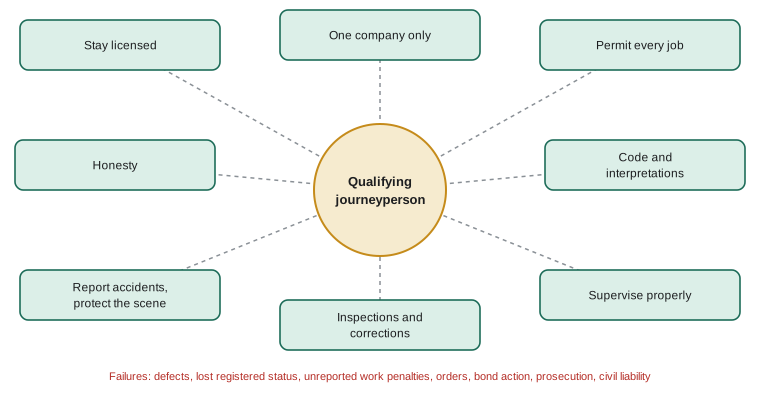
The list has eight items: stay licensed, stay with one company, permit every job, build to the Code and the interpretations, supervise properly, get inspections and fix defects, report accidents and protect the scene, and be honest with TSASK, customers and workers. This lesson works through each one.
1. Stay licensed, and keep the company licensed
The qualifier's own Saskatchewan electrical journeyperson licence must be valid. If it lapses, the company no longer has a qualified journeyperson, and its contractor licence is exposed. The contractor licence itself must be renewed by its expiry date, and the bond must stay in force, because TSASK closes a licence when either lapses. Lesson 3 covered the reopening rules; the point here is that keeping both current is the qualifier's job in practice, even if a bookkeeper handles the paperwork.
The qualifier should also make sure every journeyperson the company employs is licensed and listed, and that apprentices are properly registered. TSASK's licensing pages and annual permit paper both make the point that people must be licensed and registered before they work under a licence or permit.
2. Stay with one company
TSASK's rule is that a qualifier cannot be employed by another licensed contractor or employer while listed as a qualifying journeyperson. That rule exists so that every licensed contractor has a qualifier who is actually present in the business. Lending a name to another company, or keeping a second job with another contractor, breaks it. If the qualifier leaves, the company needs a new qualifier before it continues licensed work.
3. Permit every job
A permit is required for electrical installation work, and Saskatchewan penalizes unreported work. The qualifier is the person most likely to be asked to skip a permit, by a customer trying to save money, by a builder in a hurry, or by a friend. The answer is always no. Every change in scope needs a permit check, and every job's permit number should be recorded in the job file and on the panel schedule.
4. Build to the Code and the interpretations
Electrical installations must meet the Code as adopted in Saskatchewan, including the Saskatchewan interpretations. The qualifier is responsible for the company's work meeting those requirements, not just their own. That means knowing the current editions, keeping current documents in the shop, and training the crew on changes.
It also means using approved equipment. The interpretations deal with approved equipment requirements and how deviations are handled, in connection with Rule 2-024 of the Code. Uncertified equipment bought cheaply online is a common source of trouble, and the qualifier should not install it, or allow it to be installed, unless it has been approved in a way the rules accept.
5. Supervise properly
Apprentices must be supervised by journeypersons, and the apprenticeship rules set ratios and supervision requirements. SATCC sets those rules for apprentices in the trade. The qualifier must make sure the company follows them: an apprentice does not work alone on tasks that require supervision, and the journeyperson-to-apprentice ratio is respected on each job.
Supervision is also a practical duty. The qualifier answers for work done by everyone in the company, so the qualifier needs to check work before inspection, not after it fails. Ellie sets a rule that she or Curtis will walk every rough-in before an inspection request goes in.
| Duty | Main source | What it looks like in practice |
|---|---|---|
| Qualifier and journeyperson licences current | Electrical Licensing Act; TSASK licensing rules | Licence lookup checks; renewal reminders |
| Qualifier works for one company only | TSASK licensing rules | No second job with another contractor |
| Permit before work | Electrical Inspection Act, 1993; interpretations | GEIS permit before day one; scope changes added |
| Installations meet the Code as adopted | Inspection Act; Code; interpretations | Current documents; crew training |
| Apprentices supervised and ratios respected | Apprenticeship rules (SATCC) | Crew planning; journeyperson on site |
| Inspections requested; defects corrected before expiry | Interpretations; TSASK practice | Rough-in walk-throughs; prompt corrections |
| Accidents reported; scene preserved | Interpretations front matter; OHS law; WCB | Incident procedure in every truck |
| Honesty with TSASK, customers and workers | Legislation; contract law; professional practice | Accurate permits, records and invoices |
6. Get inspections and correct defects
The qualifier must make sure inspections are requested before work is concealed or energized, and that defects are corrected before the permit expires. Leaving defects open is one of the quickest ways to lose registered contractor status, and repeated or serious failures can lead to enforcement. Inspectors keep records, and so should the contractor: every defect, its cause and the correction.
When an inspector and a contractor disagree about whether something complies, the right response is a respectful conversation, a look at the rule and the interpretation together, and, if needed, an escalation through TSASK's processes. Arguing on site or ignoring an inspector's direction does not help.
7. Report accidents and protect the scene
The Saskatchewan interpretations' front matter deals with accident reporting and site preservation for electrical accidents. In general terms, when an electrical accident causes serious injury, death or significant damage, the contractor must report it to the inspection authority and must not disturb the scene, except as needed to protect people and property, until the authority allows it. Check the interpretations for the exact reporting requirements and timelines.
The same event can trigger separate duties under occupational health and safety law and workers compensation law, which Lesson 10 covers. A worker injury must be reported to WCB within five days of the employer learning about it. Ellie keeps a one-page incident procedure in every truck so that whoever is on site knows what to do first, whom to call and what not to touch.
8. Be honest
The last item on Ron's list is the one he says matters most. Permits must describe the actual work. Inspection requests must be made when the work is truly ready. Records must be accurate. Customers must be told when work needs a permit and what it will cost. Workers must be told about hazards. A contractor who is caught being dishonest with TSASK loses trust that takes years to rebuild, and dishonesty can turn an ordinary defect into an enforcement matter.
Consequences when duties are not met
The legislation and TSASK's processes provide a range of consequences, from the routine to the serious. The details vary with the situation, so this list is general.
- Defects recorded against permits, with re-inspection costs and delays.
- Loss of registered contractor status and the permit discount that comes with it.
- Penalties for unreported work, as provided in the interpretations.
- Orders to disconnect or not energize installations until hazards are corrected.
- Action on the bond, which immediately ends registered contractor status, and which the surety will expect the contractor to repay.
- Enforcement under the Acts, including possible prosecution for offences such as working without a licence or permit.
- Civil liability to customers and others for negligent work, and obligations under occupational health and safety law if workers are hurt.
Worked example: a scope change goes wrong
Worked problem
The extra circuits
On a renovation job, Curtis adds three receptacle circuits that the customer asked for at the last minute. He tells himself he will add them to the permit later, then forgets. Two months later, the customer's insurer asks for the permit after a small fire in a power bar plugged into one of the new circuits. What are the problems, and what should the company have done?
Show solution
- The three circuits were installation work done without being included in the permit: unreported work.
- The circuits were never inspected, so the company has no inspection record to show the insurer or TSASK.
- Even if the fire was caused by the power bar, the company is exposed: the work was not permitted, and its quality is now in question.
- The qualifier, Ellie, answers for the company's work even though Curtis made the mistake.
- The right approach was to add the circuits to the permit before pulling cable and to include them in the inspection.
Answer: Every change in scope needs a permit check before the work. The qualifier answers for the whole crew's work.
A simple compliance tracker
Ellie keeps a small script that checks the expiry dates that matter to the company and flags anything due within 60 days. The dates below are examples.
from datetime import date

today = date(2026, 11, 2)
items = {
    "contractor licence": date(2027, 5, 31),
    "surety bond": date(2026, 12, 15),
    "Ellie journeyperson licence": date(2027, 3, 31),
    "Curtis journeyperson licence": date(2026, 12, 31),
    "liability insurance": date(2027, 6, 30),
}
for name, due in sorted(items.items(), key=lambda kv: kv[1]):
    days = (due - today).days
    flag = "RENEW NOW" if days <= 60 else "ok"
print(f"{name:30s} due {due} in {days:3d} days {flag}")surety bond due 2026-12-15 in 43 days RENEW NOW Curtis journeyperson licence due 2026-12-31 in 59 days RENEW NOW Ellie journeyperson licence due 2027-03-31 in 149 days ok contractor licence due 2027-05-31 in 210 days ok liability insurance due 2027-06-30 in 240 days ok
Delegating without losing responsibility
As Kowalchuk Electric grows, Ellie will not be on every job. Curtis already runs jobs on his own, and one day Jayden will. Delegation is normal, but responsibility does not move with it. Ellie sets up three habits that let her delegate safely.
- Clear job files: each job has its permit number, scope, drawings and any special requirements in one folder, paper or digital, so whoever is on site works from the same information.
- Check-ins at the right moments: before an inspection request goes in, and before a service is energized, the journeyperson on the job calls or sends photos to Ellie.
- Learning from defects: every recorded defect is discussed with the person who did the work and added to the company's checklist, without blame, so the same mistake does not happen twice.
Ron calls this building a company that can survive a week without the qualifier on site. It is also what will let Ellie take a holiday.
The habits cost an hour or two a week. The alternative, finding out about a problem from an inspector or a customer, costs far more.
Common mistakes
MistakeThinking the qualifier answers only for the work they do personally.
InsteadThe qualifier answers for the company's work, including work by other journeypersons and apprentices.
MistakeAdding scope to a job and updating the permit later.
InsteadUpdate the permit before the added work starts; otherwise the added work is unreported.
MistakeCleaning up an accident scene before reporting it.
InsteadReport serious electrical accidents as the interpretations require and preserve the scene except to protect people and property.
MistakeTreating apprentice ratios as optional on small jobs.
InsteadApprenticeship rules on supervision and ratios apply to every job.
Summary and key terms
- The qualifying journeyperson's duties come from the licensing rules, the Inspection Act and interpretations, OHS and WCB law, and general contract and negligence law.
- The qualifier must keep their own licence, the contractor licence and the bond current, and work for one company only.
- Every job and every scope change needs a permit, and installations must meet the Code as adopted with approved equipment.
- Apprentices must be supervised within the ratios set by the apprenticeship rules, and inspections and corrections must be handled promptly.
- Serious accidents must be reported and the scene preserved; consequences of failures range from defects to bond action, prosecution and civil liability.
- Qualifying journeyperson
- The licensed journeyperson whose qualifications support the contractor licence, and who answers for the company's work.
- Scope change
- Work added to a job after the permit was bought, which must be added to the permit.
- Site preservation
- Leaving an accident scene undisturbed, except to protect people and property, until the authority allows changes.
- Bond action
- A claim against the contractor's surety bond, which ends registered contractor status.
Practice problems
Work each problem on paper first, then reveal the answer to check.
Curtis did the work, but it failed inspection. Who answers for it?
Show answer
The company and its qualifying journeyperson, Ellie, answer for the company's work.
Name three consequences a contractor can face for failing its duties.
Show answer
Any three of: recorded defects, loss of registered status, unreported work penalties, orders, bond action, prosecution, civil liability.
Within what time must an employer report a worker injury to WCB Saskatchewan?
Show answer
Within five days of learning about it.
A customer offers to pay cash if Ellie skips the permit. What should she do?
Show answer
Refuse; a permit is required for the work, and unreported work carries penalties.
Lesson quiz · 5 questions
Score 60% or more to complete this lesson.
Create a free account to save your progress, take quizzes and earn a certificate.