
MELC-203 · Lesson 2 of 12 · 20 min
Licence classes and the qualifying journeyperson
▶ Video coming soon A video version of this lesson is on the way.
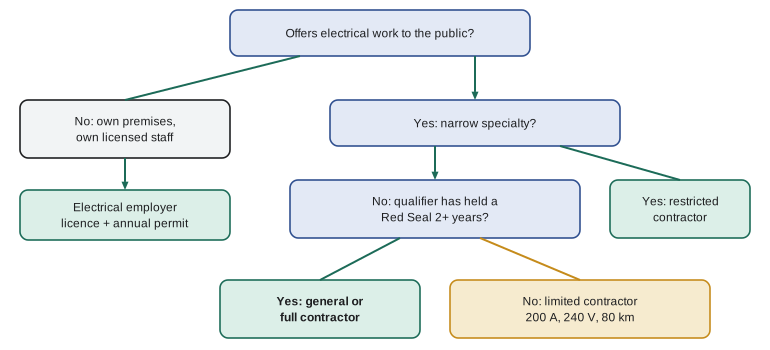
Saskatchewan's electrical licences come in families. There are licences for businesses that contract with the public, a licence for businesses that do electrical work only on their own premises, licences for individual electricians, and a set of restricted licences for narrow specialties. Picking the right class is the first real decision a new contractor makes, because the class decides what work the company may sell, how far it may travel, and who it needs on staff.
This lesson walks through the classes TSASK lists, explains the qualifying journeyperson requirement that sits at the heart of the contractor licence, and works through the questions that come up when a company's qualifier changes jobs, retires or is still early in their career. As always, the details here were checked against TSASK's published pages and its scope of authority document in late 2026. Confirm the current requirements with TSASK before you rely on them.
Ellie lays out the options
Ellie spreads TSASK's licensing pages across the kitchen table one evening. Dev reads over her shoulder. The list is longer than either expected: general or full electrical contractor, limited electrical contractor, restricted electrical contractor, electrical employer, electrical supply house, full and restricted journeyperson licences, and a list of restricted categories that includes signs, lightning rods, instrumentation, X-ray and dental equipment and power lines.
Ron, on speakerphone from Prince Albert, cuts through it. For a company that wires houses, shops and farms for paying customers, he says, there are really two choices: the full licence and the limited licence. Everything else on the list is for specialists or for companies that only work on their own buildings. The question is whether Ellie qualifies for full, and she does.
The general or full electrical contractor licence
The general or full electrical contractor licence is the standard licence for a business that offers electrical work to the public without the limits of the other classes. TSASK lists four requirements.
- The business must be registered, with the Corporate Registry operated by Information Services Corporation (ISC).
- The business must be bonded, with an electrical contractor's surety bond of at least 10,000 dollars.
- The business must be licensed with TSASK.
- The business must have at least one qualifying journeyperson: a licensed Saskatchewan electrical journeyperson who has held a Red Seal for at least two years. The qualifier may be the owner or an employee.
There is no exam for the contractor licence itself. The competence test is built into the qualifier requirement: the qualifier passed the interprovincial Red Seal examination to earn the endorsement, holds a current Saskatchewan journeyperson licence, and has at least two years of experience as a Red Seal journeyperson. Lesson 4 looks more closely at what that means and what it does not cover.
The qualifying journeyperson
The word qualifier appears throughout TSASK's material, and it carries specific rules. Ellie copies them into her notebook.
- The qualifier must hold a valid Saskatchewan electrical journeyperson licence. A Red Seal or a licence from another province is proof of qualifications, but TSASK issues its own Saskatchewan licence on that proof. Licences are not simply transferred from another province.
- For a full contractor licence, the qualifier must have held a Red Seal for at least two years.
- The qualifier cannot be employed by another licensed electrical contractor, or another licensed employer, while they are listed as a qualifying journeyperson. A qualifier works for one business.
- The qualifier may be the owner, a partner or an employee. Many small companies are qualified by their owner; larger ones often have a qualifying employee.
The single-employer rule is the one that catches people. A journeyperson who qualifies a friend's company on paper while working full time for another contractor is breaking it, and so is the friend's company. If the qualifier leaves, the business needs another qualifier to keep doing licensed work. Ron's advice is blunt: never let your company depend on a qualifier you do not control, and always know who would qualify the company if you could not.
The limited electrical contractor licence
The limited licence exists for newly certified journeypersons who want to start contracting before they have two years with a Red Seal. TSASK describes it as a licence issued as a 200 ampere contractor licence to fully certified construction electricians with under two years of experience.
- The business needs a qualifying electrical journeyperson with less than two years of experience, who is the qualifier for the business and cannot be employed elsewhere.
- The business must be registered with the Corporate Registry, bonded and licensed with TSASK, with the same 10,000 dollar minimum bond as the full licence.
- The work is limited to installations up to 200 amperes and 240 volts.
- The work is limited to an 80 kilometre radius from the town, village or community where the contractor lives and the business is located.
- The qualifier must hold Red Seal certification as a construction electrician.
When the qualifier reaches two years with a Red Seal, the business can move to the full licence. TSASK points limited contractors to its full licence page at that point. Until then, a limited contractor that takes a job beyond its limits, a 400 ampere farm service for example, or a house in a town 120 kilometres away, is working outside its licence.
| Feature | General or full contractor | Limited contractor |
|---|---|---|
| Qualifier experience | Red Seal held at least two years | Certified, under two years |
| Electrical limits | None beyond the licence scope | Up to 200 A and 240 V |
| Geographic limits | None | 80 km radius from home community and business |
| Bond | At least 10,000 dollars | At least 10,000 dollars |
| Business registration | Corporate Registry (ISC) | Corporate Registry (ISC) |
Restricted licences for specialists
Restricted licences cover narrow kinds of electrical work. Each restricted contractor needs a restricted journeyperson in the matching category, and each restricted contractor must be bonded, with the same 10,000 dollar bond. TSASK's scope of authority document lists categories that include the following.
- Restricted extra low voltage: Class 2 circuits limited to 100 volt-amperes, excluding hazardous locations, fire alarm systems and the low-voltage controls of higher-voltage equipment. It requires a year of experience and related training, plus CSA Z462 training.
- Restricted instrumentation: maintenance and repair of industrial instrumentation up to 120 volts AC single phase and the associated signal circuits, for holders of the interprovincial instrumentation and control technician Red Seal.
- Restricted lightning rod: installation and maintenance of lightning protection only.
- Restricted power line: high-voltage overhead and underground power line systems, for certified powerline technicians.
- Restricted signs: signs and outline lighting, excluding hazardous locations and connections to the main supply.
- Restricted X-ray and dental: X-ray and dental equipment, excluding hard-wired connections to panels.
A restricted journeyperson holds that designation only while employed by a restricted contractor or a matching employer. If the contractor closes, the restricted licence becomes inactive. That is a practical difference from a full journeyperson licence, which belongs to the individual.
The electrical employer licence
Some businesses do a lot of electrical work but never sell it to the public: a food processing plant, a potash mine, a hospital, a large retailer with its own maintenance staff. They hold an electrical employer licence. Under the Electrical Licensing Act, an employer licence requires that the employer employ at least one licensed journeyperson, and an employer holding the licence must obtain an annual permit for each premises where its journeypersons work full time. Lesson 6 covers annual permits.
The employer licence does not allow the business to contract with others. And the reverse applies too: no contractor may work under an employer's licence or its annual permit. When Kowalchuk Electric is hired to add a new feeder at a plant that holds an employer licence, Ellie buys her own permit for that job.
There is also a restricted industrial journeyperson licence, for holders of the industrial electrician Red Seal working in factories, plants and mines, valid only while they are employed by an electrical employer. It does not cover construction work.
Out-of-province electricians
Saskatchewan does not transfer licences from other provinces. TSASK issues its own licence and asks for proof of the qualifications earned in the home province. For a journeyperson, that means proof of the journeyperson certificate, including the seal with its interprovincial number. For a company, it means a Saskatchewan contractor licence with a Saskatchewan-licensed qualifier.
That matters for Ellie's cousin Priya if Parkland Valley ever wants to work across the border in Lloydminster or on a Saskatchewan farm. Priya's Alberta Master Electrician Certificate does not qualify a business in Saskatchewan. She would need a Saskatchewan journeyperson licence on the strength of her Red Seal, and Parkland Valley would need a Saskatchewan contractor licence and bond.
Worked example: counting Red Seal time
Worked problem
Is Curtis eligible to qualify a company?
Curtis Lafond earned his construction electrician Red Seal on September 15, 2025. He leaves the sign company and joins Kowalchuk Electric full time. Dev asks whether Curtis could serve as a second qualifier, or take over if Ellie were ever unable to, on May 1, 2027.
Show solution
- The full licence needs a qualifier who has held a Red Seal for at least two years.
- Two years after September 15, 2025 is September 15, 2027.
- On May 1, 2027, Curtis has held his Red Seal for about one year and seven and a half months, short of two years.
- He could qualify a limited licence, with its limits, but not the full licence until mid-September 2027.
Answer: Curtis reaches two years with a Red Seal on September 15, 2027. Until then he cannot qualify a full contractor licence.
The date arithmetic is simple, but it is worth automating when a company tracks several journeypersons. The code below checks the two-year rule on a given date, counting from the date the Red Seal was granted.
from datetime import date

def red_seal_years(granted, on):
    # Whole years between two dates
    years = on.year - granted.year
    if (on.month, on.day) < (granted.month, granted.day):
        years -= 1
    return years

staff = {"Ellie": date(2020, 4, 20), "Curtis": date(2025, 9, 15)}
check_on = date(2027, 5, 1)
for name, granted in staff.items():
    y = red_seal_years(granted, check_on)
    status = "can qualify a full licence" if y >= 2 else "limited licence only"
print(f"{name}: {y} full years with a Red Seal on {check_on} -> {status}")Ellie: 7 full years with a Red Seal on 2027-05-01 -> can qualify a full licence Curtis: 1 full years with a Red Seal on 2027-05-01 -> limited licence only
Planning for the qualifier you might lose
Ron spent thirty years watching small contractors fail for reasons that had nothing to do with wiring. One of the most common was losing the qualifier. A company that depends on one person is one illness, one job offer or one family move away from being unable to buy permits. He gives Ellie three rules.
- Know your backup. Identify who could qualify the company if you could not, and track their Red Seal date.
- Keep the paperwork current. Licences, bonds and the list of employed journeypersons must match reality at all times. A qualifier who has left is not a qualifier.
- Do not lend your name. Never act as the qualifier for a company you do not work for full time, and never let anyone act as yours.
A note on changing classes
Licence classes are not permanent. A limited contractor moves to the full licence when its qualifier reaches two years with a Red Seal; a full contractor whose only qualifier leaves may find that its replacement qualifies only a limited licence until they too reach two years. Ellie writes both scenarios into her business plan, with the date each journeyperson on staff will reach two years, so that a change of qualifier never takes the company by surprise.
Common mistakes
MistakeListing a qualifier who works for another licensed contractor.
InsteadA qualifying journeyperson cannot be employed by another licensed contractor or employer while listed.
MistakeTaking a 400 ampere service job on a limited licence.
InsteadThe limited licence is restricted to 200 amperes and 240 volts and an 80 kilometre radius.
MistakeAssuming an Alberta or Ontario licence carries over.
InsteadTSASK issues its own Saskatchewan licences on proof of qualifications; licences are not transferred.
MistakeDoing a customer's job under the customer's employer licence.
InsteadNo contractor may work under an employer's licence; the contractor buys its own permit.
Summary and key terms
- The general or full contractor licence needs business registration, a bond of at least 10,000 dollars, TSASK licensing and a qualifier with a Red Seal held at least two years.
- The limited licence is for qualifiers with under two years and is limited to 200 A, 240 V and an 80 km radius.
- Restricted licences cover specialties such as signs, lightning rods, instrumentation, power lines, extra low voltage and X-ray and dental equipment.
- Electrical employers do maintenance on their own premises under an annual permit and cannot contract with others.
- A qualifier must hold a Saskatchewan journeyperson licence and cannot work for another licensed contractor while listed.
- General or full contractor licence
- The standard contractor licence, qualified by a journeyperson with a Red Seal held at least two years.
- Limited contractor licence
- A contractor licence for newer journeypersons, limited to 200 A, 240 V and an 80 km radius.
- Restricted licence
- A licence limited to one specialty, such as signs or lightning protection.
- Electrical employer licence
- A licence for a business doing electrical work only on its own premises with its own licensed staff.
- Qualifier
- The licensed journeyperson whose qualifications allow a business to hold a contractor licence.
Practice problems
Work each problem on paper first, then reveal the answer to check.
A newly certified construction electrician wants to start contracting. Which licence can her business get?
Show answer
A limited electrical contractor licence, until she has held her Red Seal for two years.
What electrical limits apply to a limited contractor?
Show answer
Installations up to 200 amperes and 240 volts, within 80 km of the contractor's home community and business.
Can a qualifier also work weekends for another licensed contractor?
Show answer
No. A qualifier cannot be employed by another licensed contractor or employer while listed.
A plant with an employer licence hires Kowalchuk Electric for a new feeder. Whose permit covers the work?
Show answer
Kowalchuk Electric buys its own permit; contractors cannot work under an employer's licence or annual permit.
Lesson quiz · 5 questions
Score 60% or more to complete this lesson.
Create a free account to save your progress, take quizzes and earn a certificate.