
MELC-203 · Lesson 8 of 12 · 19 min
Contractor licensing, insurance and bonding
▶ Video coming soon A video version of this lesson is on the way.
The contractor licence from TSASK is the licence everyone thinks about, but it is only one of several registrations, licences, policies and accounts a Saskatchewan electrical contractor needs. The business must be registered. It must be bonded. It will almost always need liability insurance, even though TSASK does not list insurance among its licensing requirements. It needs a workers compensation account if it employs workers. It needs to deal correctly with federal and provincial sales taxes. And depending on where it works, it may need municipal business licences.
This lesson works through each of those with Kowalchuk Electric as the example. TSASK's licensing requirements were checked against its own pages in late 2026. Tax, insurance and municipal requirements change and depend on the details of each business, so treat this lesson as a map of what to ask about, and confirm the specifics with the relevant authority, an accountant and an insurance broker.
Dev's spreadsheet
Dev Sandhu has kept books for small businesses before, but never for a contractor. He starts a spreadsheet with a row for every registration, licence and policy the company needs, a column for who issues it, a column for the renewal date and a column for the cost. By the end of the first week it has eleven rows. Ellie is surprised; Ron is not. Every one of those rows, he tells them, is a way to be shut down, sued or fined if it is forgotten.
Business structure and registration
TSASK requires an electrical contractor to be a registered business with the Corporate Registry operated by Information Services Corporation (ISC). The structure of the business is a separate decision, with legal and tax consequences.
- Sole proprietorship: the simplest structure. The owner and the business are legally the same, so the owner is personally liable for the business's debts and obligations. A sole proprietor operating under a name other than their own registers the business name.
- Partnership: two or more people carrying on business together, sharing profits and, in a general partnership, sharing liability.
- Corporation: a separate legal person. Shareholders are generally not personally liable for the corporation's debts, although directors can be personally liable for some obligations, such as unremitted payroll deductions and certain taxes, and owners often give personal guarantees for loans and bonds.
Ellie and Dev incorporate Kowalchuk Electric Ltd. on their accountant's advice, mainly for liability and tax planning. Ron points out that incorporation does not protect Ellie from her own negligence or from the personal guarantee the surety will ask her to sign. It separates the company's debts from her house; it does not make her immune.
The surety bond
Every licensed electrical contractor in Saskatchewan must be bonded. TSASK requires an electrical contractor's surety bond with a minimum guarantee of 10,000 dollars, and notes that the same amount currently applies to both gas and electrical contractors. Restricted contractors need the same bond.
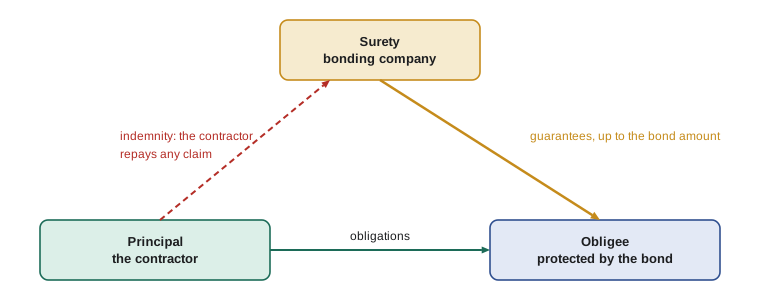
A surety bond involves three parties. The principal is the contractor. The obligee is the party protected by the bond, in this case through the licensing scheme. The surety is the company that issues the bond and promises to pay if the principal fails to meet its obligations, up to the bond amount. Unlike insurance, a bond is not meant to absorb the contractor's losses. If the surety pays a claim, it will look to the contractor, and usually to the owners who signed an indemnity agreement, to be repaid.
That is why the bond matters beyond its modest premium. TSASK closes a licence if the bond expires. Bond action, a claim on the bond, ends registered contractor status immediately. And because the surety will want to be repaid, a bond claim can follow the owners personally. Ellie treats the bond as a promise she has made with her own money behind it.
Larger projects bring other bonds: bid bonds, performance bonds and labour and material payment bonds required by owners and general contractors. Those are contract bonds, separate from the licence bond, and their amounts are set by the contract. Lesson 9 returns to them.
Liability insurance
TSASK's licensing pages list the bond but not liability insurance. That does not mean insurance is optional in practice. Most general contractors, property managers, institutions and many homeowners will ask for proof of commercial general liability insurance before they hire an electrical contractor, often with a minimum limit set in the contract and with the customer named as an additional insured.
Ellie's broker explains the policies a small electrical contractor usually considers.
- Commercial general liability (CGL): covers claims for bodily injury and property damage to others arising from the business's operations and completed work, such as a fire caused by faulty wiring.
- Tools and equipment coverage: covers the company's tools and equipment against theft and damage.
- Commercial auto insurance: in Saskatchewan, vehicle insurance is provided through SGI's basic plan, with extension coverage available; business use must be declared correctly.
- Errors and omissions or professional liability: for contractors who do design work.
- Pollution or other specialty coverages where the work calls for them.
The limits are a business decision driven by contracts and risk. Ellie's first contract with a general contractor requires a CGL limit of two million dollars per occurrence, so that sets her minimum.
| Item | Issued by | Required by |
|---|---|---|
| Business registration | Corporate Registry (ISC) | TSASK licensing requirement |
| Contractor licence | TSASK | The Electrical Licensing Act |
| Surety bond (at least 10,000 dollars) | Licensed insurer or surety | TSASK licensing requirement |
| Commercial general liability | Insurer | Customers and contracts, in practice |
| Workers compensation account | WCB Saskatchewan | Workers compensation law, for employers in covered industries |
| GST/HST registration | Canada Revenue Agency | Federal law, above the small supplier threshold |
| PST vendor licence | Government of Saskatchewan | Provincial sales tax law, where applicable |
| Municipal business licence | Municipality | Local bylaws, where required |
Workers compensation
Saskatchewan's workers compensation system is run by the Workers' Compensation Board (WCB). Employers in covered industries must register with WCB and pay premiums based on their payroll and their industry's rate. Construction trades, including electrical contracting, are covered. Ellie registers Kowalchuk Electric before Jayden's first day, because coverage needs to be in place when workers start.
WCB coverage means that a worker hurt on the job receives benefits through the system, and in exchange the employer is generally protected from being sued by its workers for workplace injuries. Owners of incorporated businesses may need to apply separately for their own personal coverage. The details are in WCB's employer guidance.
Many general contractors ask subcontractors for a WCB clearance letter showing the subcontractor's account is in good standing before they pay, because in some circumstances a principal can become liable for an unregistered subcontractor's premiums. Dev sets a reminder to download Kowalchuk Electric's clearance before every progress billing to a general contractor.
Lesson 10 covers WCB injury reporting, including the five-day deadline for employers.
Sales taxes
Taxes are where small contractors most often get advice from a cousin instead of an accountant. Dev insists on the accountant.
- GST: a business that makes taxable supplies above the federal small supplier threshold must register with the Canada Revenue Agency and charge GST. Many contractors register voluntarily so they can claim input tax credits on their purchases.
- PST: Saskatchewan's provincial sales tax applies to many goods and to some services, and Saskatchewan has specific rules for contractors working on real property, including how PST applies to materials and to contracts. Contractors may need a PST vendor licence. The rules are detailed and have changed over the years, so the company follows the Government of Saskatchewan's current guidance for contractors.
Ellie's job is to make sure the estimates include the right taxes and that Dev has the information he needs for every invoice. Dev's job is to register, collect, remit and keep records.
Municipal business licences
Some Saskatchewan cities and towns require businesses, including contractors from outside the municipality, to hold a municipal business licence. Requirements and fees vary. Kowalchuk Electric holds a business licence for Saskatoon, where its shop is, and Dev checks the rules before the company takes work in another municipality.
Worked example: the first-year budget
Worked problem
What does compliance cost Kowalchuk Electric in year one?
Dev gathers quotes: bond premium 250 dollars, CGL insurance 2,600 dollars, tools coverage 450 dollars, WCB premium estimated at 1,950 dollars on a projected payroll, contractor licence and business registration fees totalling 400 dollars, and a municipal business licence at 150 dollars. All figures are illustrative quotes for this example. What is the total, and what share of a projected 280,000 dollars in revenue does it represent?
Show solution
- Total = 250 + 2,600 + 450 + 1,950 + 400 + 150 = 5,800 dollars.
- Share of revenue = 5,800 / 280,000 = 0.0207.
- That is about 2.1 dollars of every 100 dollars of revenue.
Answer: About 5,800 dollars, or roughly 2.1 dollars in every 100 of revenue, before permits, which scale with the work.
costs = {"bond premium": 250, "CGL insurance": 2600, "tools coverage": 450,
         "WCB premium (estimate)": 1950, "licence and registration": 400,
         "municipal business licence": 150}
revenue = 280_000
total = sum(costs.values())
for k, v in costs.items():
    print(f"{k:28s} {v:6,d}")
print(f"{'total':28s} {total:6,d}")
print(f"per 100 dollars of revenue: {total / revenue * 100:.2f}")bond premium 250 CGL insurance 2,600 tools coverage 450 WCB premium (estimate) 1,950 licence and registration 400 municipal business licence 150 total 5,800 per 100 dollars of revenue: 2.07
Certificates and proof
General contractors, property managers and institutions will ask for proof before Kowalchuk Electric starts work, and sometimes before they pay. Dev keeps a set of documents ready to send the same day.
- A copy of the TSASK contractor licence and the qualifier's journeyperson licence.
- A certificate of insurance showing the commercial general liability policy, its limits and its expiry, with the customer named as an additional insured where the contract requires.
- A current WCB clearance letter.
- The company's GST registration number for invoicing.
- For larger contracts, proof that any required contract bonds can be obtained.
Each of these has an expiry date, so the folder needs refreshing through the year. A certificate of insurance that expired last month is no proof at all.
Reading the insurance policy
Ron's last piece of advice on insurance is to read the policy, not just the certificate. Exclusions matter. Some policies exclude work above a certain voltage, certain types of buildings, or work done by subcontractors who are not themselves insured. A contractor who discovers an exclusion after a claim has no remedy. Ellie and her broker go through the exclusions line by line and adjust the coverage to match the work Kowalchuk Electric actually does, including the farm work outside Saskatoon.
She also tells the broker whenever the business changes: a new kind of work such as solar installations, a new vehicle, or a first employee who will drive a company truck. Insurers price the risk they are told about, and a material change that is not disclosed can put coverage at risk.
Paying attention to cash
Registrations and policies are fixed costs, but the bigger risk for a new contractor is cash flow. Materials are bought weeks before a progress payment arrives, and the holdback covered in Lesson 9 is not paid until long after a job is substantially complete. Dev builds a simple cash forecast, month by month, showing when money goes out for materials, wages, premiums and permits and when it comes in. In the first year, the forecast shows a gap in month four, when the dental office job's materials are due before its first payment. He arranges a small line of credit in advance rather than scrambling for one when the gap arrives.
Common mistakes
MistakeAssuming incorporation protects the owner from everything.
InsteadIncorporation separates business debts, but owners may still be liable for their own negligence, personal guarantees and some director obligations.
MistakeTreating the surety bond as insurance for the contractor.
InsteadThe surety guarantees the contractor's obligations and expects to be repaid for any claim it pays.
MistakeSkipping liability insurance because TSASK does not list it.
InsteadCustomers and contracts commonly require commercial general liability insurance.
MistakeHiring the first worker before registering with WCB.
InsteadRegister with WCB before workers start, so coverage is in place.
Summary and key terms
- A Saskatchewan contractor needs business registration with ISC, a TSASK contractor licence and a surety bond of at least 10,000 dollars.
- A surety bond guarantees the contractor's obligations; the surety expects repayment, and bond action ends registered contractor status.
- Liability insurance is not a TSASK licensing requirement, but customers and contracts commonly require it.
- Employers in covered industries, including electrical contracting, must register with WCB before workers start.
- GST, Saskatchewan PST rules for contractors and municipal business licences also apply; confirm details with the authorities and an accountant.
- Principal
- The party whose obligations a bond guarantees; here, the contractor.
- Surety
- The company that issues a bond and pays valid claims up to the bond amount.
- Indemnity agreement
- An agreement by the contractor and often its owners to repay the surety for claims it pays.
- Commercial general liability
- Insurance for claims of bodily injury or property damage to others from the business's work.
- WCB clearance
- A letter confirming that an employer's workers compensation account is in good standing.
Practice problems
Work each problem on paper first, then reveal the answer to check.
What is the minimum electrical contractor's surety bond in Saskatchewan?
Show answer
10,000 dollars, according to TSASK.
If the surety pays a claim on Kowalchuk Electric's bond, who ultimately pays?
Show answer
Kowalchuk Electric and, under the indemnity agreement, usually its owners must repay the surety.
Why might a general contractor ask for a WCB clearance letter?
Show answer
To confirm the subcontractor's WCB account is in good standing, since a principal can sometimes become liable for an unregistered subcontractor's premiums.
Does TSASK require liability insurance for a contractor licence?
Show answer
TSASK's licensing pages list the bond, not liability insurance, but customers and contracts commonly require it.
Lesson quiz · 5 questions
Score 60% or more to complete this lesson.
Create a free account to save your progress, take quizzes and earn a certificate.