
MELC-201 · Lesson 9 of 12 · 21 min
Contracts and builders' liens in Alberta
▶ Video coming soon A video version of this lesson is on the way.
Electrical contractors are paid last and paid late more often than most businesses. The work is buried in walls, the owner pays the general contractor, the general contractor pays the trades, and every step in that chain is a chance for money to stop moving. Alberta's answer is the Prompt Payment and Construction Lien Act, which sets payment deadlines, gives unpaid parties a lien against the land, and requires holdbacks to protect everyone down the chain. A master electrician who runs jobs needs to know it well, and the business and law content of the exam can reach it.
The Act replaced the former Builders' Lien Act and came into force on August 29, 2022; contracts and subcontracts entered into on or after that date must conform to it. The summary below reflects the Act and published legal commentary as of late 2026. It is an overview for exam preparation and day-to-day awareness, not legal advice. For a real dispute, read the Act and its regulations and get a lawyer's advice early, because the deadlines are strict.
Contracts first
Most payment problems are really contract problems. A clear contract says what work is included, what it costs, how changes are priced and approved, when invoices are issued, when payment is due and what happens if there is a dispute. In construction, contracts are often based on standard forms, such as those published by the Canadian Construction Documents Committee, with supplementary conditions added by the owner.
For an electrical subcontractor, the key clauses are the scope of work and exclusions, the schedule, change orders, payment terms, holdback, warranty, and any clauses that try to shift risk, such as pay-when-paid language or broad indemnities. Under the prompt payment rules, contract terms that conflict with the Act's payment requirements generally do not override them, which is one reason the Act matters.
Gord's rule for change orders is the one every master electrician should adopt: no extra work without a written change, signed by someone with authority, before the work is done. Verbal changes are how a profitable job becomes a loss and a payment dispute.
Prompt payment
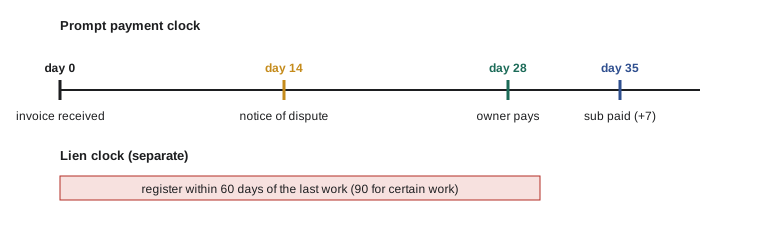
The prompt payment part of the Act sets deadlines that run down the contracting chain.
- Contractors must give the owner a proper invoice at least every 31 days, unless the contract provides otherwise in ways the Act allows.
- The owner must pay a proper invoice within 28 days of receiving it.
- If the owner disputes an invoice, it must give a notice of dispute within 14 days of receiving the invoice, stating its reasons, and must still pay any undisputed amount within the 28 days.
- A contractor that receives payment must pay its subcontractors within 7 days, and the same pattern applies further down the chain.
- Interest can accrue on amounts that are paid late.
Disputes about payment can be referred to adjudication, a fast process run by an adjudicator under the Act's framework. An adjudicator's decision is binding in the meantime unless the parties agree otherwise or a court or arbitrator later decides differently. Judicial review must be applied for within 30 days of the decision, and in some circumstances a decision can be registered as a court order.
Worked problem
When must Parkland Valley be paid?
Parkland Valley is the electrical subcontractor on the Gaetz Avenue clinic. The general contractor gives the owner a proper invoice, including Parkland Valley's work, on March 3. The owner pays in full on day 28. By what date must the general contractor pay Parkland Valley?
Show solution
- The owner's payment is due within 28 days of receiving the proper invoice; it pays on day 28, March 31.
- The contractor must pay its subcontractors within 7 days of receiving payment.
- March 31 + 7 days = April 7.
Answer: By April 7.
from datetime import date, timedelta

def payment_dates(invoice_received):
    dispute_by = invoice_received + timedelta(days=14)
    owner_due = invoice_received + timedelta(days=28)
    sub_due_if_paid_on_time = owner_due + timedelta(days=7)
    return dispute_by, owner_due, sub_due_if_paid_on_time

for inv in (date(2027, 3, 3), date(2027, 11, 20)):
    d, o, s = payment_dates(inv)
print('invoice', inv, '| dispute by', d, '| owner pays by', o, '| sub paid by', s)invoice 2027-03-03 | dispute by 2027-03-17 | owner pays by 2027-03-31 | sub paid by 2027-04-07 invoice 2027-11-20 | dispute by 2027-12-04 | owner pays by 2027-12-18 | sub paid by 2027-12-25
The code applies the basic periods. Real cases can involve non-business days, contract terms and other details in the Act, so treat it as a planning aid.
Holdback
Under the Act, the owner must hold back part of each payment, and each contractor holds back from its subcontractors in the same way. The holdback is 10 for every 100 dollars of the value of the work, a tenth of each payment. It forms part of the fund that protects lien claimants, and it is released once the time for registering liens has passed without claims, or once claims are dealt with, under the Act's procedures. Phased release of holdback during a long project is allowed only if the contract provides for it and the project lasts over a year and is worth over 10 million dollars.
For a subcontractor, holdback is real money tied up for months. On a 300,000 dollar subcontract, holdback is 30,000 dollars, and Parkland Valley will not see it until the lien period after substantial performance has run. Good cash flow planning counts on that delay.
Worked problem
Holdback on a progress payment
Parkland Valley invoices 84,000 dollars of completed work on the Riverbend condos for the month (before tax). How much is held back, and how much is paid now?
Show solution
- Holdback = 84,000 × 10 / 100 = 8,400 dollars.
- Paid now = 84,000 − 8,400 = 75,600 dollars, plus applicable GST on the invoice as the contract provides.
Answer: 8,400 dollars held back; 75,600 dollars paid on this invoice.
Liens
A lien is a claim against the owner's interest in the land for the value of work or materials supplied to improve it. In Alberta, a lien is registered at the Land Titles Office against the property. It gives an unpaid contractor, subcontractor, worker or supplier security for its claim, and it puts pressure on the owner and the parties above to resolve the debt, because a lien clouds the title.
The most important thing to know about liens is the deadline. Under the Act, a lien must generally be registered within 60 days, an increase from the 45 days under the old Act. For certain work, such as oil and gas well sites and the supply of concrete other than ready-mix, the period is 90 days. The period is usually counted from the last day the claimant supplied work or materials, or from another event the Act specifies, so keep accurate records of the last day on site. The minimum amount for a lien is 700 dollars.
A lien that is registered late is invalid. A lien that is registered must then be followed by a lawsuit within the time the Act allows, or it lapses. Those deadlines are why lawyers tell contractors to call early, not after the 59th day.
| Item | Under the Act (late 2026) | Practical note |
|---|---|---|
| Owner payment of a proper invoice | Within 28 days | Track the date the invoice was received |
| Dispute notice (notice of dispute) | Within 14 days of the invoice | Undisputed amounts are still payable in 28 days |
| Payment to subcontractors | Within 7 days of receiving payment | Applies down the chain |
| Holdback | 10 for every 100 dollars of work value | Released after the lien period, under the Act |
| Lien registration (general) | Within 60 days | Counted from the last day of work or another specified event |
| Lien registration (certain work, such as concrete supply) | Within 90 days | Check whether your work qualifies |
| Minimum lien amount | 700 dollars | Smaller claims use other remedies |
Priya's first lien
Two years ago Parkland Valley wired a custom home for a builder who went quiet after the drywall went up. Gord kept dated daily reports, so he knew the last day his crew supplied work. When the builder missed two payments, his lawyer registered a lien on day 41, well inside the period. The builder's lender, seeing the lien on title, made sure Parkland Valley was paid within a month.
Priya asks what would have happened if Gord had waited until day 65. Denise answers for him: nothing good. The lien would have been out of time, and Parkland Valley would have been left with a contract claim against a builder who might not have had the money to pay. The deadline is the point of the whole system.
Liens and residential work
Liens are available on residential projects too, but owners of homes deal with prepaid contracting rules, consumer protection rules and, on new homes, warranty programs as well. A master electrician who does residential work should understand how these interact: for example, how holdback applies when a homeowner hires the electrical contractor directly, and how deposits are handled under the Consumer Protection Act. Published guides from Alberta law firms describe the overlap between prompt payment and prepaid contracting in residential renovations, and they are worth reading before you set up your standard contract.
A dispute that went to adjudication
Last year a general contractor refused to pay part of Parkland Valley's invoice on a strip-mall job, claiming that the lighting layout had been changed without approval. Parkland Valley had a signed change order. The owner had paid the general contractor, but the general contractor withheld the disputed amount without giving a proper notice of dispute. Gord's lawyer advised that the matter could go to adjudication under the Act. Faced with an adjudication it was likely to lose, the general contractor paid within two weeks.
The lesson for Priya is that the prompt payment rules give a subcontractor real tools, but only if its paperwork is in order. The signed change order and dated invoices made the claim strong. Without them, the dispute would have become a costly argument about who said what on site.
Keeping the records that protect you
Every payment and lien right in this lesson depends on dates and documents. Keep daily reports that show who was on site and what work was done. Keep every signed change order. Keep copies of invoices with the date they were delivered. Record the last day you supplied work or materials on each project, because the lien clock may run from it. Keep correspondence about disputes. Parkland Valley's site reports are short, a few lines a day on a phone app, but they have won the company every payment dispute it has had.
Records also help with holdback release. When the lien period after substantial performance passes, the holdback should be released under the Act's procedures. A subcontractor that can show exactly when its work was finished, and that no liens were registered, is in the best position to have its holdback paid promptly.
Liens and public projects
Liens are claims against land, and some public land cannot be liened in the ordinary way. For public projects, the Act and other laws provide different protections, and labour and material payment bonds, covered in lesson 8, are often the main security for unpaid subcontractors and suppliers. Before working on a public project, check the payment security: is there a payment bond, who is the surety, and how is a claim made? The answer decides what to do if payment stops.
Common mistakes
MistakeAgreeing to verbal change orders and invoicing them later.
InsteadGet written, signed changes before doing extra work; they prevent most payment disputes.
MistakeWaiting until the end of the lien period to call a lawyer.
InsteadLien deadlines are strict; registration within 60 days and the follow-up lawsuit must both be on time.
MistakeForgetting that holdback is withheld from every progress payment.
InsteadPlan for 10 of every 100 dollars to be held until the lien period has passed.
MistakeIgnoring a notice of dispute.
InsteadRespond quickly; undisputed amounts remain payable and disputes can go to adjudication.
Summary and key terms
- Alberta's Prompt Payment and Construction Lien Act came into force on August 29, 2022.
- Owners pay proper invoices within 28 days; disputes need notice within 14 days; contractors pay subcontractors within 7 days of being paid.
- Holdback is 10 for every 100 dollars of work value and protects lien claimants.
- A lien is registered at Land Titles, generally within 60 days, or 90 days for certain work; the minimum is 700 dollars.
- Payment disputes can go to adjudication; adjudicator decisions bind in the meantime.
- Proper invoice
- An invoice meeting the Act's requirements that starts the prompt payment clock.
- Dispute notice
- Written notice, within 14 days of an invoice, of the reasons an amount will not be paid.
- Holdback
- The portion of each payment retained under the Act to protect lien claimants.
- Lien
- A claim registered against the land for the value of work or materials supplied to improve it.
- Adjudication
- A fast dispute process for payment disputes under the Act.
Practice problems
Work each problem on paper first, then reveal the answer to check.
An owner receives a proper invoice on June 2. By what date must it pay undisputed amounts?
Show answer
Within 28 days: by June 30.
How much holdback is retained on a 52,000 dollar progress invoice?
Show answer
5,200 dollars.
Within how many days must a general lien be registered?
Show answer
60 days, or 90 for certain work such as concrete supply.
A contractor is paid on October 10. By when must it pay its subcontractors?
Show answer
By October 17, within 7 days.
Lesson quiz · 5 questions
Score 60% or more to complete this lesson.
Create a free account to save your progress, take quizzes and earn a certificate.