
MELC-201 · Lesson 12 of 12 · 28 min
Practice exam review and test-day strategy
▶ Video coming soon A video version of this lesson is on the way.
This last lesson brings the course together for exam day. The Alberta master electrician exam rewards preparation that matches its structure: two separately timed parts, a minimum mark on each, an average to reach across both, and a desk full of permitted references that are only useful if you can find things in them quickly. Lesson 4 covered the format. This lesson builds the tools: a map from question types to the documents that answer them, a time plan for each part, a set of worked practice questions in the style of Part 1, and a final-week routine.
The Safety Codes Council does not publish practice exams, so every practice question here is written for this course. None is a real exam question, and none reproduces Code text. The aim is to practise the thinking: identify the topic, go to the right document, read the whole provision, and choose.
The study group's last Tuesday
Priya's exam is booked for a Saturday ten days away. Denise runs the final session as a mock Part 1: twenty questions in eighty-four minutes, the same 4.2 minutes per question as the real exam, with the exam kit and nothing else on the table. Priya scores 16 out of 20. Marcus, who has finally been approved to write in the spring, scores 13. Tyler is not writing yet but takes the mock anyway and scores 9, which pleases Gord more than anyone else's score, because a third-year apprentice who can find answers in the legislation at all is ahead of where most are.
Afterwards, Denise reviews every wrong answer the same way. Not what was the right answer, but why was it missed. Most misses fall into four types: went to the wrong document, read only part of the provision, misread the question, or ran out of time. Each type has a different fix.
A question-to-document map
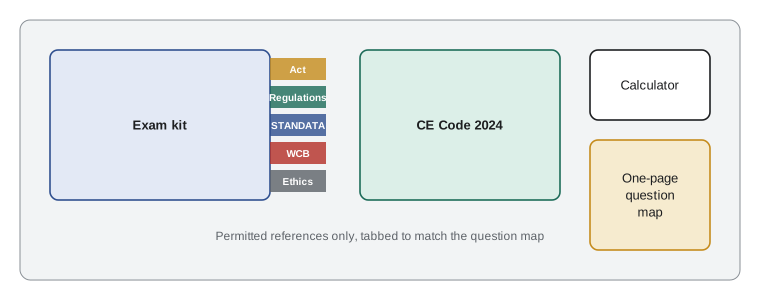
On an open-book exam, the first skill is knowing where to look. Part 1 questions come from a limited set of documents in the exam kit and the permitted references. Priya builds a one-page map from question type to document and tabs the kit to match it.
| If the question is about... | Look first in... | Course lesson |
|---|---|---|
| Who administers the system, accreditation, the Council's role | Safety Codes Act | 1 |
| Eligibility, certificates, permits and who may obtain them | Certification and Permit Regulation; Safety Codes Act | 2, 6 |
| Inspections, orders, offences and appeals | Safety Codes Act | 6 |
| Which Code edition applies, Alberta modifications | Electrical Code Regulation; STANDATA | 5 |
| Interpretations, variances, bulletins | Electrical STANDATA | 5 |
| Master electrician conduct and duties | Master Electrician Code of Ethics and Council guidance | 7 |
| Workers compensation obligations | WCB Employer Handbook | 8 |
| Anything technical about an installation | CE Code (Part 2) | MELC-101 to 106 |
The map does two things. It sends you to the right document on the first try, which is the biggest single time saver. And it shows you, while you study, which documents you have neglected. If you have never opened one of the documents on your map, expect to lose marks to it.
Time plans
Each part has 210 minutes. A time plan turns that into checkpoints, so that you know at any moment whether you are on pace. Denise's plan uses two passes. On the first pass, answer every question you can settle with one lookup or none, spending no more than a set time on each, and flag the rest. On the second pass, work the flagged questions. Keep ten minutes at the end to check that every question has an answer.
Worked problem
Checkpoints for Part 1
Priya plans a first pass at 3 minutes per question for all 50 Part 1 questions, then a second pass on the ones she flags, keeping 10 minutes at the end. If she flags 15 questions, how long can she spend on each one in the second pass?
Show solution
- First pass: 50 × 3 = 150 minutes.
- Remaining: 210 − 150 − 10 = 50 minutes.
- Second pass: 50 / 15 ≈ 3.3 minutes per flagged question, on top of the time already spent on them.
Answer: About 3.3 minutes each, with a 10-minute final check.
def plan(total_min, questions, first_pass_each, flagged, reserve=10):
    first = questions * first_pass_each
    left = total_min - first - reserve
    return first, left, left / flagged if flagged else float('inf')

for part, q, each, flagged in [('Part 1', 50, 3.0, 15), ('Part 2', 70, 2.5, 18)]:
    first, left, per = plan(210, q, each, flagged)
    print(f'{part}: first pass {first:.0f} min, {left:.0f} min left, {per:.1f} min per flagged question')
    for k in (0.25, 0.5, 0.75):
print(f' checkpoint: question {int(q * k):2d} by minute {first * k:.0f}')Part 1: first pass 150 min, 50 min left, 3.3 min per flagged question checkpoint: question 12 by minute 38 checkpoint: question 25 by minute 75 checkpoint: question 37 by minute 112 Part 2: first pass 175 min, 25 min left, 1.4 min per flagged question checkpoint: question 17 by minute 44 checkpoint: question 35 by minute 88 checkpoint: question 52 by minute 131
Adjust the first-pass time and the number of flagged questions to match your mock results. If your second-pass time per question comes out below two minutes, your first pass is too slow.
Setting a target
Because of the pass rule, every candidate should set a target for each part, based on honest mock results. A candidate who is strong on the Code and weaker on legislation might aim for 80 on Part 2 and 72 on Part 1: both comfortably above 60, average 76. The danger zone is any part where your mock scores hover near 60, because a bad day there fails the exam regardless of the other part.
Priya's mock scores average about 80 on Part 1 and 82 on Part 2. She is safe on the minimums and above the average, and her goal in the final ten days is to keep it that way, not to chase perfection.
Practice questions in the Part 1 style
Here are five practice questions written for this course in the style of Part 1, with the reasoning Denise wants to hear.
Worked problem
Practice 1
A homeowner who owns and lives in a single-family house wants to install a hot tub circuit herself. Under the usual conditions for homeowner permits, which statement is most likely correct? (A) She may obtain a homeowner permit for any electrical work in her home. (B) Hot tub installations are commonly excluded from homeowner permits. (C) Homeowner permits are issued by the Safety Codes Council. (D) No permit is needed for work in a home you own.
Show solution
- Topic: who may obtain a permit; map says the Certification and Permit Regulation and the issuing authority's conditions.
- Homeowner permits are limited, and permanently installed pools and hot tubs are commonly excluded.
- Permits are issued by the authority for the location, not the Council, and work in an owned home still needs a permit.
Answer: B.
Worked problem
Practice 2
Which document permits an alternative to a Code rule across Alberta, provided stated conditions are met? (A) An interpretation. (B) A bulletin. (C) A variance. (D) A permit.
Show solution
- Topic: STANDATA types; map says the electrical STANDATA.
- Only a variance changes a requirement, and only under its conditions.
Answer: C.
Worked problem
Practice 3
A candidate scores 59 on Part 1 and 94 on Part 2. What happens? (A) Pass; the average is 76.5. (B) Fail; Part 1 must be rewritten. (C) Fail; both parts must be rewritten. (D) Fail; the candidate chooses which part to rewrite.
Show solution
- Topic: pass and rewrite rules; lesson 4.
- A part below 60 fails the exam regardless of the average, and that part must be rewritten.
Answer: B.
Worked problem
Practice 4
An employer regularly employs 12 workers. What does Alberta's OHS Act require for worker participation? (A) Nothing. (B) A health and safety representative, or a committee if the employer chooses. (C) A joint committee only. (D) A committee designated by WCB.
Show solution
- Topic: OHS participation thresholds; Part 2 of the OHS Act.
- 5 to 19 workers: a health and safety representative, with a committee as an option.
Answer: B.
Worked problem
Practice 5
A subcontractor is paid by its general contractor 12 days after the general contractor itself was paid. Which statement best fits Alberta's prompt payment rules? (A) This is on time. (B) The general contractor was required to pay within 7 days of receiving payment. (C) Subcontractors have no payment timeline. (D) The 28-day owner period applies to subcontractors.
Show solution
- Topic: prompt payment down the chain; lesson 9.
- Contractors must pay subcontractors within 7 days of receiving payment.
Answer: B.
Reading the whole provision
Denise's favourite phrase from MELC-101 applies to legislation too: read the whole rule, then read the definitions in it. Legislation is full of qualifiers: unless, except, subject to, in accordance with. A question that seems to have two right answers usually turns on one of them. When you find the section you need, read the subsections around it and check the definitions section of the Act or regulation for any word that matters. It takes thirty seconds and saves marks.
The final ten days
Denise gives every candidate the same final-ten-days routine.
- Days 10 to 7: one timed mock of each part, with full review of every wrong answer by type.
- Days 6 to 4: targeted practice on the weakest document or Code section, and a last check of tabs and the question map.
- Day 3: run the pre-exam checklist if it is not already done, and confirm the room, the computer, the permitted references and the calculator.
- Day 2: light review only. Reread the summaries of this course and the core courses.
- Day 1: rest. Lay out the references, check the start time, and sleep.
On the morning of the exam, eat, arrive at the desk early, check that the proctoring software starts, and begin Part 1 with the first-pass plan. During the break, leave the room, eat and drink, and do not open the books. Part 2 is a fresh start.
After the exam
Results are posted on Council Connect, within seven business days in late 2026. If you pass, the certificate follows, and with it the responsibilities of lesson 7 and the renewals of lesson 11. If you do not, look at which part fell short, decide which part to rewrite where you have a choice, and use the same wrong-answer review to plan your study. Most candidates who fail once pass on the rewrite, because the second time they know exactly where the gap is.
Ten days later, Priya writes the exam. Seven business days after that, Linda prints her result and pins it to the shop wall beside Gord's thirty-year-old certificate.
Part 2 reminders from the core courses
Part 2 is the Code, and the core courses covered it in depth. Before the exam, reread the summaries and the mistakes sections of MELC-101 to MELC-106, and redo a timed set of calculation practice. The routines to bring into the exam are the ones from those courses: the lookup routine from MELC-101 (index, rule, definitions, exceptions, notes), the demand load sequences from MELC-102, the conductor and overcurrent routines from MELC-103, the grounding and bonding decision steps from MELC-104, the motor and special installation methods from MELC-105, and the exam strategy from MELC-106.
On calculations, write down each intermediate value with its units, and check that the answer is reasonable before choosing an option. A service load of 4,000 amperes for a bungalow, or a conductor smaller than the minimum size, should make you stop and recheck.
Common mistakes
MistakeLooking for Part 1 answers in the CE Code.
InsteadPart 1 is about Alberta legislation; use a question-to-document map to go straight to the right source.
MistakeSpending the same time on every question.
InsteadUse two passes with checkpoints so that hard questions do not eat the time for easy ones.
MistakeReading only the subsection that seems relevant.
InsteadRead the whole provision and the definitions; qualifiers change answers.
MistakeCramming the night before a seven-hour exam.
InsteadRest on the last day; fatigue costs more marks than one more evening of study gains.
Summary and key terms
- Build a question-to-document map and tab the exam kit to match it.
- Use a two-pass time plan with checkpoints for each 210-minute part.
- Set targets for each part based on mock results, staying well clear of the 60 minimum.
- Review every wrong practice answer by type: wrong document, partial reading, misreading or time.
- Follow a final-ten-days routine and rest the day before.
- Question map
- A one-page guide from question types to the documents that answer them.
- Two-pass method
- Answering quick questions first and returning to flagged ones in a second pass.
- Checkpoint
- A planned point in the exam, such as a question number by a certain minute, used to check pace.
- Mock exam
- A timed practice exam written under exam conditions.
- Wrong-answer review
- Analysing each missed question by the reason it was missed.
Practice problems
Work each problem on paper first, then reveal the answer to check.
A candidate plans 2.5 minutes per question for all 70 Part 2 questions on the first pass. How long does the first pass take?
Show answer
175 minutes, leaving 35 minutes, less a 10-minute reserve, for flagged questions.
Where should a candidate look first for a question about appealing an order?
Show answer
The Safety Codes Act.
A candidate's mocks average 63 on Part 1 and 88 on Part 2. What is the risk?
Show answer
Part 1 is close to the 60 minimum; a bad day there fails the exam regardless of Part 2.
What should a candidate do in the break between parts?
Show answer
Leave the desk, eat and drink, and not reopen the books.
Lesson quiz · 5 questions
Score 60% or more to complete this lesson.
Create a free account to save your progress, take quizzes and earn a certificate.