
MELC-201 · Lesson 6 of 12 · 21 min
Permits, inspections and the inspection authority
▶ Video coming soon A video version of this lesson is on the way.
The permit is where Alberta's safety codes system touches a real job. It decides who may do the work, who answers for it and who inspects it. Part 1 of the exam asks about permits more than about any other single topic, and a master electrician deals with them every week. This lesson covers when a permit is needed, who may obtain one, who issues it, how inspections and orders work, and how disputes are resolved. Where a detail varies between municipalities, the lesson says so; the Act and its regulations set the framework, and each accredited organization runs its own process within it.
The governing documents are in your exam kit: the Safety Codes Act and the Certification and Permit Regulation, along with any STANDATA on permits. Read the sections on permits, inspections, orders and appeals with this lesson beside you, and tab them.
When a permit is required
Under the Safety Codes Act, a permit is required before undertaking work that the Act and its regulations regulate, unless the regulations say a permit is not needed. For electrical installations, that covers most new installations, alterations and additions. The regulations allow some minor work without a permit, such as certain like-for-like replacements, but the exceptions are specific and narrow. If you are not sure whether work needs a permit, the answer is to check the regulation and ask the authority, not to assume.
The point of the permit is not paperwork for its own sake. A permit notifies the authority that regulated work is happening, gives it the chance to review plans where needed, leads to inspection by a certified safety codes officer, and creates a record that the work was done under the system. Owners benefit, because the record protects them when they sell or insure the property. Contractors benefit, because it documents their due diligence.
Priya hears the same request every few months: a customer who wants an extra circuit for a hot tub and asks whether Parkland Valley can do it without a permit to save money and time. Her answer is always the same, and it is the master electrician's answer: no. Work for a customer is done under a permit, and the certificate holder who takes out that permit answers for it.
Who may obtain an electrical permit
In Alberta, electrical permits for work done for others are issued to holders of the Master Electrician Certificate of Competency. That is the central rule, and it is why every electrical contracting business needs a certificate holder. The permit is taken out by, or under, that person, and their certificate is what the authority relies on.
Homeowners are the main exception. A homeowner may obtain a homeowner electrical permit to do work on their own home, under conditions. Municipal guides describe the usual conditions: the person owns a single-family dwelling, lives in it, and will do the work personally. Permits are commonly refused for rental properties, for work in apartment-style condominiums, and where the owner will not expose concealed wiring for inspection. Some types of work are commonly excluded from homeowner permits, such as permanently installed pools and hot tubs, and solar photovoltaic systems. The exact conditions come from the regulation and from the issuing authority, so check both.
| Situation | Who may obtain the permit | Why |
|---|---|---|
| Contractor wiring a customer's house | A master electrician | Work done for others needs a certificate holder |
| Owner wiring the single-family home they live in | The homeowner, under a homeowner permit | Limited exception for owner-occupants doing their own work |
| Owner wiring a rental house they own | A master electrician | Homeowner permits are commonly refused for rentals |
| Owner adding a hot tub at their own home | Commonly a master electrician | Pools and hot tubs are commonly excluded from homeowner permits |
| Condo owner renovating an apartment-style unit | A master electrician | Homeowner permits are commonly refused in apartment-style condos |
Who issues the permit
Permits are issued by the organization that administers the Act where the work is located. In an accredited municipality, that is the municipality, which may use its own staff or contract an accredited agency. In a non-accredited area, permits and inspections are provided through accredited agencies under the oversight of the Alberta Safety Codes Authority. Some specialized installations, such as those on certain provincially regulated sites, can be handled by other accredited organizations. For a contractor, the practical question is simple: who is the authority for this address? The municipality can tell you.
Each authority has its own forms, online systems and fee schedule. Large cities such as Calgary and Edmonton run online permit systems and may also require the contractor to hold a city business licence. Smaller municipalities may use a paper or emailed form, or an agency's portal. The information requested is similar everywhere: the site, the owner, the scope and value of the work, the service size and the master electrician's certificate number.
Fees
Permit fees are set by the issuing authority, often scaled by the value of the work or the size of the service, sometimes with a minimum fee and a safety codes levy added. Because fees vary, the exam is unlikely to test a specific amount, but it may test the principle that fees and levies are set under the system and must be paid for the permit to be valid. On the job, quote permit fees to the customer as a separate line so nobody is surprised.
Worked problem
An illustrative permit fee
A municipality's electrical fee schedule (illustrative, not a real schedule) charges a 120 dollar minimum, or 9 dollars per 1,000 dollars of electrical work value, whichever is greater, plus a levy of 4 dollars per 100 dollars of the permit fee. What is the total for Parkland Valley's 38,000 dollar Gaetz Avenue clinic job?
Show solution
- Value-based fee = 38 × 9 = 342 dollars, which is more than the 120 dollar minimum.
- Levy = 342 × 4 / 100 = 13.68 dollars.
- Total = 342 + 13.68 = 355.68 dollars.
Answer: About 356 dollars, under this illustrative schedule.
def permit_fee(value, minimum=120, per_thousand=9, levy_per_hundred=4):
    fee = max(minimum, value / 1000 * per_thousand)
    levy = fee * levy_per_hundred / 100
    return round(fee, 2), round(levy, 2), round(fee + levy, 2)

for job, value in [('Aspen Ridge suite', 9500), ('Gaetz Avenue clinic', 38000), ('Riverbend parkade EV', 210000)]:
    fee, levy, total = permit_fee(value)
print(f'{job:22s} fee {fee:8.2f} levy {levy:6.2f} total {total:8.2f}')Aspen Ridge suite fee 120.00 levy 4.80 total 124.80 Gaetz Avenue clinic fee 342.00 levy 13.68 total 355.68 Riverbend parkade EV fee 1890.00 levy 75.60 total 1965.60
The schedule in the code is invented for practice. Replace the numbers with your own municipality's schedule to estimate real fees.
Inspections
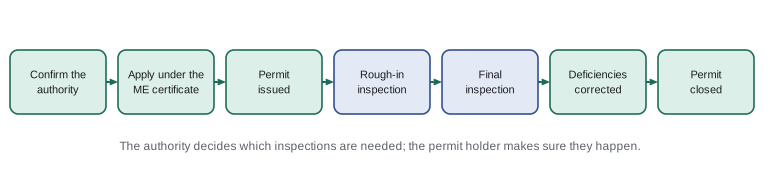
A safety codes officer inspects permitted work to check it against the Act and the codes. The authority decides which inspections a permit needs: commonly a rough-in or cover inspection before wiring is concealed and a final inspection when the work is complete, with extra inspections for services, larger projects or special installations. Not every permit receives every possible inspection. Some authorities use risk-based approaches, inspecting a share of lower-risk permits.
The permit holder is responsible for arranging inspections at the right time and for making the work accessible. Covering wiring before a required inspection is a classic and expensive mistake: the officer can require the covering to be removed. The permit holder is also responsible for correcting any deficiency found, and for doing so within the time the authority sets.
Denise's experience is that inspections go well when the master electrician prepares for them. Before calling for an inspection, walk the job yourself as if you were the officer. Check labelling, bonding, box fill, support, protection and the panel directory. Have the permit number, drawings and any test results on hand.
Orders
When work does not comply, a safety codes officer has powers under the Act to deal with it. The most serious of these is the power to issue an order. An order can require a person to do something, such as correct a deficiency, or to stop doing something, such as stop work or stop using equipment that is unsafe. Orders are written, they say what is required and by when, and they are directed to a person responsible, such as the owner or the permit holder.
Failing to comply with an order is an offence under the Act. Orders are not issued for small matters that a deficiency notice or a conversation can fix, but they are an important part of the system, and the exam expects you to know who issues them, what they can require and how they can be challenged.
Appeals and disputes
A person who disagrees with an order, or with certain other decisions under the Act, can appeal. The Safety Codes Council hears appeals of orders and of certain decisions about certificates, permits and accreditations, through appeal boards. Appeals must be started within the time limit the Act or the order states, and the order usually tells you how to appeal. Read the order carefully on the day you receive it.
Before an appeal, talk. Most disagreements with an inspector are about interpretation, and many end with an explanation, a STANDATA, or a reasonable alternative. A master electrician who keeps the conversation professional, brings the relevant rule and asks how the officer reads it will resolve most disputes without an appeal. If the disagreement is about a Code requirement that seems unreasonable for a situation, the variance process exists for that, separate from an appeal.
Worked problem
What should Priya do?
An officer issues an order requiring Parkland Valley to replace a section of wiring at the Riverbend condos that Priya believes complies with the 2024 Code as interpreted in a current STANDATA. The order gives 30 days to comply and explains how to appeal. What is the sensible sequence?
Show solution
- Read the order the same day and note the compliance date and the appeal deadline.
- Call or meet the officer, bring the Code rule and the STANDATA, and ask how they read it.
- If the officer agrees, ask for the order to be amended or withdrawn in writing.
- If not, decide quickly whether to comply or appeal, because the appeal deadline is fixed.
Answer: Discuss first with the rule and STANDATA in hand, then comply or appeal within the stated time.
Closing the permit
A permit is finished when the work passes its final inspection and the authority closes it. Open permits are a problem: they can hold up a property sale, a utility connection or the next permit at the same address. Utilities typically need confirmation of a permit, and sometimes an inspection, before connecting or reconnecting a service. Keep a list of your open permits and close them as soon as the work allows. A master electrician who leaves a trail of open permits is asking for trouble with the authority and with the Safety Codes Council.
A permit from start to finish
The Aspen Ridge secondary suite shows a typical small permit in Red Deer. Priya confirms that the city is the accredited authority for the address. She applies online under Gord's certificate with the scope (a new suite subpanel, circuits, smoke alarm interconnection and a service upgrade), the value and the service size, and pays the fee. The permit is issued within a few days. When the rough wiring is done and before the drywall goes up, she books the rough-in inspection. The officer finds one deficiency, a missing bonding jumper at a metal box, which the crew corrects that afternoon. After finishing, she books the final, which passes, and the permit is closed.
Nothing about that job is unusual, and that is the point. Most permits run smoothly when the master electrician knows the steps and books inspections at the right time. The problems come from skipped steps: work concealed early, deficiencies left open, or permits never closed.
Common mistakes
MistakeDoing customer work without a permit because it is small.
InsteadUnless the regulation exempts it, work for others needs a permit taken out by a master electrician.
MistakeAssuming any owner can take out a homeowner permit.
InsteadHomeowner permits are limited, commonly to owner-occupants of single-family dwellings doing the work themselves, with exclusions.
MistakeCovering wiring before a required inspection.
InsteadArrange inspections at the right stage; an officer can require covered work to be exposed.
MistakeMissing an appeal deadline while arguing informally.
InsteadDiscuss early, but note the appeal deadline on the day the order arrives.
Summary and key terms
- A permit is required before regulated electrical work, unless the regulations exempt it.
- Permits for work done for others are issued to master electricians; homeowners may obtain limited permits for their own homes.
- Accredited municipalities and agencies issue permits and inspect; ASCA oversees non-accredited areas.
- Safety codes officers inspect and can issue orders; failing to comply with an order is an offence.
- Orders and certain decisions can be appealed to the Safety Codes Council within the stated time.
- Permit
- Authorization under the Safety Codes Act to undertake regulated work, issued by the authority for the location.
- Homeowner permit
- A limited permit allowing an owner-occupant to do electrical work on their own home.
- Inspection
- A check by a safety codes officer that work complies with the Act and codes.
- Order
- A written direction by a safety codes officer requiring something to be done or stopped.
- Appeal
- A challenge to an order or decision, heard by the Safety Codes Council within set time limits.
Practice problems
Work each problem on paper first, then reveal the answer to check.
Who may obtain a permit to wire a rental house for its owner?
Show answer
A master electrician; homeowner permits are commonly refused for rentals.
Who issues permits in a non-accredited area?
Show answer
Accredited agencies, under the oversight of the Alberta Safety Codes Authority.
What can an order require?
Show answer
That a person do something, such as correct a deficiency, or stop doing something, such as stop work.
Where are orders appealed?
Show answer
To the Safety Codes Council, within the time limit stated.
Lesson quiz · 5 questions
Score 60% or more to complete this lesson.
Create a free account to save your progress, take quizzes and earn a certificate.