
MELC-201 · Lesson 7 of 12 · 20 min
Duties and responsibilities of the Master Electrician Certificate holder
▶ Video coming soon A video version of this lesson is on the way.
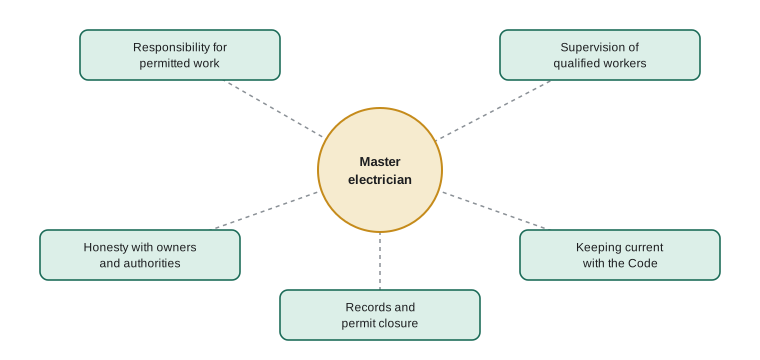
Passing the exam gives you a certificate. Holding the certificate gives you responsibilities, and those responsibilities follow every permit you take out. This lesson covers what the Alberta system expects of a master electrician: responsibility for permitted work, supervision of the people who do it, honesty in dealings with owners and authorities, keeping up with the Code, and the consequences when a certificate holder falls short. It draws on the documents the Safety Codes Council publishes for master electricians, including its Master Electrician Code of Ethics and its guidance on roles and responsibilities, which are among the permitted exam references.
Read those documents in full. The Council revises them from time to time, and the exact wording matters on Part 1. This lesson explains the ideas behind them and how they play out on a real job, in its own words.
Gord's last lesson
Gord Tremblay comes to the Tuesday-night group for this one. He has held his certificate for thirty years and pulled thousands of permits, and he wants Priya to hear the responsibilities from someone who has carried them. He starts with a story. Early in his career, a contractor he knew let a friend's company take out permits under his certificate for a fee. The friend's crew did poor work, a house fire followed, and the investigation led straight back to the certificate holder whose name was on the permits. He lost his certificate and his business.
The point, Gord says, is that a permit is personal. When you take out a permit, you are telling the authority that you, a certified master electrician, accept responsibility for that work. You cannot sell that, lend it or sign it away.
Responsibility for permitted work
The central duty is responsibility for the work covered by your permits. That means the work must comply with the Safety Codes Act, the regulations and the codes in force, and it must be done safely. It does not mean the master electrician has to hold every tool personally. Most master electricians run or work for companies with crews. But it does mean the certificate holder must have real control over the work: knowing what is being done, making sure the people doing it are qualified, checking that it complies, and fixing it when it does not.
That responsibility continues through inspection and deficiency correction until the permit is closed. If an inspector finds a deficiency, the master electrician is responsible for seeing that it is corrected. If an order is issued, they are responsible for complying or appealing within the time allowed. A master electrician who moves on from a company still answers for permits taken out under their certificate, so changes in employment need to be handled carefully with the authority and the employer, so that open permits are transferred or closed properly.
Supervision and qualified workers
Electrical work in Alberta must be done by qualified people: journeyperson electricians, and apprentices working under the supervision ratios and conditions set by the apprenticeship system. A master electrician who takes out a permit must make sure the people working under it are entitled to do the work. Sending an unregistered helper to wire a panel alone is a failure of the certificate holder, not only of the helper.
Supervision also means planning. Gord's practice at Parkland Valley is simple: every job has a named lead hand, the lead hand knows which permit covers the work, and every job closes with a walk-through before the final inspection is booked. When Priya takes over his role, she will inherit that system and the responsibility for it.
| Duty | What it looks like on the job | Typical failure |
|---|---|---|
| Responsibility for permitted work | Knowing every job under your permits and checking compliance | Permits taken out for work the holder never sees |
| Supervision | Qualified workers, correct apprentice supervision, named lead hands | Unqualified helpers working alone |
| Honesty | Accurate permit applications, declarations and records | Understating scope or value to cut fees |
| Currency | Code update training and knowledge of STANDATA | Working to an old edition |
| Closure | Inspections booked, deficiencies fixed, permits closed | A trail of open permits |
Honesty and the code of ethics
The Council's Master Electrician Code of Ethics sets out the professional conduct expected of certificate holders. Its themes will be familiar from any professional code: put public safety first, act with honesty and integrity, work within your competence, follow the law and the codes, deal fairly with clients and authorities, and do not allow your certificate to be misused. Expect Part 1 questions that describe a situation and ask which action the code of ethics requires or forbids.
Honesty applies to paperwork as much as to wiring. A permit application must describe the work and its value accurately. A declaration that work is complete or ready for inspection must be true. Understating the value of a job to reduce the permit fee, or calling for a final inspection before the work is done, are ethics problems as well as practical ones.
Worked problem
An ethics question
A builder asks Priya to take out a permit for a house that another company will wire, because that company has no master electrician. The builder offers to pay her a fee per permit and promises that the other company's work is good. What does the master electrician's role require her to do?
Show solution
- A permit means the holder accepts responsibility for the work and must have real control over it.
- Priya would have no control over the other company's crew, supervision or quality.
- Taking out permits for work she does not control would misuse her certificate.
- She must decline. If the builder wants Parkland Valley to do the work, Parkland Valley can quote it and do it under her permit.
Answer: Decline. A certificate cannot be lent or rented to cover someone else's work.
Keeping current
A master electrician must keep up with the codes in force. When a new edition is adopted, the Council can require code update training to keep certification active. For the 2024 Code, the Council required proof of code update training by March 31, 2025, ahead of the edition taking effect on April 1, 2025. Lesson 11 covers renewal and continuing education in detail. Keeping current also means reading new STANDATA, because an interpretation or variance can change how a rule is applied without any change to the Code book.
Records
Good records protect the master electrician. For each permit, keep the application, the permit, inspection results, deficiency notices and how they were corrected, test results, and the date the permit was closed. If a question ever arises about a job, months or years later, those records show what was done and when. Gord keeps them by address in a filing system that started in a cabinet and now lives on the company server. Priya will make sure it is backed up.
When things go wrong
The Council can act when a certificate holder does not meet their obligations. It publishes a master electrician compliance procedure, and under the Act and the Certification and Permit Regulation it can investigate complaints and take action ranging from conditions on a certificate to suspension or cancellation. Separately, a master electrician, like anyone else, can be prosecuted for offences under the Safety Codes Act, such as doing work without a required permit or failing to comply with an order, and can face civil claims from owners or others who suffer loss.
Denise has seen the process from the inspection side. Most compliance issues start small: a pattern of open permits, repeated deficiencies on the same type of work, or a complaint from an owner. Addressed early, they end with an explanation and better habits. Ignored, they grow. The safest master electricians are the ones who treat every deficiency as a lesson for the whole crew.
Working for a company
Many master electricians are employees rather than owners. The certificate is personal, but the work is done by the company. That arrangement works when the employer gives the master electrician the authority that matches their responsibility: the ability to stop work that does not comply, to decide who does what, to see the jobs under their permits and to insist on corrections. A master electrician who is expected to take out permits without that authority is being asked to accept responsibility without control, and should not agree to it.
Gord's advice to Priya is to put the arrangement in writing when she takes over: which permits she is responsible for, what authority she has, and what happens to open permits if she ever leaves. He wishes someone had told him the same thirty years ago.
Responsibility in numbers
Responsibility also has a workload. A master electrician responsible for many permits at once must be able to keep real control over all of them. There is no single number in the rules for how many is too many, but the question is fair to ask. If Priya has 40 open permits and spends an average of 20 minutes a week reviewing each one, that is more than 13 hours a week before she does anything else. Planning the review load is part of the job.
def weekly_review_hours(open_permits, minutes_each):
    return open_permits * minutes_each / 60

for permits in (15, 25, 40, 60):
    hours = weekly_review_hours(permits, 20)
    note = 'manageable' if hours <= 10 else 'needs a second certificate holder or a review system'
print(f'{permits:3d} open permits -> {hours:5.1f} h per week: {note}')15 open permits -> 5.0 h per week: manageable 25 open permits -> 8.3 h per week: manageable 40 open permits -> 13.3 h per week: needs a second certificate holder or a review system 60 open permits -> 20.0 h per week: needs a second certificate holder or a review system
The ten-hour threshold in the code is Gord's rule of thumb, not a regulation. Change it, and the minutes per permit, to fit your own company.
Situations examiners like
Part 1 questions on the master electrician's duties usually describe a situation and ask what the certificate holder must do, may do or must not do. Here are the patterns Denise has seen most often, with the reasoning behind each answer.
- A customer asks for work without a permit to save money. The master electrician must refuse; work for others needs a permit unless the regulation exempts it, and the certificate holder answers for doing it properly.
- A crew member who is not qualified is sent to do work alone. The master electrician must stop it; ensuring qualified workers and proper supervision is part of the responsibility that comes with the permit.
- An inspector finds a deficiency. The master electrician must see that it is corrected within the time set, even if the crew that did the work has moved to another job.
- Another company asks to use the certificate for its permits. The master electrician must decline; the certificate cannot be lent, rented or used to cover work the holder does not control.
- The master electrician is leaving the company. Open permits under the certificate must be dealt with properly, by closing them or arranging their transfer with the authority.
In each case, the reasoning is the same: the permit is personal, the responsibility is real, and the duties continue until the permit is closed.
Priya's handover plan
Gord and Priya sketch the handover for the day she receives her certificate. For the first six months, both will hold certificates, so new permits will be taken out under Priya's certificate while Gord's open permits run to completion under his. Priya will review every open permit weekly with the lead hands. Gord will stay available for advice. When his last permit closes, he can retire knowing that the company's work is covered and that no permit under his name is left open.
That plan is not required by any regulation, but it reflects the duties exactly. Responsibility follows the certificate on each permit, so a clean handover separates old permits from new ones rather than mixing them. Denise says she wishes every company did it this way.
The public interest
Underneath all the rules is a simple idea. The safety codes system exists to protect the public: the families who live in the houses, the workers in the shops and the firefighters who enter burning buildings. A master electrician is trusted by that system to take responsibility for work the public cannot see or check. The code of ethics puts public safety first for that reason, and every duty in this lesson follows from it.
Common mistakes
MistakeTaking out permits for work done by another company.
InsteadA permit means you accept responsibility and must have real control; a certificate cannot be lent or rented.
MistakeBelieving responsibility ends when the crew leaves the site.
InsteadIt continues through inspection and deficiency correction until the permit is closed.
MistakeUnderstating job value on a permit application to lower the fee.
InsteadApplications and declarations must be accurate; dishonesty is an ethics breach and can be an offence.
MistakeAccepting permit responsibility without authority to stop or correct work.
InsteadAgree in writing on the authority that matches the responsibility.
Summary and key terms
- A master electrician is responsible for the work covered by permits taken out under their certificate.
- They must have real control: qualified workers, proper supervision and compliance checks.
- The Master Electrician Code of Ethics requires public safety first, honesty, competence and fair dealing.
- Certificate holders must keep current, including code update training when a new edition is adopted.
- The Council can investigate and act on certificates; offences under the Act can also be prosecuted.
- Permit holder
- The master electrician under whose certificate a permit is taken out and who answers for the work.
- Code of Ethics
- The Council's statement of professional conduct for master electricians.
- Compliance procedure
- The Council's process for addressing certificate holders who do not meet their obligations.
- Supervision
- Real control over who does the work and how, including apprentice supervision.
- Permit closure
- The end of a permit after final inspection and correction of deficiencies.
Practice problems
Work each problem on paper first, then reveal the answer to check.
May a master electrician take out a permit for work their company will not perform?
Show answer
No. They must have real control over permitted work; lending a certificate misuses it.
When does responsibility for permitted work end?
Show answer
When the work passes inspection, deficiencies are corrected and the permit is closed.
What did the Council require of master electricians before the 2024 Code took effect?
Show answer
Proof of code update training by March 31, 2025.
A master electrician leaves a company with open permits. What should happen?
Show answer
The open permits must be dealt with properly with the authority and the employer, by transfer or closure.
Lesson quiz · 5 questions
Score 60% or more to complete this lesson.
Create a free account to save your progress, take quizzes and earn a certificate.