
MELC-201 · Lesson 1 of 12 · 20 min
How electrical licensing works in Alberta
▶ Video coming soon A video version of this lesson is on the way.
Every province regulates electrical work, but each one does it differently. In Alberta, the system rests on a single statute, the Safety Codes Act, and on a handful of organizations that share the work of writing rules, certifying people, issuing permits and inspecting installations. A candidate for the Alberta Master Electrician Certificate needs to understand that system well, because the first part of the exam is entirely about it. Fifty of the exam's questions test the Alberta Acts and Regulations, not the Canadian Electrical Code.
This course is the Alberta course in the master electrician program. The six MELC core courses taught the Code itself. This course teaches what surrounds the Code in Alberta: who certifies master electricians, who may take out an electrical permit, how inspections and orders work, what the certificate holder is personally responsible for, and the business, contract and safety law an electrical contractor works under every day. It finishes with an exam review built around the real structure of the Alberta exam.
A word on sources before we begin. Alberta's rules change. Fees go up, forms move online, regulations are amended and bulletins are replaced. Everything in this course was checked against official sources in late 2026, and the lessons say so where a detail is especially likely to change. Before you apply, book or sit the exam, confirm the current requirements with the Safety Codes Council and the Government of Alberta. And as in the rest of the series, this course never reproduces the text or tables of the CE Code. Rule numbers are cited and explained in our own words.
Back at the study table in Red Deer
Priya Raman has finished the six core courses with the Tuesday-night study group at Parkland Valley Electric. She can find a Code rule in under ninety seconds and work a dwelling demand load in her sleep. Now she faces the part of the Alberta exam that many strong electricians underestimate. Denise Lafleur, the retired safety codes officer who runs the group, puts it bluntly: candidates who fail the Alberta exam usually fail Part 1, the Acts and Regulations, because they spent all their time on the Code and walked in expecting legislation to be common sense.
Gord Tremblay, the owner of Parkland Valley, has an extra reason to care. He holds the company's only Master Electrician Certificate, and he plans to retire within three years. Without a certificate holder, the company cannot take out electrical permits for its customers, and without permits it cannot legally do most of its work. Priya's certificate is a business continuity plan as much as a career step.
Marcus Okafor, Priya's study partner, came up through industrial shutdown work where permits were handled by an owner's engineering department. He admits he has never pulled a permit in his life. Tyler Chen, the third-year apprentice, asks the question that starts the lesson: if the Code is national, why does Alberta need its own exam at all?
The Safety Codes Act at the centre
Denise answers by drawing a box in the middle of the whiteboard and writing Safety Codes Act inside it. The Act is the provincial law that makes codes enforceable. On its own, the CE Code is a consensus standard written by a national committee and published by the Canadian Standards Association. It has no legal force anywhere until a province adopts it. In Alberta, the Safety Codes Act gives the government the power to declare codes in force by regulation, and the Electrical Code Regulation is the regulation that does that for electrical installations.
The Act covers more than electrical work. It also governs building, fire, gas, plumbing, private sewage disposal, elevating devices, boilers and pressure vessels, and some other disciplines. Each discipline has its own regulations and its own codes, but they share the same administrative machinery. That shared machinery is what Part 1 of the exam tests: permits, certification, inspections, orders, variances, appeals and offences, all under one Act.
The Act also places responsibility clearly. Under Alberta's system, the owner of a building or installation has primary responsibility for making sure it complies with the Act and the codes. Contractors, designers and certificate holders have their own duties, but the owner cannot hand off the basic obligation. Expect that principle on the exam, and expect it in real life when a customer asks you to skip a permit.
The organizations and what each one does
Under the Act sit several organizations. Candidates often confuse them, so it is worth learning them as a set.
- Alberta Municipal Affairs. The government department responsible for the safety codes system. It drafts regulations, declares codes in force and publishes STANDATA, the bulletins, interpretations and variances that explain how codes apply in Alberta.
- The Safety Codes Council. A body set up under the Act. Among other roles, it certifies safety codes officers, issues the Master Electrician Certificate of Competency, runs the master electrician exam, handles certain appeals and accredits organizations to deliver safety codes services.
- The Alberta Safety Codes Authority (ASCA). A division of the Safety Codes Council that oversees permit and inspection services in areas of the province where the municipality is not accredited, working through accredited agencies.
- Accredited municipalities. Most cities and many towns and counties are accredited to administer the Act in their area. They issue permits and provide inspections, either with their own safety codes officers or by contracting an accredited inspection agency.
- Accredited agencies. Private companies accredited to provide permit and inspection services, either for municipalities or in non-accredited areas.
- Safety codes officers (SCOs). Individuals certified by the Council in a discipline and designated by an accredited organization. Electrical SCOs review permits, inspect installations, and can issue orders when work does not comply.
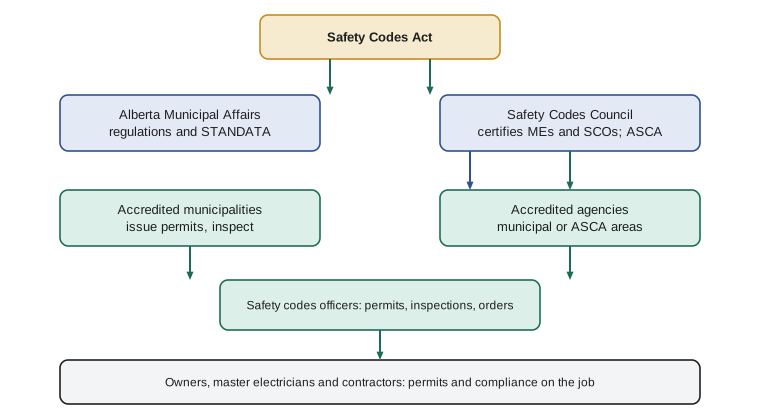
Denise has worked on both sides of that chart. For twenty-two years she was an electrical safety codes officer for a municipality, which meant she inspected under the municipality's accreditation and her own SCO certification from the Council. When she retired, her certification lapsed. She still knows the system better than anyone at the table, but she could not inspect a job today without being certified and designated again.
Where the master electrician fits
The Master Electrician Certificate of Competency is issued by the Safety Codes Council under the Certification and Permit Regulation. Its practical meaning is simple and important: in Alberta, electrical permits are issued to master electricians, apart from limited permits that homeowners can obtain for work on their own homes. A contractor that wants to wire buildings for customers needs a certificate holder who takes out the permits and accepts the responsibilities that come with them.
That is why the certificate is not just a title. A journeyperson certificate shows that a person is qualified to do electrical work. A master electrician certificate shows that a person is qualified to take responsibility, through the permit system, for electrical installations done for others. Lesson 7 covers those responsibilities in detail. For now, keep the two credentials separate in your mind.
| Credential | Issued by | What it shows |
|---|---|---|
| Journeyperson electrician trade certificate | Alberta apprenticeship system (or another province, with Red Seal endorsement where held) | Qualified to perform electrical work in the trade |
| Master Electrician Certificate of Competency | Safety Codes Council | Qualified to obtain electrical permits and take responsibility for installations under them |
| Safety codes officer certification (electrical) | Safety Codes Council | Qualified to inspect and enforce, when designated by an accredited organization |
| Professional titles such as PEC, CME or RME | Electrical Contractors Association of Alberta | Additional voluntary designations, protected titles under separate legislation |
The Electrical Contractors Association of Alberta (ECAA) also awards professional titles such as Professional Electrical Contractor (PEC), Certified Master Electrician (CME) and Registered Master Electrician (RME). Those titles are protected under separate legislation on professional associations, and they require extra training beyond the certificate. They are voluntary. A master electrician does not have to register with the association unless they want to use one of those titles.
Codes, regulations and STANDATA
Under the Act, three kinds of document tell an electrical contractor what to do, and the exam expects you to know which is which.
- Regulations are law made under the Act. The Electrical Code Regulation declares which edition of the CE Code is in force. The Certification and Permit Regulation deals with certificates and permits. Other regulations cover administrative matters such as administrative items and fees.
- Codes are the technical documents declared in force by regulation. For electrical installations, that is the CE Code Part I; for utility systems, Alberta has its own Alberta Electrical Utility Code.
- STANDATA are documents published by Alberta Municipal Affairs to explain how codes and legislation apply in Alberta. Some are interpretations of what a rule means, some are variances that allow something different from a rule across the province, and some are bulletins with information and recommended practice. Lesson 5 covers them.
The 2024 edition of the CE Code Part I, the 26th edition, was declared in force in Alberta on April 1, 2025. The exam was updated to that edition in April 2025. If you studied from an older book or an older prep course, update before you book.
Owners, contractors and the permit
Most licensing questions come back to the permit. In Alberta, a permit is required before work regulated by the Act is undertaken, unless the regulations say otherwise. The permit notifies the administering jurisdiction, triggers inspection and documents that the work was done under the system. It is also how the master electrician's responsibility becomes concrete: the permit is taken out under a particular certificate holder, and that person answers for the work it covers.
Tyler wants to know who pays when something goes wrong. Denise explains that responsibility is layered. The owner is responsible for compliance. The contractor is responsible to the owner under the contract and to the law for the work it performs. The master electrician who took out the permit is responsible under the regulation for the work covered by that permit. And the safety codes officer's inspection does not shift any of that onto the inspector. An inspection is a check, not a guarantee.
Worked problem
Who is responsible?
Parkland Valley wires a basement suite at the Aspen Ridge bungalow under a permit taken out by Gord. After the final inspection passes, a homeowner's friend adds two receptacles without a permit, and one of them later overheats. Who was responsible for which part of the work?
Show solution
- The owner remains responsible for the installation's compliance overall, including the unpermitted additions.
- Gord, as the permit holder, answers for the work covered by his permit: the suite wiring Parkland Valley installed.
- The friend did regulated work without a permit and without the qualifications to do it; that work is outside Gord's permit.
- The passed inspection does not make the inspector responsible for either part.
Answer: Responsibility follows the permit and the work. The owner carries the overall duty; the master electrician answers for permitted work.
Why this matters on the exam
Part 1 questions rarely ask you to recite a section. They describe a situation and ask who may do something, who must do something, or what happens next. Who may obtain a permit for a rental property? Who issues a certificate of competency? Who can appeal an order, and to whom? What does a variance do that an interpretation does not? Every one of those questions is easier if you can picture the chart from this lesson and place each organization on it.
The exam is open book, and the exam kit contains the legislation. But an open book is only useful if you know where to look. The next lessons build the map: eligibility and application, the exam itself, the Code as adopted, permits and inspections, the master electrician's duties, the business and safety law, and renewal. Lesson 12 pulls it all together with a timed review strategy.
Common mistakes
MistakeTreating the CE Code as law by itself.
InsteadThe Code has legal force in Alberta only because the Electrical Code Regulation under the Safety Codes Act declares it in force.
MistakeConfusing the Safety Codes Council with Alberta Municipal Affairs.
InsteadMunicipal Affairs drafts regulations and publishes STANDATA; the Council certifies people, runs the master electrician exam, handles certain appeals and accredits organizations.
MistakeAssuming a journeyperson certificate allows you to take out permits for customers.
InsteadPermits for work done for others are issued to holders of the Master Electrician Certificate of Competency.
MistakeBelieving a passed inspection transfers responsibility to the inspector.
InsteadThe owner and the permit holder keep their responsibilities; an inspection is a check, not a guarantee.
Summary and key terms
- Alberta's safety codes system rests on the Safety Codes Act, which makes codes enforceable through regulations such as the Electrical Code Regulation.
- Alberta Municipal Affairs drafts regulations and publishes STANDATA; the Safety Codes Council certifies master electricians and safety codes officers and accredits organizations.
- Accredited municipalities and agencies issue permits and inspect; ASCA oversees services in non-accredited areas.
- The owner has primary responsibility for compliance; the master electrician answers for the work done under their permits.
- The 2024 CE Code (26th edition) has been in force in Alberta since April 1, 2025.
- Safety Codes Act
- The Alberta statute that governs electrical and other safety codes disciplines and gives codes legal force.
- Safety Codes Council
- The body that certifies master electricians and safety codes officers, runs the master electrician exam and accredits organizations.
- Accredited municipality
- A municipality authorized to administer the Act, issue permits and provide inspections in its area.
- Safety codes officer
- A person certified in a discipline and designated by an accredited organization to inspect and enforce.
- STANDATA
- Interpretations, variances and bulletins published by Alberta Municipal Affairs on how codes apply in Alberta.
- Master Electrician Certificate of Competency
- The certificate that allows its holder to obtain electrical permits for work done for others.
Practice problems
Work each problem on paper first, then reveal the answer to check.
Who issues the Master Electrician Certificate of Competency in Alberta?
Show answer
The Safety Codes Council, under the Certification and Permit Regulation.
What gives the CE Code legal force in Alberta?
Show answer
The Electrical Code Regulation made under the Safety Codes Act, which declares the edition in force.
Who issues permits in a town that is not accredited?
Show answer
Permit and inspection services are provided through accredited agencies, overseen by the Alberta Safety Codes Authority.
A customer says the inspector passed the job, so any problem is the city's fault. Is that right?
Show answer
No. The owner keeps primary responsibility for compliance, and the permit holder answers for the permitted work; inspection does not transfer responsibility.
Lesson quiz · 5 questions
Score 60% or more to complete this lesson.
Create a free account to save your progress, take quizzes and earn a certificate.