
MELC-201 · Lesson 10 of 12 · 19 min
Occupational health and safety law for electrical contractors
▶ Video coming soon A video version of this lesson is on the way.
Electrical work is one of the few trades where a single mistake can kill instantly. Shock, arc flash, falls from ladders and lifts, and contact with overhead lines are all common causes of serious injury in the trade. Alberta's occupational health and safety law sets out who must do what to prevent them, and a master electrician who runs crews is usually an employer, a supervisor or both under that law. This lesson covers the Occupational Health and Safety Act, the OHS Regulation and the OHS Code as they apply to an electrical contractor, along with the points the exam and daily work most often turn on.
Alberta's current Occupational Health and Safety Act came into force on December 1, 2021. The OHS Code, which holds most of the detailed technical requirements, is amended from time to time; its electrical part was revised in 2023. Read the current versions, which the province publishes free online, and use this lesson as a guide to where things are.
A near miss at Hartley Farms
Tyler tells the study group about something that happened last month. A labourer from the trenching subcontractor at Hartley Farms nearly backed a mini-excavator's boom into the overhead line feeding the grain dryer. Marcus saw it, shouted, and the operator stopped with the bucket a couple of metres from the conductors. Nobody was hurt. Gord treated it as a serious incident anyway: he stopped the work, called the trenching company's owner, and held a toolbox meeting the next morning.
Denise uses the story to frame the lesson. Who was responsible for that hazard? The trenching company employed the operator. Parkland Valley directed the overall electrical work. The farm owned the site. The utility owned the line. Alberta's OHS law answers that question by assigning duties to each party, and by making sure that on a work site with more than one employer, someone coordinates the whole.
Duties under the Act
The Act places duties on everyone with a role at a work site. The main ones for an electrical contractor are these.
- Employers must ensure, as far as reasonably practicable, the health and safety of their workers and others at the work site, provide competent supervision, train workers, provide and maintain equipment, and involve workers in health and safety.
- Supervisors must take reasonable care to protect workers they supervise, ensure they work safely and follow the law, and advise them of known hazards.
- Workers must take reasonable care for themselves and others, cooperate with the employer, use required equipment and report hazards and concerns.
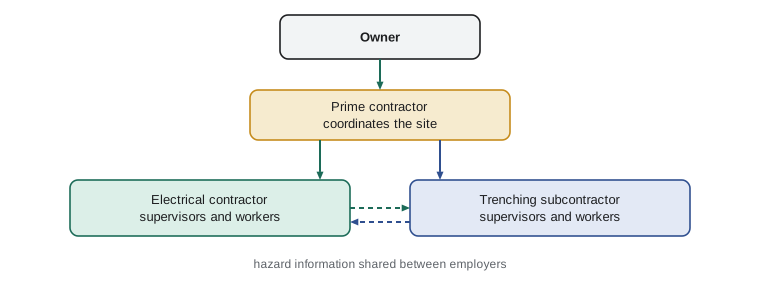
- Prime contractors coordinate health and safety at a work site where two or more employers are involved, so that the activities of all the employers do not create hazards for each other's workers.
- Owners, suppliers and service providers also have duties, for example to provide safe premises and safe equipment and to share information about known hazards.
A master electrician may wear several of these hats at once. At Parkland Valley, Gord is the employer's representative, Priya is a supervisor as a lead hand, and on a site where Parkland Valley is the only contractor hired directly by the owner, the company can end up as the prime contractor.
Prime contractors
Where two or more employers are involved in work at a work site, the Act requires a prime contractor. Often it is designated in writing by the owner, commonly the general contractor. If no one is designated, the owner can be the prime contractor by default. The prime contractor must establish a system or process to ensure compliance with the law at the site, so far as it is reasonably practicable, and coordinate the employers. That coordination does not remove each employer's own duties.
At Hartley Farms, the farm hired Parkland Valley directly for the grain-drying project, and Parkland Valley hired the trenching subcontractor. In writing, the farm and Parkland Valley had agreed that Parkland Valley was the prime contractor. That made the near miss Parkland Valley's coordination problem as well as the trenching company's supervision problem. Gord's response, stopping work and resetting the controls, was exactly what the role requires.
Committees and representatives
The Act requires worker participation through joint committees or representatives, depending on size.
- An employer that regularly employs 20 or more workers must establish a joint work site health and safety committee, and must also have a health and safety program.
- An employer that regularly employs 5 to 19 workers must designate a health and safety representative, or may establish a committee instead.
- At multi-employer work sites, the employers or the prime contractor coordinate a committee or representative based on the total number of workers, under the Act's rules.
Parkland Valley has 18 staff, so it needs a health and safety representative rather than a committee, and it has chosen to keep a written safety program anyway because its clients require one. If it grows past 20 regularly employed workers, it must establish a committee and a formal health and safety program.
Worked problem
Committee or representative?
Gord expects to hire four more electricians and a second estimator next spring. Parkland Valley regularly employs 18 workers now. What will the Act require after the hiring?
Show solution
- Current workers: 18, which is in the 5 to 19 range: a health and safety representative is required.
- After hiring: 18 + 5 = 23 workers, which is 20 or more.
- At 20 or more, the employer must establish a joint work site health and safety committee and have a health and safety program.
Answer: A joint committee and a health and safety program.
def ohs_participation(workers):
    if workers >= 20:
        return 'joint work site health and safety committee + health and safety program'
    if workers >= 5:
        return 'health and safety representative (or a committee)'
    return 'no committee or representative required by the size rule'

for n in (3, 12, 18, 23, 45):
print(f'{n:3d} workers -> {ohs_participation(n)}')3 workers -> no committee or representative required by the size rule 12 workers -> health and safety representative (or a committee) 18 workers -> health and safety representative (or a committee) 23 workers -> joint work site health and safety committee + health and safety program 45 workers -> joint work site health and safety committee + health and safety program
Rights of workers
Every worker has three basic rights under Alberta's OHS law: the right to know about hazards, the right to participate in health and safety, and the right to refuse dangerous work. A worker who believes on reasonable grounds that work is dangerous may refuse it, must report the refusal, and is protected from reprisal for refusing. The employer must investigate and take action, and if the matter is not resolved, an officer can become involved. A master electrician as supervisor needs to handle a refusal correctly: stop, listen, investigate, fix, and never punish the worker for raising it.
Reporting
Serious injuries and certain incidents must be reported to Alberta OHS as soon as possible, and the scene must not be disturbed except to protect life or prevent further injury or damage until an officer allows it. Separately, as lesson 8 explained, injuries must be reported to WCB-Alberta within 72 hours of the employer being told about them. The two reports serve different purposes: OHS reporting is about investigation and prevention; WCB reporting is about compensation. A serious incident usually needs both.
Near misses like the one at Hartley Farms may not need to be reported to the regulator, depending on the circumstances, but they should always be investigated internally. A near miss is a free lesson.
Electrical safety in the OHS Code
The OHS Code contains the detailed technical requirements, organized into parts. For electrical contractors, the most important are the parts on electrical safety, on the control of hazardous energy (lockout), on fall protection and on the competence and training of workers. The electrical part covers work on or near energized electrical equipment, the qualifications of the people who may do it, and work near overhead power lines. Read it in full; the 2023 revision changed how some requirements are organized.
The basic principle is the same one every electrician learns as an apprentice: de-energize, lock out and verify before working, wherever it is reasonably practicable. Work on or near energized equipment is allowed only under controlled conditions, by competent workers, with the right procedures and protective equipment. A contractor who lets workers routinely work live to save time is breaking the law, as well as risking lives.
Overhead power lines
Contact with overhead lines kills workers in Alberta every few years, and many of the victims are not electricians: they are operators of cranes, excavators and boom trucks. The OHS Code sets safe limits of approach to energized overhead lines, increasing with voltage, and requires contacting the utility before work that could bring workers or equipment within those limits. Utilities in Alberta publish the distances and their own procedures. One utility's contractor guidance, for example, sets 7 metres as the clearance to keep when the voltage of a line is unknown, and gives smaller distances for known lower voltages and larger ones for transmission voltages.
At Hartley Farms, the overhead line to the grain dryer was a distribution line at a voltage that would require several metres of clearance under the utility's published table. The excavator came closer than that. Gord's corrective actions were straightforward: contact the utility and ask about clearance or temporary measures, mark the line and the limit of approach on the ground, assign a spotter whenever equipment works near it, and include the hazard in the site orientation for every subcontractor.
| Hazard | Main control | Who acts |
|---|---|---|
| Work on electrical equipment | De-energize, lock out, verify absence of voltage | Employer, supervisor, competent worker |
| Unavoidable energized work | Approved procedures, competent workers, protective equipment | Employer and supervisor |
| Overhead lines near equipment | Contact utility; keep safe limits of approach; spotter | Prime contractor and every employer |
| Falls from ladders and lifts | Fall protection plan, trained workers, correct equipment | Employer and supervisor |
| Multi-employer interference | Coordination by the prime contractor | Prime contractor |
Enforcement
OHS officers can inspect work sites, investigate incidents, and issue orders, including stop-work orders, when they find contraventions. Employers and others can be prosecuted for offences under the Act, and courts in Alberta have imposed substantial penalties after serious injuries and deaths. Officers can also issue administrative penalties and tickets for certain contraventions. Like a safety codes order, an OHS order states what must be done and by when, and can be appealed through the process set out in the Act.
The best defence, legally and morally, is due diligence: a real safety program, trained workers, competent supervision, hazard assessments, and records that show it all happened. Gord has always required a written hazard assessment at the start of every job, and after the near miss he added a line for overhead lines to every farm job's form.
Hazard assessments
Alberta's OHS rules require employers to assess the hazards of the work and to control them, and to involve workers in the assessment. For an electrical contractor, a hazard assessment at the start of each job, and again when conditions change, is the practical form that duty takes. Parkland Valley's form lists the tasks, the hazards for each one, the controls and the people responsible, and every worker on the job signs it. After the near miss, the form gained a specific question: are there overhead lines within reach of any equipment on this site?
Common mistakes
MistakeAssuming the general contractor's safety program covers all of your own duties.
InsteadThe prime contractor coordinates, but each employer keeps its own duties to its workers.
MistakeTreating a worker's refusal of unsafe work as insubordination.
InsteadWorkers have the right to refuse dangerous work and are protected from reprisal; investigate and fix the hazard.
MistakeReporting a serious injury only to WCB.
InsteadSerious injuries and certain incidents must also be reported to Alberta OHS, and the scene preserved.
MistakeLetting equipment work near overhead lines without contacting the utility.
InsteadKeep the safe limits of approach and contact the utility before work that could come closer.
Summary and key terms
- Alberta's Occupational Health and Safety Act has been in force since December 1, 2021; the OHS Code holds detailed technical rules.
- Employers, supervisors, workers, prime contractors and owners all have duties.
- A prime contractor is required where two or more employers work at a site; it coordinates health and safety.
- Employers with 20 or more workers need a joint committee and a health and safety program; 5 to 19 workers need a representative.
- Workers may refuse dangerous work; serious injuries go to OHS and injuries go to WCB within 72 hours.
- Prime contractor
- The party that coordinates health and safety at a work site with two or more employers.
- Joint work site health and safety committee
- A committee of worker and employer members required for employers of 20 or more workers.
- Health and safety representative
- A worker representative required for employers of 5 to 19 workers.
- Right to refuse
- A worker's right to refuse work they reasonably believe is dangerous, with protection from reprisal.
- Limit of approach
- The minimum distance to keep from energized overhead lines, depending on voltage.
Practice problems
Work each problem on paper first, then reveal the answer to check.
An employer regularly employs 9 workers. What does the Act require for worker participation?
Show answer
A health and safety representative, or a committee if the employer chooses.
Who coordinates health and safety at a site with three employers?
Show answer
The prime contractor.
A worker is seriously injured. Which two bodies are notified?
Show answer
Alberta OHS, as soon as possible, and WCB-Alberta, within 72 hours of the employer being told.
What clearance does one Alberta utility advise when the voltage of an overhead line is unknown?
Show answer
7 metres.
Lesson quiz · 5 questions
Score 60% or more to complete this lesson.
Create a free account to save your progress, take quizzes and earn a certificate.