
MELC-201 · Lesson 4 of 12 · 23 min
The exam format and the references allowed
▶ Video coming soon A video version of this lesson is on the way.
Knowing the structure of an exam is worth marks. A candidate who knows how many questions are in each part, how long each part lasts, what the pass rule is and what may sit on the desk can plan every minute before walking in. A candidate who does not will spend the first half hour working it out under pressure. This lesson sets out the format of the Alberta master electrician exam as the Safety Codes Council described it in late 2026, then works through the pass rule, the rewrite rule and the references.
The exam was updated to the 2024 CE Code, with a new exam kit, in April 2025. If you have heard about the exam from someone who wrote it years ago, their memory of the format may be out of date. Check the Council's current exam page before you plan.
Two parts, seven hours
The exam has two parts, written on the same day.
- Part 1: Alberta Acts and Regulations. Fifty questions on the Safety Codes Act, its regulations and the other provincial documents in the exam kit.
- Part 2: Canadian Electrical Code. Seventy questions on the 2024 CE Code Part I.
Each part lasts three and a half hours, with a one-hour break between them, for a total of seven hours of writing. The exam is open book: you may use the permitted references, and only those. It is delivered online with audio and video proctoring, as lesson 3 explained.
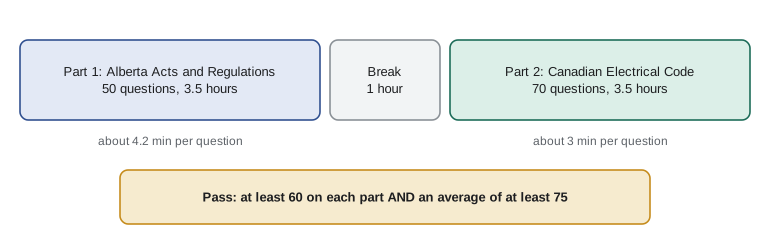
Look at the time per question. Part 1 gives you 210 minutes for 50 questions, which is 4.2 minutes each. Part 2 gives you 210 minutes for 70 questions, which is 3 minutes each. That difference matters. The legislation questions allow time to read a section carefully, but many of them need you to find the right document first. The Code questions are tighter, and some of them are calculations that take longer than three minutes, so you must bank time on the easy ones.
The pass rule
The pass rule has two conditions, and both must be met.
- You must score at least 60 out of 100 on each part.
- Your average across the two parts must be at least 75 out of 100.
The Council's own wording stresses the trap: even if your overall average is 75 or higher, you do not pass if either part scores below 60. A candidate with 95 on the Code and 58 on the legislation has an average of 76.5, but fails. That is exactly the candidate Denise warned about in lesson 1, the strong electrician who ignored Part 1.
The rule also cuts the other way. A candidate who scores 62 on Part 1 needs at least 88 on Part 2 to reach an average of 75. A weak Part 1 forces a near-perfect Part 2.
Worked problem
Pass or fail?
Three study-group members wrote practice versions scored the same way as the real exam. Priya scored 78 on Part 1 and 80 on Part 2. Marcus scored 64 on Part 1 and 90 on Part 2. A former member scored 57 on Part 1 and 96 on Part 2. Who passes under the Alberta rule?
Show solution
- Priya: both parts are at least 60; average = (78 + 80) / 2 = 79, at least 75. Pass.
- Marcus: both parts are at least 60; average = (64 + 90) / 2 = 77. Pass.
- Former member: Part 1 is below 60, so the result is a fail regardless of the average of 76.5.
Answer: Priya and Marcus pass; the former member fails on the Part 1 minimum.
def result(part1, part2):
    if part1 < 60 or part2 < 60:
        return 'fail: a part is below 60'
    avg = (part1 + part2) / 2
    if avg < 75:
        return f'fail: average {avg:.1f} is below 75'
    return f'pass: average {avg:.1f}'

for p1, p2 in [(78, 80), (64, 90), (57, 96), (70, 78), (62, 88)]:
print(p1, p2, '->', result(p1, p2))78 80 -> pass: average 79.0 64 90 -> pass: average 77.0 57 96 -> fail: a part is below 60 70 78 -> fail: average 74.0 is below 75 62 88 -> pass: average 75.0
Try your own practice scores. Then try the question the study group always asks: given your Part 1 score, what is the lowest Part 2 score that passes? It is the larger of 60 and 150 minus your Part 1 score.
Rewrites
If you do not pass, the rewrite rules depend on how you failed.
- Any part scored below 60 must be rewritten.
- If both parts are at least 60 but the average is below 75, you may choose which part to rewrite.
The Council's published information did not set a limit on the number of rewrites, and each rewrite cost 75 dollars per part in late 2026. A rewrite is a chance to fix the weak part, not a reason to arrive unprepared the first time.
Worked problem
Choosing which part to rewrite
Marcus's practice scores on a later mock were 66 on Part 1 and 80 on Part 2: both above 60, average 73. Which part should he rewrite, and what score does he need?
Show solution
- He may choose either part, because both are at least 60.
- If he rewrites Part 1, he needs a score x with (x + 80) / 2 ≥ 75, so x ≥ 70.
- If he rewrites Part 2, he needs (66 + y) / 2 ≥ 75, so y ≥ 84.
- Raising Part 1 by 4 marks is likely easier than raising Part 2 by 4 marks to 84, but the real question is which part he can improve most reliably with study.
Answer: Rewrite Part 1, needing at least 70, unless he has a clear plan to lift Part 2 to 84.
This assumes the kept part's mark carries over and the rewritten part replaces the old one. That is how the Council described choosing a part to rewrite, but confirm how marks are combined after a rewrite when you register.
What may be on the desk
The exam is open book, but only for the permitted references. The Council's list in late 2026 centred on two items.
- The 2024 Exam Kit, which contains most of the documents tested in Part 1. You buy it.
- The 26th edition (2024) of the Canadian Electrical Code Part I, which you must buy separately.
The Council's list also names the Safety Codes Act and its regulations, the WCB Employer Handbook, the electrical STANDATA and the Master Electrician Code of Ethics among the permitted items, most of which are inside the kit. The full list is on the Council's exam page, and it is the only list that counts. If an item is not on it, leave it out of the room.
| Reference | Mainly used for | Note |
|---|---|---|
| 2024 Exam Kit | Part 1 | Contains most of the legislation and provincial documents tested |
| CE Code Part I, 2024 (26th edition) | Part 2 | Bought separately; must be the 2024 edition |
| Safety Codes Act and regulations | Part 1 | Permits, certification, orders, appeals, offences |
| WCB Employer Handbook | Part 1 | Employer obligations under workers compensation |
| Electrical STANDATA | Parts 1 and 2 | Alberta interpretations, variances and bulletins |
| Master Electrician Code of Ethics | Part 1 | Professional conduct of certificate holders |
Ask the Council, or read its exam information, about what you may write in your books. Many open-book exams allow tabs and highlighting but restrict loose notes or added pages. In MELC-101 Priya tabbed her Code with a colour scheme. For the Alberta exam she adds a second set of tabs to the exam kit: one colour for the Safety Codes Act, one for each regulation, one for the WCB handbook and one for the STANDATA.
A calculator is essential for Part 2. The Council's exam page did not spell out its calculator policy in the material we checked, so confirm what type is allowed. A simple scientific calculator without memory or communication features is the safe choice on most licensing exams.
Planning the two parts
Because the parts are timed separately, plan each one separately. Denise's routine for an open-book exam is two passes. On the first pass, answer every question you can answer quickly from memory or with a single lookup, and flag the rest. On the second pass, work the flagged questions in order of how close you are to the answer. Never leave a question blank; there is no reason to on a multiple-choice exam unless the instructions say otherwise.
For Part 1, the hard part is knowing which document holds the answer. A question about who may obtain a permit is in the Certification and Permit Regulation; a question about an order and its appeal is in the Act; a question about reporting an injury is in the WCB material. Lesson 12 builds a question-to-document map. For Part 2, use the lookup routines from MELC-101 and the calculation routines from MELC-102 to MELC-105.
Worked problem
Time budget
Priya plans to spend no more than 2.5 minutes per question on her first pass in Part 2 and expects to answer 55 of the 70 questions on that pass. How much time will she have left for the remaining 15 questions?
Show solution
- First pass time = 55 × 2.5 = 137.5 minutes.
- Time left = 210 − 137.5 = 72.5 minutes.
- Time per remaining question = 72.5 / 15 ≈ 4.8 minutes, enough for most calculations.
Answer: About 72 minutes, or nearly five minutes per flagged question.
The day itself
Seven hours is a long time to concentrate. Sleep properly the night before; this is not an exam to cram for overnight. Eat before Part 1 and during the break. Keep water within reach if the rules allow it. Use the one-hour break to step away from the desk, not to reread the Code.
Priya books her exam for a Saturday, so that the shop is closed and the house is quiet, and she tells her family that from eight in the morning until late afternoon she is not to be interrupted for anything short of a fire.
What the two parts feel like
Candidates who have written the exam describe the two parts very differently. Part 1 feels like reading comprehension under time pressure. The questions are usually short, but the answer is in a section of legislation that has to be found and read carefully. Many questions describe a situation and ask who must act, who may act, or what the consequence is. The common errors are going to the wrong document and stopping at the first sentence that seems to fit.
Part 2 feels like the Code courses in this program: lookups, definitions, installation rules and calculations, some of them multi-step. The common errors are spending too long on one calculation, missing an exception or a subrule, and using a table without checking its notes. Every technique from MELC-101 to MELC-106 applies: read the whole rule, check the definitions, check the notes, and write down intermediate results.
Because the parts feel so different, many candidates find the one-hour break useful for switching mindset as well as resting. Priya plans to spend the break outside, walking, and to start Part 2 with three easy lookups to settle into Code mode.
Preparing the references
Open-book references only help if they are prepared. In the weeks before the exam, do three things with each permitted reference. First, read its table of contents and know its structure. Second, tab it, with a consistent colour scheme across all your references, within whatever the exam rules allow. Third, practise with it under time pressure, so that you know how long a typical lookup takes.
For the exam kit, the most useful tabs are the start of each Act and regulation, the definitions sections, and the provisions on permits, certificates, orders, appeals and offences. For the WCB material, tab the employer obligations and injury reporting. For the STANDATA, tab the index and the documents that affect rules you use often.
Priya times herself on twenty random Part 1 lookups with her tabbed kit. Her first attempt averages three minutes per lookup. After two weeks of practice, she is down to just over one minute. That saving, about two minutes per question across fifty questions, is the margin that makes her time plan work.
Common mistakes
MistakeAssuming a high average is enough to pass.
InsteadEach part needs at least 60, and the average of both must be at least 75.
MistakeSpending equal time per question in both parts.
InsteadPart 1 allows about 4.2 minutes per question and Part 2 about 3; plan each part separately.
MistakeBringing extra books or printed notes because the exam is open book.
InsteadOnly the permitted references are allowed; check the Council's list.
MistakeUsing an older Code edition.
InsteadThe exam is based on the 2024 CE Code, the 26th edition.
Summary and key terms
- The exam has two parts: 50 questions on Alberta Acts and Regulations and 70 on the CE Code.
- Each part lasts 3.5 hours, with a one-hour break, for seven hours in total.
- To pass, score at least 60 on each part and average at least 75.
- A part below 60 must be rewritten; if both are at least 60 but the average is below 75, you choose which part to rewrite.
- Permitted references centre on the 2024 Exam Kit and the 2024 CE Code.
- Open book
- An exam where permitted references may be used during writing.
- Part minimum
- The mark of 60 out of 100 required on each part.
- Average requirement
- The combined average of 75 out of 100 required across both parts.
- Rewrite
- Writing a part again after not passing; charged per part.
- Two-pass method
- Answering quick questions first and returning to flagged ones.
Practice problems
Work each problem on paper first, then reveal the answer to check.
A candidate scores 61 and 85. Do they pass?
Show answer
Both parts are at least 60 and the average is 73, so no; they choose which part to rewrite.
How many minutes per question does Part 2 allow on average?
Show answer
210 / 70 = 3 minutes.
A candidate scores 72 on Part 1. What is the minimum Part 2 score to pass?
Show answer
The larger of 60 and 150 − 72 = 78, so 78.
Which edition of the CE Code is used on the exam?
Show answer
The 2024 (26th) edition.
Lesson quiz · 5 questions
Score 60% or more to complete this lesson.
Create a free account to save your progress, take quizzes and earn a certificate.