
MELC-201 · Lesson 5 of 12 · 19 min
The 2024 CE Code as adopted in Alberta and the STANDATA
▶ Video coming soon A video version of this lesson is on the way.
The CE Code is national, but its adoption is provincial, and every province adds its own layer. In Alberta that layer has two parts: the regulation that declares which edition is in force, and a set of documents called STANDATA that explain how the Code applies in this province. Part 2 of the exam tests the Code; but questions on both parts can turn on how the Code is adopted and on what a STANDATA says. This lesson explains the adoption, the transition to the 2024 edition and the three kinds of STANDATA, and shows how to use them without confusing them with the Code itself.
As always in this series, no Code text or tables are reproduced. STANDATA documents are published by the Government of Alberta and are freely available on its website; this lesson describes them in its own words and cites them by subject. Read the current documents yourself, because STANDATA are revised and replaced as the Code changes.
How an edition comes into force
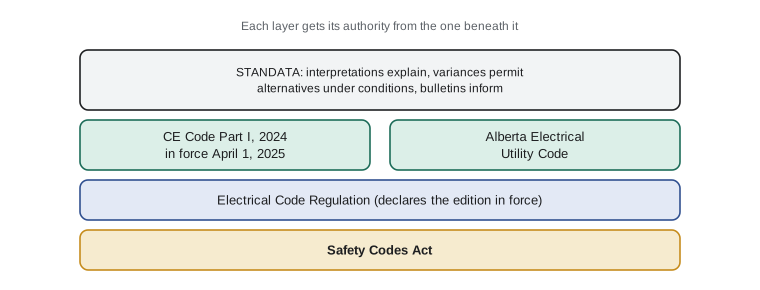
The Canadian Standards Association publishes a new edition of the CE Code Part I every three years. The 2024 edition is the 26th. Publication does not make it law in Alberta. The Safety Codes Act lets the government declare codes in force by regulation, and the Electrical Code Regulation is where that is done for electrical installations. Until the regulation is amended, the previous edition stays in force, even if a newer one is on the shelf.
Alberta declared the 2024 CE Code Part I in force on April 1, 2025. From that date, new electrical work in the province must meet the 26th edition, subject to any transition rules that apply to work already permitted. The master electrician exam was updated to the 2024 Code, with a new exam kit, in April 2025. For practising master electricians, the Safety Codes Council required proof of code update training on the new edition, which was due by March 31, 2025, to keep their certification active.
Priya asks about a job permitted in early 2025 and wired over that summer. Which Code applies? Denise's answer is that transitions are handled by the province and the administering authority, often by tying the edition to the date the permit was applied for or issued. The safe practice is to check the transition rules published with the adoption, and to ask the authority having jurisdiction when a project straddles the date. On the exam, assume the 2024 edition unless the question says otherwise.
The Alberta Electrical Utility Code
Alberta also has its own Alberta Electrical Utility Code, which governs the design and installation of electrical utility systems: generation, transmission and distribution owned or operated by utilities. The CE Code Part I generally stops at the boundary between a customer's installation and the utility's supply. The utility code picks up on the utility side, working alongside national utility standards. Most master electrician work is on the customer side, but questions about service points, metering and the division of responsibility at the service can involve both codes. The Government of Alberta lists the current edition of the utility code on its electrical codes page.
What STANDATA are
STANDATA are documents issued by Alberta Municipal Affairs under the safety codes system. For electrical work, they come in three kinds, and the exam expects you to know the difference.
- Interpretations explain what a Code rule means and how it is to be applied in Alberta, usually because the rule has been applied inconsistently. An interpretation does not change the rule. It tells everyone, inspectors and contractors alike, how the province reads it.
- Variances allow something different from what a Code rule requires, across the province, under stated conditions. A variance is a formal departure from the Code, made under the authority of the Safety Codes Act. If you follow a variance, you must meet all of its conditions; partial compliance is not compliance.
- Bulletins provide information: clarifications, recommended practices, explanations of changes and reminders. A bulletin is guidance rather than a binding change.
The documents are numbered by Code edition, discipline and type. Examples in recent years have used numbers built from the edition year, a letter code and a sequence, such as an interpretation or a variance tied to a particular section of the Code. The exact numbering system is less important than recognizing the type and the edition each document applies to.
| Type | Changes the Code requirement? | Typical purpose |
|---|---|---|
| Interpretation | No | Explains how a rule is read and applied in Alberta |
| Variance | Yes, under its stated conditions | Allows an alternative to a rule across the province |
| Bulletin | No | Information, recommended practice or explanation of changes |
Real examples
Two recent STANDATA show how the system works in practice.
The first is an interpretation of the 2024 Code on the number of supply services permitted, under Rule 6-102, as it applies to individual units of residential row housing. The interpretation was issued because the rule had been applied inconsistently, especially in how the type and location of metering equipment affected the count of services. It also noted that subdivisions may be developed with either multiple supply services or a single supply service for a row housing building, and that utilities design their facilities under the Alberta Electrical Utility Code. A contractor wiring townhouses needs to read that document alongside Section 6, because it tells them how inspectors across Alberta will apply the rule.
The second is a variance tied to Rule 2-024, the general rule on using approved equipment, for high-voltage termination and splice kits. Variances of this kind exist because a strict reading of a Code rule can block a practice the province considers safe under conditions. The variance sets out exactly when the alternative is acceptable. A contractor who relies on it must be able to show that every condition is met.
Neither example reproduces Code wording, and neither should your notes. When you annotate your Code book, write the STANDATA number and its subject next to the rule it affects, as far as the exam rules allow annotation. That way a rule that has been varied or interpreted in Alberta is flagged where you will see it during the exam.
Using STANDATA on the job
Denise tells the group about the most common STANDATA mistake she saw as an inspector: a contractor finds a variance, applies the part that suits them, and ignores the conditions. A variance that permits an alternative method only in certain occupancies, or only with certain equipment, does not apply outside them. If any condition is not met, the Code rule applies in full, and the installation will be written up.
The second mistake is using an old STANDATA. Documents are tied to a Code edition. An interpretation of the 2021 Code may have been reissued, revised or withdrawn for the 2024 Code. When the edition changes, check that the STANDATA you rely on has been reissued for the new edition. The Government of Alberta's electrical STANDATA page lists the current bulletins, interpretations and variances by Code edition.
Worked problem
Does the variance apply?
Marcus finds a STANDATA variance that permits an alternative installation method for a type of equipment, provided three conditions are met: the equipment is listed for the purpose, it is installed by a qualified person, and a specific test is performed and documented. On a Hartley Farms job, the equipment is listed and installed by Marcus, but nobody performed the test. Can Parkland Valley rely on the variance?
Show solution
- A variance applies only when all of its conditions are met.
- Two conditions are met; the documented test is missing.
- So the variance does not apply, and the Code rule applies in full.
- The fix is to perform and document the test, after which the variance can be relied on.
Answer: No, not until the test is done and documented.
STANDATA on the exam
The electrical STANDATA are among the permitted references the Council named for the exam. That means a question may be answerable directly from a STANDATA in your kit, and it also means you should know which STANDATA exist before exam day. Part 1 questions are likely to ask what kind of document something is, who issues STANDATA, or whether a variance changes a requirement. Part 2 questions may build on a Code rule that an Alberta STANDATA interprets or varies.
Priya's preparation is practical. She prints the current index of electrical STANDATA for the 2024 Code, reads each one once, and tabs the ones that relate to Code rules she uses often: services, grounding, dwelling receptacles and anything else her work touches. Where the exam rules allow, she writes the STANDATA reference next to the affected Code rule. She also adds a one-line summary of each type to the inside cover of her kit: interpretation explains, variance permits with conditions, bulletin informs.
Other provinces do the same
Tyler notices that other provinces seem to do something similar. They do. Most provinces adopt the CE Code by regulation with some amendments, and many publish bulletins or interpretations. Ontario adopts the Code as the Ontario Electrical Safety Code with its own amendments, and British Columbia adopts it through its own regulation with variations. That is why every provincial master electrician course in this program has its own lesson on adoption. The Code is shared; the layer on top is local.
Reading a STANDATA
STANDATA documents follow a consistent layout, which makes them faster to use once you know it. Most begin with identifying information: the type of document, the Code edition it applies to, the subject or rule it concerns, and the date it was issued or revised. Then comes a purpose or issue statement explaining why the document exists, a discussion or background section, and finally the interpretation, the variance with its conditions, or the information the bulletin provides.
Read the purpose first. It tells you whether the document is relevant to your question. Then go straight to the conclusion or the conditions. For a variance, list the conditions and check each one against your installation. For an interpretation, note exactly what the province says the rule means, and whether it limits its answer to certain occupancies or situations.
Denise's tip for the exam is to notice the date and the edition every time. A question about the 2024 Code is answered by documents for the 2024 Code. If your kit includes an index of STANDATA by edition, tab it, so that you can find the right document in one step.
Why Alberta adds its own layer
Tyler asks why a province would vary a national code at all. Denise gives three reasons. Sometimes local conditions differ: climate, soil, utility practices or common building types can make a national rule awkward or insufficient in Alberta. Sometimes a rule is applied inconsistently across the province, and an interpretation brings inspectors and contractors to the same reading. And sometimes technology moves faster than the three-year Code cycle, so a variance allows a safe new practice before the next edition catches up.
The layer is deliberately thin. Alberta adopts the CE Code with relatively few changes compared with the size of the Code, and most STANDATA explain rather than change it. That is good news for candidates, because the national Code knowledge from the core courses carries over almost entirely, and the Alberta layer is small enough to learn.
The utility boundary in practice
Questions about where the CE Code stops and utility rules begin come up at every service installation. Parkland Valley's Hartley Farms job shows the pattern. The utility owns the transformer and the conductors up to the service point it designates; Parkland Valley installs everything from the service point into the customer's premises under the CE Code and the permit. The utility's own standards decide things like metering arrangements and service entrance requirements on its side, and the utility generally needs confirmation of the permit, and sometimes an inspection, before it connects. When a question involves both sides, identify the service point first, then apply the right code to each side.
Common mistakes
MistakeAssuming a new Code edition applies the day it is published.
InsteadAn edition applies in Alberta only from the date the Electrical Code Regulation declares it in force; the 2024 edition took effect April 1, 2025.
MistakeTreating an interpretation as a change to the Code.
InsteadInterpretations explain how a rule is applied; only a variance permits something different, and only under its conditions.
MistakeApplying part of a variance.
InsteadA variance applies only if every one of its conditions is met; otherwise the Code rule applies in full.
MistakeRelying on a STANDATA written for an older edition.
InsteadCheck that the document has been issued for the 2024 Code before relying on it.
Summary and key terms
- The Electrical Code Regulation under the Safety Codes Act declares the CE Code edition in force; the 2024 edition took effect April 1, 2025.
- Alberta also has its own Alberta Electrical Utility Code for utility systems.
- STANDATA are issued by Alberta Municipal Affairs: interpretations explain, variances permit alternatives under conditions, bulletins inform.
- Only a variance changes a requirement, and only when all of its conditions are met.
- Electrical STANDATA are permitted exam references; know them and flag affected rules.
- Electrical Code Regulation
- The Alberta regulation that declares the CE Code edition in force.
- Interpretation
- A STANDATA explaining how a Code rule is read and applied in Alberta.
- Variance
- A STANDATA permitting an alternative to a Code rule across the province, under stated conditions.
- Bulletin
- A STANDATA providing information, clarification or recommended practice.
- Alberta Electrical Utility Code
- Alberta's code for electrical utility systems on the utility side of the service.
Practice problems
Work each problem on paper first, then reveal the answer to check.
On what date did the 2024 CE Code come into force in Alberta?
Show answer
April 1, 2025.
A STANDATA explains how Rule 6-102 is applied to row housing. What kind is it?
Show answer
An interpretation; it does not change the rule.
A contractor meets two of three conditions of a variance. Does the variance apply?
Show answer
No. All conditions must be met; otherwise the Code rule applies.
Who publishes STANDATA?
Show answer
Alberta Municipal Affairs.
Lesson quiz · 5 questions
Score 60% or more to complete this lesson.
Create a free account to save your progress, take quizzes and earn a certificate.