
MELC-201 · Lesson 8 of 12 · 19 min
Contractor licensing, insurance and bonding
▶ Video coming soon A video version of this lesson is on the way.
The Master Electrician Certificate lets a person take out electrical permits. It does not, on its own, make anyone a lawful business. An electrical contractor in Alberta also needs to be properly set up as a business, licensed where municipalities or provincial consumer law require it, covered by workers compensation, insured against the risks of the work and, for many projects, bonded. Part 1 of the exam reaches into some of this, especially workers compensation and the documents in the kit, and every master electrician who runs or helps run a company deals with all of it.
This lesson describes the main requirements as they stood in late 2026. Business rules change often and vary by municipality, so treat this as a map of what to check, not a substitute for checking. Where a requirement comes from a specific Act, the lesson names it.
Priya does the paperwork
Gord asks Priya to spend an afternoon with Linda, Parkland Valley's office manager, going through the company's licences, insurance certificates and bonding documents. Gord's view is that a master electrician who does not understand the business side will one day sign a contract the company cannot afford. Priya finds a binder of renewals, each with a different date, and a spreadsheet Linda uses to track them.
The business itself
A contracting business can be a sole proprietorship, a partnership or a corporation. Parkland Valley is a corporation registered in Alberta, which separates the company's debts from the owners' personal assets in most situations and makes it easier to sell or transfer. Whatever the form, the business must be registered as the law requires, must file taxes, and, once its revenue passes the small supplier threshold, must register for and collect the federal goods and services tax. The threshold has been 30,000 dollars of taxable supplies over four consecutive calendar quarters, but check the Canada Revenue Agency for the current rules.
The master electrician and the business are separate in law even when one person owns both. Permits are taken out under the certificate; contracts are signed by the business. That separation matters when things go wrong, and lesson 9 returns to it with contracts and liens.
Municipal business licences
Many Alberta municipalities require businesses operating within their boundaries to hold a municipal business licence, and some require it specifically for contractors applying for permits. Edmonton, for example, requires an electrical contractor applying for a permit to hold a valid City of Edmonton business licence. Calgary and other municipalities have their own rules. A company that works across several municipalities may need several licences, each with its own fee and renewal date. Linda's spreadsheet lists seven.
Prepaid contracting licences
Alberta's Consumer Protection Act regulates prepaid contracting, which matters for any contractor who does residential work. A business needs a prepaid contracting business licence if it solicits, negotiates or concludes contracts in person somewhere other than its own place of business, takes money before all the work is done, and the contract is for construction, maintenance, repair, alteration, addition or improvement of a private dwelling or the land used with it.
In plain terms: if Parkland Valley's estimator visits a homeowner's kitchen, signs a contract to upgrade the service and takes a deposit, the company needs the licence. If the customer comes to the office and signs there, or if the contract is for a commercial building, or if it is a contract between contractors, the licence requirement does not apply to that contract. The Act lists other exemptions, such as certain new home construction covered by warranty programs.
The application requires business information, a criminal record or police information check, a security, copies of standard contracts and a fee. Licensed businesses must notify the government of changes within 15 days, keep records for 3 years and provide identification cards to salespeople. The Act also restricts door-to-door selling of some energy-related products. Selling a water heater, furnace, air conditioner, windows or an energy audit in a consumer's home is prohibited unless the consumer invited the business beforehand.
| Contract | Prepaid contracting licence needed? | Reason |
|---|---|---|
| Deposit taken at the customer's home for a residential service upgrade | Yes | Solicited away from the business, prepaid, private dwelling |
| Customer signs at the contractor's office, deposit paid | Not for this contract | Concluded at the place of business |
| Commercial tenant improvement with a deposit | No | Commercial buildings are exempt |
| Subcontract with a general contractor | No | Contracts between contractors are exempt |
| Residential work invoiced only after completion | No | No money taken before the work is done |
Workers compensation
Electrical contracting is an industry where workers compensation coverage through WCB-Alberta is mandatory. An employer must register with WCB, report payroll, pay premiums, and report workplace injuries. WCB-Alberta states that employers must report a worker's injury within 72 hours of being told about it. The WCB Employer Handbook, one of the documents named among the permitted exam references, sets out these obligations, and Part 1 questions can draw on it.
WCB coverage is also a business requirement in contracting chains. Prime contractors and owners commonly require subcontractors to provide a WCB clearance letter, which shows the subcontractor's account is in good standing. A company that hires an uncovered subcontractor can end up responsible for that subcontractor's unpaid premiums, so checking clearance before paying is standard practice. Parkland Valley requests clearance from every subcontractor it hires, such as the trenching company on its farm jobs, and provides its own clearance to every general contractor it works for.
Premiums are set per 100 dollars of insurable earnings, at a rate that depends on the industry and on the employer's claims experience. The exam is unlikely to test a rate, but you should understand the calculation, because it affects every quote.
Worked problem
Estimating WCB premiums
Parkland Valley expects insurable earnings of 1,350,000 dollars next year. Its WCB rate (illustrative) is 1.85 dollars per 100 dollars of insurable earnings. What is the estimated annual premium?
Show solution
- Premium = earnings / 100 × rate.
- 1,350,000 / 100 = 13,500 units of 100 dollars.
- 13,500 × 1.85 = 24,975 dollars.
Answer: About 24,975 dollars a year, under this illustrative rate.
Insurance
Insurance protects the business against claims that would otherwise threaten its survival. Electrical contractors commonly carry several kinds.
- Commercial general liability (CGL) insurance covers claims by others for bodily injury or property damage arising from the business's work, such as a fire traced to an installation. Many owners, general contractors and municipalities require proof of a minimum limit, commonly 2 million dollars or more per occurrence, and ask to be named as additional insureds.
- Automobile insurance for company vehicles, with commercial use declared.
- Property and equipment insurance for tools, stock, the shop and equipment on job sites.
- Builders risk or course of construction insurance, often carried by the owner or general contractor on larger projects, which covers the work itself while it is being built.
- Other coverages, such as errors and omissions for companies that do design work, or pollution liability for certain sites.
Insurance certificates expire, and an expired certificate can stop payment on a project. Linda tracks every policy's renewal date and sends updated certificates to clients as soon as they are renewed.
Bonding
Bonds are not insurance for the contractor. They are guarantees, issued by a surety company, that the contractor will do what it promised. If the contractor fails, the surety pays the owner or the unpaid parties, and then seeks repayment from the contractor and, often, its owners. Public owners and many large private owners require bonds on significant projects.
- A bid bond guarantees that a contractor who wins a tender will enter into the contract and provide the required performance and payment bonds.
- A performance bond guarantees that the contractor will complete the work according to the contract, commonly for a stated portion of the contract price, often half.
- A labour and material payment bond guarantees that the contractor will pay its subcontractors, workers and suppliers on the project.
A contractor's bonding capacity, the size of work a surety will bond, depends on the company's financial strength, track record and management. Growing companies often find that bonding capacity, not workload, limits the projects they can bid. Gord built Parkland Valley's capacity slowly, by keeping clean financial statements and finishing jobs on time.
def bond_amounts(contract_price, performance_share=0.5, payment_share=0.5):
    return contract_price * performance_share, contract_price * payment_share

for job, price in [('School gym lighting', 420000), ('Water treatment MCC', 1850000)]:
    perf, pay = bond_amounts(price)
print(f'{job:22s} price {price:>10,.0f} performance bond {perf:>10,.0f} payment bond {pay:>10,.0f}')School gym lighting price 420,000 performance bond 210,000 payment bond 210,000 Water treatment MCC price 1,850,000 performance bond 925,000 payment bond 925,000
The shares in the code are a common pattern, not a rule. Each tender states the bond amounts it requires; change the shares to match.
Associations and designations
Membership in an industry association such as the Electrical Contractors Association of Alberta is voluntary. Associations offer training, contract documents, safety programs and advocacy, and the ECAA awards professional designations such as Professional Electrical Contractor for people who complete its additional programs. The designations are protected titles, so only people registered with the association may use them. They are useful for credibility and business skills, but they are not required to take out permits.
Reading an insurance requirement
Contracts and tender documents often set out insurance requirements in detail. A typical clause asks for commercial general liability insurance with a stated minimum limit per occurrence, names the owner and the general contractor as additional insureds, requires notice before cancellation and asks for a certificate of insurance before work starts. Some require automobile liability limits and proof of WCB coverage as well. Before signing, compare the requirement with your actual policies, and ask your broker whether you can meet it and at what cost.
Priya reads the insurance clause for the Riverbend condos subcontract with Linda. It asks for a liability limit higher than Parkland Valley's current policy. Linda calls the broker, who confirms that the limit can be raised for a modest extra premium, and adds the cost to the quote. Had they not noticed, Parkland Valley could have been in breach of the subcontract from the first day.
Bonding capacity in practice
Bonding capacity grows with the company. A surety looks at the company's financial statements, working capital, existing workload, history of completed jobs and the experience of its management before agreeing to bond a project. A company that wants to bid larger public work, such as school renovations or water treatment plants, needs to build that capacity over years, with clean statements and finished projects.
Gord's advice to Priya is to meet the surety in person once a year, explain the company's plans, and never surprise them. A surety that understands the business is far more likely to support a larger bid than one that hears about it on the day the bid bond is needed.
A business checklist
Linda's renewal spreadsheet, simplified, makes a useful checklist for any electrical contractor in Alberta.
- Corporate registration and annual returns.
- GST registration and filings, once past the small supplier threshold.
- Municipal business licences for each municipality where the company works or applies for permits.
- Prepaid contracting business licence, if residential contracts are concluded away from the office with money taken in advance.
- WCB-Alberta account, payroll reporting and premium payments; clearance letters for clients and from subcontractors.
- Liability, automobile and property insurance, with certificates sent to clients on renewal.
- Surety relationship and bonding capacity, if the company bids bonded work.
- The master electrician certificate itself, renewed every year.
Each item has its own renewal date. The company that keeps them in one place, and looks at the list every month, rarely gets caught out.
Common mistakes
MistakeAssuming the master electrician certificate is a business licence.
InsteadThe certificate allows permits; the business may still need municipal licences, a prepaid contracting licence and WCB registration.
MistakeTaking a deposit at a homeowner's kitchen table without a prepaid contracting licence.
InsteadThat is exactly the situation the Consumer Protection Act licence covers.
MistakeHiring a subcontractor without checking WCB clearance.
InsteadAn uncovered subcontractor can leave the hiring company liable for unpaid premiums.
MistakeTreating a performance bond as insurance for the contractor.
InsteadA bond guarantees the contractor's obligations; the surety seeks repayment from the contractor if it pays a claim.
Summary and key terms
- A contracting business must be properly registered, file taxes and register for GST once past the small supplier threshold.
- Many municipalities require business licences, and some require them for contractors applying for permits.
- A prepaid contracting licence under the Consumer Protection Act is needed for residential contracts solicited away from the business with money taken in advance.
- WCB coverage is mandatory for electrical contractors; injuries must be reported within 72 hours of the employer being told.
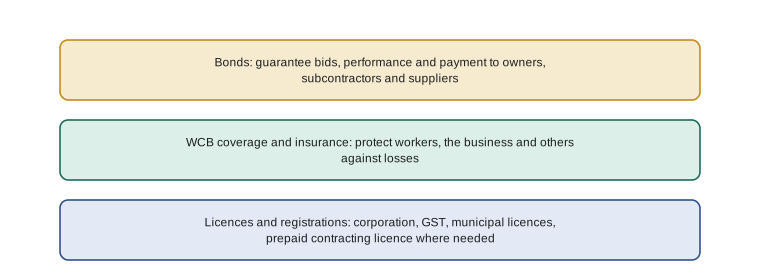
- Contractors carry liability and other insurance, and bonds guarantee bids, performance and payment on many projects.
- Prepaid contracting licence
- A Consumer Protection Act licence for certain residential contracts taken away from the business with prepayment.
- WCB clearance letter
- Proof that a contractor's workers compensation account is in good standing.
- Commercial general liability
- Insurance covering claims for injury or damage to others caused by the business.
- Performance bond
- A surety's guarantee that the contractor will complete the work as contracted.
- Labour and material payment bond
- A surety's guarantee that the contractor will pay its workers, subcontractors and suppliers.
Practice problems
Work each problem on paper first, then reveal the answer to check.
A homeowner signs a contract at Parkland Valley's office and pays a deposit. Is a prepaid contracting licence needed for that contract?
Show answer
No; it was concluded at the place of business.
Within what time must an employer report a worker's injury to WCB-Alberta?
Show answer
Within 72 hours of being told about it.
What does a labour and material payment bond guarantee?
Show answer
That the contractor will pay its subcontractors, workers and suppliers on the project.
Insurable earnings are 800,000 dollars at an illustrative rate of 2.10 dollars per 100 dollars. What is the premium?
Show answer
8,000 × 2.10 = 16,800 dollars.
Lesson quiz · 5 questions
Score 60% or more to complete this lesson.
Create a free account to save your progress, take quizzes and earn a certificate.