
MELC-201 · Lesson 3 of 12 · 20 min
Applying, approval and booking the exam
▶ Video coming soon A video version of this lesson is on the way.
Once you know you are eligible, the next steps are administrative: apply to the Safety Codes Council, wait for approval, register for an exam date and prepare your computer and room for an online, proctored exam. None of it is difficult, but every step has a rule that can cost you a week or a fee if you miss it. This lesson walks through the process as the Council described it in late 2026 and builds a checklist the study group uses for every candidate.
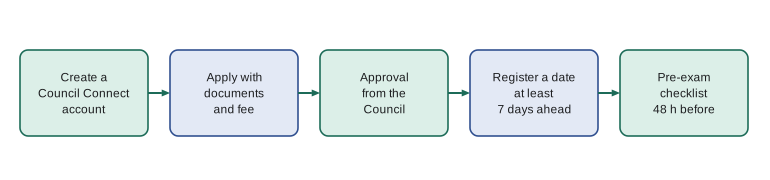
The Council runs its applications, registrations and results through an online portal called Council Connect. If you have taken a Council course or exam before, you may already have an account. If not, creating one is the first step. Keep your login details somewhere safe; you will use the same account to see your results, to renew your certificate every year and to update your contact details.
Step 1: apply
The application is made through the applications area of your Council Connect dashboard. It asks for your personal details and your supporting documents: proof of your journeyperson trade certificate and proof of your work experience as a journeyperson, as covered in lesson 2. The Council's published application fee was 50 dollars in late 2026.
Accuracy matters more than speed. The name on your application should match the name on your trade certificate and on the identification you will show at the exam. If your name has changed, include the documents that connect the old name to the new one. Make the employer letters easy to read: dates first, position second, and a contact person the Council can reach.
Priya uploads her documents on a Sunday evening and sets herself a reminder to check her dashboard every few days. Denise warns her that a missing or unclear document is the usual cause of delay. The Council cannot approve an application it cannot verify, and every request for more information adds days.
Step 2: approval
The Council reviews the application against the eligibility requirements. If it is approved, you can register for the exam. If something is missing, the Council will ask for it. If the application is refused, the reasons should be stated, and you can fix the problem and reapply when you meet the requirements, for example once your experience window reaches 36 months.
Approval is not the same as registration. An approved candidate still has to register for a specific exam offering and pay the exam fee. Tyler asks whether approval expires. The Council's terms can change, so Denise's answer is practical: plan to register reasonably soon after approval, and if a long delay is likely, check the Council's current policy rather than assume.
Step 3: register for an exam date
Registration is also done through Council Connect. As the Council described it, you go to the courses and exams area, choose exam offerings, search for the master electrician exam code, choose the standard offering, select individual registration, pick a date and pay. The date must be at least seven days ahead. The exam fee was 150 dollars in late 2026.
Because the exam is written online, there is no exam centre to travel to. You choose a date that suits your study plan and your work schedule. Most candidates book their date when they are about four weeks from being ready, which gives them a firm target without leaving the final weeks unplanned.
Step 4: prepare for online proctoring
The Alberta master electrician exam is written online and monitored with audio and video through the Council's secure proctoring software. That means your own computer, camera, microphone and room become part of the exam. The Council requires candidates to complete a pre-exam checklist at least 48 hours before the exam, so that technical problems are found while there is still time to fix them.
The practical requirements are worth taking seriously.
- A computer with a working camera and microphone. A laptop is fine; a phone or tablet is not a substitute unless the Council says so.
- Permission to install and run the proctoring software. Work computers often block it. The Council notes that a work computer may need its IT department to configure it, and that a Mac may need extra steps.
- A quiet, private room where you will not be interrupted for the length of each part.
- A stable internet connection. If the connection is shared, ask others not to stream video during the exam.
- Your permitted references on the desk and nothing else that is not allowed. Lesson 4 covers what is permitted.
Once a part of the exam starts, it cannot be paused. The Council's rules allowed candidates to leave the room for no more than five minutes at a time. Plan your water, coffee and washroom breaks around the one-hour break between the two parts.
Priya decides to write from home rather than from the office at Parkland Valley, because the shop is noisy and the office computer belongs to the company's IT contractor. She runs the checklist on her own laptop two weeks early, finds that her old webcam is not recognized, and buys a new one. Marcus laughs until Denise reminds him that the same thing happened to a candidate she knew, who found out on exam morning.
Fees and what they cover
The Council publishes its fees, and they change from time to time. The figures below were the published amounts in late 2026; confirm them before you budget.
| Fee | Amount (late 2026) | When it applies |
|---|---|---|
| Application | 50 dollars | Once, when you apply |
| Exam | 150 dollars | When you register for the exam |
| Rewrite | 75 dollars per part | Each time you rewrite a part |
| Regrading appeal (reread) | 50 dollars | If you ask for a reread; refunded if your mark rises to a pass |
The Council also publishes a separate refund and cancellation policy. If you need to change your exam date, read that policy first. Cancelling too close to the date may mean losing some or all of the fee.
Worked problem
Budgeting for the exam
Marcus wants to know the worst realistic cost of becoming a master electrician, assuming he passes on his first attempt at Part 1 but has to rewrite Part 2 once, and asks for one reread that does not change his mark. Using the late-2026 fees, what is his total?
Show solution
- Application: 50 dollars.
- Exam: 150 dollars.
- One rewrite of Part 2: 75 dollars.
- One reread that does not raise the mark to a pass: 50 dollars, not refunded.
- Total = 50 + 150 + 75 + 50 = 325 dollars.
Answer: 325 dollars in Council fees, before prep courses, the Code book and the exam kit.
FEES = {'application': 50, 'exam': 150, 'rewrite_part': 75, 'reread': 50}

def total_cost(rewrites=0, rereads=0, rereads_refunded=0):
    cost = FEES['application'] + FEES['exam']
    cost += rewrites * FEES['rewrite_part']
    cost += (rereads - rereads_refunded) * FEES['reread']
    return cost

print('Pass first time        :', total_cost())
print('One rewrite            :', total_cost(rewrites=1))
print('One rewrite, one reread:', total_cost(rewrites=1, rereads=1))
print('Two rewrites :', total_cost(rewrites=2))Pass first time : 200 One rewrite : 275 One rewrite, one reread: 325 Two rewrites : 350
Edit the fee table if the Council changes its amounts. The structure of the calculation stays the same.
Results and what happens next
The Council posts results on Council Connect, and in late 2026 it said results would be posted within seven business days of the exam. If you pass, the certificate process follows. If you do not, lesson 4 explains the rewrite rules: which part you must rewrite, and when you can choose.
A candidate who believes a mark is wrong can ask for a regrading appeal, a reread of the exam. The Council allowed only one reread per exam, and the fee was refunded if the mark rose to a passing grade. Rereads are not a strategy; they exist for genuine errors.
Preparation courses and materials
The Council does not offer its own prep courses, study materials or practice exams. It lists several Alberta providers instead, including SAIT, NAIT, Keyano College, Northwestern Polytechnic, Lethbridge College, Red Deer Polytechnic and Lakeland College, and the Electrical Contractors Association of Alberta, which offers one-on-one tutoring. Prep courses are optional. Many candidates take one for structure, especially for the Code part; others, like the Tuesday-night group, study together.
Whatever route you choose, you need two sets of materials: the exam kit, which contains most of the documents tested in Part 1, and your own copy of the 2024 CE Code, which you buy separately. Lesson 4 lists the permitted references. Buy them early. Tabbing and annotating them, as you practised in MELC-101, takes weeks, not evenings.
The study group's checklist
Denise keeps a one-page checklist for every candidate she mentors. It is not official; it is the list of things she has seen go wrong.
- Council Connect account created and login details saved.
- Trade certificate scanned; name matches identification.
- Employer letters collected; journeyperson months counted inside the window.
- Application submitted with fee; dashboard checked every few days.
- Approval received; exam date chosen at least seven days ahead and fee paid.
- Exam kit and 2024 CE Code bought, tabbed and annotated within the rules.
- Computer, camera and microphone tested; proctoring software installed; work IT consulted if needed.
- Pre-exam checklist completed at least 48 hours before the exam.
- Room arranged: quiet, private, permitted references only.
- Breaks planned around the one-hour gap between parts.
Identification and exam-day rules
Because the exam is proctored remotely, identity checks happen through the camera. Expect to show government-issued photo identification, and expect the proctor to ask you to show the room and the desk before you start. The name on your identification should match the name on your Council Connect account and your application. If there is any difference, sort it out with the Council before exam day, not in front of the camera.
Proctoring software usually locks the computer to the exam window, watches for other applications, and records audio and video throughout. Talking to someone, leaving the camera's view for longer than allowed, opening another program or using an unpermitted reference can all be treated as a breach of the exam rules. The consequences of a breach can include a voided exam. Read the Council's rules of conduct and the proctoring instructions in full before the day.
A few practical habits help. Close every other program before starting, and turn off notifications. Put your phone in another room unless the rules require it nearby for authentication. Tell everyone in the house when the exam starts and ends. Keep your permitted references stacked within reach so that you do not have to leave the camera's view to fetch a book.
If something goes wrong
Technology fails. If your connection drops or the software crashes during the exam, follow the instructions the Council and the proctoring provider give, which usually means contacting their support immediately and documenting what happened. Do not simply walk away. A candidate who reports a technical failure promptly is in a much better position than one who tries to explain it days later.
Life fails too. If you are ill or have an emergency before the exam, check the Council's refund and cancellation policy and contact the Council as early as possible. Rebooking is usually possible; the cost depends on the policy and on how much notice you give.
Marcus's application
Marcus's application shows why the order of steps matters. He emails the Council first, describing his planning role and asking whether it can count as journeyperson experience. While he waits for the answer, he collects letters from his employers. When the reply arrives, it confirms what Denise expected: the planning work is unlikely to count, so his window needs more months on the tools. He sets a reminder to recalculate in six months and keeps studying with the group, because the material will not change much before he is eligible, and by then he will have heard every question twice.
Priya's application, by contrast, goes straight through. Her approval arrives eight business days after she submits. She books her date six weeks out, runs the pre-exam checklist that week, and spends the rest of the time studying rather than chasing paperwork. The difference between their experiences is not luck. It is the preparation each did before pressing submit.
Common mistakes
MistakeBooking an exam date for next week before the application is approved.
InsteadApproval comes first; registration then needs a date at least seven days ahead.
MistakeTesting the computer on exam morning.
InsteadComplete the pre-exam checklist at least 48 hours ahead, and test the camera, microphone and software well before that.
MistakePlanning to write on a locked-down work computer without asking IT.
InsteadWork computers may block the proctoring software; arrange configuration in advance or use your own.
MistakeAssuming the Council sells practice exams.
InsteadThe Council does not provide prep courses, study materials or practice exams; it lists outside providers.
Summary and key terms
- Applications are made through Council Connect with proof of certificate and experience; the application fee was 50 dollars in late 2026.
- After approval, register for an exam date at least seven days ahead; the exam fee was 150 dollars.
- The exam is online and proctored with audio and video; complete the pre-exam checklist at least 48 hours ahead.
- Parts cannot be paused, and candidates may leave the room for no more than five minutes at a time.
- Results are posted on Council Connect, within seven business days in late 2026; rewrites cost 75 dollars per part.
- Council Connect
- The Safety Codes Council's online portal for applications, exam registration, results and renewals.
- Proctoring
- Supervision of an exam; here, remote audio and video monitoring through secure software.
- Pre-exam checklist
- A technical and room check that must be completed at least 48 hours before the exam.
- Reread
- A regrading appeal of a written exam, limited to one per exam.
- Exam kit
- The package of documents the Council permits for Part 1, bought by the candidate.
Practice problems
Work each problem on paper first, then reveal the answer to check.
How far ahead must an exam date be chosen?
Show answer
At least seven days ahead.
When must the pre-exam checklist be finished?
Show answer
At least 48 hours before the exam.
A candidate rewrites one part twice. Using the late-2026 fees, what do the rewrites cost?
Show answer
2 × 75 = 150 dollars.
Does the Council provide practice exams?
Show answer
No. It lists outside prep providers instead.
Lesson quiz · 5 questions
Score 60% or more to complete this lesson.
Create a free account to save your progress, take quizzes and earn a certificate.