
MELC-201 · Lesson 2 of 12 · 22 min
Eligibility for the Master Electrician Certificate
▶ Video coming soon A video version of this lesson is on the way.
Before you can sit the Alberta master electrician exam, the Safety Codes Council has to approve your application, and approval depends on eligibility. The rules are short, but they are precise, and candidates lose months by misreading them. This lesson works through each requirement, shows how the experience window is counted, and looks at the special routes for electricians certified in other provinces and for master electricians who already hold an equivalent credential elsewhere in Canada.
As with every administrative detail in this course, the requirements below were checked against the Safety Codes Council's published information in late 2026. The Council can change its requirements and forms, so confirm them on the Council's website, or by contacting the Council, before you apply.
The two core requirements
The Council's published eligibility requirements for the exam come down to two things.
- A journeyperson electrician trade certificate, from Alberta or from another Canadian province or territory.
- Work experience as a journeyperson electrician for three of the last five years.
Passing the exam is then the third requirement for the certificate itself. The Certification and Permit Regulation is the legal basis. The Council's job is to check that an applicant meets the requirements before allowing them to write, and then to issue the certificate when the exam is passed.
Look closely at the wording of the experience requirement: three years as a journeyperson, within the last five. Experience as an apprentice does not count toward the three years, no matter how many years you spent in the trade before you earned your journeyperson certificate. And experience from long ago does not count either. The window is the five years immediately before your application.
Priya's numbers
Priya has been in the trade for eight years: four as an apprentice and a little over five as a journeyperson. On paper she qualifies easily. Marcus is in a different position. He completed his apprenticeship twelve years ago, but he spent four of the last five years working as a planner for an oil sands operator, scheduling shutdown work and ordering materials. Only about a year and a half of the last five was hands-on journeyperson work.
Marcus asks whether planning electrical shutdown work counts. Denise tells him that the requirement is experience as a journeyperson electrician, and that the Council decides what qualifies based on the evidence submitted. A planning role may not be accepted as journeyperson work, even if it involves electrical knowledge. If he is unsure, the right step is to ask the Council before applying, not to guess. In the meantime, every month he spends back on the tools adds to the window, and the old planning months drop out of it as time passes.
Counting the window
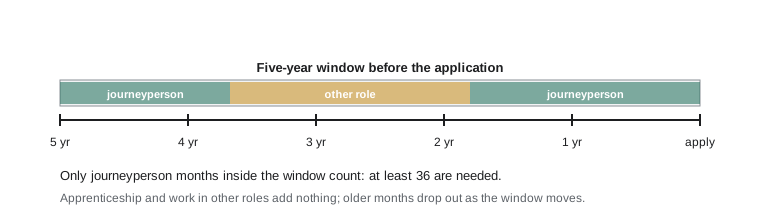
The requirement is easiest to check month by month. Mark the date you plan to apply. Count back five years. Inside that window, add up the months you worked as a journeyperson electrician. If the total is 36 months or more, you meet the experience requirement on that date. If not, find the date when it will be met.
There are two common surprises. The first is that the window moves. A candidate who qualifies in March may not qualify in October if an old block of journeyperson work drops out of the window and nothing replaces it. The second is that gaps count against you only by not adding months. Time off, layoffs, time in another trade or time in a non-electrical job do not disqualify you, but they do not add to the 36 months either.
Worked problem
Does Marcus qualify yet?
Marcus plans to apply on 1 June 2027. In the five years before that date he worked 10 months as a journeyperson at the start of the window, then 32 months as a planner, then returned to Parkland Valley as a journeyperson for the last 18 months. Assuming the planning work is not accepted, does he have 36 months of journeyperson experience in the window?
Show solution
- Journeyperson months in the window: 10 + 18 = 28.
- The planning months do not count toward the requirement.
- He is 8 months short on 1 June 2027.
- But by then the oldest journeyperson months also start to drop out of the window as it moves. The months that drop out are journeyperson months, so his total will not rise until those 10 old months are behind him and new ones replace them one for one.
- Each new month at Parkland Valley adds one month while each old journeyperson month dropping out removes one, so the total stays at 28 until the old block has passed. After that, it climbs by one a month.
Answer: He does not qualify in June 2027. He needs 8 more net months of journeyperson work after the old block has left the window.
That example is deliberately awkward, because real careers are. When the timing matters, write the months out. The calculator below does the same counting from a list of work periods, so you can try your own history.
from datetime import date

def months_between(a, b):
    return (b.year - a.year) * 12 + (b.month - a.month)

def jp_months_in_window(periods, apply_on, years=5):
    start = date(apply_on.year - years, apply_on.month, 1)
    total = 0
    for kind, begin, end in periods:
        if kind != 'journeyperson':
            continue
        a = max(begin, start)
        b = min(end, apply_on)
        if b > a:
            total += months_between(a, b)
    return total

marcus = [
    ('journeyperson', date(2022, 6, 1), date(2023, 4, 1)),
    ('planner', date(2023, 4, 1), date(2025, 12, 1)),
    ('journeyperson', date(2025, 12, 1), date(2027, 6, 1)),
]
for when in (date(2027, 6, 1), date(2028, 6, 1), date(2029, 6, 1)):
    m = jp_months_in_window(marcus, when)
print(when, m, 'months', 'eligible' if m >= 36 else 'not yet')2027-06-01 28 months not yet 2028-06-01 18 months not yet 2029-06-01 18 months not yet
Change the dates to match your own history. The code assumes Marcus keeps working as a journeyperson after the last date shown only if you extend that period, so try moving the end date of the last period forward and watch the total change.
Showing the evidence
Eligibility is not taken on trust. The application asks for proof of your trade certificate and proof of your work experience. In practice that usually means a copy of your journeyperson certificate and letters or forms from employers confirming the dates and nature of your work as a journeyperson. Self-employed electricians may need other evidence, such as permits they worked under, business records or statements from clients or other professionals.
Denise's advice is to collect the evidence before you need it. Employers close, merge and lose records. A former supervisor who could write a letter today may be hard to find in two years. Priya asks each of her previous employers for a short letter on letterhead stating her position, her dates of employment and that she worked as a journeyperson electrician. She keeps them in a folder with her trade certificate.
| Item | Purpose | Tip |
|---|---|---|
| Journeyperson trade certificate | Shows you are certified in the trade | Keep a clear scan; include the Red Seal endorsement if you have one |
| Employer letters or forms | Show dates and that the work was at journeyperson level | Ask for start and end dates, position and a contact name |
| Other proof for self-employment | Shows journeyperson work when there is no employer | Ask the Council what it will accept before you apply |
| A month-by-month summary | Lets you and the Council check the 36 months quickly | Not usually required, but it prevents counting mistakes |
Certificates from other provinces
The trade certificate requirement accepts a journeyperson certificate from Alberta or from another Canadian province or territory. An electrician who earned their certificate in Saskatchewan or Ontario and moved to Alberta does not need to redo their apprenticeship to qualify. Their journeyperson experience in another province can also count toward the three years, provided it is properly documented, because the requirement is about experience as a journeyperson electrician rather than experience in Alberta.
Tyler, who is thinking ahead, asks about the Red Seal. The Red Seal endorsement is an interprovincial standard for the trade itself. It makes it easier to work as a journeyperson across Canada. It is not a master electrician credential, and it does not replace the Alberta exam.
Master electricians from other jurisdictions
A different route exists for people who already hold a master electrician or equivalent contractor credential in another Canadian jurisdiction. The Council's published information says certified master electricians from other provinces may be eligible for an interprovincial exam instead of the full exam. That exam covers the material that is specific to Alberta, chiefly the Alberta legislation, rather than retesting the Code.
The details of that route, including which credentials qualify and what the interprovincial exam covers, are set by the Council and are best confirmed directly with it. The principle behind it is labour mobility: Canada's internal trade agreements generally require provinces to recognize equivalent certifications from other provinces, subject to reasonable local requirements such as knowledge of local law.
Worked problem
Choosing the right route
A new hire at Parkland Valley, Sophie Gagnon, holds an Ontario master electrician licence and moved to Red Deer last year. She has six years of journeyperson experience and three years as a master in Ontario. Which route should she explore first?
Show solution
- She meets the standard eligibility requirements: a journeyperson certificate from another province and well over three years of journeyperson work in the last five.
- She also holds an equivalent master credential from another province, so she may be eligible for the interprovincial exam.
- She should ask the Council whether her Ontario licence qualifies for the interprovincial route, because that exam is shorter and focused on Alberta law.
Answer: Explore the interprovincial route first, and keep the standard route as a fallback.
Timing your application
Eligibility is assessed when you apply, so plan backward from the date you want to write. Allow time for the Council to process the application, for you to book an exam date at least a week ahead, and for your own study. Most candidates find that 12 to 16 weeks of steady preparation is about right, which is why the study group's plan in the core courses ran for fourteen weeks.
Priya's plan is straightforward: she qualifies now, she has her evidence, and she will apply in week 2 of her Alberta study block so that approval arrives well before she books. Marcus's plan takes more care. He will ask the Council about his planning years, keep working as a journeyperson, and recalculate his window every few months.
Common eligibility questions
Denise keeps a list of the eligibility questions candidates ask her most often. The answers below are the general principles; for any particular case, the Council's decision on the evidence is what counts.
- Does part-time journeyperson work count? It can add to your experience, but the Council assesses experience on the evidence provided, so part-time work may count for less than full-time months. Document hours as well as dates if your work was part-time.
- Does supervisory work count? Working as a foreman or lead hand while holding a journeyperson certificate and doing or directing electrical work is generally journeyperson-level experience. Purely office-based roles are less clear, which is why Marcus is asking the Council about his planning years.
- Does work outside Canada count? The requirement starts with a Canadian journeyperson trade certificate. Experience gained abroad before that certificate is not journeyperson experience under it. Ask the Council about any unusual history.
- Can I apply early and wait for my window to fill? Eligibility is assessed on your application, so apply when you meet the requirements, not before.
Priya's history raises none of those questions, which is one reason she can focus on studying. Marcus's raises two, which is why his plan includes an early email to the Council. Both approaches are sensible. The mistake is the third approach Denise has seen too often: applying with a vague history, getting a request for more information, and losing a month assembling letters that could have been gathered beforehand.
Tyler asks one more question: when will he be eligible? He will finish his apprenticeship next year, at the end of his fourth period, and become a journeyperson. Three years of journeyperson work after that, all inside the window, makes him eligible about four years from now, assuming he works steadily. Gord tells him to start a folder now.
Common mistakes
MistakeCounting apprenticeship years toward the three years of experience.
InsteadOnly work as a journeyperson electrician counts, and only inside the five years before you apply.
MistakeAssuming that eligibility, once reached, can never be lost.
InsteadThe window moves; old journeyperson months drop out, so recheck the count if your application is delayed.
MistakeTreating a Red Seal endorsement as a master electrician credential.
InsteadThe Red Seal is an interprovincial trade standard; the Alberta master certificate requires its own exam.
MistakeWaiting until application day to find evidence of past work.
InsteadCollect employer letters and your certificate early, while records and contacts still exist.
Summary and key terms
- To write the exam you need a journeyperson electrician trade certificate from Alberta or another province.
- You also need three years of work as a journeyperson within the last five years.
- Apprenticeship time and work in other roles do not count toward the three years.
- The application must include proof of your certificate and your work experience.
- Master electricians certified in other provinces may be eligible for a shorter interprovincial exam.
- Experience window
- The five years immediately before the application, inside which at least three years of journeyperson work must fall.
- Journeyperson
- A certified tradesperson who has completed apprenticeship and holds a trade certificate.
- Red Seal
- An interprovincial standard of excellence for a trade; not a master electrician credential.
- Interprovincial exam
- A shorter exam for master electricians certified in another province, focused on Alberta requirements.
- Proof of experience
- Documents such as employer letters that confirm dates and journeyperson-level work.
Practice problems
Work each problem on paper first, then reveal the answer to check.
An electrician has 10 years in the trade, the last 2 as a journeyperson. Do they meet the experience requirement?
Show answer
No. They need 3 years as a journeyperson within the last 5; apprenticeship time does not count.
A journeyperson worked 40 months in the trade, but 15 of them were more than five years before the application. How many months count?
Show answer
25 months, which is short of the 36 required.
Does journeyperson experience earned in British Columbia count?
Show answer
Yes, journeyperson experience in another province can count if it is properly documented; confirm with the Council.
What route should an out-of-province master electrician ask about first?
Show answer
Whether they are eligible for the interprovincial exam instead of the full exam.
Lesson quiz · 5 questions
Score 60% or more to complete this lesson.
Create a free account to save your progress, take quizzes and earn a certificate.