
LSAT-150 · Lesson 9 of 12 · 19 min
Targeted drills for Reading Comprehension
▶ Video coming soon A video version of this lesson is on the way.
Reading Comprehension drills work differently from Logical Reasoning drills because the unit of practice is not a single question but a passage set: a passage of roughly 450 to 500 words, or a comparative pair, with five to eight questions. A candidate cannot drill one Reading Comprehension question type in isolation the way they can drill necessary assumption questions, because every question depends on reading the passage first. This lesson explains how to target Reading Comprehension practice anyway: by passage type, by question family, by reading habit and by timing.
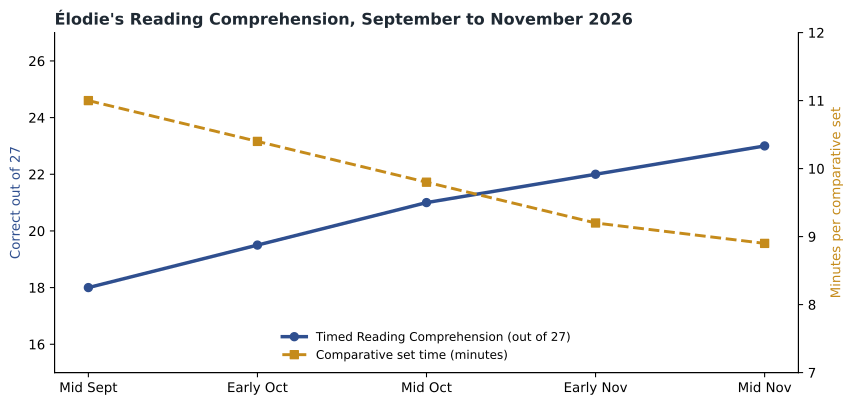
Élodie's story ran through this session, as it had through LSAT-120 and LSAT-121. In September she had answered 18 of 27 timed Reading Comprehension questions and run out of time, guessing on five. By mid-November she was answering about 23 of 27 on recent practice sections, without guessing, and her comparative-set average had fallen from about eleven minutes to just under nine. Harriet used her path to show how targeted Reading Comprehension work progresses.
Drilling by passage type
The first way to target Reading Comprehension is by passage type. LSAC describes passages drawn from the humanities, the social sciences, the natural sciences and law, and the section includes comparative passages as well as single ones. Most candidates find some types harder than others. Marcus found science passages easy and humanities passages hard; Dani found law passages comfortable from her paralegal work and science passages slow.
A passage-type drill gathers three or four passage sets of the weaker type from official tests not reserved for full practice, and works them one at a time. Harriet's structure for Marcus's humanities drills was the same three stages as a Logical Reasoning drill. First, one passage untimed, reading for structure and writing a short map: the main point, the purpose of each paragraph and the author's attitude. Second, two or three passages under time, at about eight minutes and forty-five seconds per set, the average available in a 35-minute section of four sets. Third, review of every question against the passage, with misses logged.
Marcus's humanities results improved steadily through October, culminating in his best humanities result on November 2, six of seven, and all six questions right on a standard-time passage in the LSAT-121 capstone. He said the untimed map was what made the difference: once he had practised reading a humanities passage for its argument rather than its details, the timed version became manageable.
Drilling by question family
The second way to target Reading Comprehension is by question family: main point and purpose, detail, inference, function and meaning in context, author's attitude, analogy and application, new information, and the relationship questions of comparative sets. LSAT-120 and LSAT-121 covered each family. A question-family drill still requires reading whole passages, but the candidate works only, or mainly, the questions of the target family and reviews them closely.
Dani's main Reading Comprehension weakness, as her error log showed, was attributing a view to the author that the author only reported. That weakness appears mostly in inference, attitude and main point questions, which ask what the author thinks. Her drill took four passages that contained more than one viewpoint, such as a critic's position and the author's response. For each, she wrote a single line before answering: "Author thinks: ... Others think: ..." Then she answered only the questions about the author's view. Over three drills, her accuracy on those questions rose from about two in three to about five in six.
Drilling reading habits
Some Reading Comprehension weaknesses are not about passage types or question families but about how a candidate reads. Common habits that cost points include reading too slowly on the first pass because of over-annotation, reading too fast and missing the structure, rereading paragraphs because concentration drifted, and over-reading answers that go beyond the text. Each of these can be drilled.
Dani's over-annotation was an early example. In September she copied out phrases from passages onto scratch paper, which used time and paper. Her drill was a set of passages with a strict rule: no more than three marks per paragraph, each a few words. Her first-pass time fell by about a minute per passage within two weeks, without a loss of accuracy. Élodie's habit was the opposite at first: she read quickly to save time and then had to return to the passage for almost every question. Her drill was to read for structure, slowing at the topic sentence and the final sentence of each paragraph, and to write a one-line map before starting the questions. That added about thirty seconds to her reading and saved two minutes in the questions.
Ji-won's habit was different again. Her accuracy on the last passage set of a section tended to be lower than on the first, which LSAT-120 had flagged. Her drill was to take three passage sets in a row, timed under her accommodated pace of about thirteen minutes per set, and to treat the third as carefully as the first. She tracked her accuracy on the third set separately. By mid-November it matched her first-set accuracy.
Drilling timing
For candidates whose main problem is time, like Élodie in September, the most important drill is timed passage sets with checkpoints. LSAT-140 described Harriet's pacing plan for Reading Comprehension: about nine minutes per set, with checkpoints at roughly 9, 18 and 27 minutes, and a final set handled with whatever time remains. Élodie's drill was two timed sets a week, each recorded with its time, plus one full timed Reading Comprehension section each week, until her average per set settled below nine minutes with no drop in accuracy.
Harriet's guiding phrase for Élodie, "flag sooner, never read faster", captured the key point about Reading Comprehension timing. Reading faster usually costs comprehension and creates more rereading. What saves time is a structural first reading and the discipline to choose, flag and move on when a question resists, returning only if time allows. Élodie's September section, with five guesses at the end, had come from reading carefully and then spending too long on a few hard questions. Her November sections, with no guesses, came from the same careful reading combined with earlier flags.
Comparative passage drills
Comparative passages, a pair of shorter passages followed by questions about both, call for their own drills. LSAT-121 described the comparison map: a short note of each passage's main point and a line on how the two relate. A comparative drill takes two or three pairs, works them under time, and reviews the relationship questions closely. Dani's voting-test card, "Both vote. Same vote. Nobody abstains.", came from such a drill, as a quick check on questions asking what both authors would agree with.
Because comparative sets usually appear once per section, candidates have fewer chances to practise them on full tests. Harriet suggested one comparative drill a week for anyone who found them hard, which by November meant Dani and, occasionally, Thomas.
Sources for Reading Comprehension drills
Reading Comprehension drills use up passages quickly: a single drill of three passages consumes most of a section. That makes the test library plan in Lesson 1 especially important. Harriet suggested drawing Reading Comprehension drills from older official tests, keeping the recent tests intact for full practice, and supplementing with passages written for courses, such as those in LSAT-120 and LSAT-121, for untimed method work. Unofficial passages are useful for practising a reading habit but less reliable for timing, since their length and density may not match official ones.
Reading outside the test also helps, more slowly. Candidates who regularly read dense, argumentative writing, such as long-form journalism, academic essays and court judgments, often find Reading Comprehension passages less daunting. Harriet recommended twenty minutes a day of such reading for anyone more than two months from test day, reading for the argument rather than the facts. Thomas, a history graduate, had done this naturally for years, which partly explained why Reading Comprehension was his strongest section.
Is it working?
As with Logical Reasoning drills, every Reading Comprehension drill should produce numbers: accuracy, time per set and, for timing drills, whether the checkpoints held. After two weeks, the numbers should show progress on the targeted passage type, question family or habit, and the progress should appear in full timed sections. If it does not, the drill needs changing.
Élodie's check in mid-November showed her timing gains holding in full sections and her remaining misses spread thinly across question families. That told her that further Reading Comprehension gains would be small and steady, and that maintenance, one full timed section a week, was enough. Her remaining drill time went to the trap answers that went slightly beyond the passage, her "surinterprétation".
Common mistakes
Building a comparison map in a drill
Harriet showed the group how a comparison map looks in practice, using a pair of short passages she had written about whether cities should replace parking minimums with market pricing. The map was four lines. Passage A: parking minimums raise housing costs and should be removed. Passage B: removing them without transit improvements shifts costs to residents. Relationship: B accepts A's diagnosis but disputes its remedy. Both: parking rules affect housing costs. Writing the map took about forty seconds. Every relationship question in the set could be answered by checking the map first and then confirming in the text.
Dani, whose comparative-set scores had lagged, made the map a fixed step in every comparative drill. After three weeks, her accuracy on relationship questions rose from about four in six to about five in six, and her time per set fell by about a minute.
Reading Comprehension under fatigue
Reading Comprehension is especially vulnerable to fatigue, because it depends on sustained concentration over several minutes per passage. The group's fatigue chart showed Reading Comprehension sections in the fourth position losing more accuracy than Logical Reasoning sections in the same position. Harriet suggested that candidates who saw this pattern occasionally place a timed passage set at the end of a long study session, as Lesson 8 recommended for Logical Reasoning, and practise a deliberate reset before starting it: a slow breath, a glance at the checkpoint, and a reminder to read for structure.
Thomas found this useful for his fourth-section drop. His Reading Comprehension accuracy in fourth position had been about four questions lower than in other positions. After two weeks of end-of-session passage sets, the gap narrowed to about two.
Drills and vocabulary
Occasionally a Reading Comprehension miss comes from an unfamiliar word or technical term. These are knowledge misses, in Lesson 6's terms, and they are usually rare. Harriet's advice was to note the word, learn it, and not worry about building long vocabulary lists. Passages almost always explain technical terms in context, and most questions can be answered from the structure of the argument even when one term is unclear. Élodie, reading in her second language, kept a short list of English words and phrases that had caused her trouble, mostly idioms and words used in unusual senses. By November the list had stopped growing.
Recording Reading Comprehension drills
Reading Comprehension drills should be recorded like any other practice: the passage source and type, the time taken for reading and for questions, the accuracy by question family, and any reading habit being practised. Élodie's record for each timed set had four numbers: reading time, question time, correct answers and guesses. Over the autumn, the record showed her reading time staying almost constant while her question time fell, which confirmed Harriet's advice that her gains would come from earlier flags rather than faster reading.
Dani's record added a fifth column for questions about whose view an answer expressed, so that she could watch that specific weakness. By late November, the column showed one miss in her last four drills, down from three or four per drill in October.
Harriet's final advice on Reading Comprehension drills was to keep at least one in every three drill sessions focused on full passages read exactly as on test day, without stopping to annotate the drill itself, so that the habits practised in isolation are rehearsed together.
Common mistakes
MistakeTrying to drill Reading Comprehension one question at a time.
InsteadDrill whole passage sets, targeted by passage type, question family, habit or timing.
MistakeReading faster to save time.
InsteadRead for structure and flag sooner; never read faster.
MistakeOver-annotating passages.
InsteadLimit marks to a few words per paragraph and write a one-line map.
MistakeUsing recent official passages for drills.
InsteadDraw drills from older tests and keep recent tests for full practice.
MistakeTreating the last passage set as less important.
InsteadTrack last-set accuracy separately and give it the same care as the first.
Summary and key terms
- Reading Comprehension drills use whole passage sets, targeted by passage type, question family, reading habit or timing.
- Each drill moves from an untimed passage with a written map to timed sets at about 8 minutes 45 seconds, then review.
- Question-family drills focus on one family, such as questions about the author's view.
- Timing drills use checkpoints at about 9, 18 and 27 minutes; flag sooner rather than read faster.
- Draw drills from older tests, add comparative drills where needed, and check the numbers after two weeks.
- Passage set
- A passage or comparative pair with its five to eight questions.
- Passage-type drill
- A drill of several passages of one type, such as humanities or science.
- Question-family drill
- A drill focused on one family of Reading Comprehension questions.
- Comparison map
- A short note of each comparative passage's main point and how the two relate.
- Per-set budget
- The time available for each passage set, about 8 minutes 45 seconds in a four-set section.
Practice problems
Work each problem on paper first, then reveal the answer to check.
Why can Reading Comprehension not be drilled one question type at a time like Logical Reasoning?
Show answer
Every question depends on reading the passage, so the unit of practice is the passage set.
What is the average time per set in a 35-minute section of four passage sets?
Show answer
About 8 minutes 45 seconds.
What line did Dani write before answering questions in her drill?
Show answer
"Author thinks: ... Others think: ..."
What does "flag sooner, never read faster" mean?
Show answer
Save time by reading for structure and flagging resistant questions earlier, not by reading faster.
Where should Reading Comprehension drill passages come from?
Show answer
Mainly older official tests, keeping recent tests for full practice.
Lesson quiz · 5 questions
Score 60% or more to complete this lesson.
Create a free account to save your progress, take quizzes and earn a certificate.