
LSAT-150 · Lesson 1 of 12 · 19 min
Official practice materials
▶ Video coming soon A video version of this lesson is on the way.
By the time the Thursday Circle reached November, every member had taken at least one full official practice test, and most had taken several. Harriet Nakamura-Fox had spent the autumn teaching the parts of the test one at a time: arguments, flaws, inferences, reading, writing and timing. This final course puts the parts back together. It is about full practice tests: where they come from, how to take them so that the score means something, how to review every question afterwards, and how to turn what the review shows into a plan for the last weeks before test day.
Harriet opened her practice-test review clinic, a series of undated evening calls she ran alongside the regular sessions, with a question: "What is a practice test for?" Dani Ruiz said it was for finding out her score. Marcus Feld said it was for building stamina. Thomas Okafor-Reid said it was for finding out what he still got wrong. Harriet said all three were right, and that the order mattered. A practice test measures, it trains and it diagnoses, but the diagnosis is where most of the value lies, and most candidates spend the least time on it.
Why official questions matter
The Law School Admission Council (LSAC), which writes and administers the LSAT, publishes its own practice material through LawHub, its online platform. The questions in those practice tests are real questions from past administrations of the test, presented in the same digital interface candidates use on test day. That combination is what makes them valuable. Each question went through the same writing, editing and pretesting process as the questions on the test you will take, so its difficulty, length and wording match the real thing.
Questions written by commercial prep companies, by tutors or for courses like this one can teach a method very well. Harriet writes her own questions for drills, and every question in this course is original. But no unofficial question can reproduce the exact feel of an official one, and the difference matters most for timing and scoring. A set of unofficial questions that is slightly easier than the real test produces a false sense of pace; a set that is harder produces needless discouragement. For a score you can trust, and for pacing that will carry over to test day, full timed practice should use official tests.
What LawHub offers for free
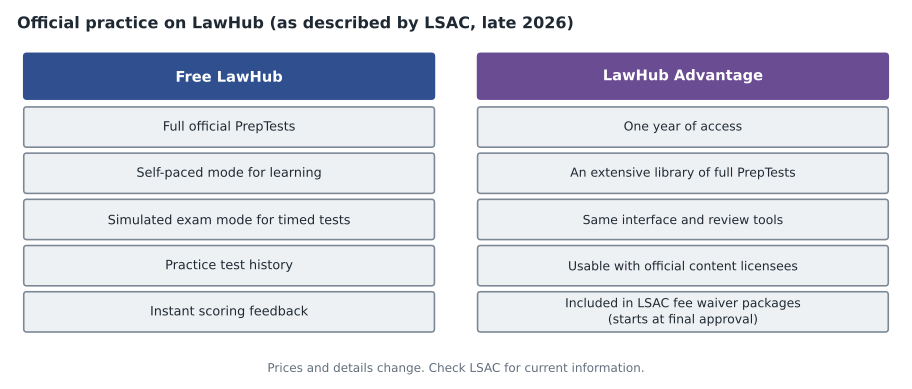
Anyone with a free LSAC account can use the free tier of LawHub. LSAC describes it as including full official LSAT PrepTests, unlimited practice in the authentic test interface, a self-paced mode and a simulated exam mode, a history of the practice tests you have taken and instant scoring feedback. The free tests are a small part of the full library, but they are enough for a diagnostic at the start of preparation and for a few timed tests along the way.
The two modes do different jobs. Self-paced mode lets you work without the clock, pause and review as you go. It suits learning, when the goal is to understand how a question type works. Simulated exam mode runs the sections under real time limits, without pausing, and produces a score. It suits measurement. Harriet's rule was simple: use self-paced mode for drilling, and simulated mode, under the conditions described in Lesson 2, for every full test whose score you intend to record.
LawHub Advantage
LawHub Advantage is LSAC's paid subscription. LSAC describes it as one year of access to an extensive library of full LSAT PrepTests, in the same interface, with the same scoring and review tools. The price is set by LSAC and can change; check the current price on LSAC's site rather than relying on a figure from a forum or an older guide. The subscription can also be used with LSAC's Official LSAT Content Licensees, the commercial prep companies licensed to use official questions in their own courses.
Candidates who receive an LSAC fee waiver get LawHub Advantage as part of the package. According to LSAC, both Tier 1 and Tier 2 fee waiver packages include a one-year LawHub Advantage subscription, which begins as soon as the fee waiver receives final approval. Dani's Tier 1 waiver was approved in October 2026, so her subscription began then and runs well past her January test. She had not realized this until Harriet pointed it out, and she said it changed her whole plan: instead of rationing a few free tests, she could take a full test every week through December.
Older tests and the current format
The LSAT has changed over the years, and the official library includes tests from different periods. The most important change for practice is that the analytical reasoning section, known as logic games, was retired after June 2024. Older official tests that contain a logic games section are still useful, but only their Logical Reasoning and Reading Comprehension sections match the current test. When an older test is used for a full timed practice test, the logic games section has to be replaced, usually with an extra Logical Reasoning section from another test, so that the practice test has the same mix of sections as the real one.
Older and newer questions are not identical in style either. Reading Comprehension passages and Logical Reasoning stimuli from more recent tests tend to reflect the test as it is written now, and Harriet suggested weighting practice toward recent material, especially in the final weeks. Older questions remain excellent for drilling a question type, where volume matters more than recency.
Candidates testing from August 2027 should also keep the announced format change in mind. As LSAT-101 explained, LSAC has announced a three-section format for August 2027, with Reading Comprehension first. LSAC has said practice material for the new format will be released in advance. Anyone testing under the new format should take at least several full practice tests in it before test day, because the section lengths and the order differ. Everything in this course about review, error logs and planning applies to either format.
Planning your library
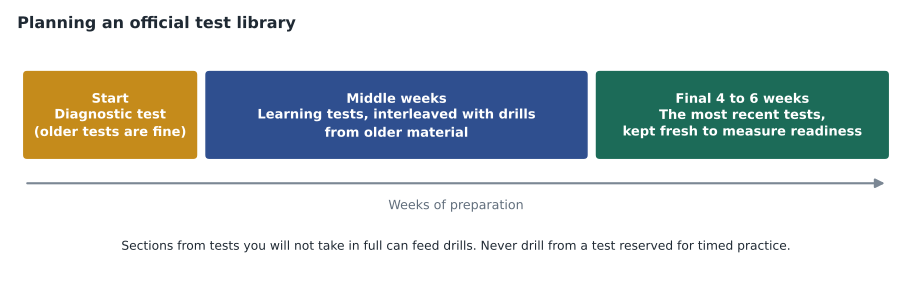
A finite number of recent official tests is the most valuable resource a candidate has, and it is easy to use them up too early. Harriet asked each member to sketch a plan for their library before taking any more full tests. The plan has three parts.
- A diagnostic: one full test early in preparation, to establish a baseline. Older tests are fine for this.
- Learning tests: full tests taken during the middle weeks, interleaved with drilling. These can be from the middle of the library.
- Final-weeks tests: the most recent tests, saved for the last four to six weeks, when the goal is to measure readiness as accurately as possible.
Individual sections from tests you will not take in full can feed drills. Harriet kept a simple spreadsheet for each member listing which tests were reserved for which purpose, so that no one accidentally drilled from a test they had planned to take timed later. A question you have already seen tells you much less on a timed test, because recognizing it is not the same as solving it.
How the group used its materials
Each member's situation was different. Élodie Brassard had bought LawHub Advantage in September and had more tests than she needed; her plan reserved the six most recent for December and early January. Ji-won Park also had Advantage and, because she tested with 50 percent extra time, planned fewer but longer full tests, each taken under her accommodated timing. Thomas, testing in April, had the most time and the most risk of running through recent tests too early. His plan used older tests through February and kept the most recent for March.
Marcus, who had already tested in November, was in a different position. His score would be released on December 2. If he cancelled it under his rule, keeping the score only if it was above 158, he would be starting another cycle and would need fresh tests. Harriet suggested he leave his remaining recent tests untouched until he knew. Dani's fee waiver gave her the full library, and her plan was a full test every Saturday morning in December, with drills from older material in between.
Materials beyond LawHub
Some candidates use books of official tests published in earlier years, or commercial courses that license official questions. Those can be useful, but two cautions apply. First, check whether a given test is also in your LawHub library, so you do not take the same test twice by accident. Second, printed tests do not reproduce the digital interface, including the timer, the flagging tools and the way passages and questions appear side by side. Full timed practice should happen in the digital interface whenever possible, because that is how the real test is delivered.
Harriet's view of commercial explanations was practical. Written or video explanations of official questions can help, especially for a question you cannot work out in blind review. But they should come after your own review, not instead of it. A candidate who reads an explanation first learns the answer to one question; a candidate who struggles with it first and then reads the explanation learns how to find answers.
Common mistakes
How many full tests are enough?
Members of the group asked Harriet how many full practice tests they should take. She refused to give a single number, because the right number depends on how much time a candidate has, how far they are from their target and how thoroughly they review. But she gave a range and a principle. Most of her students took somewhere between eight and fifteen full timed tests across a preparation period of three to five months, with more in the final weeks than at the start. The principle was that every full test should be followed by a full review before the next one. A candidate who takes three tests a week without reviewing them learns less than one who takes one test a week and reviews it completely.
Taking full tests too often has a cost beyond lost review time. It uses up the recent library, and it can turn preparation into a cycle of measuring rather than improving. A candidate who takes a test, sees a disappointing score, takes another the next day hoping for a better number and then another after that is not studying; they are rolling dice. Harriet called this "score chasing" and treated it as one of the most common ways strong candidates stall.
Taking full tests too rarely has a cost too. Stamina, pacing over four sections and the habit of recovering after a hard section all need full-length practice. A candidate who drills question types for three months and takes one full test a week before the real one will find the length of the day a shock. The middle path is a schedule that starts with a full test every two or three weeks and moves to one a week, occasionally two, in the final month, as Lesson 11 describes.
Keeping a test record
Harriet asked each member to keep a simple record of every full test: the date, which official test it was, the time of day it was taken, the conditions, the section-by-section raw scores, the scaled score, the number of questions flagged and the blind review score. The record took two minutes to fill in after each test and became the backbone of the later lessons. Without it, a candidate remembers the best and worst scores and forgets the pattern in between.
The record also protects the library. When Élodie later wondered whether she had already seen a particular Reading Comprehension passage, her record showed that it came from a test she had taken in October, so she skipped it in a drill and chose another. Thomas found that his record showed he had taken three of his first five tests in the evening, after work, while his April appointment would almost certainly be in the morning. That observation shaped how he planned the conditions for his next tests.
Practice material for accommodations
Candidates with approved testing accommodations should practise under the same conditions they will have on test day. Ji-won took her full tests with 50 percent extra time on every section, as her accommodation provided, and she did not take the 10-minute intermission longer than allowed. Harriet pointed out that practising under standard timing would give Ji-won misleading information about her pace, while practising under her own timing gave accurate information. Candidates whose accommodations involve other changes, such as breaks between sections or screen settings, should check which of those LawHub can reproduce and simulate the rest as closely as possible.
Common mistakes
MistakeTaking full timed tests with unofficial questions and trusting the score.
InsteadUse official LawHub tests for scored practice; use other questions for learning methods.
MistakeUsing the most recent official tests early in preparation.
InsteadPlan your library and save the most recent tests for the final four to six weeks.
MistakeTaking an older test with its logic games section as a full practice test.
InsteadReplace the retired section with an extra Logical Reasoning section from another test.
MistakeAssuming LawHub Advantage is out of reach on a fee waiver.
InsteadFee waiver packages include a one-year subscription starting at final approval.
MistakeReading explanations before reviewing a question yourself.
InsteadDo your own blind review first, then use explanations for what remains unclear.
Summary and key terms
- A practice test measures, trains and diagnoses; the diagnosis is where most of the value lies.
- Official LawHub tests reproduce the real test's difficulty, wording and interface; use them for scored practice.
- Free LawHub includes full official PrepTests and two modes; LawHub Advantage adds one year of access to an extensive library.
- LSAC fee waiver packages include a one-year LawHub Advantage subscription from final approval.
- Replace retired logic games sections when using older tests, and save the most recent tests for the final weeks.
- LawHub
- LSAC's online platform for official LSAT practice in the real test interface.
- LawHub Advantage
- LSAC's paid one-year subscription to an extensive library of full official practice tests.
- Simulated exam mode
- A LawHub mode that runs sections under real time limits without pausing.
- Self-paced mode
- A LawHub mode for untimed practice with pausing and review.
- Test library plan
- A plan assigning official tests to diagnostic, learning and final-weeks use.
Practice problems
Work each problem on paper first, then reveal the answer to check.
Why should full timed practice use official tests?
Show answer
Their questions match the real test's difficulty, length, wording and interface, so the score and pacing carry over.
Which LawHub mode suits measurement, and which suits learning?
Show answer
Simulated exam mode for measurement; self-paced mode for learning.
When does a fee waiver recipient's LawHub Advantage subscription begin?
Show answer
When the fee waiver receives final approval, for one year.
What must be done with an older test that includes logic games?
Show answer
Replace that section with an extra Logical Reasoning section from another test.
What are the three parts of Harriet's library plan?
Show answer
A diagnostic, learning tests in the middle weeks, and the most recent tests saved for the final weeks.
Lesson quiz · 5 questions
Score 60% or more to complete this lesson.
Create a free account to save your progress, take quizzes and earn a certificate.