
LSAT-150 · Lesson 12 of 12 · 75 min
Capstone: a timed practice set and review worksheet
▶ Video coming soon A video version of this lesson is on the way.
The course ends where every full practice test should end: with a timed set and a complete review. Harriet wrote this capstone set for the group as the first assignment of their December practice weeks, to be taken after the course ended. At the time of writing, on November 22, 2026, no one had taken it yet. It combines fifteen Logical Reasoning questions and one Reading Comprehension passage with six questions, all written for this course, into a single 30-minute set. It is shorter than a full section pair, but complete: it uses every technique from this course and LSAT-140, and it comes with a review worksheet that puts Lessons 3 to 7 into practice.
Every question here is original. None comes from LSAC, and the set is designed to practise technique and review, not to predict a score. For scored practice, use official tests as Lesson 1 explained.
Instructions
Set a timer for 30 minutes, or 45 minutes with 50 percent extra time. Work the fifteen Logical Reasoning questions first, then the passage, as Harriet planned for the group; or begin with the passage if that is your habit, but decide before you start. Suggested checkpoints: question 6 by about minute 8, question 12 by about minute 17, the passage begun by about minute 21, with a sweep at about minute 29. With extra time, multiply each by one and a half: about minutes 12, 25, 31 and 43. Keep a flag log. Answer every question. Do not read the explanations until you have finished the set and completed blind review of your flagged questions, as Lesson 5 describes.
Part 1: Logical Reasoning
Worked problem
Drill question 1
Town historian: The covered bridge on Mill Road has stood for more than 150 years and is one of only a few such bridges left in the region. Replacing it with a modern span would be cheaper over the next fifty years than repairing it. But the bridge draws visitors who spend money in local shops, and once demolished it could never be rebuilt as it was. The town should repair the bridge. Which one of the following most accurately expresses the main conclusion of the historian's argument? (A) The covered bridge has stood for more than 150 years. (B) Replacing the bridge would be cheaper over the next fifty years. (C) The town should repair the covered bridge on Mill Road. (D) The bridge draws visitors who spend money in local shops. (E) A demolished bridge could never be rebuilt as it was.
Show solution
- (C) is correct. The final sentence states the recommendation that the rest of the argument supports.
- (A) is background supporting the bridge's value.
- (B) is a concession: a consideration against the conclusion that the historian acknowledges.
- (D) is a premise supporting repair.
- (E) is another premise supporting repair.
Answer: (C).
Worked problem
Drill question 2
Columnist: Since the city began publishing restaurant inspection grades online, complaints about food poisoning reported to the health department have fallen by a quarter. Clearly, publishing the grades has made restaurants cleaner. The columnist's reasoning is most vulnerable to criticism on the grounds that it fails to consider the possibility that (A) diners now avoid low-graded restaurants, so fewer people are exposed to unsanitary kitchens even if those kitchens have not changed. (B) some restaurants with high grades have had complaints. (C) the health department publishes other information online. (D) restaurant owners dislike having their grades published. (E) food poisoning can be caused by food prepared at home.
Show solution
- (A) is correct. It offers another explanation for fewer complaints: diners shifted away from dirty restaurants, rather than restaurants becoming cleaner.
- (B) is consistent with the conclusion; a few complaints at high-graded restaurants do not undermine an overall improvement.
- (C) is irrelevant to the cause of the decline.
- (D) concerns owners' attitudes, not cleanliness or complaints.
- (E) is true but does not explain a change since publication began, unless home cooking changed, which the choice does not say.
Answer: (A).
Worked problem
Drill question 3
Every apprentice electrician in the province must complete at least 900 hours of supervised work each year. Some apprentices who complete more than 1,200 hours also take evening courses. No apprentice who takes evening courses is exempt from the annual safety exam. If the statements above are true, which one of the following must also be true? (A) Every apprentice who takes evening courses completes more than 1,200 hours. (B) Some apprentices are exempt from the annual safety exam. (C) No apprentice completes fewer than 1,200 hours. (D) Every apprentice who completes 900 hours takes evening courses. (E) Some apprentices who complete more than 1,200 hours of supervised work are not exempt from the annual safety exam.
Show solution
- (E) is correct. Some apprentices with more than 1,200 hours take evening courses, and no one who takes evening courses is exempt, so those apprentices are not exempt.
- (A) reverses the "some" relationship into an "all" claim the stimulus does not support.
- (B) is not guaranteed; the stimulus never says anyone is exempt.
- (C) contradicts nothing but is not required; the minimum is 900 hours.
- (D) is unsupported; meeting the minimum says nothing about evening courses.
Answer: (E).
Worked problem
Drill question 4
Nutritionist: People who eat breakfast every day tend to weigh less than people who skip breakfast. So anyone who wants to lose weight should start eating breakfast every day. Which one of the following, if true, most seriously weakens the nutritionist's argument? (A) Some people who eat breakfast every day also exercise regularly. (B) In controlled studies, people assigned to start eating breakfast did not lose more weight than those assigned to skip it. (C) Breakfast foods vary widely in calories. (D) Many people skip breakfast because they are short of time in the morning. (E) People who eat breakfast every day report feeling more alert in the morning.
Show solution
- (B) is correct. If starting breakfast does not cause weight loss when tested directly, the association does not support the recommendation.
- (A) hints at a possible confounder but only for some people; it weakens less directly than a controlled result.
- (C) does not show that breakfast fails to help.
- (D) explains why people skip breakfast, not whether eating it helps weight loss.
- (E) is irrelevant to weight.
Answer: (B).
Worked problem
Drill question 5
Ecologist: The wetland restoration project succeeded in raising the number of nesting herons from twelve pairs to forty. Although the project also increased mosquito populations nearby, it should be repeated at the second site along the river. The ecologist's argument depends on which one of the following assumptions? (A) Herons are the most important species in the wetland. (B) Mosquito populations will not increase at the second site. (C) The second site has more herons than the first. (D) The benefits observed at the first site are likely to occur at the second site as well. (E) No other project could raise heron numbers more cheaply.
Show solution
- (D) is correct. The argument moves from success at one site to a recommendation for another; if the second site would not produce similar benefits, the recommendation fails. Negating (D) breaks the argument.
- (A) is too strong; herons need not be the most important species.
- (B) is not required; the ecologist already accepts the mosquito increase as a cost at the first site.
- (C) is irrelevant and not implied.
- (E) is not required; the argument does not claim the project is the cheapest option.
Answer: (D).
Worked problem
Drill question 6
Principle: An employer should offer flexible working hours to an employee if doing so allows the employee to meet family obligations without reducing the quality of the employee's work. Which one of the following judgments most closely conforms to the principle? (A) A firm should let an accountant start work an hour later so he can take his children to school, since his work has stayed equally good during a trial of the later start. (B) A firm should not let a receptionist change her hours, because clients prefer to see the same person each morning. (C) A firm should let a designer work from home, because she lives far from the office. (D) A firm should give all employees flexible hours, since flexibility is popular. (E) A firm should let an engineer leave early on Fridays, because he has worked there for many years.
Show solution
- (A) is correct. It satisfies both conditions of the principle: a family obligation and no loss of work quality.
- (B) gives a reason against flexibility, but the principle says when flexibility should be offered; it does not say when it should be refused.
- (C) concerns distance, not family obligations, and does not address work quality.
- (D) relies on popularity, which the principle does not mention.
- (E) relies on seniority, which the principle does not mention.
Answer: (A).
Worked problem
Drill question 7
All of the novels on this year's prize shortlist were written by authors under forty. Every novel written by an author under forty that was published by a small press received a grant from the arts council. Therefore, every novel on the shortlist received a grant from the arts council. Which one of the following, if assumed, allows the conclusion to be properly drawn? (A) Most novels that received grants were shortlisted. (B) Some shortlisted novels were published by large presses. (C) Every novel on the shortlist was published by a small press. (D) Authors under forty are more likely to receive grants. (E) The arts council funds only novels by authors under forty.
Show solution
- (C) is correct. With it, every shortlisted novel is by an author under forty and published by a small press, so each received a grant.
- (A) reverses the direction needed and speaks only of "most".
- (B) would undermine the conclusion, not support it.
- (D) is a probability claim that cannot guarantee the conclusion.
- (E) tells us whom the council funds but does not show that every shortlisted novel was funded.
Answer: (C).
Worked problem
Drill question 8
Many households in the town installed rooftop solar panels last year, yet the total amount of electricity the town drew from the regional grid rose. Which one of the following, if true, most helps to resolve the apparent discrepancy? (A) Solar panels produce less electricity in winter than in summer. (B) Some households considered installing panels but decided not to. (C) The cost of solar panels fell last year. (D) The regional grid uses some solar power from other towns. (E) A large data centre that opened in the town last year uses far more electricity than the new panels produce.
Show solution
- (E) is correct. A new, very large user would raise total grid demand even as panels reduced some households' use.
- (A) applies every year and does not explain an increase.
- (B) explains nothing about why demand rose.
- (C) might explain why households installed panels but not why grid use rose.
- (D) concerns the grid's sources, not the town's demand.
Answer: (E).
Worked problem
Drill question 9
Some members of the debating society are law students. All law students in the society have taken the advocacy workshop. Therefore, some people who have taken the advocacy workshop are members of the debating society. Which one of the following arguments is most similar in its reasoning to the argument above? (A) All the violinists in the orchestra practise daily. Some people who practise daily are students. So some violinists are students. (B) Some cyclists in the club race. All racers wear helmets. So all cyclists in the club wear helmets. (C) No one on the committee is a teacher. Some teachers coach sports. So no coaches are on the committee. (D) Some residents of the building are nurses. All nurses in the building work night shifts. So some people who work night shifts are residents of the building. (E) All gardeners in the club grow tomatoes. Some members grow tomatoes. So some members are gardeners.
Show solution
- (D) is correct. It has the same valid structure: some A are B; all B (among A) are C; so some C are A.
- (A) is invalid: the students who practise daily need not be violinists.
- (B) draws an "all" conclusion from a "some" premise, unlike the original.
- (C) uses negative statements and draws an invalid conclusion.
- (E) is invalid: members who grow tomatoes need not be gardeners in the club.
Answer: (D).
Worked problem
Drill question 10
Hiroshi: The new parking fees downtown will drive shoppers to the mall on the highway, hurting downtown businesses. Adaeze: In other cities, parking fees freed up spaces near shops, so shoppers who had given up on finding a spot came back. Adaeze responds to Hiroshi by (A) questioning whether downtown businesses will be affected at all. (B) offering evidence that the fees could have an effect opposite to the one Hiroshi predicts. (C) arguing that the mall should also charge for parking. (D) pointing out that Hiroshi has no experience running a business. (E) agreeing with Hiroshi's prediction but disputing its importance.
Show solution
- (B) is correct. Adaeze cites other cities where fees brought shoppers back, the opposite of Hiroshi's prediction.
- (A) is wrong; she implies businesses will be affected, positively.
- (C) is wrong; she does not mention the mall's parking.
- (D) is wrong; she does not attack Hiroshi personally.
- (E) is wrong; she disagrees with the prediction itself.
Answer: (B).
Worked problem
Drill question 11
Researcher: Students who take handwritten notes in lectures perform better on later tests than students who type their notes. So typing notes impairs learning. Which one of the following would it be most useful to know in evaluating the researcher's argument? (A) Whether lectures in the study covered science or humanities. (B) How many lectures the students attended. (C) Whether handwritten notes are easier to carry. (D) Whether students who type notes own more electronic devices. (E) Whether students chose their own note-taking method or were assigned one.
Show solution
- (E) is correct. If students chose, those who handwrite might differ in other ways, such as study habits, that explain the results; if assigned, the comparison is much stronger. Either answer bears directly on the causal claim.
- (A) might matter for generalizing, but it does not test the causal inference itself.
- (B) is relevant only if attendance differed between groups, which the choice does not suggest.
- (C) is irrelevant to learning.
- (D) does not bear on whether typing causes poorer results.
Answer: (E).
Worked problem
Drill question 12
Mira: The library should extend its weekend hours, because many residents work during the week and can only visit on weekends. Tomas: Extending weekend hours would mean cutting weekday evening hours, which are when most students use the library. The dialogue provides the most support for the claim that Mira and Tomas disagree about whether (A) the library should extend its weekend hours. (B) many residents work during the week. (C) students use the library on weekday evenings. (D) the library has enough staff. (E) residents who work during the week visit the library at all.
Show solution
- (A) is correct. Mira argues for extending weekend hours; Tomas points to a cost that implies he opposes it.
- (B) is asserted by Mira and not disputed by Tomas.
- (C) is asserted by Tomas and not disputed by Mira.
- (D) is not discussed by either.
- (E) is not discussed by Tomas, and Mira says they visit on weekends.
Answer: (A).
Worked problem
Drill question 13
Editor: The magazine's readers who subscribe to the print edition renew at much higher rates than those who subscribe only online. Several of our longest-running features appear only in print. Which one of the following is most strongly supported by the editor's statements? (A) Online readers dislike the magazine's long-running features. (B) Print subscribers read every feature in each issue. (C) The magazine will stop publishing its online edition. (D) Online-only subscribers do not have access to all of the magazine's longest-running features. (E) Renewal rates are the best measure of reader satisfaction.
Show solution
- (D) is correct. If several long-running features appear only in print, online-only subscribers lack access to them.
- (A) goes beyond the statements; nothing is said about online readers' preferences.
- (B) is unsupported.
- (C) is a prediction the statements do not support.
- (E) is a general claim the editor does not make.
Answer: (D).
Worked problem
Drill question 14
Planner: The proposed bus lane on Harbour Street will slow car traffic. Car traffic, however, is not the only traffic that matters. More people travel on Harbour Street by bus than by car at rush hour, and the bus lane will speed their trips considerably. The claim that the bus lane will slow car traffic plays which one of the following roles in the planner's argument? (A) It is the main conclusion of the argument. (B) It is evidence offered to support the main conclusion. (C) It is a consideration the planner acknowledges before arguing that other factors outweigh it. (D) It is a claim the planner argues is false. (E) It is an example used to illustrate a general principle.
Show solution
- (C) is correct. The planner concedes the slowdown, then argues that faster trips for more bus riders matter more.
- (A) is wrong; the implied conclusion favours the bus lane.
- (B) is wrong; the slowdown counts against the conclusion, not for it.
- (D) is wrong; the planner accepts the claim.
- (E) is wrong; no general principle is illustrated.
Answer: (C).
Worked problem
Drill question 15
Scientist: Our new coating prevented corrosion on every steel sample we tested in fresh water for two years. Therefore, it will prevent corrosion on the steel supports of the new pier, which stand in seawater. The scientist's reasoning is flawed because it (A) relies on too small a number of samples. (B) assumes without justification that results in fresh water will hold in the different conditions of seawater. (C) confuses a necessary condition with a sufficient one. (D) attacks the credibility of other scientists. (E) draws a conclusion that merely restates its premise.
Show solution
- (B) is correct. Seawater is a different environment, and the argument assumes the fresh water results transfer to it.
- (A) is not shown; the stimulus does not say how many samples were tested.
- (C) does not describe the error; no conditional relationship is reversed.
- (D) is wrong; no one's credibility is discussed.
- (E) is wrong; the conclusion goes beyond the premise.
Answer: (B).
Part 2: Reading Comprehension
Read the passage and answer the six questions that follow it.
Legislatures sometimes attach a "sunset clause" to a new law: a provision stating that the law will expire on a fixed date unless the legislature votes to renew it. Supporters argue that such clauses discipline lawmaking. A statute passed in haste, perhaps during a crisis, will lapse unless its continued value can be shown. The clause forces a later legislature to examine the law's record, rather than leaving it in force by default simply because repealing it would take effort that no one is willing to spend.
Critics reply that this picture of careful review is idealized. Renewal votes, they observe, often take place under the same pressures that produced the original law, and they rarely involve the systematic evaluation supporters describe. A legislature facing an expiry date may simply renew a law in a single vote, with little debate, because letting it lapse would be politically awkward. Worse, the clause may give lawmakers false comfort: a measure they would hesitate to pass permanently becomes easier to pass when it is labelled temporary, even though temporary measures are frequently renewed again and again.
Both views capture something real, but the debate is often framed as if the value of a sunset clause depended only on the clause itself. A more promising approach looks at what accompanies it. A clause that requires an independent review body to report on the law's effects before the expiry date, and that requires the legislature to consider that report, changes the conditions of the renewal vote. It replaces the question "Is repeal worth the trouble?" with the question "What has the law actually done?" Without such provisions, a sunset clause may do little more than move the moment of decision to a later date, where it can be met with the same inattention.
None of this means that sunset clauses guarantee better laws. It suggests, rather, that a deadline alone is a weak instrument, and that its usefulness depends on whether the legislature has arranged, in advance, for evidence to be in front of it when the deadline arrives.
Worked problem
Drill question 16
Which one of the following most accurately expresses the main point of the passage? (A) Sunset clauses should be attached to every law passed during a crisis. (B) Critics are right that sunset clauses give lawmakers false comfort. (C) Legislatures rarely renew laws that contain sunset clauses. (D) The value of a sunset clause depends largely on whether it is paired with provisions that put evidence before the legislature at renewal. (E) Independent review bodies are more reliable than legislatures.
Show solution
- (D) is correct. The third and fourth paragraphs argue that a deadline alone is weak and that accompanying review provisions determine a clause's usefulness.
- (A) is not argued; the passage does not recommend clauses for every crisis law.
- (B) captures only the critics' view, which the author treats as partly right.
- (C) contradicts the critics' observation that temporary measures are frequently renewed.
- (E) is a broader claim the passage does not make.
Answer: (D).
Worked problem
Drill question 17
The author's attitude toward the supporters' view of sunset clauses is best described as (A) complete agreement. (B) partial acceptance combined with doubt about whether the clause alone achieves what they claim. (C) dismissal as naive and unsupported. (D) indifference. (E) enthusiasm tempered only by concerns about cost.
Show solution
- (B) is correct. The author says both views "capture something real" but argues that a deadline alone is a weak instrument.
- (A) is too strong; the author qualifies the supporters' view.
- (C) is too strong; the author grants the view some merit.
- (D) is wrong; the author engages closely with the debate.
- (E) is wrong; cost is not the author's concern.
Answer: (B).
Worked problem
Drill question 18
According to the passage, critics of sunset clauses claim which one of the following? (A) Sunset clauses are unconstitutional. (B) Independent review bodies are too expensive. (C) Laws with sunset clauses are always repealed. (D) Sunset clauses prevent legislatures from passing laws during a crisis. (E) Labelling a measure as temporary can make it easier to pass.
Show solution
- (E) is correct. The second paragraph says a measure lawmakers would hesitate to pass permanently becomes easier to pass when labelled temporary.
- (A) is not mentioned.
- (B) is not mentioned; review bodies appear only in the author's own proposal.
- (C) contradicts the critics' point that temporary measures are often renewed.
- (D) is not claimed.
Answer: (E).
Worked problem
Drill question 19
The author mentions the question "What has the law actually done?" primarily in order to (A) illustrate how a review requirement changes the focus of a renewal vote. (B) summarize the critics' main objection. (C) suggest that most laws have no measurable effect. (D) argue that legislatures should never renew laws. (E) describe the supporters' original argument.
Show solution
- (A) is correct. The question contrasts with "Is repeal worth the trouble?" to show how a review provision shifts what legislators consider.
- (B) is wrong; the question belongs to the author's proposal, not the critics.
- (C) is not suggested.
- (D) is far too strong.
- (E) is wrong; it is the author's point, introduced after both views are described.
Answer: (A).
Worked problem
Drill question 20
Which one of the following, if true, would most strengthen the author's position? (A) Most legislatures meet only part of the year. (B) Some laws without sunset clauses are repealed after a few years. (C) Laws whose sunset clauses required an independent report before renewal were amended or allowed to lapse more often than laws with bare expiry dates. (D) Crisis legislation is usually passed quickly. (E) Lawmakers generally prefer permanent laws.
Show solution
- (C) is correct. It shows that review requirements change renewal outcomes, which supports the claim that accompanying provisions determine a clause's value.
- (A) is irrelevant to the comparison.
- (B) concerns laws without clauses and does not bear on review provisions.
- (D) is background the passage already assumes.
- (E) does not address whether review provisions make a difference.
Answer: (C).
Worked problem
Drill question 21
Which one of the following situations is most closely analogous to a sunset clause without review provisions, as the author describes it? (A) A company hires an outside auditor to examine its accounts every year. (B) A homeowner signs a lease with a fixed end date and an inspection before renewal. (C) A scientist repeats an experiment to confirm its results. (D) A committee sets a date to reconsider a policy but arranges no information to be gathered before that date, so the policy is simply extended when the date arrives. (E) A school reviews its curriculum using student test results.
Show solution
- (D) is correct. A deadline without arranged evidence leads to renewal by default, which is what the author warns a bare sunset clause may produce.
- (A) involves regular independent review, the opposite of a bare deadline.
- (B) includes an inspection before renewal, like a clause with review provisions.
- (C) involves gathering evidence, not a bare deadline.
- (E) involves evidence-based review.
Answer: (D).
Answer key
Logical Reasoning: 1 (C), 2 (A), 3 (E), 4 (B), 5 (D), 6 (A), 7 (C), 8 (E), 9 (D), 10 (B), 11 (E), 12 (A), 13 (D), 14 (C), 15 (B). Reading Comprehension: 16 (D), 17 (B), 18 (E), 19 (A), 20 (C), 21 (D). The letters were set by hand so that each appears four or five times; real sections do not follow a pattern.
The review worksheet
Harriet's worksheet turns the review methods of this course into one page. Fill it in after blind review.
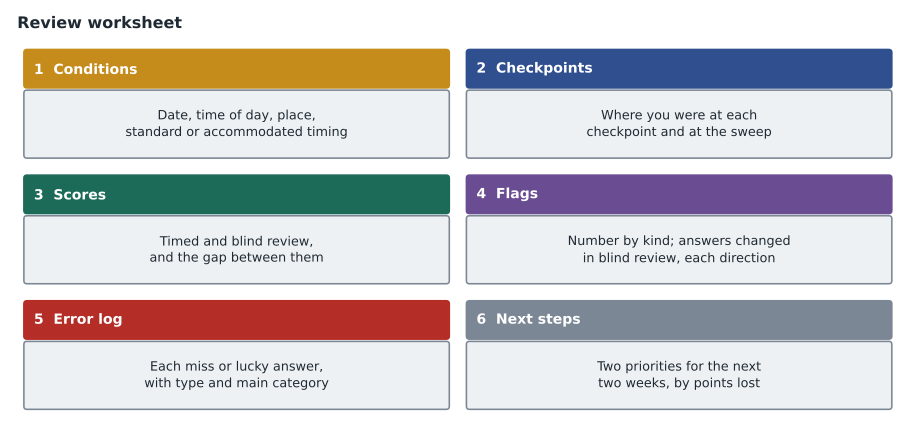
- Conditions: the date, time of day and place, and whether you used standard or accommodated timing.
- Checkpoints: where you were at about minutes 8, 17, 21 and 29 (or your scaled times).
- Scores: your timed score out of 21, your blind review score, and the gap between them.
- Flags: how many questions you flagged, of which kind (two finalists or time), and how many answers you changed in blind review, in each direction.
- Error log: each missed or lucky question, with its type and its main category from Lesson 6: method, reading, trap, pace or knowledge.
- Next steps: two priorities for the next two weeks, chosen with the expected-points reasoning of Lesson 7.
Reading your results
With 21 questions, the set is too short to support firm conclusions about any single question type; Lesson 7's rule about fifteen or twenty questions per type still applies. Its value lies in the review process itself and in how your results fit the larger pattern of your test record. Ask the same questions you would ask of a full test. Was your timed-to-blind gap large or small? Did your misses cluster in one category? Did a technique slip, as Marcus's two-minute ceiling slipped on October 31? Did your accuracy on the passage hold after fifteen Logical Reasoning questions, or did fatigue show?
Harriet planned to read each member's worksheet with particular questions in mind. For Thomas, whether he held his checkpoints instead of beating them. For Élodie, whether she finished the passage without guessing and whether any "surinterprétation" appeared in questions 16 to 21. For Dani, whether her assumption accuracy held under time in questions 5 and 7, and how she handled the voice of the critics in question 18. For Ji-won, whether the passage at the end of the set got the same care as the first questions. For Marcus, depending on December 2, either a gentle return to practice or a first look at how much the course had stayed with him.
Where to go from here
This course completes the LSAT Prep program. LSAT-101 explained how the test works. The Logical Reasoning courses, LSAT-110, LSAT-111 and LSAT-112, taught arguments, flaws and inferences. LSAT-120 and LSAT-121 taught reading. LSAT-130 taught the Argumentative Writing sample. LSAT-140 taught timing and test day. This course has tied them together: official materials, honest conditions, blind review, error logs, tracking weaknesses, targeted drills, plateaus and a final review plan.
Harriet's closing message to the group, sent with the capstone set, was short. "From here, the work is simple, though not easy: take a test, review every question, log what you learn, drill where the points are, rest, and repeat. Do that honestly for the weeks you have left, and the score you earn will be the one you prepared for." Then she added the line she had used at the end of the timing lab: "You have done the work. Let it show."
Common mistakes
MistakeReading the explanations before blind review.
InsteadFinish the set, do blind review of flagged questions, then read the explanations.
MistakeTreating the capstone result as a score prediction.
InsteadUse it to practise review; use official tests for scored practice.
MistakeDrawing firm conclusions about a question type from one or two questions.
InsteadCombine the results with your larger test record.
MistakeSkipping the worksheet because the set was short.
InsteadComplete every box; the habit is the point.
MistakeChoosing five priorities from the review.
InsteadChoose two for the next two weeks.
Summary and key terms
- The capstone set has fifteen Logical Reasoning questions and one passage with six questions, timed at 30 minutes (45 with 50 percent extra time).
- Use checkpoints at about minutes 8, 17, 21 and 29, a flag log, and an answer for every question.
- Do blind review before reading explanations, then complete the six-box review worksheet.
- Read the results in the context of your full test record, not as a score prediction.
- The program's method: take a test, review every question, log, drill where the points are, rest and repeat.
- Capstone set
- A 21-question timed set written for this course to practise taking and reviewing a test.
- Review worksheet
- A one-page summary of conditions, checkpoints, scores, flags, errors and next steps.
- Sunset clause
- A provision making a law expire on a fixed date unless renewed (from the capstone passage).
- Concession
- A consideration against the conclusion that an author acknowledges before arguing past it.
- Next-step priorities
- Two specific focuses for the next two weeks chosen from the review.
Practice problems
Work each problem on paper first, then reveal the answer to check.
How long is the capstone set with 50 percent extra time?
Show answer
45 minutes.
What is the structure of the capstone set?
Show answer
Fifteen Logical Reasoning questions and one Reading Comprehension passage with six questions.
In question 14, what role does the claim that the bus lane will slow car traffic play?
Show answer
A consideration the planner acknowledges before arguing that other factors outweigh it.
According to the capstone passage, what does a review requirement change about a renewal vote?
Show answer
It shifts the question from whether repeal is worth the trouble to what the law has actually done.
What are the six boxes of the review worksheet?
Show answer
Conditions, checkpoints, scores, flags, error log and next steps.
Lesson quiz · 5 questions
Score 60% or more to complete this lesson.
Create a free account to save your progress, take quizzes and earn a certificate.