
LSAT-150 · Lesson 5 of 12 · 18 min
Blind review
▶ Video coming soon A video version of this lesson is on the way.
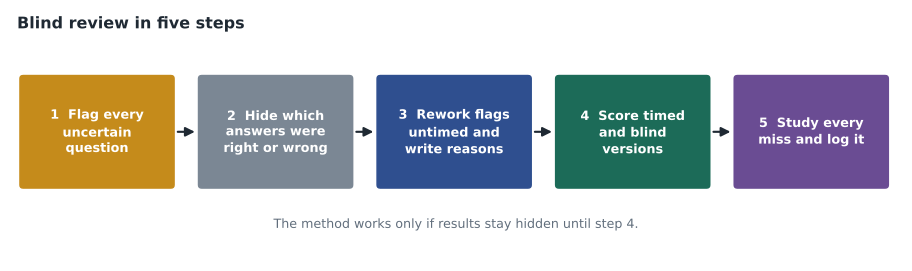
Blind review is the single most useful thing a candidate can do after a practice test, and the one most often skipped. The idea is simple. Before looking at which answers were right or wrong, you go back through the questions you were unsure about and work them again, without a time limit, as carefully as you can. Only then do you check the answer key. Comparing your timed score with your blind review score separates two very different problems: questions you missed because of time pressure, and questions you missed because your method or understanding was not yet good enough.
Harriet had used blind review with every member of the group since September, and the Nov 19 mini diagnostic in LSAT-101 had reported blind review totals alongside timed scores. In this session she explained the method step by step, using the review Marcus did on Sunday, November 1, of his October 31 test.
Step 1: mark uncertainty during the test
Blind review starts during the test itself. Every time you answer a question without being confident, flag it. That includes two-finalist questions, time flags and any question where you chose an answer but felt a doubt. The flag log described in Lesson 3 records why each question was flagged. Some candidates also mark, on their scratch paper, questions they answered quickly but with a flicker of doubt. Harriet's instruction was to be generous: it costs nothing to flag a question you turn out to have answered correctly, but a question you were unsure of and did not flag will be missed in review.
Marcus's October 31 test had eleven flagged questions across the three scored sections and the added section, plus three he added to the list right after the test from memory.
Step 2: hide the results
After the test, do not open the question-by-question results. LawHub may show the overall score at the end of a simulated test, which is fine to note, but avoid the screens that show which questions were right and wrong. If you accidentally see some results, set those questions aside and review the rest. The method only works if you do not know the answers in advance.
Step 3: rework each flagged question untimed
For each flagged question, work it again as if for the first time, with no time limit. Reread the stimulus or passage carefully. For Logical Reasoning, identify the conclusion and the premises, name the question type, predict what the right answer must do and then evaluate every choice, writing a short reason why each wrong choice is wrong. For Reading Comprehension, find the relevant part of the passage and justify the answer from the text. Then commit to an answer.
This is slow. Marcus spent a little over two hours on his fourteen questions. Harriet said that was normal and worth it. The point is not only to get the right answer but to be able to explain it, in writing, as if teaching it to someone else. An answer you cannot explain is a guess, even if it is correct.
Step 4: score both versions
Now open the results. Record two scores: the timed score, from the test as taken, and the blind review score, from the test with your reworked answers substituted for the flagged questions. The difference between them is your timed-to-blind gap.
On October 31, Marcus's timed raw score was 66 of the 77 scored questions on that form, which converted to his scaled 162. His blind review raw score was 68. His gap was two questions. Of his eleven flagged questions in scored sections, he had changed his answer on four in blind review: three changes went from wrong to right, and one went from right to wrong.
What the gap tells you
The timed-to-blind gap separates pace problems from method problems. A question you missed timed but got right in blind review is usually a pace or pressure problem: you could solve it, but not in the time available or under the stress of the clock. A question you missed in both is a method or understanding problem: even with unlimited time, your approach did not reach the right answer.
The two problems call for different remedies. Pace problems respond to timing practice, checkpoints and the techniques of LSAT-140, along with deeper familiarity that makes the method faster. Method problems respond to study: reviewing how a question type works, practising it untimed until the method is reliable, and only then adding time pressure.
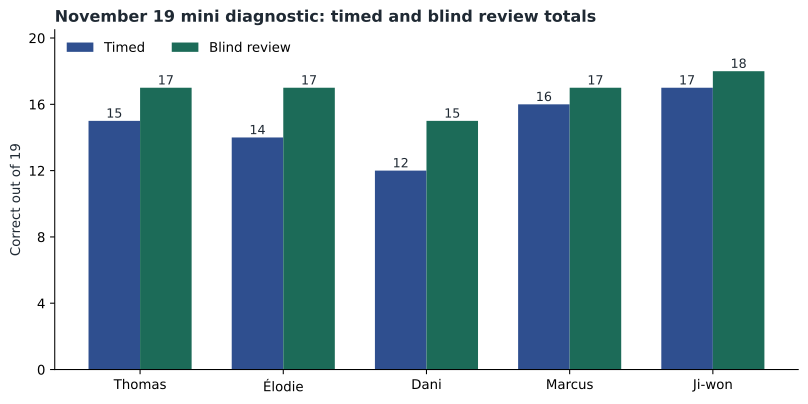
Harriet showed the group their own numbers from the Nov 19 mini diagnostic in LSAT-101, a set of 12 Logical Reasoning questions and one Reading Comprehension passage with 7 questions, 19 questions in all. The timed totals and blind review totals were: Thomas 15 and 17, Élodie 14 and 17, Dani 12 and 15, Marcus 16 and 17, and Ji-won 17 and 18. Élodie's gap of three was mostly in Reading Comprehension, where she had answered 4 of 7 timed; Dani's gap of three was spread across both sections.
A large gap and a small gap
Neither a large gap nor a small one is good or bad in itself. A large gap means there is a lot of score available through better pacing, because the candidate can already solve many of the questions they miss. Élodie's September gap had been about seven questions across a full test, and most of her progress in the autumn came from closing it: by mid-November it was down to about two, and her timed Reading Comprehension accuracy had risen from 18 of 27 to about 23 of 27 on recent practice sections.
A small gap with a score below target means the opposite: the candidate is using the time well, and further gains have to come from method. Marcus's small gap of two on October 31 told him that more timing practice would not add much; what remained were questions he could not reliably solve even untimed, mostly parallel reasoning and some principle questions. That pointed to targeted study, as Lesson 8 describes.
Step 5: learn from every miss
After scoring, study every question you got wrong in blind review, and every question you got right timed but only by luck. Read the official explanation if one is available, or a reliable commercial explanation, and compare it with your own reasoning. Find the exact point where your reasoning went wrong. Then record the question in your error log, which Lesson 6 explains.
Harriet emphasized that a correct answer reached by poor reasoning is a miss waiting to happen. If you guessed between two finalists and happened to choose the right one, treat it as if you missed it: work out why the right answer is right and why the other finalist is wrong. Otherwise the same trap will catch you on test day.
Changing answers in blind review
Marcus's four changes, three from wrong to right and one from right to wrong, fit a pattern Harriet saw often. Most considered changes made in blind review improve the answer, because the candidate has time to read carefully. But some changes go the other way, usually when a candidate over-thinks a question and talks themselves out of a correct first reading. When that happens, the error log should note it. Marcus's one wrong change came on a Reading Comprehension inference question where he had chosen a cautious answer timed, then switched to a stronger one in review that went beyond the passage. He wrote "over-read" beside it, a word Élodie had already added to her own glossary as "surinterprétation".
Blind review for Reading Comprehension
Reading Comprehension questions in blind review take some adjustment. Since the passage is the same for all the questions in a set, it is tempting to reread it quickly and assume your memory is accurate. Harriet asked the group to treat each flagged question as a fresh search: go back to the passage, find the lines that support an answer, and quote them, briefly, in your written reason. If you cannot point to lines, your answer may rest on an impression rather than the text.
Dani found this especially useful. Her timed misses in Reading Comprehension were often on questions about whose voice an answer expressed: the author's, a critic's or a group described in the passage. In blind review, forcing herself to find the exact sentence showed her that she had been attributing views to the author that the author only reported. That pattern became one of her main error log entries.
Making blind review a habit
Blind review takes time, typically two to three hours for a full test, and candidates under time pressure in their lives are tempted to skip it. Harriet's view was that a full test without blind review is only partly used. If time is short, it is better to take fewer full tests and review each one properly than to take more tests and review none. She also suggested splitting the review across two sessions when needed: Logical Reasoning one evening, Reading Comprehension the next.
By November, blind review was automatic for most of the group. Thomas said it had changed how he thought about the test. Before, a practice test was a judgement on him. Now it was a list of specific questions to understand, each one a small step closer to his target.
Common mistakes
A worked example of blind review
Harriet walked the group through one question from Marcus's review to show what thorough reworking looks like. It was a principle question from section 1 that he had flagged as two finalists. Under time, he had chosen the answer that matched the principle's general spirit. In blind review, he wrote out the principle as a conditional: if an action meets condition one and condition two, then it should be done. He then checked each finalist against both conditions in turn. The answer he had chosen satisfied the first condition clearly but said nothing about the second. The other finalist satisfied both. He changed his answer, and when he checked the results, the change was correct.
His written reason was a single sentence: "Chose spirit over letter; the principle has two conditions and my answer met one." That sentence went into his error log with the category "method" and the lesson "Write principles as conditionals and check every condition." Harriet said this was blind review at its best: a specific error, a specific reason and a lesson that would apply to the next principle question.
Blind review in a group
The Thursday Circle sometimes did part of their blind review together. After each member had reviewed their flagged questions alone, they met to discuss the hardest questions, each explaining their reasoning before checking the credited answer. Harriet found that explaining a question aloud to others exposed weak reasoning quickly. A candidate who could not explain why a wrong answer was wrong usually discovered, mid-sentence, that they had not really understood the question.
Group review has a risk, though: the most confident voice can sway everyone. Harriet's rule was that each person committed to an answer in writing before anyone spoke. Dani said this rule had helped her trust her own reasoning, because several times she turned out to be right when more confident members were wrong.
Blind review for the added section
The added section in a practice test, the one taken from another official test to make four sections, deserves blind review too. It is unscored in the practice test's total but it contains real official questions, and the mistakes in it are just as informative. Harriet asked the group to review it with the same care, log its misses and include it in the tables of Lesson 7.
Thomas noticed that discussing questions aloud also improved his timing, because explaining a method to others made it clearer and quicker when he used it alone.
Ji-won added that blind review had changed how she felt about flags. A flag was no longer a sign of weakness; it was a note to her future self about where to look first.
Common mistakes
MistakeChecking answers before blind review.
InsteadKeep question-by-question results hidden until you have reworked every flagged question.
MistakeFlagging only questions you were sure you missed.
InsteadFlag every question you answered without confidence.
MistakeReworking questions quickly and from memory.
InsteadWork each one untimed, write reasons for every choice, and for passages point to the lines.
MistakeCounting a lucky correct answer as mastered.
InsteadTreat right-by-luck answers as misses and study them.
MistakeSkipping blind review to take more tests.
InsteadTake fewer tests and review each one fully.
Summary and key terms
- Blind review means reworking uncertain questions untimed before seeing which answers were right.
- Flag generously during the test and keep detailed results hidden until review is done.
- Compare timed and blind review scores; the gap separates pace problems from method problems.
- A large gap points to pacing gains; a small gap with a score below target points to method study.
- Study every miss and every lucky answer, and record each one in an error log.
- Blind review
- Reworking flagged questions untimed before seeing the results, then scoring both versions.
- Timed-to-blind gap
- The difference between the timed score and the blind review score.
- Pace problem
- A miss under time that the candidate can solve untimed.
- Method problem
- A miss that remains even untimed, showing a gap in approach or understanding.
- Right by luck
- A correct answer reached by guessing or poor reasoning, treated as a miss in review.
Practice problems
Work each problem on paper first, then reveal the answer to check.
What must stay hidden until blind review is complete?
Show answer
The question-by-question results showing which answers were right or wrong.
What does a question missed timed but right in blind review usually indicate?
Show answer
A pace or pressure problem.
What were Élodie's timed and blind review totals on the November 19 mini diagnostic?
Show answer
14 timed and 17 in blind review, out of 19.
What did Marcus's small gap on October 31 suggest?
Show answer
Further gains had to come from method, mainly parallel reasoning and principle questions.
How should a Reading Comprehension question be handled in blind review?
Show answer
As a fresh search of the passage, pointing to the lines that support the answer.
Lesson quiz · 5 questions
Score 60% or more to complete this lesson.
Create a free account to save your progress, take quizzes and earn a certificate.