
LSAT-150 · Lesson 2 of 12 · 19 min
Simulating test conditions
▶ Video coming soon A video version of this lesson is on the way.
A practice score is only as good as the conditions it was earned under. Harriet made the point with Thomas's record. Three of his first five full tests had been taken on weekday evenings after a full shift at the credit union, at his kitchen table, with his phone face down beside him. One had been taken on a Saturday morning in a quiet room at the Halifax public library. His Saturday score was four points higher than the average of the evening tests. Was he four points better on Saturdays? Possibly. But it was just as likely that the evening scores understated his ability, and that neither condition matched what his April test day would look like.
"The point of simulating conditions," Harriet said, "is not to make practice hard. It is to make practice honest." A practice test taken under easier conditions than the real test inflates the score and hides problems. One taken under harder conditions deflates the score and causes needless worry. The aim is to make practice as close to the real test as you can, so that the score predicts the real result and the habits you build transfer to test day.
The length of the day
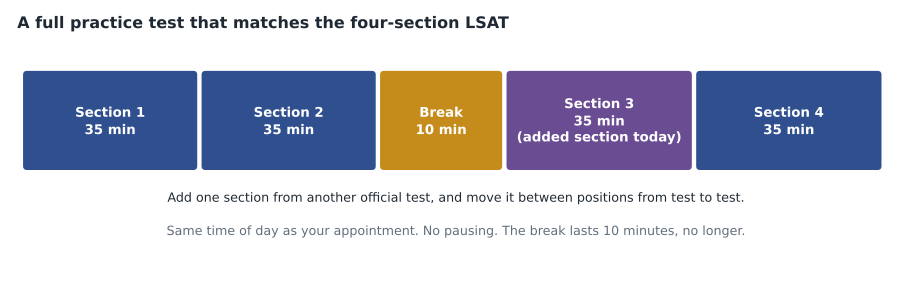
The most important condition to reproduce is the full length of the test. Through June 2027, the LSAT has four 35-minute sections: two scored Logical Reasoning sections, one scored Reading Comprehension section and one unscored section, which may be either type. There is a 10-minute intermission after the second section. A practice test from LawHub contains the three scored sections. To match the real test, add a fourth section, usually a Logical Reasoning or Reading Comprehension section from another official test, so that you work through four sections and the intermission.
Candidates sometimes skip the fourth section because it does not count toward the practice score. Harriet insisted on it. The fatigue chart from the group's last full practice tests, discussed in LSAT-140, showed the group averaging about 21 correct per section in sections 1 to 3 and about 18 in section 4. Thomas dropped from about 22 to about 17. On test day, any of the four sections could be the unscored one, so a scored section may well come fourth, after the fatigue has set in. Practising with only three sections hides exactly the problem that costs points.
Where to place the extra section is a choice. Harriet suggested varying it: sometimes first, sometimes third, sometimes fourth. On the real test you will not know which section is unscored, and you should treat every section as if it counts. Placing the extra section in different positions trains the habit of giving full effort throughout and shows whether your performance depends on section order.
Time of day
Practice at the time of day you will test. Élodie's appointment is at 8:30 a.m. on Saturday, January 16, 2027, at a Prometric centre in Ottawa. Her December plan set every remaining full practice test for a Saturday at 8:30 a.m. Ji-won and Dani both planned weekday morning appointments in January, so they moved their practice tests to mornings too, which for Dani meant arranging a few hours away from work. Thomas would not schedule his April appointment until the new year, but he expected a morning slot and began moving his practice tests to Saturday mornings.
Alertness varies through the day, and most people's reading and reasoning feel different at 8:30 a.m. than at 7 p.m. Practising at the test time also exposes practical problems: how long it takes to wake up properly, what breakfast does to concentration, whether caffeine timing works. LSAT-140 covered the final week in detail. The point here is simply that a practice score earned in the evening is a less reliable predictor of a morning test.
Place and noise
Most candidates in the United States and Canada now take the LSAT at a test centre. Since August 2026, LSAC has moved most candidates back to in-person testing, with remote testing available only for listed exceptions, such as candidates who live more than 180 miles or three hours from a centre with capacity. A test centre is quiet but not silent. There may be other candidates working on different exams, the sound of keyboards, someone coughing, a door opening. Earplugs or headphones may or may not be available, depending on the centre and LSAC's current rules.
For that reason, Harriet suggested taking at least some practice tests away from home. Élodie took a practice section in her university library. Ji-won planned to take her last two full tests in a public library near her home in Seattle. Marcus, before his November test, had taken one full test at a coworking space. A public place is not identical to a test centre, but it removes the comforts of home and introduces mild, unpredictable noise, which is much closer to test day than a silent bedroom.
Candidates who will test remotely under one of the exceptions should practise in the same room and setup they will use on test day, with the same desk, chair and lighting, and with the computer and connection they will use. The remote setting has its own rules, including a room check and a second camera, which LSAT-140 described. Practising in the same room removes surprises.
Scratch paper and tools
At a test centre, LSAC provides three blank, unlined scratch paper booklets, and candidates may not bring their own paper or pencils. Remote candidates may use six blank sheets. Practise with the same amount of paper you will have, and practise in the same way you will use it. A candidate who spreads notes across a large desk pad at home may find three small booklets cramped. Dani discovered that she used much more paper than she expected on Reading Comprehension, because she copied out phrases from passages. She switched to brief marks of three or four words per paragraph, which fit easily and saved time.
The digital interface has its own tools: highlighting, flagging questions, eliminating answer choices and a timer. Use them in practice exactly as you will on test day. If you plan to flag questions with the interface's flag and keep a short flag log on paper, as Ji-won did, do both in every practice test. Habits formed in practice are the habits that will appear under pressure.
No pausing, no peeking
The hardest condition to keep is the one that depends only on willpower: no pausing. At home, it is tempting to stop the clock to answer the door, check a message or get a drink of water. Each pause gives the brain a rest that it will not get on test day and breaks the pressure of continuous time. Harriet asked each member to treat practice tests as if they were the real thing: phone in another room, household told not to interrupt, water on the desk before starting, and no stopping once a section begins.
The intermission should also be kept to 10 minutes. Use it the way you will on test day: stand, walk, drink water, eat a small snack if you plan to, and return before the time is up. LSAC's rules at test centres prohibit using electronic devices, working on scratch paper or discussing the test during the intermission, and candidates must check back in with staff before section 3. Practising a 10-minute break, including a return to the desk with a minute or two to spare, makes the real one feel familiar.
No peeking applies afterwards too. Do not look at the answer key or the scored results before doing blind review, which Lesson 5 explains. Once you have seen which questions you got wrong, you cannot review them the same way again.
Accommodated timing
Candidates with approved accommodations should simulate their own test day, not the standard one. Ji-won's accommodation gave her 50 percent extra time on each section, without extra breaks, so her practice sections ran about 52 minutes and 30 seconds each, with the standard 10-minute intermission. Practising under standard timing would have told her almost nothing useful about her pace. Practising under her own timing let her set and test scaled checkpoints, as LSAT-140 described.
Candidates with 100 percent or more extra time may, under LSAC's current rules, request five-minute breaks between sections. Those candidates should practise with the breaks they expect to have and use them as planned, not as unplanned rests. Anyone whose accommodation involves something LawHub cannot reproduce should simulate it as closely as possible and note the difference in their test record.
Keeping a conditions record
Each practice test should be recorded with its conditions, not just its score. Harriet's record template had a column for time of day, place, whether all four sections and the intermission were included, and anything that went wrong: an interruption, a technical problem, illness, a bad night's sleep. When the group later looked at score trends in Lesson 7, the conditions column explained several outliers. Dani planned to note conditions on every December test, so that a score taken after a late night at work could be set aside honestly rather than shake her confidence.
A score taken under compromised conditions is not worthless, but it should be interpreted with that in mind. Harriet's rule was that a test with a serious break in conditions, such as a long pause or a missing section, should be recorded but not counted in the rolling average described in Lesson 4.
When conditions cannot be matched
Sometimes conditions cannot be matched. A candidate who works full time may only be able to practise in the evenings on weekdays. Harriet's advice was to accept the constraint but make it explicit. Take as many tests as possible under true conditions, ideally on weekends, and treat the rest as training rather than measurement. A weekday evening section can still build stamina and pacing, and its review can still be thorough. It simply should not be given the same weight as a Saturday morning test when deciding whether you are ready.
Dani, with a full-time job and a long commute, had faced exactly this in October. Her solution was to take full tests on Saturday mornings and do drills and single timed sections on weekday evenings. The full tests gave her reliable scores; the evening sections kept her practising without pretending to measure readiness.
Common mistakes
A dress rehearsal before test day
Harriet recommended that every candidate make one practice test, about two weeks before the real one, a full dress rehearsal. That means every condition at once: the same wake-up time as test day, the same breakfast, the same departure time if the practice is taken away from home, the same clothes in layers, the same snack and drink for the intermission, and the same pre-test routine. The score from a dress rehearsal is useful, but its main value is practical. It reveals problems that no amount of section practice will: a breakfast that leaves you hungry by section 3, a sweater that is too warm, a parking problem, a habit of checking a watch that LSAC's current rules may not allow in the testing room.
Élodie planned her dress rehearsal for a Saturday in late December, with an 8:30 a.m. start in a quiet study room at her university, leaving home at the same time she would leave for Ottawa on January 16. Dani planned hers for a weekday morning off work, at a branch library near her Tucson test centre, so that the drive and the parking would be part of the rehearsal. Ji-won planned hers in the public library where she would take her last two full tests, under her accommodated timing.
When the simulation reveals a problem
Sometimes a simulation shows that a condition you cannot change will affect you. Thomas discovered that he found the gentle background noise of a library more distracting than he expected, and that his concentration in section 4 suffered noticeably. He could not make the test centre silent. What he could do was practise in noisier places more often, so that background noise became ordinary, and rehearse the recovery routine from LSAT-140 for moments when his attention drifted. By late November he reported that library noise no longer bothered him much.
Harriet said that kind of adjustment was exactly what simulation was for. A problem found in practice is a problem that can be worked on. A problem found on test day can only be endured.
Common mistakes
MistakeTaking only the three scored sections in a practice test.
InsteadAdd a fourth section from another official test and include the intermission.
MistakePractising in the evening for a morning appointment.
InsteadTake scored practice tests at the time of day you will test.
MistakePausing the timer for interruptions.
InsteadRemove distractions beforehand and never pause once a section begins.
MistakePractising with standard timing when you have an accommodation.
InsteadPractise under your own accommodated timing and breaks.
MistakeRecording a score without its conditions.
InsteadNote time, place, sections and anything unusual so outliers can be interpreted.
Summary and key terms
- Simulating conditions makes practice honest, so the score predicts the real result and habits transfer.
- Practise with four sections and a 10-minute intermission, moving the added section between positions.
- Take scored tests at the time of day you will test, in a quiet but not silent place.
- Use the same scratch paper limits and interface tools, and never pause once a section begins.
- Practise under your own accommodated timing, and record the conditions of every test.
- Added section
- A section from another official test added to a practice test so it matches the four-section LSAT.
- Conditions record
- A note of the time, place, completeness and problems of each practice test.
- Fatigue effect
- The drop in accuracy late in a long test, which three-section practice hides.
- Scaled checkpoints
- Pacing checkpoints recalculated for accommodated timing.
- Honest practice
- Practice under conditions close enough to test day that its score is a fair prediction.
Practice problems
Work each problem on paper first, then reveal the answer to check.
Why add a fourth section to a LawHub practice test?
Show answer
The real test has four sections, and any of them could be scored; three-section practice hides fatigue.
Why vary the position of the added section?
Show answer
You will not know which section is unscored, and varying it trains full effort throughout and shows order effects.
How much scratch paper do candidates get at a test centre?
Show answer
Three blank, unlined scratch paper booklets; they may not bring their own.
How long is each of Ji-won's practice sections?
Show answer
About 52 minutes and 30 seconds, with 50 percent extra time and the standard intermission.
How should a test with a serious break in conditions be treated?
Show answer
Record it, but leave it out of the rolling average.
Lesson quiz · 5 questions
Score 60% or more to complete this lesson.
Create a free account to save your progress, take quizzes and earn a certificate.