
LSAT-150 · Lesson 8 of 12 · 25 min
Targeted drills
▶ Video coming soon A video version of this lesson is on the way.
Once a candidate knows where the points are being lost, the next step is a targeted drill: a short, focused set of questions built to practise one skill. Drills are where most improvement actually happens between full tests. A full test measures and diagnoses; a drill trains. This lesson covers how to build Logical Reasoning drills, how to time them, how to mix them, and how to tell whether they are working. Lesson 9 does the same for Reading Comprehension.
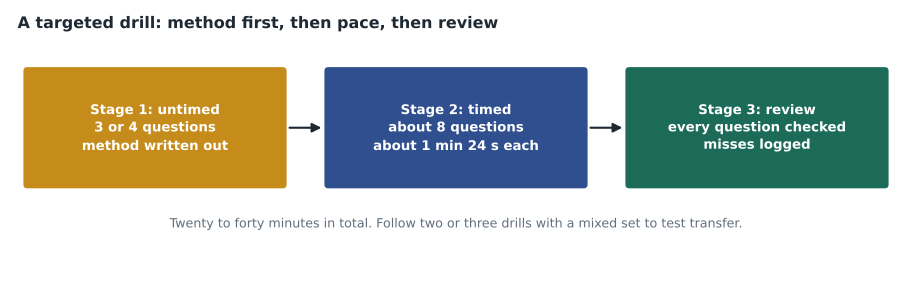
Harriet's first principle was that a drill should be smaller and more focused than most candidates expect. "A drill is not a mini test," she said. "It is a workout for one muscle." A good drill takes twenty to forty minutes including review, focuses on one question type or one skill, and ends with a clear answer to the question "Did that get better?"
Building a drill
A drill starts from the priority list in Lesson 7. Suppose the priority is necessary assumption questions. The candidate gathers eight to twelve necessary assumption questions from official tests they will not take in full, ideally from a range of difficulty. Questions they have seen before, including redos from the error log, can be included if they are marked as such; fresh questions should be the majority.
The drill then has three stages. In the first, the candidate works three or four questions untimed, writing out the method explicitly: identify the conclusion and premises, find the gap, predict what the assumption must do, and test finalists by negating them. In the second, the candidate works the remaining questions under time, at the real-test pace of about one minute and twenty-four seconds per question. In the third, the candidate reviews every question, right or wrong, against the method, and logs any misses.
Dani's first assumption drill in November followed that pattern. She worked three questions untimed with the negation test written out in full, then nine questions in about twelve and a half minutes, then reviewed. She got eight of the nine timed. Her two November drills on assumptions after that each ran a little faster, and her accuracy held. That told her the method was becoming automatic.
Pacing a drill
The pace for a timed drill should match the test. In a 35-minute Logical Reasoning section of about 25 questions, the average is roughly one minute and twenty-four seconds per question. Harriet set drill times by multiplying: eight questions in about eleven minutes, ten in fourteen, twelve in seventeen. Ji-won, with 50 percent extra time, multiplied again by one and a half: eight questions in about sixteen and a half minutes.
Harder question types may deserve a slightly longer allowance at first. Marcus's parallel reasoning drills started at about two minutes per question while he built a faster method for comparing structures, and tightened toward the standard pace over two weeks. Harriet said the aim was to reach standard pace with good accuracy, not to start there.
A sample drill
Here are three sample necessary assumption questions written for this course, of the kind Harriet used in Dani's drills. Try them at about one minute and twenty-four seconds each before reading the explanations.
Worked problem
Sample drill question 1
Gallery director: Visitors spend more time in rooms where the paintings are hung at eye level than in rooms where they are hung higher. So if we lower the paintings in our upper gallery to eye level, visitors will spend more time there. The director's argument requires assuming which one of the following? (A) The upper gallery currently attracts fewer visitors than the other rooms. (B) Visitors prefer paintings hung at eye level to all other arrangements. (C) Lowering the paintings will not require any other changes to the upper gallery. (D) The difference in time spent is not due mainly to some feature of the eye-level rooms other than the height of the paintings. (E) The gallery's most popular paintings are hung at eye level.
Show solution
- (D) is correct. Negate it: the difference is due mainly to some other feature of those rooms, such as better lighting. Then lowering the paintings would not produce the effect, and the argument collapses. So the argument needs (D).
- (A) is not needed; the argument is about time spent per visitor, not attendance.
- (B) is too strong; the argument needs height to make a difference, not that eye level beats every other arrangement.
- (C) is not needed; other changes could also happen without undermining the prediction.
- (E) is irrelevant to whether height affects time spent.
Answer: (D).
Worked problem
Sample drill question 2
Coach: Every player on our team who attended the summer conditioning camp improved their sprint times this season. Since Nadia did not attend the camp, she will not have improved her sprint time. The coach's reasoning is most vulnerable to criticism on the grounds that it takes for granted that (A) the camp was the only way a player on the team could have improved. (B) Nadia wanted to attend the camp. (C) sprint times are the best measure of fitness. (D) all players who attended the camp improved by the same amount. (E) Nadia's sprint time was already among the team's best.
Show solution
- (A) is correct. The coach treats attending the camp as necessary for improvement, when the stimulus shows only that it was sufficient. The conclusion needs the camp to be the only route.
- (B) is irrelevant to whether Nadia improved.
- (C) concerns how fitness is measured, not the logic of the conclusion.
- (D) is irrelevant; the amount of improvement is not at issue.
- (E) might make improvement harder but is not something the argument assumes.
Answer: (A).
Worked problem
Sample drill question 3
Historian: Letters from the town's founders rarely mention the river, although it supplied the town's water and power. So the founders must have taken the river for granted. Which one of the following is an assumption on which the historian's argument depends? (A) The founders wrote many letters. (B) The river was the town's most important resource. (C) The founders' letters that survive are not a set selected in a way that would leave out letters mentioning the river. (D) Later residents mentioned the river more often than the founders did. (E) Taking something for granted always leads people to avoid mentioning it.
Show solution
- (C) is correct. Negate it: the surviving letters were selected in a way that excluded mentions of the river, for example because letters about the mill were archived separately. Then the scarcity of mentions says nothing about the founders' attitude. The argument needs (C).
- (A) is not needed; even a modest number of letters could support the inference if they are representative.
- (B) is not needed; the argument depends on the river being important, not on its being the most important.
- (D) is a comparison the argument never relies on.
- (E) is too strong; the argument needs only that the rare mentions reflect the founders' attitude in this case, not a universal rule.
Answer: (C).
Each of these questions rewards the same move, the negation test, applied to the finalists. A drill of eight to twelve questions of this kind, taken at pace, rehearses that move until it becomes automatic.
Mixed sets
Single-type drills build a method. But the real test does not announce question types, and a candidate must recognize the type before applying the method. That recognition is a skill in itself, and single-type drills do not train it, because the candidate knows the type in advance. Mixed sets, short timed sets of different question types in random order, train recognition and transfer.
Harriet suggested a rhythm: two or three single-type drills on a priority, then a mixed set of ten questions in fourteen minutes that includes a few questions of the priority type among others. If accuracy on the priority type holds in the mixed set, the method is transferring. If it drops, the candidate is relying on knowing the type in advance, and needs more practice recognizing it from the stem.
This rhythm reflects a broader finding about learning: practice that mixes types, and practice spread out over time, tends to produce more durable learning than practice concentrated on one type in one long session, even though concentrated practice feels more productive at the time. Harriet did not ask the group to take that on faith; their own mixed-set results were the test.
Spacing and revisiting
A skill drilled intensively for a week and then left alone tends to fade. Harriet asked each member to revisit each priority at least once a week after the intensive phase ended, with a short maintenance drill or a few questions in a mixed set. Thomas's assumption accuracy stayed at about 70 in 100 through November with one maintenance set a week; it had climbed there through intensive work in October.
The error log's redo column is part of the same idea. Redoing missed questions a week later, then again a few weeks after that, spaces practice exactly where it is most needed.
Is the drill working?
Every drill should produce a number: accuracy on the timed questions, and time per question. Over several drills on the same priority, those numbers should improve, and the improvement should show up in mixed sets and then in full tests. Harriet asked each member to check their priority after two weeks against the tables from Lesson 7. If the expected points lost on that type had fallen, the drill was working and the candidate could move to the next priority. If not, the drill needed changing: more untimed method work, different questions, or a closer look at the error log to find what was really going wrong.
Dani's check after two weeks showed her assumption accuracy up and her time per question down, and both held in mixed sets. Her parallel reasoning had improved less, which told her the method still needed work before speed. She moved assumptions to maintenance and gave parallel reasoning the larger share for the next fortnight.
What drills cannot do
Drills cannot replace full tests. They train skills in isolation, without fatigue, without section-level pacing and without the uncertainty of not knowing what comes next. A candidate who drills well but rarely takes full tests may find that skills do not survive the length of the day. Harriet's balance in the final six weeks was roughly one full test a week, with its review, and three to five drill sessions between tests, each targeted at a priority from the latest data.
Common mistakes
Choosing questions for a drill
Not every question of a type is equally useful in a drill. Harriet suggested choosing a mix of difficulty: a few easier questions to confirm the method, several medium questions to build fluency and two or three hard ones to test its limits. Questions from the error log's redo list can be added, marked so that the candidate knows they have seen them before. Questions from tests reserved for full practice should never be used.
She also suggested varying the source of questions within a drill, mixing older and more recent official tests. Question styles have shifted slightly over the years, and a method that works on older questions should be checked on newer ones before test day.
Drilling under fatigue
One kind of drill is easy to overlook: practising a method when tired. Marcus's October 31 stall showed that a technique can work well when fresh and slip under fatigue. Harriet suggested occasionally placing a short timed drill at the end of a long study session, or after a timed section, so that the method is rehearsed under the conditions in which it is most likely to fail. Marcus did exactly this in his final week before November 12, and said the two-minute ceiling felt automatic by test day.
Drills and confidence
Drills have one more benefit that is easy to underestimate: they build confidence in a specific skill. A candidate who has worked forty assumption questions in a fortnight, with rising accuracy, approaches the next assumption question on a full test with a sense of having seen it before. Dani said that by late November she no longer felt a jolt of anxiety when she saw "The argument depends on assuming" in a stem. That calm was itself worth points, because anxiety slows reading and clouds judgement.
Harriet added that a drill should end on a question answered well. If the last question of a set goes badly, she suggested working one more easy question of the same type before stopping, so that the method is the last thing practised, not the mistake.
Common mistakes
MistakeTreating a drill as a mini test of mixed types.
InsteadFocus each drill on one skill: method first, then pace, then review.
MistakeStarting drills at full speed on a weak type.
InsteadBegin untimed or with a longer allowance, then tighten to standard pace.
MistakeDoing only single-type drills.
InsteadFollow them with mixed sets to train recognition and transfer.
MistakeDrilling a skill for a week and then dropping it.
InsteadRevisit each priority weekly with maintenance practice.
MistakeContinuing a drill that is not working.
InsteadCheck results after two weeks and change the drill if the numbers have not moved.
Summary and key terms
- A drill is a short, focused workout for one skill, built from the priority list.
- Each drill moves from untimed method work to timed practice at about 1 minute 24 seconds per question, then review.
- Mixed sets train recognition of question types and test whether a method transfers.
- Spaced revisiting and error-log redos keep skills from fading.
- Check drills against data after two weeks and balance them with weekly full tests.
- Targeted drill
- A short set of questions focused on one skill or question type.
- Mixed set
- A short timed set of different question types in random order.
- Standard pace
- About one minute and twenty-four seconds per Logical Reasoning question.
- Maintenance drill
- A short weekly drill on a skill already improved, to keep it from fading.
- Transfer
- A method working in mixed sets and full tests, not only in single-type drills.
Practice problems
Work each problem on paper first, then reveal the answer to check.
What are the three stages of Harriet's drill?
Show answer
Untimed method work, timed practice at test pace, and review with logging.
How long should ten questions take at standard pace?
Show answer
About fourteen minutes.
Why are mixed sets needed after single-type drills?
Show answer
They train recognizing the question type and test whether the method transfers.
What move do all three sample drill questions reward?
Show answer
Negating the finalists to see whether the argument collapses.
What balance did Harriet suggest in the final six weeks?
Show answer
About one full test a week, with review, and three to five drill sessions between tests.
Lesson quiz · 5 questions
Score 60% or more to complete this lesson.
Create a free account to save your progress, take quizzes and earn a certificate.