
LSAT-150 · Lesson 4 of 12 · 18 min
Scoring and the score band
▶ Video coming soon A video version of this lesson is on the way.
Every practice test ends with a number, and every candidate wants to know what that number means. Is a 157 on Saturday really different from a 155 the week before? Is a jump of five points real progress or luck? When is a practice score good enough to sit the real test? This lesson explains how LSAT scores are produced, why practice scores vary, and how to read a series of scores without over-reacting to any single one.
Harriet began the session with a story from her own early years as a tutor. A student of hers had taken two practice tests a week apart and scored 151 and then 158. The student was elated and moved her test date forward. On the next two tests she scored 153 and 154. "The 158 was real," Harriet said, "in the sense that she earned it. But it was the top of her range that week, not the middle." The student had treated one number as a verdict. This lesson is about treating numbers as evidence.
From raw score to scaled score
The LSAT raw score is the number of questions answered correctly in the scored sections. Every question is weighted the same, and there is no deduction for wrong answers. LSAC then converts the raw score to the scaled score on the familiar range of 120 to 180. The conversion differs slightly from one test form to another, through a statistical process called equating, so that a given scaled score represents about the same level of ability regardless of which form a candidate happened to take. On a slightly harder form, a given scaled score requires a few fewer correct answers; on a slightly easier form, a few more.
For practice purposes, two consequences follow. First, compare scaled scores, not raw scores, across different practice tests, because the raw score needed for, say, 160 varies between forms. Second, do not try to predict the exact conversion for your real test. LawHub converts each practice test using that form's own scale, and the real test will be converted using its own. Your job is to raise the number of questions you answer correctly; the conversion takes care of itself.
Percentiles
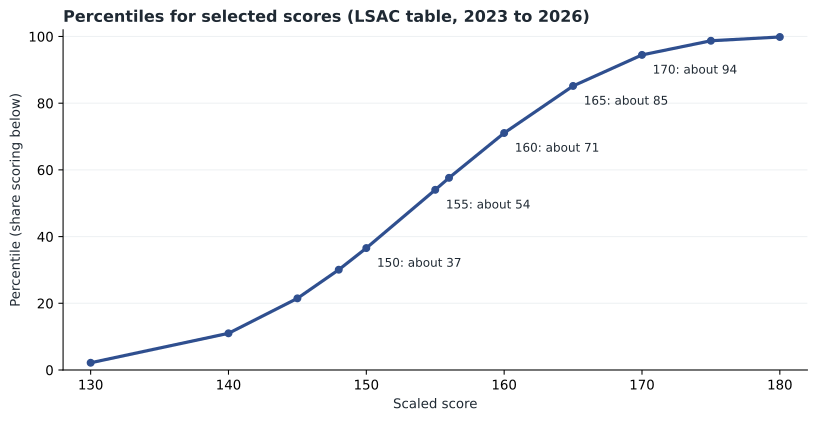
LSAC also reports a percentile for each scaled score: the percentage of test takers over the previous three testing years who scored below it. The table LSAT-101 discussed, covering 2023 to 2026, put a 150 at about the 37th percentile, a 155 at about the 54th, a 160 at about the 71st, a 165 at about the 85th and a 170 at about the 94th. Percentiles change slightly from year to year as the pool of test takers changes.
The table shows something important about the top of the scale. Near the middle, one scaled point moves a candidate several percentiles. Near the top, each additional point is rarer. Moving from 150 to 155 passes about a sixth of test takers; moving from 170 to 175 passes only about four percent of them. This is one reason progress tends to feel slower as scores rise: each point requires a smaller number of additional correct answers on harder questions, and those questions are harder to master.
The score band
LSAC's score reports include a score band: a range of a few points around each scaled score. The band reflects the fact that no test measures ability perfectly. If a candidate could take many different forms of the test on the same day, with no learning or fatigue in between, their scores would vary somewhat around a central value. The score band is LSAC's way of showing that a reported score is best understood as a likely range rather than a single exact point.
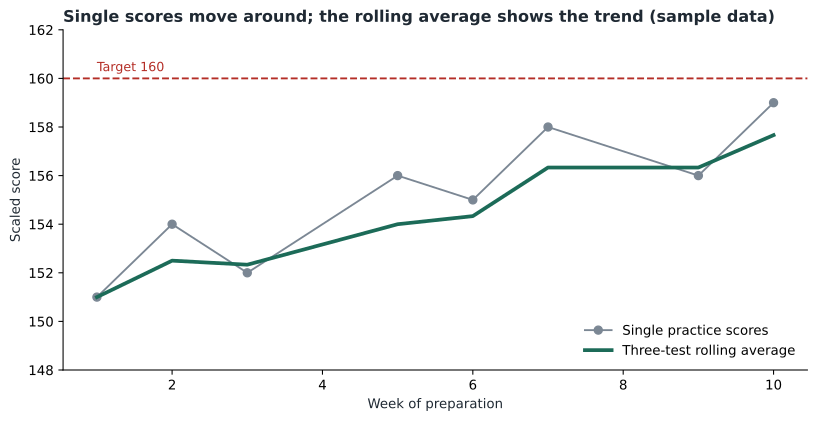
Practice scores vary for the same reason, and for several more. Some forms suit a particular candidate better than others: a Reading Comprehension section with a science passage may help a candidate like Marcus and hurt another. Conditions vary, as Lesson 2 explained. Sleep, stress and concentration vary from day to day. Taken together, these mean that a candidate's practice scores normally move up and down by two or three points from test to test even when their underlying ability is not changing at all.
Harriet put it bluntly: "A change of two points between two practice tests is not news. A change of two points in your average over a month is."
The rolling average
Because single scores vary, Harriet asked each member to track a rolling average: the average of the three most recent full practice tests taken under good conditions. Each new test replaces the oldest in the average. The rolling average moves more slowly than single scores and shows the trend more clearly. It is also the number she used, along with blind review results, to judge readiness.
In early November, the group's rolling averages were Thomas 157, Élodie 160, Dani 153 and Ji-won 163 under her accommodated timing. Their targets were Thomas 162, with a stretch goal of 165, Élodie 162, Dani 156 and Ji-won 165. Marcus's target had been 163, and his last practice tests before November had averaged close to it. Each of those numbers was an average, not a best score, which made them a fair basis for planning.
Harriet's rule for tests taken under compromised conditions, as Lesson 2 explained, was to record them but leave them out of the rolling average. A test taken after a sleepless night or with a long interruption tells you something, but not about readiness.
Reading a series of scores
With a rolling average and a test record, a candidate can ask better questions than "Did my score go up?" Harriet suggested four.
- Is the rolling average rising, flat or falling over the last month?
- Is the gap between timed and blind review scores, explained in Lesson 5, shrinking?
- Are the section scores moving together, or is one section holding the total back?
- Do any outliers have an explanation in the conditions record?
Thomas's record in November answered all four. His rolling average had risen from 154 in September to 157. His timed-to-blind gap had shrunk from about six questions to about three. His Logical Reasoning had improved faster than his Reading Comprehension, which had been strong from the start. And his lowest recent score came from an evening test after a double shift. The picture was steady progress with a clear next focus: pacing, which LSAT-140 had addressed, and the remaining gap between timed and untimed work.
Section scores
A scaled score combines three scored sections, but the raw score in each section tells its own story. Harriet asked each member to record their raw score for each scored section and, where they could tell from the test, for the added section as well. Two Logical Reasoning sections of about 25 to 26 questions each make up roughly two thirds of the scored questions, and one Reading Comprehension section of about 26 to 28 questions makes up the rest. A weakness in Logical Reasoning therefore costs about twice as many points as the same weakness in Reading Comprehension.
That arithmetic shaped several plans. Dani's Logical Reasoning raw scores lagged her Reading Comprehension more than anyone else's, and improving them by two questions per section would add about four raw points, roughly enough to reach her target. Élodie's case was the opposite: her Logical Reasoning was already near her target level, and her Reading Comprehension, after a long struggle with timing, was where the remaining points lay.
When is a score good enough?
Candidates often ask when their practice scores are good enough to sit the real test. Harriet's answer was that a candidate is ready when the rolling average under good conditions is at or near the target, the timed-to-blind gap is small and stable, and the candidate has taken at least a few full tests under true conditions in the final month. She did not expect the real score to match the rolling average exactly. Some candidates score slightly higher on test day, helped by adrenaline and fresh material; others score slightly lower, affected by nerves. The rolling average is the best single prediction, with a likely range of a few points either side.
That is why she encouraged everyone to set a target and a decision rule in advance. Marcus's rule, to keep his November score only if it was above 158, was set before he tested and reflected his April 2025 score of 158 and his practice range. A rule set in advance protects a candidate from deciding emotionally after seeing a number.
Scores and admissions
Finally, Harriet reminded the group what the score is for. Law schools use LSAT scores, along with grades and other parts of an application, in admissions decisions. As LSAT-101 explained, many US schools consider the highest score, consistent with the rule since 2006 that ABA-approved schools report the highest score, while some Canadian schools, such as the University of Toronto, consider all scores within a five-year period. A practice score is a means to an end: preparing to earn the best real score you can, once, under the conditions of the day.
Common mistakes
Practice scores and the real test
Members often asked how their practice scores would compare with their real scores. Harriet's experience was that, for candidates who practised honestly under true conditions with official tests, the real score usually fell within a few points of the rolling average in the final weeks. Some candidates scored higher on test day, helped by adrenaline, fresh material and a well-rehearsed routine. Others scored lower, affected by nerves, an unusual form or a bad night's sleep. Very large differences were uncommon and usually had an identifiable cause, such as practice tests taken under easy conditions, repeated exposure to the same tests, or a serious problem on test day.
That is one reason Harriet discouraged retaking practice tests already seen. A second attempt at the same test usually produces a higher score, because the candidate remembers some questions and passages, even without meaning to. That higher score says little about readiness. The test record should note any repeated tests, and the rolling average should leave them out.
Scores under accommodated timing
For candidates with approved accommodations, practice scores should be earned under the accommodated timing, as Lesson 2 explained, and compared with targets on that basis. Ji-won's rolling average of 163 was earned with 50 percent extra time on every section, which is how she would test. LSAC does not annotate scores earned with accommodations, and approvals generally carry forward to later administrations, as LSAT-101 described. Her practice scores were therefore directly comparable with the real score she would receive.
Keeping the numbers in perspective
Harriet ended the session by reminding the group that the scale exists to compare candidates fairly, not to measure their worth. A three-point difference between two practice tests says nothing about intelligence or promise as a future lawyer. It says something about a particular set of questions on a particular day. Thomas said he had started writing his rolling average in pencil, as a reminder that it would change.
Two candidates, one score
Harriet asked the group to imagine two candidates who both scored 157 on their most recent practice test. The first had scores of 150, 153, 155 and 157 over the past month. The second had scores of 161, 159, 158 and 157. The single number was identical, but the stories were opposite: one rising steadily, the other drifting down. The first candidate's rolling average was rising and suggested continued progress; the second's was falling and called for a closer look at conditions, fatigue and review habits. A score read without its history, Harriet said, is a sentence read without its paragraph.
Dani said the example changed how she read her own record. She stopped looking first at her latest score and began looking first at the direction of her rolling average, then at the timed-to-blind gap, and only then at the latest number.
Common mistakes
MistakeTreating a single practice score as a verdict.
InsteadRead each score as the middle of a likely range and track a rolling average.
MistakeComparing raw scores across different practice tests.
InsteadCompare scaled scores, since the conversion differs between forms.
MistakeCelebrating or panicking over a two-point change.
InsteadExpect normal variation of two or three points between tests.
MistakeCounting a compromised test in the rolling average.
InsteadRecord it but leave it out of the average.
MistakeDeciding after seeing a score whether it is good enough.
InsteadSet a target and a decision rule in advance.
Summary and key terms
- The raw score is the number correct, all questions weighted equally with no deduction; LSAC converts it to 120 to 180 through equating.
- Percentiles compare a score with test takers over three years; each point is rarer near the top.
- The score band reflects measurement error; practice scores normally vary by two or three points.
- Track a three-test rolling average under good conditions and read trends, gaps and sections, not single numbers.
- Logical Reasoning makes up about two thirds of the scored questions; set targets and decision rules in advance.
- Raw score
- The number of questions answered correctly in the scored sections.
- Scaled score
- The score on the 120 to 180 range, converted from the raw score for each form.
- Equating
- The statistical process that adjusts the conversion for differences in difficulty between forms.
- Score band
- A range of a few points around a score, reflecting measurement error.
- Rolling average
- The average of the three most recent full practice tests taken under good conditions.
Practice problems
Work each problem on paper first, then reveal the answer to check.
Why compare scaled rather than raw scores across practice tests?
Show answer
The raw score needed for a given scaled score varies between forms because of equating.
About what percentile was a 160 in LSAC's 2023 to 2026 table?
Show answer
About the 71st percentile.
How much do practice scores normally vary between tests?
Show answer
About two or three points, even without a change in ability.
What is Harriet's rolling average?
Show answer
The average of the three most recent full practice tests under good conditions.
Why does a Logical Reasoning weakness cost more points than a Reading Comprehension weakness?
Show answer
There are two scored Logical Reasoning sections, about two thirds of the scored questions.
Lesson quiz · 5 questions
Score 60% or more to complete this lesson.
Create a free account to save your progress, take quizzes and earn a certificate.