
LSAT-150 · Lesson 3 of 12 · 19 min
Taking a timed test
▶ Video coming soon A video version of this lesson is on the way.
Lesson 2 set the stage: four sections, the right time of day, a quiet but not silent place, no pausing. This lesson is about what happens once the clock starts. A full practice test is not just a long quiz. It is a rehearsal of a three-hour performance, and like any rehearsal it is most useful when it follows a plan and produces notes that can be reviewed afterwards.
Harriet's clinic covered this lesson on an evening when Marcus, a week after his November test, had agreed to talk through how he had taken his last full practice test before it, on Saturday, October 31. He had reviewed it the next day, as LSAT-140 described, and he still had his notes. His account became the group's model of a well-run practice test, partly because he described what went wrong as frankly as what went right.
Before the first section
Marcus began by describing the twenty minutes before the test. He set out his three booklets of scratch paper, a pencil and a glass of water on the desk. He put his phone in a drawer in another room. He wrote the date and the test number at the top of the first booklet, then wrote his two pacing checkpoints, question 10 by minute 11 and question 18 by minute 22, at the top of the first page. He decided in advance where the added section would go; that day it was third. Then he sat for a minute and did the breathing routine Harriet had taught in LSAT-140: four counts in, six counts out, six times.
Harriet said the routine mattered more than it seemed. A candidate who starts a practice test in a rush, still finishing a message or looking for a pencil, begins the first section already behind. A candidate who begins the same way every time builds a habit that will carry onto test day, when nerves make small decisions harder. The routine should be the one you will use on the real day, adjusted for the fact that at a test centre your belongings will be in a locker and you will receive the scratch paper there.
During each section
The techniques from LSAT-140 all apply during a full test: checkpoints, a two-minute ceiling on any single question, choosing an answer before flagging, a short flag log and a last-minute sweep to make sure every question has an answer. The difference in a full test is that they have to be applied four times in a row, and the fourth time is harder than the first.
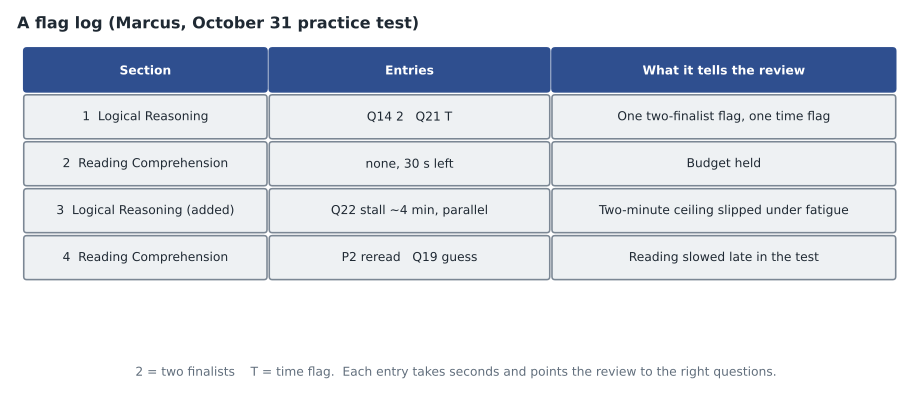
Marcus's notes for October 31 showed the pattern. In section 1, Logical Reasoning, he was at question 11 at minute 11 and question 19 at minute 22, slightly ahead of his checkpoints, with two flags. In section 2, Reading Comprehension, he kept to his per-set budget of about eight minutes forty-five seconds and finished with thirty seconds to spare. In section 3, the added Logical Reasoning section, he hit his first checkpoint but stalled on a parallel reasoning question near the end and spent nearly four minutes on it, despite his own two-minute ceiling. In section 4, Reading Comprehension again, he felt the fatigue in the second passage and reread a paragraph twice.
His flag log captured each of those moments in a few characters: "Q14 2" for two finalists, "Q21 T" for a time flag, "P2 reread". Harriet said the flag log is what turns a practice test into data. Without it, a candidate remembers a vague sense that section 3 went badly. With it, the candidate knows exactly which question cost the time and why.
Between sections and at the intermission
The moment between sections is short, but it matters. On the real test, the next section begins after a brief transition screen. In practice, Harriet asked the group to begin the next section within a minute of finishing the previous one, without reviewing their answers or looking at their scratch paper from the finished section. The temptation to dwell on a hard section is strong, and it is exactly the wrong habit. Each section is scored separately, and a candidate who carries a bad section into the next one often loses points twice.
At the intermission, Marcus stood up, walked around his apartment, drank water and ate a granola bar. He did not look at his phone. He was back at his desk with two minutes to spare. Harriet pointed out that on test day the return includes a recheck-in with staff, which took Marcus about a minute on November 12, so practising a return with a margin is sensible.
When things go wrong
Something usually goes wrong on a practice test, and how a candidate responds is part of what the practice trains. Marcus's stall on question 22 in section 3 was the main thing that went wrong on October 31. He described the moment frankly. He had narrowed the choices to two, felt he was close, and kept reading the stimulus again instead of choosing, flagging and moving on. When he finally looked at the clock, he had about four minutes left for the last four questions. He rushed them, got two wrong and guessed on one.
Harriet asked the group what Marcus should have done. Dani said he should have chosen one of the two finalists at two minutes and flagged it. Thomas said he should have checked the clock when he first felt stuck. Harriet agreed with both. The lesson was not that Marcus lacked the technique; he knew the two-minute ceiling well. It was that in the third section of a long test, with fatigue setting in, the technique slipped. That is precisely why full practice tests matter: they reveal which techniques hold under fatigue and which do not.
Other things can go wrong too: a sudden noise, a moment of panic, a passage that feels impenetrable. Harriet's advice was the same for all of them. Use the recovery routine from LSAT-140, a single slow breath and the phrase on your calm card, then go to the next question. A practice test is the place to learn that a bad moment does not have to become a bad section.
Finishing the test
When the fourth section ended, Marcus did three things before anything else. He wrote down, in a sentence or two, how the test had felt: "S3 stall cost time; S4 tired, reread P2. Otherwise steady." He noted any questions he remembered being unsure of that were not already in his flag log. And he did not look at the score.
This last point surprised the group. LawHub shows the score immediately after a test in simulated mode, and the temptation to look is strong. Harriet's advice was to avoid seeing the detailed results until blind review was complete, which Lesson 5 explains. If the score appears automatically on the screen, a candidate can note it and move on, but should not open the question-by-question results. The reason is simple: once you know which questions you got wrong, you cannot honestly redo them as if you did not know.
Marcus had taken a short break, had lunch and then begun his blind review the next morning, Sunday, November 1. Harriet said that rhythm, test one day and review the next, suited most people, because a full test is tiring and review needs a fresh mind.
What the test tells you
Marcus's scaled score on October 31 was 162, one point below his target and four points above his April 2025 official score of 158. But Harriet asked the group to look past the number. The test told Marcus three things: his pacing held through two sections; his two-minute ceiling slipped under fatigue in the third section; and his reading slowed in the fourth. Those three findings shaped his final ten days before November 12: one more timed section late in a long study session to rehearse the ceiling under fatigue, and a plan to use the intermission to reset fully before sections 3 and 4.
That is the general pattern for every full practice test. The score answers one question, "Where am I?" The flag log, the notes and the review answer a more useful one, "What should I do next?"
Practising the timed test as a skill
Several members found that taking full tests became easier with practice, not only because their skills improved but because the experience itself became familiar. Élodie said her first full test in September had felt overwhelming, with too many things to remember at once. By November, the routine was automatic: checkpoints written before starting, flags in the log, a reset at the intermission, no checking results before review. She compared it to rehearsing a piece of music until the fingering no longer needed thought, leaving attention free for the music itself.
Harriet said that was the aim. Every technique in LSAT-140 and this course should become automatic before test day, so that on the day itself a candidate's attention can go entirely to reading and reasoning. The only way to get there is repetition under real conditions.
Partial tests and timed sections
Not every timed practice session needs to be a full test. A single timed section, or two sections back to back, can build pacing and focus between full tests. Harriet's rule was that single sections should still follow the full routine: checkpoints, flag log, no pausing, no peeking. They should also be recorded, with the section type and raw score, so that they feed into the data used in Lesson 7.
What single sections cannot do is measure stamina or produce a scaled score. Harriet suggested that once a candidate is within six weeks of test day, most timed practice should be full tests, with single sections used for targeted work, as Lessons 8 and 9 describe.
Common mistakes
Using the score screen wisely
In simulated mode, LawHub may display a score at the end of the test. Seeing an overall number is not a serious problem for blind review, because it does not tell you which questions were right or wrong. But it can affect mood, and mood can affect review. A candidate who sees a disappointing score may rush the review or skip it; one who sees a pleasing score may review carelessly. Harriet suggested a simple routine: glance at the score, write it in the test record, and then close the screen and do something else before starting blind review the next day. "The number is one line in the record," she said. "The review is the rest of the page."
Several members found this harder than it sounded. Dani admitted that a low score in early October had put her off reviewing that test for nearly a week. When she finally reviewed it, she found that most of her misses came from two sections where she had rushed the last five questions, a pattern she could have addressed a week earlier. After that, she treated review as an appointment she kept regardless of the score.
A practice test is not a referendum
Harriet returned several times to the idea that no single practice test is a judgement on a candidate's ability or prospects. A test taken on a bad day, or on a form that happened not to suit a candidate, can produce a score several points below their average. A test on a good day can produce one several points above. What matters is the trend and what each test teaches. Marcus said that thinking of his practice tests as experiments rather than verdicts had made him calmer about them, and that the calm itself had helped his scores. Thomas put it another way: a practice test was a question he was asking himself, not an answer someone else was giving him.
Élodie added a practical point. She kept her test note and flag log on the same page, so that her review the next day started from a single sheet that showed both how the test had felt and where the time had gone.
Common mistakes
MistakeStarting a practice test in a rush.
InsteadUse the same short pre-test routine every time, including writing your checkpoints.
MistakeReviewing a finished section before starting the next.
InsteadBegin the next section within a minute and leave the last one behind.
MistakeRemembering a practice test only by its score.
InsteadKeep a flag log and write a two-sentence note at the end.
MistakeOpening question-by-question results before blind review.
InsteadDo blind review first; only then look at what was right and wrong.
MistakeTreating a slip in technique as a lack of knowledge.
InsteadUse full tests to find which techniques fail under fatigue, and rehearse those.
Summary and key terms
- A full practice test is a rehearsal; it is most useful when it follows a plan and produces notes.
- Begin with the same short routine every time, including writing your checkpoints.
- Apply LSAT-140's pacing techniques in every section, and use a flag log to record where time went.
- Leave each finished section behind, use the intermission as planned, and recover from bad moments quickly.
- Note how the test felt and avoid opening detailed results until blind review is complete.
- Pre-test routine
- A short, fixed sequence of steps before the first section, repeated every time.
- Flag log
- A short written record of flagged questions and where time went, kept during a test.
- Two-minute ceiling
- The rule to choose, flag and move on after about two minutes on any question.
- Section reset
- Starting each section fresh without dwelling on the previous one.
- Test note
- A one- or two-sentence summary of how a practice test felt, written before seeing results.
Practice problems
Work each problem on paper first, then reveal the answer to check.
What did Marcus write at the top of his first scratch page before starting?
Show answer
The date, the test number and his two pacing checkpoints.
What went wrong in section 3 of Marcus's October 31 test?
Show answer
He stalled for nearly four minutes on a parallel reasoning question despite his two-minute ceiling.
Why begin the next section within a minute?
Show answer
Dwelling on a finished section carries its effects into the next and can cost points twice.
Why avoid opening question-by-question results before blind review?
Show answer
Once you know which questions were wrong, you cannot redo them honestly.
What did Marcus's October 31 test tell him beyond his score of 162?
Show answer
His pacing held for two sections, his ceiling slipped under fatigue in section 3, and his reading slowed in section 4.
Lesson quiz · 5 questions
Score 60% or more to complete this lesson.
Create a free account to save your progress, take quizzes and earn a certificate.