
LSAT-150 · Lesson 7 of 12 · 19 min
Tracking weaknesses
▶ Video coming soon A video version of this lesson is on the way.
An error log records individual mistakes. Tracking weaknesses means stepping back and asking which kinds of question, which sections and which parts of the test cost the most points, and whether that is changing. The answers decide how to spend the hours left before test day. A candidate with forty hours to go who spends them evenly on everything will improve less than one who spends most of them where the points are.
Harriet ran this session as a working session. Each member brought their test record and error log, and she showed them how to turn the raw material into a few simple tables. "You do not need statistics," she said. "You need counts, percentages and the discipline to believe them."
Accuracy by question type
The most useful table is accuracy by question type. For each type, count how many questions of that type you have answered in recent full tests and timed sections, and how many you got right. Divide to get an accuracy rate. LawHub may help with some of this in its review tools; otherwise a spreadsheet or notebook works.
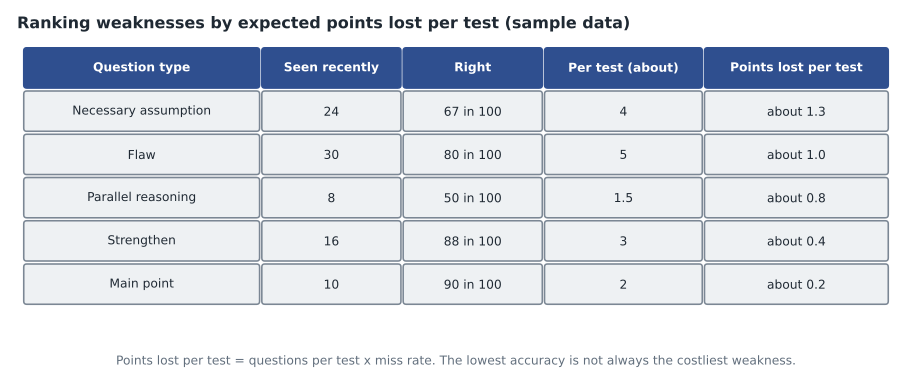
Accuracy alone is not enough, because question types appear with different frequencies. A type you get wrong half the time but that appears once per test costs less than a type you get wrong a quarter of the time that appears six times per test. Harriet asked the group to multiply: the number of questions of a type they expected to see per test, times their miss rate on it, gives the expected points lost per test. That is the number that ranks weaknesses.
Dani's table in November made the point. Her accuracy on parallel reasoning questions was low, but they appear only a few times per test. Her accuracy on necessary and sufficient assumption questions was higher, but those types together appear much more often, so they cost her more points overall. Her strengthen and weaken accuracy was already good. The table told her to put her next drilling hours into assumptions, with a smaller amount on parallel reasoning, not the other way round, as she had assumed.
How many questions make a pattern?
Small numbers mislead. A candidate who has seen four parallel reasoning questions and missed two has an accuracy of 50 in 100, but that could easily be bad luck. Harriet's rule of thumb was to treat a rate as meaningful only once a type had appeared at least fifteen or twenty times, and to treat changes of a few questions either way as noise. For rarer types, it helps to combine recent full tests with drill sets of that type, timed under the same per-question pace.
She also asked the group to separate recent data from old data. A candidate's accuracy on assumption questions in September says little about November if they have studied assumptions intensively since. Thomas's assumption accuracy had moved from about 41 in 100 in September to about 64 in the third week of October and about 70 by early November. An overall rate across the whole autumn would have understated where he now stood. Harriet suggested using roughly the last four weeks of data for decisions.
Accuracy by position
Difficulty tends to rise through a Logical Reasoning section, so accuracy by position, the first ten questions, the middle and the last seven or so, shows a different kind of weakness. A candidate who loses points early is usually rushing; one who loses points late is usually running out of time or making errors under pressure. Thomas's early-section misses in October, four careless errors in the first ten questions of a timed diagnostic, pointed straight at rushing, which the checkpoint work in LSAT-140 addressed.
For Reading Comprehension, the equivalent is accuracy by passage set and by passage type: science, law, humanities and social science, single and comparative. Marcus's table showed science passages consistently strong and humanities passages weaker, until his best humanities result in early November. Élodie's showed accuracy holding steady across passage types once her timing improved, which told her that her remaining Reading Comprehension misses were spread thinly rather than concentrated anywhere.
Accuracy by section order
The fatigue chart in LSAT-140 compared accuracy by section position across a full test: about 21 correct per section in sections 1 to 3 for the group on average, and about 18 in section 4. Every candidate should look at their own version of that chart over several full tests. A consistent drop in the fourth section points to stamina, which calls for more full-length practice and attention to the intermission and to the end of the test. A drop after the intermission, or in the first section, can point to warming up or resetting, which calls for a better routine.
Thomas's own drop, from about 22 to about 17, was the largest in the group. Harriet's advice for him was not to drill harder but to make every remaining full test a true four-section test, to rehearse a deliberate reset at the start of section 4, and to watch whether the drop narrowed by March.
Time per question
LawHub's review screens record time per question, which allows a further kind of tracking. For each question type, look at your average time and compare it with the time available, about one minute and twenty-four seconds per question in a 35-minute Logical Reasoning section of 25 questions. Types that take much longer than average are slowing you down even when you answer them correctly, and that time is taken from later questions.
Marcus found that his parallel reasoning questions averaged well over two minutes, even when correct. That was why his October 31 stall happened on one: the type was slow for him, and fatigue made it slower. The remedy was partly method, a faster way to compare structures, and partly policy: treat any parallel reasoning question that is not resolving quickly as a candidate for choose, flag and move on.
Turning tables into decisions
Harriet asked each member to finish the session by writing three priorities for the next two weeks, based on the tables, with a rough share of study time for each. The priorities had to be specific enough to plan drills around.
- Dani: necessary and sufficient assumption questions, about half of drill time; whose voice an answer expresses in Reading Comprehension, about a quarter; parallel reasoning, the rest.
- Thomas: pacing and the fourth-section reset in full tests; EXCEPT and NOT stems; and keeping his assumption accuracy where it was with one maintenance set a week.
- Élodie: full timed Reading Comprehension sections to keep her timing gains; trap answers that go beyond the passage; and one mixed Logical Reasoning set a week.
- Ji-won: cannot-be-true questions; keeping her accuracy on the last passage set as high as the first; and full tests under her accommodated timing.
- Marcus: waiting for December 2 before deciding anything; then, if he retested, parallel reasoning and principle questions.
Harriet said the lists were deliberately short. A candidate with ten priorities effectively has none. Two or three priorities for a fortnight, reviewed against new data at the end of it, is a plan that can actually be followed.
Watching strengths as well as weaknesses
Tracking weaknesses should not mean neglecting strengths. Skills that are not practised fade, especially under the stress of a test. Harriet suggested a small amount of maintenance practice in each area that was already strong, one mixed set a week, so that a strength did not quietly become a weakness. Thomas's Reading Comprehension, his strength from the start, got a timed set every week even while most of his time went elsewhere.
Strengths also carry information. A candidate's strongest areas show what good preparation looks like for them. Élodie noticed that her Logical Reasoning had improved fastest when she wrote out reasons for every answer choice in drills, and she applied the same habit to her Reading Comprehension drills, with good results.
Common mistakes
A worked example of the tables
Harriet showed how Thomas's tables guided his November decisions. His accuracy by question type was now fairly even across Logical Reasoning, with no type below about 70 in 100. His accuracy by position, however, showed a clear pattern: he lost more points in the first ten questions than in the middle of the section, which matched the rushing identified in LSAT-140. His section order table showed the largest fourth-section drop in the group. His time per question was below average on nearly every type.
Put together, the tables told a coherent story. Thomas's knowledge and methods were in good shape; his remaining points were being lost to speed in the wrong places and to fatigue at the end. That pointed away from more content study and toward disciplined pacing and stamina, exactly the priorities he chose. Harriet said a good set of tables should tell a story like this, and that when the tables seemed to contradict each other, it usually meant the data was still too thin.
Tracking with limited time
Some candidates find the idea of tables intimidating or time-consuming. Harriet's minimum version took fifteen minutes a week. After each full test, add the number of questions of each type and the number missed to a running tally. Once a week, compute the miss rate for the five most common types and multiply by how often each appears. That single list is enough to rank priorities. Position, passage type and time per question can be added for candidates who want more detail.
Dani, with the least free time in the group, used exactly this minimum version, in a notebook. It took her about a quarter of an hour on Sunday evenings. She said it was the best fifteen minutes of her week, because it told her what to do with the other hours.
Strengths that hide weaknesses
A strong overall accuracy on a broad category can hide a weakness within it. Élodie's Reading Comprehension accuracy was high by November, but when she split it by question family, author's attitude questions lagged slightly behind the others. Splitting it further by passage type showed that the lag came almost entirely from humanities passages, where tone is often subtle. That was a narrow, specific weakness, easy to drill once found and invisible in the overall number.
When the data says something surprising
Occasionally the tables contradict what a candidate believes about themselves. Marcus had long believed that Reading Comprehension was his weak section, because it felt harder. His tables showed that his Reading Comprehension accuracy was in fact close to his Logical Reasoning accuracy, and that his real weakness was a few slow Logical Reasoning types. Harriet said that kind of surprise was common, because difficulty that is felt is not always difficulty that costs points. The tables are there to replace feelings with evidence.
Revisiting the tables
Tables are only useful if they are updated. Harriet asked each member to update their tables after every full test and to revisit their priorities every two weeks. At each revisit, the question was the same: has the expected points lost on each priority fallen? If so, the candidate could move that priority to maintenance and choose the next one from the table. If not, the drill needed changing, as Lesson 8 explains.
Over the autumn, the group's priorities shifted several times. Dani's moved from conditional language in October to assumptions in November, and would move to parallel reasoning in December. Thomas's moved from assumption questions to pacing. Each shift came from the tables, not from a feeling that it was time for something new.
Harriet closed the session with a caution about over-tracking. A candidate who spends more time on tables than on practice has the balance wrong. The tables exist to choose what to practise; once they have done that, the practice itself is what moves the score. Fifteen minutes a week of tracking, she repeated, is usually enough for anyone, and the remaining hours belong to tests, review and drills.
Marcus, the engineer, admitted that he had enjoyed building his tables a little too much in October. By November his weekly tracking took him twenty minutes, and he said the rest of his time had become noticeably more productive.
Common mistakes
MistakeRanking weaknesses by accuracy alone.
InsteadRank them by expected points lost per test: frequency times miss rate.
MistakeDrawing conclusions from a handful of questions.
InsteadWait for fifteen or twenty questions of a type before trusting a rate.
MistakeUsing the whole autumn's data to judge current skill.
InsteadUse roughly the last four weeks of data for decisions.
MistakeIgnoring time per question on correct answers.
InsteadTrack slow question types, since their time is taken from later questions.
MistakeSetting ten priorities.
InsteadChoose two or three priorities for the next two weeks and review them against new data.
Summary and key terms
- Track accuracy by question type, by position in a section, by passage type and by section order.
- Rank weaknesses by expected points lost per test, combining frequency and miss rate.
- Trust rates only after fifteen or twenty questions, and use recent data for decisions.
- Track time per question to find slow types that cost later questions.
- Turn the tables into two or three priorities for the next fortnight, with maintenance for strengths.
- Accuracy by type
- The share of questions of a given type answered correctly in recent practice.
- Expected points lost
- The number of questions of a type expected per test multiplied by the miss rate.
- Positional accuracy
- Accuracy in the early, middle and late parts of a section.
- Maintenance practice
- A small regular amount of practice in strong areas so they do not fade.
- Priority list
- Two or three specific focuses for a fixed period, based on the data.
Practice problems
Work each problem on paper first, then reveal the answer to check.
How do you calculate expected points lost per test for a question type?
Show answer
Multiply the number of questions of that type expected per test by the miss rate.
How many questions of a type did Harriet want before trusting an accuracy rate?
Show answer
At least fifteen or twenty.
What does losing points early in a Logical Reasoning section usually indicate?
Show answer
Rushing.
How much time is available per question in a 35-minute section of 25 questions?
Show answer
About one minute and twenty-four seconds.
Why did Dani's table change her drilling plan?
Show answer
Assumption questions cost her more points overall than parallel reasoning because they appear more often.
Lesson quiz · 5 questions
Score 60% or more to complete this lesson.
Create a free account to save your progress, take quizzes and earn a certificate.