
LSAT-150 · Lesson 6 of 12 · 19 min
Error logs and categorizing mistakes
▶ Video coming soon A video version of this lesson is on the way.
Blind review shows which questions you missed and whether time or method was to blame. An error log turns those findings into a record you can learn from over weeks. Harriet had shared an error log template with the group in September, and by November each member's log ran to well over a hundred entries. This lesson explains what goes into a log, how to categorize mistakes so that patterns appear, and how to use the log without letting it become busywork.
Harriet's view of error logs was firm. "A practice test you do not log is a practice test you will repeat," she said. "Not the same questions, but the same mistakes."
What an entry contains
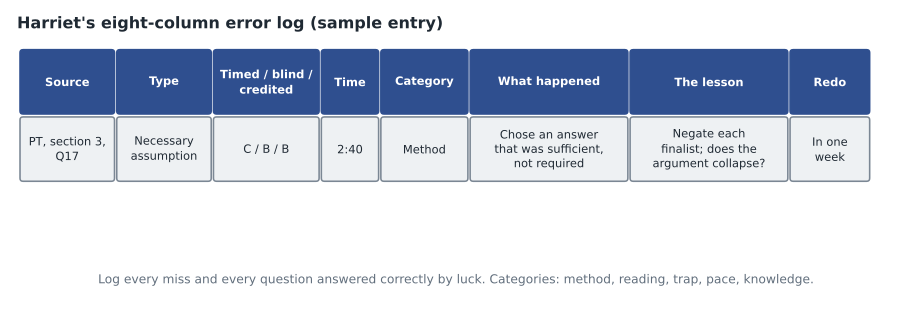
Harriet's template had eight columns. Each missed question, and each question answered correctly by luck, got one row.
- Source: the test number, section and question number, so the question can be found again.
- Question type: for example, flaw, necessary assumption, parallel reasoning, main point, inference or author's attitude.
- Timed and blind answers: what you chose under time and in blind review, and the credited answer.
- Time spent: from the LawHub review screen, if available.
- Category: the kind of mistake, explained below.
- What happened: one or two sentences in your own words describing exactly where your reasoning went wrong.
- The lesson: one sentence you could apply to the next question of this kind.
- Redo date: when you will try the question again from scratch.
Thomas found the "what happened" column the hardest at first. His early entries said things like "misread" or "fell for trap". Harriet pushed him to be specific: misread what, and how? Which trap, and why did it attract you? By November, his entries read more like this: "Read 'most' in the conclusion as 'all'; chose an answer that defended a universal claim the author never made. Lesson: underline every quantifier in the conclusion before reading the choices."
Categories of mistakes
The category column is what makes patterns visible. Harriet used five categories, broad enough to apply to every question and narrow enough to point to a remedy.
- Method: the approach to the question type was wrong or incomplete. For example, treating a sufficient assumption question like a necessary assumption question, or answering an inference question with a choice that needs outside support.
- Reading: the candidate misread the stimulus, the passage, the question stem or an answer choice. Missing "EXCEPT" in a stem, reading "some" as "most", or attributing a view to the author that the author only reported.
- Trap: the candidate understood the question but was drawn to an attractive wrong answer of a recognizable kind, such as an answer that is true but irrelevant, too strong, or a reversal of a conditional.
- Pace: the question was solvable, as blind review showed, but time pressure led to a rushed or skipped answer.
- Knowledge: the candidate did not know something the question assumed, such as the meaning of a word or a basic logical relationship.
Many misses involve more than one category. Harriet asked the group to choose the main one, the category whose remedy would most likely have prevented the miss. A question rushed because of a stall elsewhere is pace, even if the rushed reading also caused an error. A question missed in blind review because of a misread quantifier is reading.
Patterns in the group's logs
When the group compared their logs in mid-November, each member's pattern was different, and each pattern matched what the earlier courses had found.
Dani's log was dominated by method misses in conditional and parallel reasoning, consistent with her early difficulty with formal logic language, and by reading misses in Reading Comprehension about whose voice an answer expressed. Her remedy cards already reflected this: "Guaranteed is still possible", "Both vote. Same vote. Nobody abstains." and "Don't eliminate an answer for its wording; eliminate it for what it says."
Thomas's log had shifted over the autumn. In September, most of his misses were method misses on assumption questions. By November, they were mostly reading misses caused by rushing, such as missing a capitalized EXCEPT, and pace misses late in sections. That shift was itself a sign of progress: his method had become reliable, and what remained was discipline.
Élodie's log showed pace misses in Reading Comprehension in September and October, which had nearly disappeared by November, and a steady trickle of trap misses involving answers that went slightly beyond the passage, her "surinterprétation". Ji-won's log was the shortest, mostly trap misses on cannot-be-true questions, which she had addressed by sorting answer choices into bins. Marcus's log, after his October 31 test, was heavily weighted toward parallel reasoning and principle questions, as Lesson 5 described.
Using the categories to choose remedies
Each category points to a different kind of work. Method misses call for study of the question type: rereading the relevant lesson, working a set of that type untimed with written reasons for every choice, and only then timing it. Reading misses call for reading habits: underlining quantifiers, checking stems for EXCEPT and NOT, finding the sentence that supports an answer. Trap misses call for naming the trap: writing down the kind of wrong answer that attracted you and practising sets where you label every wrong choice by its kind. Pace misses call for the timing work of LSAT-140. Knowledge misses call for a short list of terms to learn.
Harriet suggested reviewing the log once a week, not after every test. A weekly review, the "Sunday error-log review" several members had adopted after LSAT-121, makes patterns visible that single tests hide. It also prevents the log from becoming a chore filled in mechanically and never read.
The redo column
The last column, the redo date, is where the log pays off. Harriet asked each member to redo every logged question from scratch about a week after logging it, and again a few weeks later if it was missed again. On the redo, the candidate should not look at the log entry first. If they get it right with the correct reasoning, the entry is marked done. If not, the entry gets a new date and a closer look.
Redoing questions is valuable because it tests whether the lesson has actually been learned. Writing "negate each finalist" in a log is easy; applying it automatically a week later is the real test. Ji-won described redos as the part of her preparation that most changed her timed scores, because each redo rehearsed exactly the decision she had once got wrong.
Some candidates worry that redoing a question they have seen before is pointless, since they may remember the answer. Harriet's response was that remembering the credited letter is useless; what matters is whether the candidate can explain why it is right and why each other choice is wrong. If you remember the letter but cannot explain it, you have not learned it. If you can explain it, you have.
Keeping the log manageable
Logs can grow until they feel overwhelming. Harriet suggested three ways to keep them useful. First, keep entries short: one or two sentences in the "what happened" column and one in "the lesson". Second, use the categories and question types to filter, so that a weekly review can focus on the most frequent kinds of miss. Third, retire entries once they have been redone successfully twice, so the active log contains only questions that still need work.
Élodie kept her log in a spreadsheet with a filter on each column. Dani kept hers in a notebook, with a coloured tab for each category, and transferred the lessons to index cards she kept at work. Marcus used a single text file with one line per entry, which he said suited an engineer. Harriet said the format did not matter; what mattered was that the log was used.
From log to cards
The final step is to turn the most important lessons into short reminders a candidate can carry into the test. Several members already had cards: Thomas's "HOLD THE CHECKPOINTS", Dani's five-line routine, Marcus's "A hard question is still one point". Harriet suggested that in the final weeks each candidate choose the five lessons from their log that had prevented the most misses and write them on a single card. On test day, with no notes allowed, those lessons should be in memory; the card is for rehearsal in the weeks before.
Common mistakes
An entry written well and badly
Harriet showed the group two versions of the same entry to make the point about specificity. The weak version read: "Q12, weaken, chose wrong answer, trap." The strong version read: "PT section 2 Q12, weaken. Timed D, blind B, credited B. 2 min 10 s. Trap. Chose D because it mentioned the same group as the conclusion, but D supported the argument slightly rather than weakening it. Lesson: before choosing, say whether the answer makes the conclusion more or less likely." The weak version tells a candidate nothing they can use. The strong version describes a trap they can recognize next time and a check they can apply.
Writing strong entries takes a few minutes more per question. Harriet argued that those minutes were the most valuable part of review, because they forced the candidate to understand the error well enough to describe it. A candidate who cannot describe a mistake has not yet understood it.
Patterns across categories
Some of the most useful patterns appear only when categories are combined with question types or positions. Dani noticed that her reading misses clustered in the last five questions of Logical Reasoning sections, which suggested that fatigue and time pressure were making her read less carefully late in a section, not that she read poorly in general. That insight shifted her remedy from general reading practice to pacing, so that she reached the final questions with more time and less pressure. Élodie noticed that her trap misses almost all involved answers that used strong language, such as "always", "never" or "proves", in questions where the passage supported only a moderate claim.
Logging pace misses honestly
Pace misses are the easiest category to under-report. A candidate who guessed on the last three questions of a section may be tempted to leave them out of the log, since they were never really attempted. Harriet asked the group to log them anyway, with the category "pace" and a note about where the time went. Over several tests, those entries show how many points are being lost to time each week, which is useful evidence for the timing work of LSAT-140 and for the readiness judgements of Lesson 4.
The log as a record of progress
An error log also records progress. Looking back over two months of entries, a candidate can see mistakes that used to be common and have now disappeared. Thomas found that his September entries on assumption questions, once a dozen a week, had dwindled to one or two by November. He said that seeing the change written down did more for his confidence than any practice score.
How long an error log takes
Members asked how much time the log should take. Harriet's estimate for a full practice test was thirty to forty-five minutes of logging after blind review, depending on the number of misses. That is a substantial part of the review time, but it is the part that turns a test into learning. Marcus logged his October 31 test in about thirty-five minutes. Dani, whose tests produced more entries, took closer to an hour in October and about forty minutes by November, as her entries became quicker to write and her misses fewer.
Harriet also suggested a rule for very long logging sessions: if logging a test takes more than an hour, log the method and reading misses in full and record pace misses in a single summary line for each section. Method and reading misses carry the most information; pace misses mainly show how much time was lost, which a summary captures.
Élodie added one refinement: she kept a short column of "near misses", questions she got right but slowly, because those were often the next questions she would get wrong under more pressure.
Common mistakes
MistakeWriting vague entries such as "misread" or "trap".
InsteadDescribe exactly what was misread or which trap attracted you, and why.
MistakeLogging only wrong answers.
InsteadLog questions answered correctly by luck too.
MistakeGiving every miss several categories.
InsteadChoose the main category, whose remedy would most likely have prevented the miss.
MistakeFilling in the log and never reading it.
InsteadReview it weekly and redo logged questions about a week later.
MistakeCounting a remembered letter as a successful redo.
InsteadA redo succeeds only if you can explain why the answer is right and the others wrong.
Summary and key terms
- An error log records every miss and lucky answer with its source, type, answers, time, category, explanation, lesson and redo date.
- Five categories point to remedies: method, reading, trap, pace and knowledge.
- Patterns across weeks show where to focus, and shifting categories can be a sign of progress.
- Redo logged questions about a week later without looking at the entry, and again if missed.
- Keep the log short, filtered and active, and turn its most useful lessons into reminders.
- Error log
- A record of missed and lucky questions, with what went wrong and what to do differently.
- Method miss
- A miss caused by a wrong or incomplete approach to the question type.
- Reading miss
- A miss caused by misreading the stimulus, passage, stem or a choice.
- Trap miss
- A miss caused by an attractive wrong answer of a recognizable kind.
- Redo
- Working a logged question again from scratch to test whether the lesson was learned.
Practice problems
Work each problem on paper first, then reveal the answer to check.
What are Harriet's five categories of mistakes?
Show answer
Method, reading, trap, pace and knowledge.
How should a question rushed because of an earlier stall be categorized?
Show answer
As pace, since time pressure was the main cause.
How had Thomas's log changed from September to November?
Show answer
From mostly method misses on assumption questions to mostly reading and pace misses from rushing.
When should a logged question be redone?
Show answer
About a week after logging, without looking at the entry, and again later if missed.
When does Harriet retire a log entry?
Show answer
After it has been redone successfully twice.
Lesson quiz · 5 questions
Score 60% or more to complete this lesson.
Create a free account to save your progress, take quizzes and earn a certificate.