
LSAT-150 · Lesson 10 of 12 · 19 min
Plateaus and adjusting the study plan
▶ Video coming soon A video version of this lesson is on the way.
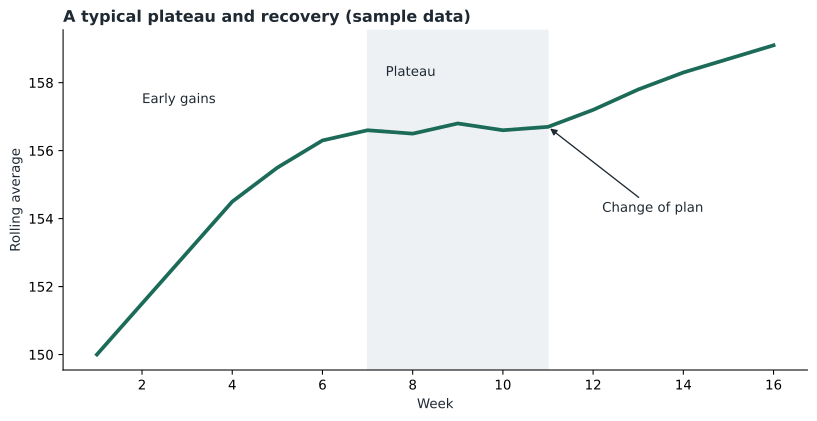
Almost every candidate hits a plateau at some point: several weeks in which practice scores stop rising despite steady work. Plateaus are discouraging, and they lead to two common mistakes. Some candidates keep doing exactly what they were doing, harder, hoping the scores will move. Others abandon their plan entirely and try something new every few days. This lesson explains why plateaus happen, how to tell a real plateau from normal variation, and how to adjust a study plan, including the decision to change a test date.
Harriet had seen hundreds of plateaus over eleven years of tutoring. "A plateau is information," she told the group. "It tells you that what got you here will not get you further. That is useful to know."
Is it really a plateau?
The first question is whether scores have actually stopped rising. As Lesson 4 explained, single practice scores move up and down by two or three points from test to test. A run of three scores at 156, 154 and 157 after an earlier 158 may feel like stagnation or even decline, but it is consistent with a stable ability around 156, and that may itself be a gain from a month before. Harriet's test for a plateau was a rolling average that had not risen for about four weeks of steady, reviewed practice under good conditions.
Other measures can show progress even when the score is flat. A shrinking timed-to-blind gap, rising accuracy on a priority question type, faster time per question or a smaller fourth-section drop all suggest that skills are improving, and that the score may follow. Dani's rolling average stayed near 153 for three weeks in late October and early November, but her assumption accuracy and her conditional translation scores had risen sharply in that period. Harriet told her the score was likely to follow, and that the work was paying off in the places it should.
Why plateaus happen
Plateaus usually have one of a few causes.
- The easy gains are gone. Early in preparation, learning the structure of the test and the basic methods produces quick gains. Later, each point requires mastering harder questions, which takes longer, as the percentile curve in Lesson 4 suggested.
- The plan targets the wrong things. A candidate still drilling their strongest question types, or practising untimed when the problem is pace, will not move.
- Practice without review. A candidate taking many tests but reviewing few repeats the same mistakes.
- Fatigue or burnout. Long hours of study for weeks without rest can lower performance, especially for candidates who also work full time.
- Conditions have changed. Tests taken at a worse time of day, with less sleep or with more interruptions produce lower scores that look like a plateau.
Each cause calls for a different response, which is why diagnosing the cause matters more than reacting to the score.
Responding to a plateau
Harriet's response to a plateau began with the data from Lessons 5 to 7. If the timed-to-blind gap is large, the problem is pace, and the plan should shift toward timed practice, checkpoints and full tests. If the gap is small and the score is below target, the problem is method, and the plan should shift toward untimed study of the question types costing the most points. If the error log shows the same mistakes recurring, the review process needs attention: deeper "what happened" entries, more redos. If the test record shows long hours with no rest days, the plan needs rest.
Thomas had a short plateau in October, when his rolling average sat at 155 for about four weeks. His tables showed his assumption accuracy still climbing, but his early-section careless errors growing, as he rushed to finish. The plateau was a pacing problem disguised as a content problem. Once he adopted Harriet's checkpoints in LSAT-140 and stopped trying to beat them, his early errors fell and his average moved to 157.
Rest is part of the plan
Harriet was blunt about rest. Candidates who study every day for months without a break often perform worse than those who take a regular day off. Concentration, reading speed and patience all suffer under sustained fatigue, and the LSAT rewards all three. She asked each member to keep at least one day a week completely free of LSAT work, and to take a longer break of two or three days after any full test that left them exhausted.
Dani, with a full-time job and a long commute, was most at risk. In early October she had been studying every evening and both weekend days. Her error log in that period showed an increase in reading misses, which Harriet attributed partly to tiredness. Dani took Sundays off from mid-October, apart from occasional clinics, and her reading misses fell. She said the day off had felt like a loss at first and then like a relief.
Changing the plan without starting over
Adjusting a plan is different from abandoning it. Harriet's rule was to change one or two things at a time and to give each change two weeks before judging it. Changing everything at once makes it impossible to tell what worked. Changing things every few days does not give any change time to show results.
A typical adjustment might replace one weekly drill session on a strong area with one on a weak area, or add a timed section in the middle of the week, or move a full test to a better time of day. Each adjustment should be written down with the date, so that the test record shows when it began and whether the numbers moved afterwards.
Changing a test date
Sometimes the right adjustment is a different test date. A candidate whose rolling average is well below target a few weeks before the test, despite good preparation, may do better to test later. Harriet's view was that a later date makes sense if three things are true: there is a realistic reason to expect further improvement, such as a clear weakness still being addressed; the application timeline allows it; and the candidate can sustain preparation for longer. A later date makes less sense if the candidate is near their target and simply anxious, or if the delay would push them past the deadlines they care about.
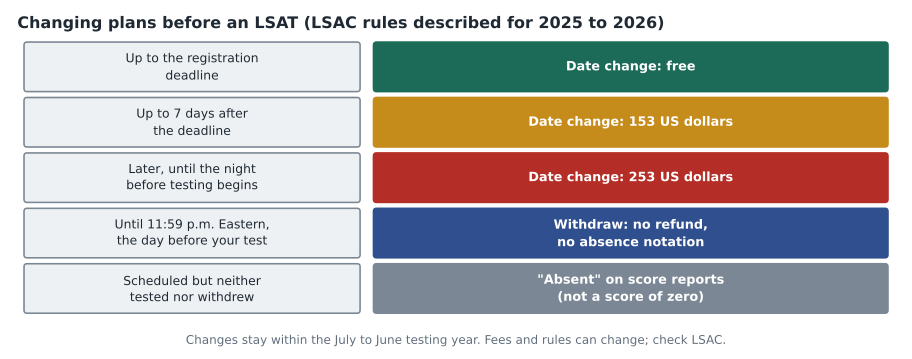
LSAC's rules affect the timing of that decision. For the 2025 to 2026 administrations, LSAC's date change page described a free date change up to the registration deadline for the current test, a fee of 153 US dollars for a change requested within seven days after that deadline, and 253 US dollars after that, until 11:59 p.m. Eastern time on the night before the first day of testing. Changes must stay within the testing year, which runs from July to June, with an exception allowing a move from the last test of one year to the first of the next. A candidate may also withdraw by 11:59 p.m. Eastern time on the day before the test; a withdrawal is not refunded, but it prevents an absence notation from appearing on the candidate's LSAC file. Fees and rules can change, so check LSAC's current pages before deciding.
Not showing up without withdrawing has a cost. According to LSAC, a candidate who has scheduled a testing time and neither tests nor withdraws receives an "Absent" designation on score reports sent to schools. LSAC says this is not considered a score of zero and does not affect reportable scores already on file, but it is avoidable. Absences and withdrawals do not count toward LSAC's testing limits, as LSAT-101 explained; cancelled scores do.
The group's decisions
In mid-November, Harriet asked each January tester to write down the conditions under which they would change their date, while they were calm and well before the December 1 registration deadline for January. Élodie's rule was that she would keep her January 16 appointment unless her rolling average fell below 158 by Christmas. Dani's rule was more complex, because her target of 156 was only three points above her rolling average: she would keep her January date if her average reached 155 by mid-December, and otherwise move to the February administration, which LSAT-101's notes showed was February 12 to 13, 2027, with a registration deadline of December 29. Ji-won, already above her target under her accommodated timing, planned to keep her date regardless.
Thomas, testing in April, had the luxury of time and set a checkpoint for the end of February: if his rolling average was below 160 then, he would consider the June administration instead. Marcus's decision depended on his November score, due December 2, and his rule to keep it only if above 158.
Harriet said the point of writing the rules in advance was not to remove judgement but to protect it. A candidate deciding at 11 p.m. after a bad practice test is not deciding well. A candidate following a rule written three weeks earlier, with room to discuss it with a tutor or a friend, usually is.
Plateaus and confidence
Finally, plateaus affect confidence, and confidence affects performance. Harriet asked the group to keep a short list of evidence of progress: blind review scores that had risen, question types that had gone from weak to strong, timing that had improved. When a plateau made them doubt themselves, the list was a reminder that the work was real. Élodie's list started with her September Reading Comprehension section, 18 of 27 with five guesses, and ended with her November capstone, finished with forty seconds to spare and no guesses.
Common mistakes
Plateaus in specific sections
Sometimes the overall score keeps rising slowly while one section stalls. Ji-won's Logical Reasoning had improved steadily, but her Reading Comprehension sat at about the same raw score for most of October. Her tables showed that her accuracy on the last passage set was the problem, not any particular question family. The plateau was a pattern of care that faded late in the section, not a gap in skill. Once she adopted the last-set drill in Lesson 9, her Reading Comprehension moved again.
A section-level plateau is easier to diagnose than an overall one, because the possible causes are fewer. Harriet suggested checking section-level trends whenever the overall rolling average slows, since the overall number often hides one section that has stopped while another continues to rise.
Plateaus near the target
Plateaus near the target are a special case. A candidate whose rolling average has settled one or two points below the target may be at the natural limit of their preparation time, or close enough that normal variation on test day could take them either way. Harriet's advice in that case was not to change the plan dramatically, but to consolidate: protect the gains, keep stamina sharp with full tests, reduce careless errors, rest well and test. The expected score is close to the target, and the score band means the real result could land on either side.
Élodie was in exactly this position in mid-November: a rolling average of 160 against a target of 162. Harriet told her that the remaining two points were most likely to come from eliminating the trap misses still in her log and from arriving rested, not from new study. Élodie said that was a relief, because she had been preparing to add more hours to an already full schedule.
When to ask for help
Some plateaus resist every adjustment a candidate can make alone. Harriet suggested that a candidate who had been stuck for six weeks or more, despite reviewing every test, keeping a log and adjusting the plan, should ask someone else to look at their work: a tutor, a study partner or a friend who had done well on the test. A fresh pair of eyes often spots a habit the candidate cannot see, such as a consistent misreading of one kind of stem or a pacing pattern hidden in the flag log.
Common mistakes
MistakeCalling three flat scores a plateau.
InsteadLook for a rolling average that has not risen for about four weeks of good practice.
MistakeWorking harder at the same plan during a plateau.
InsteadDiagnose the cause with the data and change what the data points to.
MistakeChanging everything at once.
InsteadChange one or two things and give each change two weeks.
MistakeStudying every day without rest.
InsteadKeep at least one day a week free and rest after exhausting full tests.
MistakeSkipping the test without withdrawing.
InsteadWithdraw by 11:59 p.m. Eastern the day before to avoid an absence notation.
Summary and key terms
- A real plateau is a rolling average that has not risen for about four weeks of good practice.
- Plateaus come from exhausted easy gains, mistargeted plans, lack of review, fatigue or worse conditions.
- Diagnose the cause with the timed-to-blind gap, the error log and the tables, and change one or two things at a time.
- Rest is part of the plan; keep at least one day a week free.
- Know LSAC's date change and withdrawal rules, and write date-change rules in advance.
- Plateau
- A period in which the rolling average stops rising despite steady practice.
- Date change
- Moving an LSAT registration to another administration within the testing year, with fees after the registration deadline.
- Withdrawal
- Cancelling a registration by 11:59 p.m. Eastern the day before the test, without refund, avoiding an absence notation.
- Absent designation
- A notation on score reports for a candidate who scheduled a time but neither tested nor withdrew.
- Decision rule
- A condition, written in advance, for changing a test date or keeping a score.
Practice problems
Work each problem on paper first, then reveal the answer to check.
What was Harriet's test for a real plateau?
Show answer
A rolling average that had not risen for about four weeks of steady, reviewed practice under good conditions.
What did Thomas's October plateau turn out to be?
Show answer
A pacing problem, with rushing causing early-section careless errors.
Until when can a candidate withdraw from an LSAT?
Show answer
Until 11:59 p.m. Eastern time on the day before the test.
What happens if a candidate schedules a time but neither tests nor withdraws?
Show answer
An Absent designation appears on score reports sent to schools.
What was Dani's rule for her January date?
Show answer
Keep it if her rolling average reached 155 by mid-December; otherwise move to February.
Lesson quiz · 5 questions
Score 60% or more to complete this lesson.
Create a free account to save your progress, take quizzes and earn a certificate.