
LAWC-304 · Lesson 9 of 12 · 22 min
Water and surface rights
▶ Video coming soon A video version of this lesson is on the way.
The ninth class begins with Professor Mawhinney reading a short letter aloud. It is from Dragana Ruskovich, who runs the family ranch with her brother, and it has been anonymized only by changing the names. 'Your company has a well on our north quarter that has not produced in five years,' it reads. 'You stopped paying our annual rental two years ago. Your trucks still use our road. And this summer, when the creek ran low, the province told us we could not take water for our cattle because a licence with an earlier date comes first. Who is responsible for any of this?'
Mawhinney puts the letter down. 'Water and surface rights,' she says, 'are where resource law meets the people who live on the land. Dragana Ruskovich does not care about section 92A. She cares about her road, her rent and her creek.' The lesson covers both subjects: who owns and controls water in Canada, how water licences work in Alberta, how other provinces differ, and how resource companies gain access to private land and what they owe the owner when they do.
Who owns water?
At common law, flowing water could not be owned in the ordinary sense. Owners of land along a watercourse, called riparian owners, had rights to use it, including the right to receive the natural flow undiminished in quantity and quality, subject to the reasonable use of other riparian owners upstream and downstream. The leading nineteenth century statement of riparian rights in the Commonwealth is Miner v. Gilmour (1859), 12 Moo. P.C. 131, a Privy Council appeal from Lower Canada. Riparian rights remain the starting point in Ontario and the Atlantic provinces, although statutes have greatly limited them.
The western provinces abandoned riparian rights for a different system. Because water in the west was scarce and needed for irrigation and mining, the federal government and later the provinces vested ownership of water in the Crown and allocated it through licences. Alberta's Water Act provides that the property in and the right to the diversion and use of all water in the province is vested in the Crown in right of Alberta. Saskatchewan and British Columbia have similar provisions. Quebec took yet another approach: a 2009 statute affirms the collective nature of water resources, declaring that water is part of the common heritage of the Quebec nation and that its use requires authorization.
Licences and priority in Alberta
In Alberta, a person who wants to divert water for most purposes other than household use needs a licence under the Water Act. Licences specify a source, a volume, a purpose and a priority number based on the date the application was filed. In a shortage, licences are honoured in order of priority: first in time, first in right. Senior licences, often held by irrigation districts and municipalities with priority dates in the early twentieth century, are satisfied before junior licences. Household users, who use small volumes for domestic purposes, have a statutory right that takes precedence over licences. Farmers who had used water for livestock and similar traditional agricultural purposes before 1999 could register their use and keep its original priority.
That is why Dragana Ruskovich was told she could not take water. If her family relies on a licence or registration with a later priority than another licence on the creek, and the creek cannot satisfy both, the senior licence comes first. Hannah Kowalczyk explains how this plays out in a drought. 'In 2023 and 2024, the province negotiated water sharing agreements with the biggest licence holders in the south,' she says. 'Senior licensees agreed to take less than their full rights so that junior users would not be cut off completely.' Mawhinney says that such voluntary agreements show both the strength and the limits of the priority system: it gives certainty to senior holders, but in a real shortage it can produce results that no one considers fair.
The southern river basins have been closed to most new licence applications since 2006, when the province approved a water management plan for the South Saskatchewan River basin. In a closed basin, new users must acquire water by transferring all or part of an existing licence, with the approval of the regulator, and the government may hold back up to ten percent of the transferred volume to protect the aquatic environment. Transfers have become an important market mechanism, but each one is reviewed for its effects on other users.
Water for oil and gas operations is licensed in the same way. Hydraulic fracturing can use large volumes, and operators are encouraged to use saline groundwater or recycled water instead of fresh surface water. For energy projects, the Alberta Energy Regulator administers the Water Act, so Gannet applies to the same regulator for its water licences as for its wells.
| Feature | Alberta | British Columbia | Ontario |
|---|---|---|---|
| Ownership | Crown (Water Act) | Crown (Water Sustainability Act) | Riparian rights at common law, subject to statute |
| Allocation | Licences ranked by priority date | Licences ranked by priority date; groundwater licensed since 2016 | Permits to take water above a daily threshold |
| Domestic use | Statutory household right | Domestic groundwater use exempt from licensing | Generally exempt |
| Shortage | First in time, first in right | First in time, first in right, with powers to protect critical flows | Permit conditions and drought response plans |
| Transfers | Allowed with approval, especially in closed basins | Limited, with approval | Permits are not generally transferable as property |
British Columbia and Ontario
British Columbia replaced its Water Act with the Water Sustainability Act, which came into force on February 29, 2016. The most important change was the licensing of groundwater for non-domestic use, which had previously been unregulated. Existing groundwater users were given a transition period to apply for licences and keep a priority based on their historical use. The statute also strengthened the province's powers to protect environmental flows during drought.
Ontario regulates water withdrawals through permits to take water under the Ontario Water Resources Act. A permit is generally required to take more than 50,000 litres a day. The permit system sits on top of common law riparian rights and has largely displaced them for significant uses. Sophie Tremblay-Hart notes that both Quebec and Ontario participate with the Great Lakes states in an agreement that bans most large diversions of water out of the Great Lakes and St. Lawrence basin. Mawhinney says that agreement, and the international Boundary Waters Treaty of 1909, are reminders that some water law is not provincial at all.
Water contamination and regulator immunity
Water and oil and gas meet most painfully when groundwater is contaminated. Ernst v. Alberta Energy Regulator, 2017 SCC 1, arose from a landowner's claim that hydraulic fracturing by a gas company had contaminated her well water, and that the regulator's predecessor had treated her as a security threat and refused to communicate with her after she criticized it publicly. She sought damages from the regulator for breach of her Charter right to freedom of expression. The regulator relied on an immunity clause in its statute barring actions against it.
A majority of the Supreme Court held that the immunity clause barred the claim. Four judges, in reasons by Justice Cromwell, concluded that Charter damages would not be an appropriate and just remedy against a quasi-judicial regulator of this kind, so the clause did not need to be justified. Justice Abella concurred in the result on the basis that the landowner had not given notice of a constitutional challenge to the clause. Four judges dissented. Her separate claims against the gas company and the province continued in the Alberta courts. Daniel Whitecloud observes that the case shows how hard it is to hold a regulator itself liable. Mawhinney agrees. 'The usual targets are the operator, which caused the harm, and sometimes the province. The regulator is usually protected.'
Surface access
Resource development requires access to the surface. Under the common law, the owner of a mineral estate had an implied right to use as much of the surface as was reasonably necessary to work the minerals. In Alberta and the other producing provinces, that common law right has been replaced by statute. An operator that wants to drill a well, build a pipeline or construct a facility on private land must obtain either the consent of the owner and occupant, usually through a surface lease, or an order granting a right of entry.
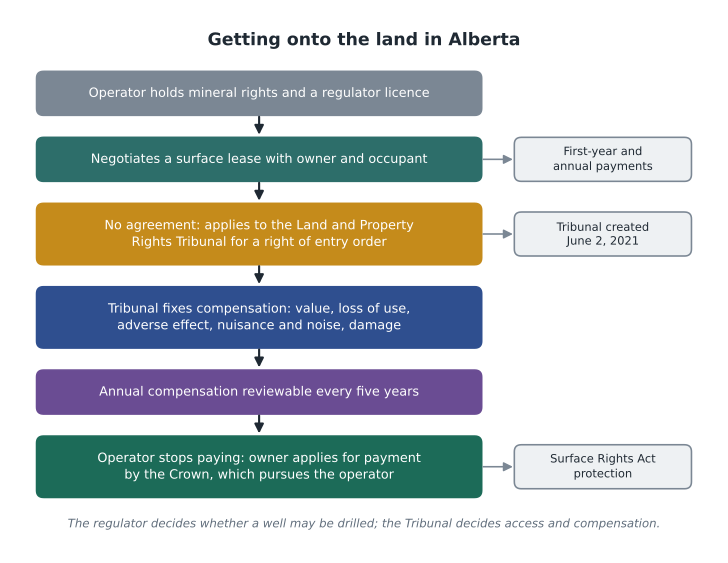
In Alberta, rights of entry are granted under the Surface Rights Act by the Land and Property Rights Tribunal, which was created on June 2, 2021 by combining the former Surface Rights Board with the Land Compensation Board and other tribunals. An operator applies after it has a licence from the regulator and has failed to reach agreement. The tribunal grants entry and fixes compensation. The statute lists the factors the tribunal may consider, including the value of the land, the loss of use of the land taken, the adverse effect on the rest of the owner's land, nuisance, inconvenience and noise, and damage to the land. Compensation usually consists of a first-year payment and an annual payment for continuing loss of use and adverse effect. Either party may ask for the annual payment to be reviewed every five years.
Most operators negotiate surface leases instead of seeking orders, and the tribunal's decisions on compensation shape the terms of those negotiations. Leases typically cover the well site, an access road and sometimes pipelines, and include terms on fencing, weed control, gates and notice before entry.
Unpaid rentals and abandoned sites
When an operator stops paying annual compensation under a surface lease or a tribunal order, the landowner may apply to the tribunal for payment by the government of Alberta under the Surface Rights Act. If the tribunal finds that the operator has defaulted, the government pays the landowner and then seeks to recover the amount from the operator. This protection has become important as many small operators have failed. Landowners can also ask the regulator to require the operator to abandon and reclaim an inactive well, using the tools described in lesson 5.
Theo Marchetti raises a practical point. 'A lot of the time, the landowner wants the well gone more than the rent paid.' Mawhinney says that is common, and that an inactive well with an access road is a burden on farming operations. The landowner cannot remove the well itself, but it can press the regulator to issue a closure order, and if the operator becomes defunct, the Orphan Well Association will eventually do the work.
Federal pipelines across private land
For interprovincial pipelines, surface access is governed by the Canadian Energy Regulator Act. After a pipeline route is approved, landowners can object to the detailed route through a hearing before the regulator. If the company cannot reach agreement with a landowner, it may apply to the regulator for a right of entry order, and compensation is settled through negotiation, mediation or arbitration under the federal statute. The federal regime also gives landowners protection for damage caused by pipeline operations and makes pipeline companies liable without proof of fault for spills from major pipelines, up to set limits.
Advising Dragana Ruskovich
Mawhinney asks the class to answer the letter. On the unpaid rental, the Ruskovich family can apply to the tribunal for payment by the Crown, and the province will pursue Gannet. On the inactive well, they can ask the regulator to require Gannet to abandon and reclaim it, and Gannet's mandatory closure spending obligation gives the regulator leverage. On the road, Gannet's surface lease or right of entry order defines the area it may use; if its trucks are using land outside that area, it is a trespass. On the water, the family's rights depend on whether they hold a licence or registration and its priority, and whether they have a household right for domestic use; a water sharing arrangement with senior licensees may be the only practical solution in a dry year. Mehta adds one more suggestion: check whether Gannet's own water licence on the creek is junior to the family's registration, in which case Gannet, not the family, should have been the one to stop diverting.
Worked problem
A right of entry hearing
Gannet wants to drill a new well on the Ruskovich south quarter, which is under cultivation. The family refuses to sign a lease because of a dispute over the north quarter. Gannet holds the freehold mineral lease and has a well licence from the Alberta Energy Regulator. What happens next, and how will compensation be set?
Show solution
- Statutory route: because the family will not consent, Gannet applies to the Land and Property Rights Tribunal for a right of entry order under the Surface Rights Act. The tribunal does not decide whether the well should be drilled, which the regulator has already decided.
- Entry: if Gannet has the necessary licence and has tried to negotiate, the tribunal will usually grant entry, with conditions on the area used and on fencing and access.
- Compensation factors: the tribunal considers the value of the land taken, loss of use of the well site and road, adverse effect on the rest of the field (for example, working around the site with equipment), nuisance, inconvenience and noise, and any damage.
- Form of payment: typically a first-year payment and annual compensation, reviewable every five years.
- Default protection: if Gannet later stops paying, the family can apply to the tribunal for payment by the Crown, which will then pursue Gannet.
Common mistakes
MistakeAssuming that landowners in Alberta own the water flowing across their land.
InsteadAlberta's Water Act vests property in and the right to use all water in the Crown; use requires a licence, registration or statutory household right.
MistakeTreating water licences in Alberta as shared equally in a shortage.
InsteadLicences are honoured by priority date, first in time, first in right, although voluntary sharing agreements may be negotiated.
MistakeThinking that the surface rights tribunal decides whether a well should be drilled.
InsteadThe regulator decides whether to license the well; the tribunal decides access and compensation.
MistakeAssuming that a landowner whose operator stopped paying rent has no remedy if the operator is insolvent.
InsteadUnder the Surface Rights Act, the landowner can apply for payment by the Crown, which then pursues the operator.
MistakeReading Ernst (2017) as holding that regulators can never be liable for Charter damages.
InsteadErnst held that the particular statutory immunity barred the claim; the reasoning was divided and depended on the regulator's quasi-judicial role and the procedural posture.
Practice problems
Work each problem on paper first, then reveal the answer to check.
What is the difference between riparian rights and prior allocation?
Show answer
Riparian rights give owners of land along a watercourse rights to its natural flow, subject to others' reasonable use. Prior allocation vests water in the Crown and grants licences ranked by priority date, so that senior licences are satisfied first in a shortage.
What happens when a new user wants water in a closed basin in southern Alberta?
Show answer
It must acquire water by an approved transfer of all or part of an existing licence, and the government may hold back up to ten percent of the transferred volume to protect the aquatic environment.
Name four factors the Land and Property Rights Tribunal may consider in setting surface compensation.
Show answer
Any four of: the value of the land; loss of use; adverse effect on the remaining land; nuisance, inconvenience and noise; and damage to the land.
What did British Columbia's Water Sustainability Act change in 2016?
Show answer
It brought non-domestic groundwater use under licensing for the first time, with a transition period for existing users to keep a priority based on historical use, and strengthened powers to protect environmental flows.
Summary and key terms
- Riparian rights remain the base of water law in Ontario and the Atlantic provinces; the western provinces vest water in the Crown and allocate it by licence and priority.
- In Alberta, licences are ranked first in time, first in right; household users have a statutory right; southern basins have been closed to new licences since 2006, and transfers fill the gap.
- British Columbia licensed groundwater from 2016; Ontario uses permits to take water above 50,000 litres a day; Quebec treats water as common heritage.
- Ernst (2017) held that a statutory immunity barred a Charter damages claim against Alberta's energy regulator.
- Surface access in Alberta requires agreement or a right of entry order from the Land and Property Rights Tribunal, which sets compensation using statutory factors and can order the Crown to pay when an operator defaults.
- Riparian owner
- An owner of land bordering a watercourse, with common law rights to its natural flow.
- Prior allocation
- A system in which water rights are ranked by the date they were granted, first in time, first in right.
- Priority number
- The ranking of an Alberta water licence, based on the date the application was filed.
- Closed basin
- A river basin where no new licences are issued, so new users must obtain transfers.
- Surface lease
- An agreement between an operator and a landowner allowing use of the surface for a well, road or facility, with compensation.
- Right of entry order
- An order of the Land and Property Rights Tribunal granting an operator access to land without the owner's consent.
- Annual compensation
- Recurring payments to a landowner for continuing loss of use and adverse effect, reviewable every five years.
Lesson quiz · 5 questions
Score 60% or more to complete this lesson.
Create a free account to save your progress, take quizzes and earn a certificate.