
LAWC-304 · Lesson 7 of 12 · 21 min
Electricity markets and the energy transition
▶ Video coming soon A video version of this lesson is on the way.
Arjun Mehta has been waiting for this lesson since the first week. Before law school he worked on a transmission upgrade in southern Ontario, and he arrives at the seventh class with a printout of a provincial supply mix chart. Professor Mawhinney lets him explain it. 'Electricity is the only product where supply has to match demand every second,' he says. 'If it does not, the frequency drifts and the grid fails. Everything else follows from that.' Mawhinney adds the legal version. 'And every province has decided differently who should be responsible for keeping the lights on.'
Gannet Ridge has its own electricity problem. Its gas plant uses a great deal of power, and its board is considering a solar farm on the Ruskovich ranch and a contract to sell some of its own gas to a natural gas power plant that a data centre developer wants to build in the County of Sable Hills. Each idea depends on Alberta's electricity market and on federal climate rules that are changing as the course is taught.
This lesson covers the constitutional basis for electricity regulation, the provincial market models, Alberta's market and its restructuring, the federal Clean Electricity Regulations and the litigation over them, the Canada and Alberta agreements of 2025 and 2026, and the Churchill Falls cases on long-term electricity contracts.
Constitutional basis
Electricity generation is primarily provincial. Section 92A(1)(c), discussed in lesson 1, gives provinces exclusive power over the development, conservation and management of sites and facilities for the generation and production of electrical energy. Distribution and intraprovincial transmission fall under property and civil rights and local works. Federal jurisdiction applies to international and designated interprovincial power lines, to exports of electricity outside Canada, to nuclear facilities through the declaratory power and the national concern doctrine, and, through the criminal law and national concern powers, to some environmental standards that affect generators.
Four provincial models
Canadian provinces have taken different paths. Some kept vertically integrated Crown utilities that generate, transmit and distribute power under rate regulation. Others introduced competition into wholesale markets. The result is a set of systems that are hardly connected to each other and are governed by quite different laws.
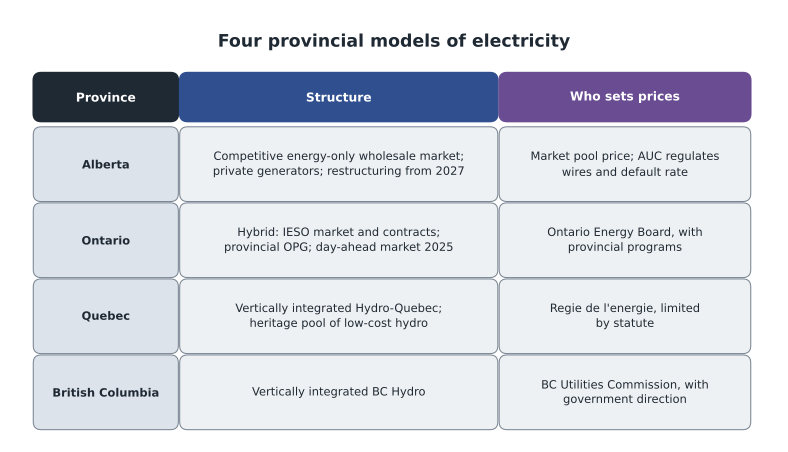
In Quebec and British Columbia, large hydroelectric Crown corporations dominate. Hydro-Québec's rates for most customers are regulated by the Régie de l'énergie, but Quebec's legislature has repeatedly limited rate increases by statute. A heritage pool of low-cost hydro supply is reserved for Quebec customers. In British Columbia, BC Hydro is regulated by the BC Utilities Commission, although the government directs important policy choices, such as major projects like the Site C dam, which came into service in 2024 and 2025.
Ontario has a hybrid system. The Independent Electricity System Operator runs the grid and a wholesale market, and procures new generation and storage under long-term contracts. Ontario Power Generation, a provincially owned company, operates the province's nuclear and large hydro plants. The Ontario Energy Board sets rates for distribution and for some of OPG's output, while provincial programs reduce bills for many customers. Ontario's wholesale market was redesigned in 2025, when the operator introduced a day-ahead market as part of its market renewal program.
Alberta's competitive market
Alberta is the outlier. Under the Electric Utilities Act, it began restructuring in 1996 and opened a fully competitive wholesale market in 2001. Generators are privately owned and are not rate-regulated. They offer their power into an energy-only market operated by the Alberta Electric System Operator, which dispatches the cheapest offers first and sets an hourly pool price. Retail customers can choose competitive retailers or a regulated default rate. Transmission and distribution remain regulated monopolies under the Alberta Utilities Commission.
The Market Surveillance Administrator monitors the market and enforces rules against anticompetitive conduct, such as economic withholding of capacity in ways that are not permitted. Generators cannot collude, but within the rules they may offer power at prices above their costs when supply is tight. Supporters say that this is what attracted billions of dollars of private investment, including large renewable projects. Critics point to price spikes and volatility.
Hannah Kowalczyk explains why the system is changing. 'When coal plants closed and wind and solar grew, prices became more volatile and reliability became harder to manage,' she says. Alberta's response is the restructured energy market. In 2025 the legislature amended the Electric Utilities Act to enable a restructured market with new day-ahead and real-time constructs, ancillary services and transmission constraint management. The system operator released its final design in August 2025, and in March 2026 a ministerial order adopted the regulation under which the new market rules can take effect without the usual approval of the utilities commission. Implementation is to begin in 2027. A separate 2025 statute gave priority to data centres that bring their own generation.
Large loads and data centres
The data centre in Sable Hills is part of a wave of proposals in Alberta and elsewhere for very large new electricity loads. Large data centres can need as much power as a city. They raise questions about who pays for new transmission, whether a data centre must bring its own generation, and how its demand affects prices for others. Alberta has adopted policies that limit how much new large-load capacity can connect to the grid in the near term, gives priority to self-supplied projects, and imposes a levy framework on artificial intelligence data centres from January 1, 2026. Gannet's idea of selling gas to a power plant for a data centre therefore depends on rules that are still being written.
Federal climate rules for electricity
The federal government's main instrument for the power sector is the Clean Electricity Regulations, made under the Canadian Environmental Protection Act, 1999 and finalized in December 2024. They set emission limits for fossil fuel generating units that apply from 2035, with flexibility mechanisms and exemptions for backup and peak use, and they aim at a net-zero electricity grid by 2050. The regulations apply mainly to units fuelled by natural gas and coal, and they affect Alberta and Saskatchewan most because those provinces rely most on fossil generation.
Alberta referred the constitutionality of the regulations to the Court of Appeal of Alberta in 2025. It argues that the regulations intrude on provincial jurisdiction over electricity generation under section 92A and are not a valid use of the federal criminal law power. Canada relies on the criminal law power as interpreted in R. v. Hydro-Québec, [1997] 3 S.C.R. 213, which upheld federal regulation of toxic substances, and on the national concern reasoning in the 2021 carbon pricing references. The reference was still pending in the fall of 2026.
The Canada and Alberta agreements
In the meantime, the two governments have negotiated. On November 27, 2025 they signed a memorandum of understanding on energy, and on May 15, 2026 they signed an agreement to implement it. Under the implementation agreement, Alberta's headline industrial carbon price will rise to 140 dollars per tonne by 2040, with a price floor and with the effective price expected to reach 130 dollars by 2040. The two governments will jointly offer carbon contracts for difference for large emission reductions. On electricity, they agreed to defer to the courts. If the Clean Electricity Regulations are upheld, they will negotiate an equivalency agreement so that Alberta's own rules apply instead; if they are struck down, the regulations will be stood down. Either way, the other terms of the agreement continue. Alberta also agreed to adjust its restructured market to encourage renewables investment, and the two governments created a working group on electricity toward net zero by 2050.
Sophie Tremblay-Hart asks whether such agreements are legally binding. Mawhinney says that they usually are not enforceable contracts in court, but they can become binding when implemented through statute or regulation, such as an equivalency agreement under the federal environmental statute, which allows provincial rules to replace federal regulations where they are equivalent in effect. 'The law,' she says, 'is increasingly written in agreements first and in regulations second.'
Long-term contracts: Churchill Falls
Electricity law also includes the law of long-term contracts, and Canada's most famous example is the Churchill Falls contract. In 1969, the Churchill Falls (Labrador) Corporation agreed to sell almost all of the output of a huge new generating station in Labrador to Hydro-Québec for sixty-five years, at fixed prices that fell over time. The contract made the project financeable. As energy prices rose in later decades, the fixed price became extremely favourable to Hydro-Québec, which resold much of the power at much higher prices.
Newfoundland tried several legal routes to escape the contract. In Reference re Upper Churchill Water Rights Reversion Act, [1984] 1 S.C.R. 297, the Supreme Court held that a Newfoundland statute purporting to revoke the corporation's water rights was unconstitutional, because in pith and substance it was aimed at destroying the contract rights of Hydro-Québec, which were located outside the province. In Churchill Falls (Labrador) Corp. v. Hydro-Québec, 2018 SCC 46, the corporation argued that the civil law duty of good faith, and the doctrine of unforeseeability, required Hydro-Québec to renegotiate the price. The majority, in reasons by Justice Gascon, held that the contract was not a joint venture that required sharing unforeseen profits, that Quebec civil law did not recognize the doctrine of unforeseeability, and that good faith did not require Hydro-Québec to agree to change the price. Justice Rowe dissented.
The contract's initial forty-year term ended in 2016, and a twenty-five-year renewal at a still lower fixed price runs until 2041. In December 2024, Hydro-Québec and Newfoundland and Labrador Hydro signed a memorandum of understanding for a new long-term arrangement, including new generating projects and a higher price for Churchill Falls power. Whether and in what form definitive agreements are concluded is a question students should check, because the arrangement became a political issue in Newfoundland and Labrador.
Theo Marchetti draws the practical lesson. 'If you lock in a price for sixty-five years,' he says, 'you had better be the one who benefits when prices change.' Mawhinney agrees but adds a second point. 'The Supreme Court's message in 2018 was that courts will not rewrite a hard bargain because one side now regrets it. Long-term energy contracts need renegotiation and price review clauses. If they do not have them, the law will not supply them.'
Gannet's options
The class applies the lesson to Gannet. A solar farm on the Ruskovich ranch would need approval from the Alberta Utilities Commission under the Hydro and Electric Energy Act, and Alberta's policy on renewable development on agricultural land, introduced after a seven-month pause on new approvals in 2023 and 2024, would require Gannet to show that the project is compatible with agricultural use and to provide security for reclamation. Selling gas to a data centre power plant would depend on the restructured market rules and the large-load policies. Both projects face uncertainty about federal climate rules. Mehta suggests that Gannet structure any long-term supply contract with a price review clause. Mawhinney says that after Churchill Falls, no Canadian energy lawyer would advise otherwise.
Worked problem
Drafting a long-term power purchase agreement
The data centre developer offers to buy power from a new Gannet gas-fired plant for twenty years at a fixed price. Gannet's board likes the certainty but worries about future carbon costs, the Clean Electricity Regulations and changes to Alberta's market. What should Gannet's lawyers negotiate?
Show solution
- Price review: include a clause allowing either party to request a price review on stated triggers, such as changes in carbon prices or market rules, with arbitration if the parties cannot agree. Churchill Falls (2018) shows that courts will not imply one.
- Change in law: allocate the risk of new laws, including federal clean electricity rules, a court decision in the Alberta reference, or an equivalency agreement, through a change in law clause that adjusts the price or allows termination.
- Carbon costs: specify who bears the cost of compliance with Alberta's industrial carbon pricing system as the headline price rises toward 140 dollars per tonne by 2040, and who receives any credits.
- Market restructuring: address how the restructured energy market from 2027 affects delivery, settlement and payments for ancillary services.
- Termination and security: include termination rights and security from the developer, because a data centre may change plans faster than a power plant can be built.
Common mistakes
MistakeAssuming that electricity in every province is sold in a competitive market.
InsteadAlberta has a competitive wholesale market; Ontario is hybrid; Quebec and British Columbia rely on regulated, vertically integrated Crown utilities.
MistakeTreating the Clean Electricity Regulations as settled law in Alberta.
InsteadAlberta's reference challenging them was pending in the Court of Appeal of Alberta in 2026, and the 2026 implementation agreement provides for either an equivalency agreement or standing the regulations down depending on the outcome.
MistakeArguing that good faith requires a party to renegotiate an unexpectedly favourable long-term contract.
InsteadChurchill Falls (2018) held that Quebec civil law good faith did not require Hydro-Québec to renegotiate the price.
MistakeThinking that a province can escape an out-of-province contract by legislation.
InsteadThe 1984 Upper Churchill reference struck down a Newfoundland statute aimed at extinguishing Hydro-Québec's contract rights located outside the province.
Practice problems
Work each problem on paper first, then reveal the answer to check.
Which constitutional provision gives provinces exclusive power over electricity generation facilities?
Show answer
Section 92A(1)(c) of the Constitution Act, 1867.
What is the restructured energy market in Alberta?
Show answer
A redesign of Alberta's wholesale electricity market enabled by 2025 amendments to the Electric Utilities Act, with new day-ahead and real-time constructs, ancillary services and transmission constraint management, to be implemented from 2027.
What did the Canada and Alberta implementation agreement of May 15, 2026 say about the Clean Electricity Regulations?
Show answer
The two governments will defer to the courts: if the regulations are upheld, they will negotiate an equivalency agreement; if they are struck down, the regulations will be stood down. The rest of the agreement continues either way.
What did the majority decide in Churchill Falls v. Hydro-Québec (2018)?
Show answer
That the 1969 contract was not a joint venture requiring profit sharing, that Quebec law does not recognize the doctrine of unforeseeability, and that good faith did not require Hydro-Québec to renegotiate the price.
Summary and key terms
- Electricity generation is provincial under section 92A(1)(c); federal power reaches exports, international lines, nuclear facilities and some environmental standards.
- Provinces use different models: competitive (Alberta), hybrid (Ontario) and vertically integrated Crown utilities (Quebec, British Columbia).
- Alberta is restructuring its energy-only market, with implementation from 2027, and is adopting rules for large loads such as data centres.
- The federal Clean Electricity Regulations (2024) are challenged in an Alberta reference; the 2025 memorandum and 2026 implementation agreement between Canada and Alberta tie their fate to the courts and set an industrial carbon price path to 140 dollars per tonne by 2040.
- Churchill Falls (1984 reference; 2018 SCC 46) shows that courts will not rewrite long-term energy contracts; parties must draft price review and change in law clauses.
- Energy-only market
- A wholesale market in which generators are paid only for energy produced, not for standing capacity.
- Pool price
- The hourly wholesale price of electricity in Alberta, set by the highest accepted offer needed to meet demand.
- Ancillary services
- Services such as operating reserves and frequency regulation that keep the grid stable.
- Day-ahead market
- A market in which electricity is scheduled and priced a day before delivery.
- Equivalency agreement
- An agreement under federal environmental law allowing provincial rules to apply instead of federal regulations where they are equivalent in effect.
- Power purchase agreement
- A long-term contract for the sale of electricity from a generator to a buyer.
- Change in law clause
- A contract term allocating the risk of new legislation or regulation affecting the parties' costs or obligations.
Lesson quiz · 5 questions
Score 60% or more to complete this lesson.
Create a free account to save your progress, take quizzes and earn a certificate.