
LAWC-304 · Lesson 5 of 12 · 22 min
Oil and gas regulation in Alberta: the AER, well licences and orphan wells
▶ Video coming soon A video version of this lesson is on the way.
Professor Mawhinney begins the fifth class with a number. 'Alberta has well over four hundred thousand wells that have been licensed since the industry began,' she says. 'Many are still producing. Many more are inactive, suspended or abandoned but not yet reclaimed. Somebody has to pay to plug each of those wells, clean up the site and give the land back. The question in this lesson is who, and what happens when that somebody no longer exists.'
Gannet Ridge's file now has a problem in it that most junior producers in Alberta eventually face. Gannet has forty wells, but only twenty-two are producing. The rest are inactive, some for more than a decade. Gannet's lender has told the board that the company's asset retirement obligations, the estimated cost of plugging and reclaiming its wells, are larger than its remaining reserves are worth. Hannah Kowalczyk says she reviewed files like this every week in her regulatory job. 'This is the most common story in the province,' she says. 'And it usually ends with the Orphan Well Association.'
This lesson explains the structure of the Alberta Energy Regulator, how wells and facilities are licensed and transferred, the end-of-life obligations of licensees, the liability management system and the Supreme Court's decision in Redwater, and the reforms that followed.
A single regulator
Oil and gas development in Alberta is regulated by the Alberta Energy Regulator under the Responsible Energy Development Act, which came into force in 2013 and created a single regulator responsible for oil, gas, oil sands and coal development across its whole life, from application to reclamation. The regulator took over the energy functions of the former Energy Resources Conservation Board and the environmental and water functions of the provincial environment department as they applied to energy projects. Its mandate is to provide for the efficient, safe, orderly and environmentally responsible development of energy resources.
The regulator administers a group of statutes, including the Oil and Gas Conservation Act, the Pipeline Act, the Oil Sands Conservation Act and, for energy projects, the Environmental Protection and Enhancement Act, the Water Act and the Public Lands Act. It issues licences, makes rules through directives, conducts hearings, inspects operations and enforces compliance. Its decisions can be reviewed internally and appealed, with permission, to the Court of Appeal of Alberta on questions of law or jurisdiction.
Arjun Mehta asks why one regulator is better than several. Mawhinney gives both sides. A single regulator offers one window for applicants, consistent standards and expertise. Critics argue that combining promotion of development with environmental protection in one agency risks regulatory capture, and that a regulator funded by industry levies may lean toward the industry it regulates. Alberta's statute tries to manage this by requiring the regulator to consider the interests of landowners and the public, but the debate continues.
Licences and the licensee
No one may drill a well, build a facility or construct a pipeline in Alberta without a licence from the regulator. The licence is not a property right in the minerals, which come from the Crown agreement or freehold lease, but a regulatory permission to carry out the activity. It is held by a licensee, which must meet the regulator's eligibility requirements. Those requirements, set out in a directive on licensee eligibility, include being registered to do business in Alberta, having a resident representative, having adequate insurance and, since 2021, satisfying the regulator that the licensee has the financial capacity and the operational capability to meet its obligations.
Licences can be transferred, but only with the regulator's approval. When Gannet acquired the company that held the 1979 Ruskovich leases, it also had to apply to transfer the licences for the wells on those lands into its own name. The regulator assesses whether the transferee is capable of meeting the obligations that come with the licences. A transfer that would leave a financially weak licensee holding a large inventory of inactive wells may be refused, or approved only on conditions such as a security deposit.
End-of-life obligations
Every licence carries end-of-life obligations. When a well is no longer needed, the licensee must abandon it, which in regulatory language means permanently plugging the well bore so that fluids cannot escape, and cutting and capping the casing below the surface. It must then reclaim the surface lease, removing equipment and contamination and restoring the land to equivalent land capability. When reclamation is complete, the licensee may apply for a reclamation certificate. Even after a certificate is issued, the licensee remains liable for contamination discovered later.
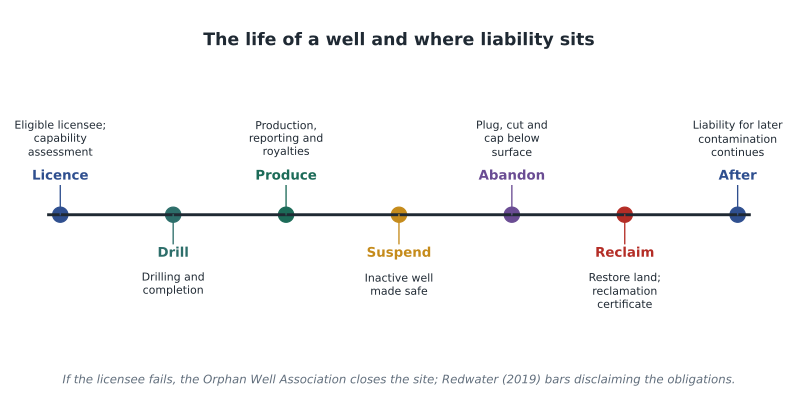
These obligations are owed to the public, through the regulator, rather than to the landowner or mineral owner, although they protect both. The regulator may order a licensee to abandon and reclaim, and if the licensee fails, it may do the work itself and recover the cost. The regulator can also hold responsible parties beyond the licensee, including working interest participants who share in a well, and in some cases directors and officers of licensees that left obligations unmet.
The Orphan Well Association
When a licensee becomes defunct, its wells and facilities may be designated as orphans. The Orphan Well Association is an independent non-profit organization, operating under delegated authority from the regulator, that abandons and reclaims orphan sites. It is funded mainly by an orphan fund levy paid by all licensees in proportion to their share of the industry's liability, so the industry as a whole bears the cost of members that fail. During the COVID-19 period, the federal and Alberta governments provided loans and grants to the association and to site closure programs to accelerate cleanup.
The system has a well-known weakness. If a licensee can sell its valuable wells and keep its worthless ones, or if a receiver or trustee can sell the good assets and walk away from the bad ones, the cost of the bad ones shifts to the orphan fund and so to the rest of the industry. That is what happened in Redwater.
Redwater
Redwater Energy Corporation was a small Alberta producer that became insolvent in 2015. Its lender, ATB Financial, held security over its assets. Grant Thornton was appointed as receiver and later as trustee in bankruptcy. Redwater held licences for 127 assets, including wells, pipelines and facilities, of which only a minority had value. The trustee sold the valuable ones and purported to disclaim the rest under the federal Bankruptcy and Insolvency Act, which would have left the regulator and the Orphan Well Association to pay for plugging and reclaiming them while the lender received the sale proceeds.
The regulator and the association objected. The trial judge and a majority of the Court of Appeal of Alberta held that the federal statute prevailed under the doctrine of paramountcy, so that the trustee could disclaim the worthless assets and the regulator's claims ranked as unsecured debts.
The Supreme Court of Canada reversed, in Orphan Well Association v. Grant Thornton Ltd., 2019 SCC 5, decided on January 31, 2019. Chief Justice Wagner wrote for a majority of five. Justice Côté, with Justice Moldaver, dissented. Justice Martin, who had dissented in the Court of Appeal, did not sit. The majority held, first, that there was no operational conflict and no frustration of federal purpose. The federal statute protects a trustee from personal liability for environmental obligations, but it does not allow the bankrupt estate to avoid obligations that apply to the property it holds. Alberta's regime did not require the trustee to pay out of its own pocket; it required the estate to comply with the law that governs anyone holding licensed assets.
Second, the majority held that the regulator's end-of-life requirements were not provable claims in the bankruptcy. Applying the three-part test from Newfoundland and Labrador v. AbitibiBowater Inc., 2012 SCC 67, the court asked whether the regulator was a creditor, whether the obligation arose before the bankruptcy, and whether it was sufficiently certain that the regulator would perform the work and claim reimbursement. The regulator, the majority held, was not acting as a creditor when it enforced public duties, and it was not sufficiently certain that the regulator would perform the work itself, given that the association would do so. The obligations were therefore not debts to be paid with other unsecured claims. They had to be satisfied out of the estate's assets before the secured lender was paid.
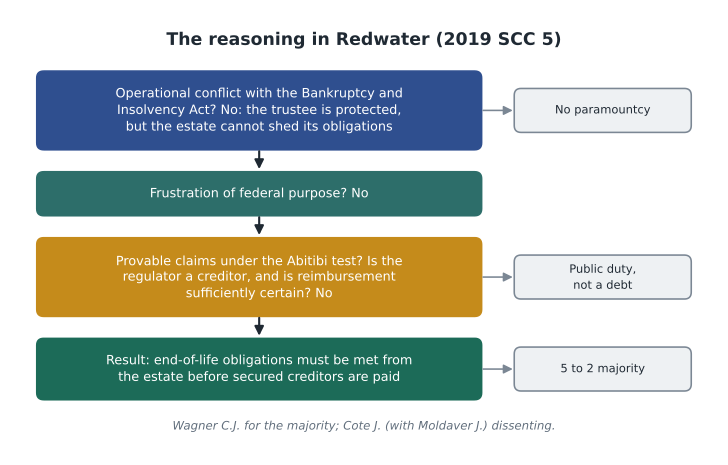
Theo Marchetti summarizes the consequence for lenders. 'The bank lends against the good wells, but it has to accept that the bad wells come first.' Mawhinney agrees. 'Polluter pays, and then lender pays. After Redwater, nobody lending to an Alberta producer can ignore the inactive well list.'
The liability management reforms
Alberta's former liability management system relied mainly on a ratio comparing a licensee's deemed assets with its deemed liabilities. Licensees with ratios below a threshold had to post security. The system was criticized for using deemed rather than real values and for doing little about the growing inventory of inactive wells. After Redwater, Alberta adopted a new liability management framework in 2020 and 2021. The regulator's directive on licensee life-cycle management replaced the old ratio with a broader assessment of a licensee's capability, using a licensee capability assessment that considers financial health, the size and age of its inactive inventory, and its record on closure.
The framework also introduced mandatory closure spending. The regulator sets an industry-wide annual target for spending on closure work and assigns each licensee a share based on its inactive liability. A licensee that fails to meet its target may face restrictions, including limits on transfers and new licences. Inactive wells are expected to be closed within set periods, and the regulator monitors inventories more closely. Kowalczyk says that from inside the regulator the change felt real. 'For the first time, we could tell a company that it had to spend money on its old wells this year, not someday.'
| Tool | What it does | Who bears the cost |
|---|---|---|
| Licensee eligibility and capability assessment | Screens who may hold licences and acquire wells; assesses financial and operational capability | Licensee, through compliance costs and security deposits |
| Transfer approvals | Prevents transfers that leave weak licensees with large inactive inventories | Buyer and seller, through conditions |
| Mandatory closure spending | Requires each licensee to spend a set amount each year on closure | Licensee |
| Abandonment and reclamation orders | Requires a licensee or responsible party to do end-of-life work | Licensee, working interest partners and, in some cases, directors |
| Orphan fund levy | Funds the Orphan Well Association to close sites of defunct licensees | Industry as a whole |
Other provinces and the federal picture
The issue is not unique to Alberta. British Columbia's regulator, renamed the BC Energy Regulator in 2022, administers a similar system funded by an orphan site levy. Saskatchewan and Ontario have their own programs. Ontario's legacy well problem is different, involving thousands of wells drilled in the nineteenth and early twentieth centuries in the southwest of the province, many with no known owner. Federal programs have funded cleanup in several provinces, but responsibility rests primarily with provincial regulators.
The legal principle from Redwater has also travelled. Courts in other insolvency proceedings have applied it to environmental obligations generally, holding that a debtor cannot use insolvency to shed obligations that apply to the property it continues to hold. Courts have also applied Redwater in proceedings under the Companies' Creditors Arrangement Act, the restructuring statute used by larger companies.
Gannet's inactive wells
Mawhinney asks the class to advise Gannet's board. The class identifies the immediate risks: the regulator may restrict Gannet's ability to acquire or transfer wells if its capability assessment is weak; Gannet must meet its mandatory closure spending target; its lender will apply Redwater to any refinancing; and its directors face potential exposure if they allow the company to shed obligations improperly. Sophie Tremblay-Hart suggests that Gannet consider selling its inactive wells to a company specializing in closure work, or partnering with a lithium developer that wants to reuse some well bores. Mawhinney says that is exactly the idea that will appear in the capstone.
Worked problem
Can the trustee walk away?
Suppose Gannet becomes bankrupt next year. Its trustee proposes to sell Gannet's twenty-two producing wells for 14 million dollars and to disclaim the eighteen inactive wells, whose closure costs are estimated at 9 million dollars. Gannet's lender, which is owed 20 million dollars and holds security over all assets, supports the plan. The Orphan Well Association objects. How will a court approach the plan after Redwater?
Show solution
- Paramountcy: the federal Bankruptcy and Insolvency Act protects the trustee personally, but it does not allow the estate to disclaim assets to avoid provincial end-of-life obligations (Redwater). There is no operational conflict.
- Provable claim: apply the Abitibi test. The regulator enforcing abandonment and reclamation obligations acts in the public interest, not as a creditor, so the obligations are not provable claims that rank with unsecured debts.
- Priority: the obligations must be satisfied from the estate's assets before distribution to the secured lender. In practice, the 14 million dollars from the sale must first fund the 9 million dollars of closure work, or the sale must transfer the inactive wells with the producing ones to a buyer approved by the regulator.
- Transfer approval: any buyer must be approved by the regulator, which will assess its capability to handle the obligations it assumes.
- Result: the lender is likely to receive about 5 million dollars, not 14 million. The plan as proposed will not be approved.
Common mistakes
MistakeTreating a well licence as a property right in the minerals.
InsteadThe licence is a regulatory permission to carry out activities; the right to the minerals comes from the Crown agreement or freehold lease.
MistakeAssuming that a trustee in bankruptcy can disclaim worthless wells and leave the cost to the orphan fund.
InsteadRedwater (2019) held that the estate must meet end-of-life obligations before secured creditors are paid, although the trustee is protected from personal liability.
MistakeThinking that end-of-life obligations are debts owed to the regulator.
InsteadApplying the Abitibi test, Redwater held that the regulator acts in the public interest, not as a creditor, so the obligations are not provable claims.
MistakeBelieving that a reclamation certificate ends all liability.
InsteadLicensees remain liable for contamination discovered after the certificate is issued.
MistakeDescribing Alberta's current system as a ratio of deemed assets to deemed liabilities.
InsteadSince 2020 and 2021, Alberta uses a broader licensee capability assessment and mandatory closure spending under its licensee life-cycle management directive.
Practice problems
Work each problem on paper first, then reveal the answer to check.
What did the Responsible Energy Development Act do?
Show answer
It created the Alberta Energy Regulator as a single regulator for oil, gas, oil sands and coal across the full life cycle, combining the energy functions of the former board with environmental, water and public lands functions as they apply to energy projects.
What are abandonment and reclamation?
Show answer
Abandonment is permanently plugging a well bore and cutting and capping the casing below the surface. Reclamation is restoring the surface lease to equivalent land capability, after which a reclamation certificate may be issued.
What were the two main holdings in Redwater?
Show answer
First, there was no conflict between Alberta's regime and the Bankruptcy and Insolvency Act, so paramountcy did not allow the trustee to disclaim assets to avoid obligations. Second, the end-of-life obligations were not provable claims under the Abitibi test, because the regulator was not acting as a creditor, so they had to be satisfied before secured creditors were paid.
How is the Orphan Well Association funded?
Show answer
Mainly by an orphan fund levy paid by licensees in proportion to their share of industry liability, supplemented in some periods by government loans and grants.
Summary and key terms
- The Alberta Energy Regulator, created by the Responsible Energy Development Act (in force 2013), regulates energy development across the full life cycle.
- Licences are regulatory permissions held by eligible licensees; transfers require approval and a capability assessment.
- Licensees must abandon and reclaim wells and sites; liability for contamination continues after a reclamation certificate.
- Redwater (2019 SCC 5) held that bankruptcy does not let an estate shed end-of-life obligations, which must be met before secured creditors are paid.
- Alberta replaced its liability ratio with a licensee capability assessment and mandatory closure spending; the industry-funded Orphan Well Association closes sites of defunct licensees.
- Licensee
- The person holding the regulator's licence for a well, facility or pipeline and responsible for its obligations.
- Abandonment
- Permanently plugging a well and cutting and capping the casing below the surface.
- Reclamation certificate
- A certificate that a site has been reclaimed to the required standard; it does not end liability for later-discovered contamination.
- Orphan
- A well, facility or site whose licensee is defunct or unable to meet its obligations.
- Asset retirement obligation
- The estimated cost of abandoning and reclaiming a company's wells and facilities.
- Provable claim
- A claim that may be proved in bankruptcy and shares in the distribution to creditors.
- Mandatory closure spending
- An annual amount each licensee must spend on closure work, set by the regulator.
Lesson quiz · 5 questions
Score 60% or more to complete this lesson.
Create a free account to save your progress, take quizzes and earn a certificate.