
LAWC-304 · Lesson 11 of 12 · 24 min
Treaty rights, cumulative effects and UNDRIP
▶ Video coming soon A video version of this lesson is on the way.
Professor Mawhinney opens the eleventh class by projecting the text of a single sentence from Treaty 8, signed in 1899. In it, the Crown promises that the Indians shall have the right to pursue their usual vocations of hunting, trapping and fishing throughout the tract surrendered, subject to regulations and saving and excepting such tracts as may be required or taken up from time to time for settlement, mining, lumbering, trading or other purposes. 'For a hundred years,' she says, 'governments read the second half of that sentence as if it swallowed the first. The cases in this lesson are about how courts have put the first half back.'
The Gannet file has moved from one project to the whole region. The Ochre Lake First Nation, a Treaty 6 nation, has written to Alberta arguing that the total amount of oil and gas development, forestry and agriculture in its traditional territory has left too little land on which its members can meaningfully hunt and gather. It points to the Yahey decision in British Columbia and asks Alberta to stop issuing new authorizations until the province addresses cumulative effects. Gannet's six new wells are among the applications on hold.
This lesson covers the interpretation of the numbered treaties, the taking-up clause and the limits on it, infringement and justification, cumulative effects after Yahey, recent Supreme Court decisions on the honour of the Crown in treaties and agreements, Aboriginal title as it affects resources, and the role of the United Nations Declaration on the Rights of Indigenous Peoples in Canadian law.
The numbered treaties and their interpretation
Between 1871 and 1921, the Crown entered into eleven numbered treaties with First Nations across what is now Ontario, the Prairie provinces, northeastern British Columbia and parts of the territories. Treaty 6, signed in 1876 at Fort Carlton and Fort Pitt, covers much of central Alberta and Saskatchewan. Treaty 8, signed in 1899, covers northern Alberta, northeastern British Columbia, northwestern Saskatchewan and part of the Northwest Territories. In each, the First Nations agreed to share land in exchange for reserves, annuities and other promises, including the protection of their way of life through continued hunting, trapping and fishing.
Courts interpret treaties with special principles. In R. v. Badger, [1996] 1 S.C.R. 771, which concerned Treaty 8 hunting rights in Alberta, the Supreme Court restated them: treaties are sacred promises; the honour of the Crown is always at stake; ambiguities are resolved in favour of the First Nations; and treaty terms must be interpreted in the sense they would naturally have been understood by the First Nations at the time, with regard to the oral promises made at the treaty negotiations. Badger held that the right to hunt did not extend to privately owned land that was visibly in use, but continued on unoccupied private land.
Taking up land
The taking-up clause allows the Crown to take land out of the area available for treaty harvesting. In Grassy Narrows First Nation v. Ontario (Natural Resources), 2014 SCC 48, the Supreme Court held that Ontario, not only Canada, has the power to take up land in the Treaty 3 area, because the province owns and regulates the land under sections 109, 92A and 92(5). But that power must be exercised in accordance with the treaty and the honour of the Crown. The province must consult and, if taking up would leave the First Nation with no meaningful right to harvest in its traditional territory, it would be a breach of the treaty and an infringement that must be justified.
Mikisew Cree (2005), discussed in lesson 10, held that taking up land triggers the duty to consult. Grassy Narrows identified the substantive limit: the Crown cannot take up so much land that the treaty right becomes meaningless. Daniel Whitecloud puts it in the words his grandfather used. 'The treaty was supposed to last as long as the sun shines and the rivers flow,' he says. 'It was not supposed to last only until the last good hunting ground was leased.'
Infringement and justification
When a government action interferes with an Aboriginal or treaty right, the court asks whether the interference is a prima facie infringement and, if so, whether it is justified. The framework comes from R. v. Sparrow, [1990] 1 S.C.R. 1075, and was applied to treaty rights in Badger. The government must show a compelling and substantial objective, and that the infringement is consistent with the Crown's fiduciary duty and the honour of the Crown, considering questions such as whether there has been as little infringement as possible, whether fair compensation is available and whether the group was consulted. In Tsilhqot'in Nation v. British Columbia, 2014 SCC 44, the court added that once Aboriginal title is established, the Crown must obtain the consent of the title holders or justify the incursion under this framework.
Cumulative effects: Yahey
The most important resource case of the last decade on treaty rights is Yahey v. British Columbia, 2021 BCSC 1287, decided in June 2021. Blueberry River First Nations, a Treaty 8 nation in northeastern British Columbia, argued that the province had authorized so much industrial development in its territory, including oil and gas wells and roads, forestry, mining, hydroelectric projects and agriculture, that its members could no longer meaningfully exercise their treaty rights. The province argued that each authorization was lawful and had been subject to consultation.
The court agreed with Blueberry River. It held that the cumulative effects of development had significantly diminished the ability of the nation's members to exercise their treaty rights, that this amounted to an infringement of the treaty, and that the province had not justified it. It also found that the province's regulatory regimes did not adequately consider cumulative effects and that project-by-project consultation did not address the problem. The province did not offer a justification defence. The court declared that the province could not continue to authorize activities that breached the treaty, suspended that declaration for six months, and directed the parties to negotiate mechanisms to assess and manage cumulative impacts.
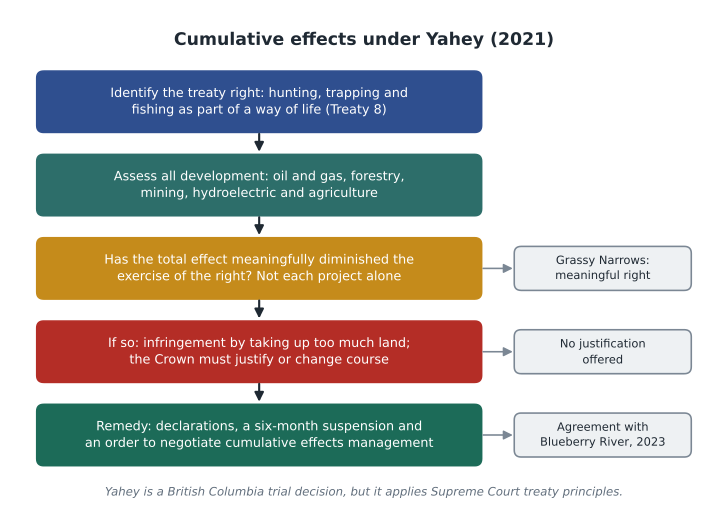
British Columbia did not appeal. After interim agreements, the province and Blueberry River signed an implementation agreement in January 2023 that set limits on new disturbance in high-value areas, created a restoration fund and established a process for shared decision-making on future development. The province made similar agreements with other Treaty 8 nations. Hannah Kowalczyk says the industry in Calgary watched closely. 'Overnight, northeastern British Columbia went from open for business to wait and see,' she says. 'Then it went to negotiated.'
Will Yahey travel to Alberta?
Yahey is a trial decision from British Columbia, and it is not binding in Alberta. But its reasoning is based on treaty principles from the Supreme Court that apply everywhere: the treaties protect a way of life, the taking-up power is limited, and the Crown must manage the total effect of its authorizations. Several First Nations in Alberta and elsewhere have brought or threatened similar claims. Theo Marchetti asks whether Alberta could avoid the problem by consulting on each project. Mawhinney says that was exactly British Columbia's argument, and it failed. 'Consultation on each project is necessary,' she says. 'Yahey says it is not sufficient. Somebody has to count.'
The honour of the Crown in recent cases
Two recent Supreme Court decisions have strengthened the enforceability of Crown promises. In Ontario (Attorney General) v. Restoule, 2024 SCC 27, the court held that the Crown had breached the augmentation clause of the 1850 Robinson Treaties, which promised to increase annuities if the land produced more revenue, by failing for over a century to increase the annuity beyond four dollars per person. The court held that the clause created a duty to diligently consider whether to increase annuities, and that the Crown had breached the treaty and the honour of the Crown. Rather than fix damages itself, the court directed the Crown to make an honourable decision on compensation for the past breach within a set time, after engaging with the First Nations.
In Québec (Attorney General) v. Pekuakamiulnuatsh Takuhikan, 2024 SCC 39, the court held that the honour of the Crown applied to a tripartite agreement on policing among Canada, Quebec and a First Nation, and that Quebec had breached its obligations by failing to negotiate in good faith over funding when the agreement was renewed. The court upheld an award of damages. Sophie Tremblay-Hart says the case matters for resource agreements as well. 'Impact benefit agreements and revenue sharing agreements with governments are not just contracts,' she says. 'If the Crown is a party, it has to act honourably.' Mawhinney agrees that the principle is likely to be tested in resource agreements soon.
Aboriginal title and resources
Aboriginal title is the strongest Aboriginal interest in land. Tsilhqot'in (2014) declared title to about 1,750 square kilometres in British Columbia and held that title includes the right to decide how the land will be used, to enjoy and occupy it, to possess it and to its economic benefits, including resources. Since then, courts have begun to address title over lands that include private interests. In Cowichan Tribes v. Canada (Attorney General), 2025 BCSC 1490, the Supreme Court of British Columbia declared Aboriginal title to part of the Cowichan Tribes' historic village lands in Richmond and held that Canada's and the city's fee simple interests in some of the lands were defective, while declining to invalidate private fee simple titles and directing the Crown to negotiate. In JD Irving Ltd. v. Wolastoqey Nation, 2025 NBCA 129, the New Brunswick Court of Appeal held that a declaration of title is not available over privately held lands in that claim, although findings of title may ground claims against the Crown. Both cases were under appeal in 2026.
The UN Declaration in Canadian law
The United Nations Declaration on the Rights of Indigenous Peoples was adopted by the General Assembly in 2007. Canada endorsed it in 2010 and announced its full support in 2016. Several articles refer to free, prior and informed consent, including article 32, which calls on states to consult and cooperate in good faith with Indigenous peoples in order to obtain their free and informed consent before approving projects affecting their lands and resources.
British Columbia enacted its Declaration on the Rights of Indigenous Peoples Act in November 2019. It requires the government to take all measures necessary to ensure that provincial laws are consistent with the Declaration, to prepare an action plan, and allows agreements for joint decision-making with Indigenous governing bodies. In 2021, British Columbia added a provision to its Interpretation Act stating that every provincial enactment must be construed as being consistent with the Declaration. Parliament enacted the United Nations Declaration on the Rights of Indigenous Peoples Act, which received Royal Assent on June 21, 2021. It affirms the Declaration as a universal international human rights instrument with application in Canadian law, requires the government to take all measures necessary to ensure that federal laws are consistent with it, and required an action plan, which was released in 2023.
What these statutes do in court is now the central question. In Reference re An Act respecting First Nations, Inuit and Métis children, youth and families, 2024 SCC 5, the Supreme Court said in passing that the federal statute incorporated the Declaration into the country's positive law. In Kebaowek First Nation v. Canadian Nuclear Laboratories, 2025 FC 319, the Federal Court relied on that statement to hold that the Declaration is a mandatory interpretive lens for the duty to consult, and that a federal regulator approving a nuclear waste facility near the Ottawa River had to consider whether consultation met the standard of free, prior and informed consent, while confirming that consent is not a veto. On appeal, in Canadian Nuclear Laboratories Ltd. v. Kebaowek First Nation, 2026 FCA 174, the Federal Court of Appeal set aside that judgment. It held that the federal statute provides a framework for future implementation and a process for aligning federal laws, but does not itself implement the Declaration's articles, including those on free, prior and informed consent, into federal law; and that the nuclear regulator was not bound to apply them. The existing duty to consult framework governed.
The British Columbia Court of Appeal took a different view of its provincial statute in Gitxaala (2025), discussed in lesson 3, holding that the provincial Declaration Act gave the Declaration legal effect in British Columbia. The two statutes are worded differently, and the provincial Interpretation Act amendment has no exact federal equivalent, so the decisions can be reconciled in part. But the Supreme Court's decision in Gitxaala is likely to address the general question of how the Declaration operates in Canadian law.
| Instrument or case | Year | Effect on resource decisions |
|---|---|---|
| British Columbia Declaration Act | 2019 (Interpretation Act amendment 2021) | Provincial laws to be made consistent and construed consistently with the Declaration; joint decision agreements possible |
| Federal UN Declaration Act | 2021 (action plan 2023) | Framework for aligning federal laws with the Declaration |
| Gitxaala, BCCA | 2025 | Majority: provincial Act gives the Declaration legal effect; provincial law presumed consistent |
| Kebaowek, FC | 2025 | Declaration a mandatory interpretive lens for consultation; consent is not a veto |
| Kebaowek, FCA | 2026 | Federal Act does not itself implement the Declaration's articles; existing consultation framework applies |
| Gitxaala, SCC | Leave granted 2026 | Pending; likely to settle the general question |
Advising Alberta and Gannet
The class returns to the Ochre Lake letter. The nation's cumulative effects argument has a real legal foundation in Grassy Narrows and Yahey, even though Yahey does not bind Alberta. Alberta should assess the state of the nation's territory and the effect of further authorizations on the meaningful exercise of treaty rights, not only the effect of each project. A negotiated arrangement on new disturbance, restoration and shared decision-making, of the kind British Columbia reached with Treaty 8 nations, is likely to be far less costly than litigation. Gannet's best course is to support that process and to design its project to reduce disturbance, for example by using existing well pads, which the capstone will explore. On the Declaration, the federal statute does not, after Kebaowek, change the consultation standard in Alberta, but the Supreme Court's decision in Gitxaala could change the landscape for every province.
Worked problem
A cumulative effects claim in Alberta
Assume the Ochre Lake First Nation sues Alberta, alleging that the province has taken up so much of its Treaty 6 territory through oil and gas, forestry and agricultural authorizations that members can no longer meaningfully hunt. It seeks a declaration of infringement and an order preventing new authorizations until cumulative effects are managed. How would a court approach the claim?
Show solution
- Treaty right: interpret Treaty 6 using Badger principles, including the oral promises and the First Nation's understanding at the time; identify the protected way of life and harvesting rights.
- Taking up: under Grassy Narrows, Alberta may take up land, but not so much that the First Nation is left with no meaningful right to harvest in its traditional territory.
- Cumulative effects: following Yahey's reasoning, assess the total effect of all development on the ability to exercise the right, using evidence of disturbance, wildlife populations and members' practices, rather than project-by-project effects.
- Justification: if there is a prima facie infringement, Alberta must justify it under Sparrow and Badger, showing a compelling objective and consistency with the honour of the Crown.
- Remedy: a court might grant declarations and require negotiation of mechanisms for managing cumulative effects, possibly suspending a prohibition on new authorizations to allow time, as in Yahey.
Common mistakes
MistakeReading the taking-up clause as allowing the Crown to take up any amount of treaty land.
InsteadGrassy Narrows holds that taking up must respect the treaty; if it leaves no meaningful right to harvest, it is an infringement that must be justified.
MistakeAssuming that consultation on each project protects the Crown from a cumulative effects claim.
InsteadYahey found infringement despite project-by-project consultation, because no one managed the total effect.
MistakeTreating Yahey as binding in Alberta.
InsteadYahey is a British Columbia trial decision; its reasoning is persuasive because it applies Supreme Court treaty principles.
MistakeSaying that the federal UN Declaration Act requires consent for every project.
InsteadKebaowek (2026 FCA 174) held that the federal Act does not itself implement the Declaration's articles; consent is not a veto in the existing framework, and the Supreme Court's Gitxaala decision is pending.
Practice problems
Work each problem on paper first, then reveal the answer to check.
What principles of treaty interpretation did Badger (1996) restate?
Show answer
Treaties are sacred promises; the honour of the Crown is at stake; ambiguities are resolved in favour of the First Nations; and terms must be interpreted as the First Nations would naturally have understood them at the time, considering the oral promises.
What did Grassy Narrows (2014) decide?
Show answer
That Ontario may take up land in the Treaty 3 area under its own powers, but must do so in accordance with the treaty and the honour of the Crown, including consultation and respect for the limit that the First Nation must retain a meaningful right to harvest.
What remedies did the court grant in Yahey (2021)?
Show answer
Declarations that the province had infringed Treaty 8 through cumulative effects, that it could not continue to authorize activities breaching the treaty (suspended for six months), and that the parties must negotiate mechanisms to assess and manage cumulative impacts.
How did the Federal Court of Appeal in Kebaowek (2026) differ from the Federal Court?
Show answer
The Federal Court treated the Declaration as a mandatory interpretive lens for consultation; the Federal Court of Appeal held that the federal Act does not itself implement the Declaration's articles into federal law and that the existing consultation framework applied.
Summary and key terms
- The numbered treaties protect a way of life; Badger requires generous interpretation in light of the First Nations' understanding and oral promises.
- The Crown may take up treaty land (Grassy Narrows, 2014) but must consult and may not leave the First Nation without a meaningful right to harvest.
- Yahey (2021) found that the cumulative effects of authorized development infringed Treaty 8; British Columbia negotiated limits on new disturbance and restoration with Blueberry River in 2023.
- Restoule (2024) and Pekuakamiulnuatsh (2024) strengthened the enforceability of Crown promises in treaties and agreements through the honour of the Crown.
- British Columbia's Declaration Act (2019) and the federal UN Declaration Act (2021) have been read differently: Gitxaala (2025 BCCA) gave the Declaration legal effect provincially; Kebaowek (2026 FCA) held the federal Act does not itself implement it. The Supreme Court's Gitxaala appeal is pending.
- Numbered treaties
- Eleven treaties made between 1871 and 1921 between the Crown and First Nations across the west and north.
- Taking-up clause
- The treaty term allowing the Crown to take land for settlement, mining, lumbering and other purposes.
- Cumulative effects
- The combined effects of many developments over time on land, resources and the exercise of rights.
- Infringement
- A government interference with an Aboriginal or treaty right that must be justified.
- Free, prior and informed consent
- The standard in the UN Declaration for consultation and cooperation with Indigenous peoples before projects affecting their lands and resources.
- Augmentation clause
- The term in the Robinson Treaties promising increased annuities if the land produced more revenue.
Lesson quiz · 5 questions
Score 60% or more to complete this lesson.
Create a free account to save your progress, take quizzes and earn a certificate.