
LAWC-304 · Lesson 1 of 12 · 25 min
Natural resources and energy law in Canada: the Constitution and section 92A
▶ Video coming soon A video version of this lesson is on the way.
Natural Resources and Energy Law is a third-year course at Brannock University Faculty of Law, and on the first morning the Lister Room is fuller than the registrar expected. Professor Elspeth Mawhinney explains why in her first sentence. 'Almost every big public argument in this country eventually becomes an argument about a resource,' she says. 'A pipeline, a mine, a dam, a well that nobody will pay to clean up. If you understand who owns the resource, who regulates it and who must be asked before it is touched, you can follow those arguments to the bottom.'
Mawhinney practised in Calgary for seventeen years, first on oil and gas transactions and later in hearings before the Alberta Energy Regulator and the federal energy regulator. She then spent five years as in-house counsel to the consultation office of a First Nation in central Alberta before coming to Brannock. She writes three questions on the whiteboard and leaves them there for the term: Who owns it? Who regulates it? Who must be asked?
She also introduces the file the class will follow. Gannet Ridge Resources Ltd. is a fictional junior oil and gas producer based in Calgary. It operates about forty wells in the fictional County of Sable Hills in central Alberta. Several of its wells sit on the ranch of the Ruskovich family, who have owned the land, and the minerals under it, since their great-grandfather bought it from a railway company in 1884. The area lies within the traditional territory of the fictional Ochre Lake First Nation, a signatory to Treaty 6. 'Every lesson,' Mawhinney says, 'will add a problem to Gannet's desk.'
Hannah Kowalczyk, who grew up in Calgary and worked in an oil and gas regulatory office before law school, smiles at the name of the county. 'Every county in Alberta has a Gannet,' she says. Mawhinney agrees. 'That is why it is useful.'
This lesson builds the constitutional frame. It covers provincial ownership of resources, the division of legislative powers over resources and energy, the history that produced section 92A of the Constitution Act, 1867, and the federal powers that cut across provincial control. Later lessons rely on this frame whenever they ask whether a statute or a regulator has authority over a project.
Ownership and legislative power are different things
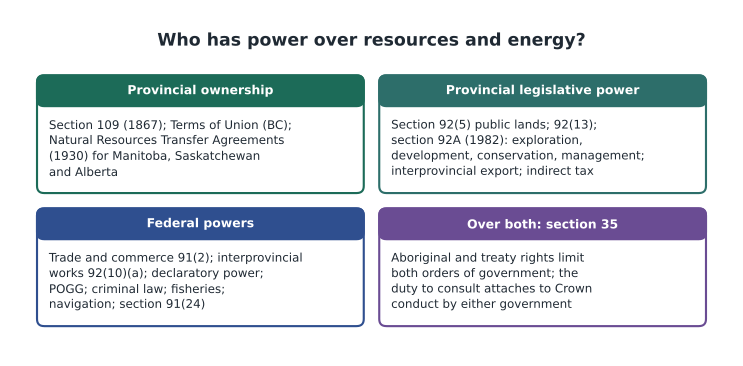
Canadian resource law begins with a distinction that students often blur. The first question is proprietary: who owns the resource? The second is legislative: which level of government can make laws about it? A province can own minerals and also regulate them, but the two powers come from different parts of the Constitution, and a province can regulate resources it does not own, such as minerals held by private owners.
Ownership comes from section 109 of the Constitution Act, 1867. It provides that all lands, mines, minerals and royalties belonging to the original provinces at Confederation belong to those provinces. British Columbia received the same position under its Terms of Union in 1871. The three Prairie provinces did not. When Manitoba was created in 1870, and Alberta and Saskatchewan in 1905, Canada kept their Crown lands and natural resources 'for the purposes of the Dominion'. The Natural Resources Transfer Agreements of 1930, confirmed by the Constitution Act, 1930, transferred those lands and resources to the three provinces and put them in the same position as the original provinces.
Kowalczyk explains why this history still matters in Alberta. 'It took twenty-five years for Alberta to get its resources,' she says. 'People at home still talk about it as if it happened last week.' Mawhinney adds a second point. The transfer agreements also contain a paragraph protecting the right of Indians to hunt, trap and fish for food on unoccupied Crown lands, which the courts have treated as modifying the treaty rights of First Nations in those provinces. 'So the same document that gave Alberta its resources also shaped the treaty rights that limit how it develops them.'
Legislative power over provincial public lands comes from section 92(5), which gives provinces power over the management and sale of public lands belonging to the province and the timber and wood on them. Provinces also regulate resources under property and civil rights (section 92(13)) and matters of a local or private nature (section 92(16)). Section 92A, discussed below, was added in 1982 to make provincial power over non-renewable resources, forestry and electricity explicit and to widen it.
Federal powers that reach resources
Provincial control is broad, but it is not exclusive. Several federal heads of power regularly apply to resource and energy projects.
| Federal power | Source | How it reaches resources and energy |
|---|---|---|
| Trade and commerce | Section 91(2) | Interprovincial and international trade in oil, gas, electricity and minerals; export licensing |
| Interprovincial works and undertakings | Section 92(10)(a) | Pipelines and power lines that cross provincial or national borders, interprovincial railways |
| Declaratory power | Section 92(10)(c) | Works declared to be for the general advantage of Canada; historically uranium works |
| Peace, order and good government | Opening words of section 91 | Matters of national concern such as nuclear energy and, after 2021, minimum standards of greenhouse gas pricing |
| Criminal law | Section 91(27) | Prohibitions on toxic substances backed by penalties, as in R. v. Hydro-Québec (1997) |
| Fisheries and navigation | Sections 91(12) and 91(10) | Protection of fish habitat and navigable waters affected by projects |
| Indians and lands reserved for the Indians | Section 91(24) | Reserve lands and resources, First Nations oil and gas under federal statute |
The interprovincial undertaking power is the reason the federal regulator approves pipelines that cross provincial borders. In Westcoast Energy Inc. v. Canada (National Energy Board), [1998] 1 S.C.R. 322, the Supreme Court held that gas gathering and processing facilities in British Columbia were part of a single interprovincial undertaking with the pipeline itself, because they were functionally integrated and under common management. The case shows that federal jurisdiction over a pipeline can extend upstream to facilities that look local.
The limit on provincial power over such undertakings was tested in Reference re Environmental Management Act (British Columbia), 2020 SCC 1. British Columbia proposed a permit requirement for anyone increasing the amount of heavy oil moving through the province, aimed in practice at the Trans Mountain expansion. The Supreme Court, ruling from the bench for the reasons of the unanimous British Columbia Court of Appeal, held that the law was in pith and substance about regulating a federal undertaking and was beyond provincial power. A province can apply general environmental laws to a federal pipeline, but it cannot single the pipeline out for its own approval process.
How section 92A came about
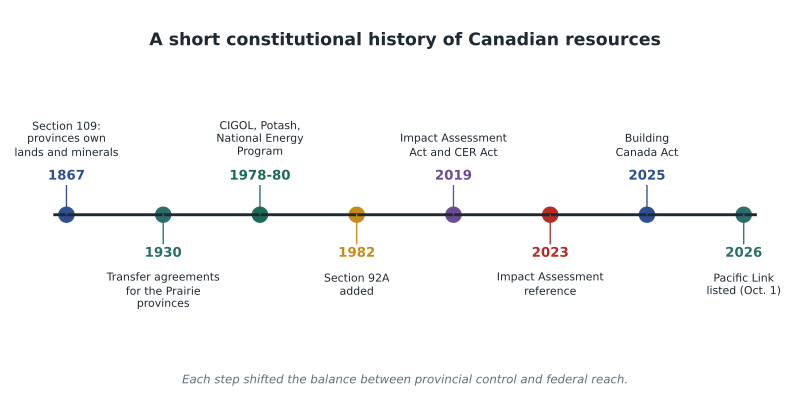
Section 92A is a product of the energy conflicts of the 1970s. After the 1973 oil price shock, Saskatchewan imposed a mineral income tax and a royalty surcharge on oil producers designed to capture almost all of the rise in prices. In Canadian Industrial Gas & Oil Ltd. v. Government of Saskatchewan, [1978] 2 S.C.R. 545 (CIGOL), the Supreme Court struck the measures down. The majority found that they were indirect taxes, which section 92(2) did not allow provinces to impose, and that they intruded on federal power over trade and commerce because most of the oil was exported from the province. A year later, in Central Canada Potash Co. v. Government of Saskatchewan, [1979] 1 S.C.R. 42, the court struck down a provincial scheme that fixed potash production quotas and prices, because it was aimed at the export market.
The producing provinces concluded that their control over their own resources was weaker than they had assumed. The federal National Energy Program of 1980, which set domestic oil prices below world levels and introduced new federal taxes and incentives, sharpened the conflict. When the Constitution was patriated in 1982, the provinces' price for agreement included a new section 92A. Sophie Tremblay-Hart asks whether Quebec cared. 'Very much,' Mawhinney says. 'Electricity was the resource Quebec was thinking about, and section 92A covers electrical energy as well as oil and minerals.'
What section 92A says
Section 92A has four main parts. Subsection (1) gives each province exclusive power to make laws in relation to the exploration for non-renewable natural resources in the province; the development, conservation and management of non-renewable natural resources and forestry resources, including the rate of primary production; and the development, conservation and management of sites and facilities for the generation and production of electrical energy.
Subsection (2) gives the provinces power to make laws about the export from the province to another part of Canada of the primary production from those resources and of electrical energy, provided the laws do not discriminate in prices or supplies exported to another part of Canada. Subsection (3) makes clear that this export power does not take away from Parliament's power over the same subject, and that federal law prevails where the two conflict. Export outside Canada remains federal.
Subsection (4) answers CIGOL. It allows provinces to raise money by any mode or system of taxation, including indirect taxation, in respect of those resources and the electrical energy produced from them, provided the tax does not differentiate between production exported to another part of Canada and production not exported. A sixth schedule defines primary production, so that refining and manufacturing do not count.
Arjun Mehta, who was an engineer before law school, draws a quick diagram. 'Inside the province, the province is supreme over the resource. Across a provincial border, both governments can act and federal law wins. Across the national border, it is federal only. And the province can now tax the resource indirectly as long as it does not punish exports.' Mawhinney says that is as good a summary as any textbook.
Section 92A in the courts
The leading case on the electricity part of section 92A is Ontario Hydro v. Ontario (Labour Relations Board), [1993] 3 S.C.R. 327. The question was whether labour relations at Ontario Hydro's nuclear generating stations were governed by federal or provincial law. A majority held that they were federal, because the stations had been declared to be works for the general advantage of Canada under the federal nuclear energy legislation, and the federal declaration brought labour relations at those works under federal control. Section 92A, the court held, did not displace the declaratory power. The case is a reminder that section 92A expanded provincial authority but did not create a zone that federal powers cannot enter.
The relationship between section 92A and federal environmental power came before the Supreme Court in the climate and impact assessment references. In References re Greenhouse Gas Pollution Pricing Act, 2021 SCC 11, a majority upheld the federal carbon pricing backstop under the national concern branch of the peace, order and good government power, defined narrowly as establishing minimum national standards of greenhouse gas price stringency. Saskatchewan and Alberta argued that the scheme intruded on their section 92A powers over resource development. The majority accepted that the law had effects on provincial jurisdiction but held that those effects were limited and justified by the national concern.
In Reference re Impact Assessment Act, 2023 SCC 23, the court reached the opposite result for most of the federal impact assessment scheme. Lesson 8 examines that decision closely. For now, the important point is that the majority treated section 92A as a significant part of the provincial side of the balance. Federal assessment is valid only when it is anchored in federal heads of power and focused on effects within federal jurisdiction.
The modern federal balance
The constitutional picture has continued to move. In 2024 Parliament amended the Impact Assessment Act to respond to the Supreme Court's decision. In 2025 it enacted the Building Canada Act as part of the One Canadian Economy Act, which received Royal Assent on June 26, 2025. That Act allows the federal Cabinet to list projects of national interest and then issue a single document of federal conditions in place of separate federal approvals. On October 1, 2026, the federal government listed a crude oil pipeline from Alberta to the British Columbia coast, now called Pacific Link, as a project of national interest. Lesson 8 covers both statutes.
Intergovernmental agreements have become as important as court decisions. On November 27, 2025, Canada and Alberta signed a memorandum of understanding on energy, and on May 15, 2026 they signed an implementation agreement. It sets Alberta's industrial carbon price on a path to 140 dollars per tonne by 2040, links the West Coast pipeline to the Pathways carbon capture project, and provides that the federal Clean Electricity Regulations will be stood down in Alberta if the courts strike them down, or replaced by an equivalency agreement if they are upheld. Alberta's reference challenging those regulations was still pending in the Court of Appeal of Alberta in the fall of 2026.
Kowalczyk notes that the provincial politics are just as live. In Alberta's referendum on October 19, 2026, about three quarters of voters chose to remain in Canada. 'Nobody in Calgary thinks the argument about resources is over because of a vote,' she says. Mawhinney agrees, but she draws a narrower lesson. 'For lawyers, the argument happens inside the Constitution. That is where we will keep it.'
Section 35 over everything
One more constitutional provision sits above both orders of government. Section 35 of the Constitution Act, 1982 recognizes and affirms existing Aboriginal and treaty rights. It does not grant legislative power, but it limits how both governments use theirs. A provincial mining statute, a federal pipeline approval and a municipal permit can all trigger the Crown's duty to consult when they might adversely affect asserted or established rights. Aboriginal title, where proven, is a property interest in land that includes the resources on and under it, as the Supreme Court held in Tsilhqot'in Nation v. British Columbia, 2014 SCC 44.
Daniel Whitecloud, who worked in band administration in northern Saskatchewan before law school, makes the point practically. 'On the ground, the question is never just federal or provincial,' he says. 'It is federal, provincial and us.' Mawhinney writes his sentence under her three questions. Lessons 10 and 11 develop the duty to consult, treaty rights and the federal and British Columbia statutes on the United Nations Declaration on the Rights of Indigenous Peoples.
Applying the frame to Gannet Ridge
Mawhinney closes with the Gannet file. Gannet's wells, its gathering lines and its gas plant are all inside Alberta and are regulated by the Alberta Energy Regulator under provincial statutes. Its gas is shipped to market on a pipeline that crosses into Saskatchewan and British Columbia, which is regulated by the Canada Energy Regulator. Its emissions are subject to Alberta's industrial carbon pricing system, which the federal government accepts as meeting the federal benchmark. If Gannet built a new facility that harmed fish habitat in a creek, federal fisheries law would apply. And every new licence on Crown land that might affect the treaty rights of the Ochre Lake First Nation would require the province to consider whether its duty to consult is triggered.
Worked problem
Sorting a resource problem by jurisdiction
Gannet Ridge proposes three projects: (1) ten new oil wells on Crown land in the County of Sable Hills; (2) a new 12-kilometre gas pipeline connecting its plant to a pipeline that runs into Saskatchewan; and (3) a small solar farm on the Ruskovich ranch to power the plant. Which level of government regulates each project, and what constitutional questions should Gannet's lawyers flag?
Show solution
- Wells on Crown land: the minerals belong to Alberta under section 109 and the 1930 transfer agreement, and Alberta regulates their development under section 92A(1). The Alberta Energy Regulator licenses the wells. Federal law applies only if a federal head is engaged, such as fish habitat.
- The connecting pipeline: if it is functionally integrated with the interprovincial pipeline and under common management, Westcoast Energy suggests it could be part of a federal undertaking under section 92(10)(a). If it is owned and operated separately as part of Gannet's local gathering system, it is provincial. The answer depends on facts about ownership and operation.
- The solar farm: generating facilities fall under section 92A(1)(c), and the Alberta Utilities Commission approves power plants. Federal law is unlikely to apply unless the project affects federal lands, migratory birds or another federal subject.
- All three: section 35 applies. If any provincial decision could adversely affect the treaty rights of the Ochre Lake First Nation, Alberta must consider whether its duty to consult is triggered, and the depth of consultation will vary by project.
Common mistakes
MistakeAssuming that because a province owns its minerals, Parliament has no say over them.
InsteadOwnership under section 109 and provincial legislative power under sections 92(5) and 92A coexist with federal powers over trade, interprovincial works, fisheries, criminal law and matters of national concern.
MistakeTreating section 92A as giving provinces control over exports to other countries.
InsteadSection 92A(2) covers exports to other parts of Canada only, and federal law prevails if it conflicts. International exports remain federal.
MistakeThinking provinces still cannot levy indirect taxes on resources after CIGOL.
InsteadSection 92A(4) allows indirect taxation of non-renewable resources, forestry and electricity, as long as it does not differentiate against production exported to other provinces.
MistakeAssuming that a province can create a special approval process for a federal pipeline.
InsteadReference re Environmental Management Act (2020) held that a provincial permit regime targeting heavy oil in a federal pipeline was beyond provincial power, although general provincial laws may still apply.
MistakeForgetting section 35 because it is not a head of legislative power.
InsteadSection 35 constrains both orders of government; the duty to consult attaches to decisions by either Crown that may adversely affect Aboriginal or treaty rights.
Practice problems
Work each problem on paper first, then reveal the answer to check.
Why did Alberta and Saskatchewan not own their natural resources when they became provinces in 1905, and how was that changed?
Show answer
Canada kept the Crown lands and natural resources of the Prairie provinces for federal purposes. The Natural Resources Transfer Agreements of 1930, confirmed by the Constitution Act, 1930, transferred them to the provinces and put them in the same position as the original provinces under section 109.
What did CIGOL decide, and how did section 92A respond?
Show answer
CIGOL (1978) struck down Saskatchewan's oil taxes as indirect taxation beyond provincial power and as an intrusion on federal trade and commerce. Section 92A(4) now allows provinces to raise money by indirect taxation of non-renewable resources, forestry and electricity, provided it does not differentiate against interprovincial exports.
What did the Supreme Court hold in Reference re Environmental Management Act (2020)?
Show answer
It held that British Columbia's proposed permit regime for increasing heavy oil shipments was in pith and substance the regulation of a federal interprovincial undertaking and was therefore beyond provincial jurisdiction.
Name three federal heads of power that may apply to a resource project inside one province.
Show answer
Any three of: fisheries (91(12)), navigation (91(10)), criminal law (91(27)), Indians and lands reserved for the Indians (91(24)), the national concern branch of POGG, and the declaratory power (92(10)(c)).
Summary and key terms
- Ownership of resources comes from section 109 (and, for the Prairie provinces, the 1930 transfer agreements); legislative power comes from sections 92(5), 92(13) and 92A.
- Section 92A, added in 1982 after CIGOL and Central Canada Potash, gives provinces exclusive power over exploration, development, conservation and management of non-renewable resources, forestry and electricity generation, a concurrent power over interprovincial exports subject to federal paramountcy, and a power to levy non-discriminatory indirect taxes.
- Federal powers over trade, interprovincial works, the declaratory power, POGG, criminal law, fisheries, navigation and section 91(24) continue to reach resource and energy projects.
- Courts have policed the boundary in both directions, striking down a provincial permit regime for a federal pipeline (2020) and most of the federal Impact Assessment Act (2023), while upholding federal carbon pricing (2021).
- Section 35 constrains both orders of government; every resource decision must be checked for the duty to consult.
- Section 109
- The provision of the Constitution Act, 1867 giving the provinces ownership of lands, mines, minerals and royalties.
- Natural Resources Transfer Agreements
- The 1930 agreements that transferred Crown lands and resources to Manitoba, Saskatchewan and Alberta.
- Section 92A
- The 1982 amendment giving provinces power over non-renewable resources, forestry and electrical energy, including interprovincial exports and indirect taxation.
- Primary production
- Production from a resource before refining or manufacturing, as defined in the Sixth Schedule to the Constitution Act, 1867.
- Interprovincial undertaking
- A work or business connecting provinces or extending beyond a province, such as a pipeline, which falls under federal jurisdiction under section 92(10)(a).
- Declaratory power
- Parliament's power to declare a local work to be for the general advantage of Canada and so bring it under federal jurisdiction.
Lesson quiz · 5 questions
Score 60% or more to complete this lesson.
Create a free account to save your progress, take quizzes and earn a certificate.