
LAWC-304 · Lesson 2 of 12 · 23 min
Ownership of resources
▶ Video coming soon A video version of this lesson is on the way.
Professor Mawhinney opens the second class by handing each student a photocopy of a certificate of title. It is a fictional title, but the format is real: a legal description of a quarter section in the County of Sable Hills, the name of the registered owner, and a line that reads 'Excepting thereout all mines and minerals.' 'Half of the oil and gas law in this province,' she says, 'is about what that line means and who owns what it excepts.'
The title belongs to a neighbour of the Ruskovich family. The Ruskovich title itself has no such exception. Their great-grandfather bought the land from a railway company in 1884, and the railway's grant from Canada predated the federal policy of reserving minerals to the Crown. The Ruskovich family therefore owns the minerals as well as the surface. Their neighbour's land was homesteaded in 1906, and the patent from Canada reserved the mines and minerals, which passed to Alberta in 1930.
This lesson explains how resource ownership works in Canada: the dominance of Crown ownership, the freehold mineral titles that survive in western Canada, the severance of mineral estates, the nature of an owner's interest in oil and gas in place, the rule of capture and the conservation statutes that limit it, and the forms of interest that private parties create when they deal with minerals.
Crown ownership is the rule
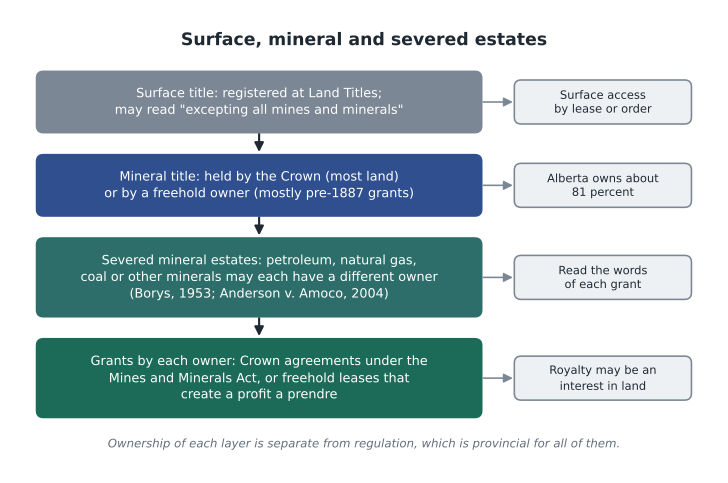
In most of Canada the Crown in right of the province owns most minerals. Section 109 and the 1930 transfer agreements give the provinces ownership of the minerals in their public lands. Provincial governments have also reserved minerals when granting land to settlers for well over a century. The government of Alberta reports that it owns about 81 percent of the province's mineral rights; the federal Crown owns a further share, mainly in national parks and First Nations reserves; and the rest is freehold, held by individuals, corporations and successors of the railway and land companies.
The policy that produced this result was federal. Under the Dominion Lands Act regime, homestead patents and grants issued in the North-West Territories after October 31, 1887 generally reserved the mines and minerals to the Crown. Earlier grants, including large grants to the Canadian Pacific Railway and the Hudson's Bay Company, often passed the minerals with the land. That is why freehold mineral titles are concentrated in older settled areas of southern and central Alberta and Saskatchewan, and why the Ruskovich family owns its minerals while its neighbour does not.
Crown minerals are managed under provincial statutes. In Alberta, the Mines and Minerals Act provides that the Crown may grant rights to explore for and produce minerals through agreements such as petroleum and natural gas licences and leases, coal leases and metallic and industrial mineral permits. Rights are usually sold in public offerings of Crown land sales, in which companies bid a bonus for the right to explore and produce. The agreement then requires the holder to pay rental and, once production begins, royalties set by regulation. Alberta's current royalty system for oil and gas, the Modernized Royalty Framework, has applied to wells drilled since 2017.
| Owner | Typical source of title | How rights are granted | Who regulates operations |
|---|---|---|---|
| Crown in right of the province | Section 109; 1930 transfer agreements; reservations in patents | Crown agreements under the Mines and Minerals Act (licences, leases, permits) | Alberta Energy Regulator |
| Federal Crown | National parks; federal lands; offshore beyond provincial boundaries | Federal statutes, including the Canada Petroleum Resources Act and the accord acts for the Atlantic offshore | Canada Energy Regulator or the offshore boards |
| First Nation (through Canada) | Reserve lands set apart under treaty or statute | Indian Oil and Gas Act and regulations, with the consent of the First Nation | Indian Oil and Gas Canada, with provincial conservation rules |
| Freehold owner | Pre-1887 grants, railway and company grants, early patents | Private lease negotiated with the owner | Alberta Energy Regulator |
Theo Marchetti asks why the regulator is the same for Crown and freehold minerals. Mawhinney explains that ownership and regulation are separate questions, as the first lesson showed. Whoever owns the oil and gas, the province regulates how wells are drilled, spaced, produced and abandoned under its conservation and safety statutes. 'The Ruskovich family can choose who drills under their land,' she says. 'They cannot choose whether the well meets the regulator's rules.'
Surface and mineral titles, and severance
A mineral title can be separated from the surface title. When that happens, two estates exist in the same land, each registered at the Land Titles Office. The mineral estate carries with it an implied right to use as much of the surface as is reasonably necessary to work the minerals, but in Alberta that common law right has been replaced in practice by the surface rights statute, which requires the operator to obtain the surface owner's consent or an order of the Land and Property Rights Tribunal before entering. Lesson 9 covers surface access.
Mineral titles can be severed further. A freehold owner may own 'petroleum and natural gas' but not coal, or may have sold the coal and kept everything else. Older transfers and leases often used words such as 'petroleum', 'natural gas', 'oil' or 'mines and minerals' without definition, and the courts have had to decide what each word included.
The leading case is Borys v. Canadian Pacific Railway, [1953] A.C. 217 (P.C.). The railway had sold land to Borys but reserved the petroleum. A dispute arose over natural gas, both the gas dissolved in the oil and the free gas in a gas cap above it. The Privy Council held that the reservation of petroleum included the gas dissolved in the oil in the reservoir, because in its natural state it was part of the liquid, but did not include the free gas, which belonged to the surface owner who held the other minerals. It also held that the railway was entitled to produce its petroleum even though some of the owner's gas would inevitably be released, provided it acted without negligence.
Fifty years later, in Anderson v. Amoco Canada Oil and Gas, 2004 SCC 49, [2004] 3 S.C.R. 3, the Supreme Court decided a related question about gas that is dissolved in oil in the reservoir but comes out of solution as the oil is produced, called solution gas. The owners of the natural gas argued that solution gas was theirs once it became gaseous in the reservoir or the well. The court held that ownership should be determined by the state of the substance in the reservoir, at the time of the grant and before production. Because the gas was in solution in the oil in the reservoir, it belonged to the petroleum owner. The decision gave the industry certainty about thousands of wells.
What does an owner of oil and gas in the ground own?
Oil and gas differ from coal or gold because they move. They are described as fugacious: they migrate through porous rock toward areas of lower pressure, including toward any well that penetrates the reservoir. Canadian law treats the owner of a mineral estate as the owner of the oil and gas in place under its land, but that ownership is precarious, because the substance may be drained away by a neighbour's well.
The common law answer is the rule of capture. The owner of land may extract oil and gas from beneath its own land, and it owns whatever it lawfully produces, even if some of it migrated from beneath a neighbour's land. The neighbour has no action for the drainage; its remedy is to drill its own well. Borys accepted this rule as part of Canadian law. The rule rewards fast production, which in the early years of the industry led to too many wells, rapid loss of reservoir pressure and enormous waste.
Conservation legislation was the response. Alberta's Oil and Gas Conservation Act, first enacted in the 1930s after the waste in the Turner Valley field, does not abolish the rule of capture but contains it. The regulator sets spacing units, so that only a set number of wells may be drilled in a given area for a given pool. It can restrict the rate of production. And it can order compulsory pooling, so that where several owners hold interests within one spacing unit, production from a single well is shared among them in proportion to their tracts. Mehta draws the comparison. 'The rule of capture says whoever drinks fastest wins. The conservation statute puts everyone at the same table with one straw and divides the glass.'
The nature of the interests: profits, royalties and working interests
When a freehold owner grants a lease of its oil and gas, what does the lessee get? Canadian courts have held that a freehold petroleum and natural gas lease is not a lease in the landlord and tenant sense. It grants a profit a prendre, an interest in land that gives the holder the right to enter, drill and take the substance, coupled with ownership of what is produced. In Berkheiser v. Berkheiser, [1957] S.C.R. 387, the Supreme Court treated an oil and gas lease as creating a profit a prendre, an interest in land. That classification matters for registration, for the formalities of transfer and for the law of priorities.
Royalties raise a related question. The owner who grants a lease usually keeps a lessor's royalty, a share of production or its value free of the costs of production. Parties also create overriding royalties, which are carved out of the lessee's working interest. Whether a royalty is an interest in land or only a contractual right to payment matters greatly in insolvency, because an interest in land survives the lessee's bankruptcy while a contractual claim ranks as an unsecured debt.
In Bank of Montreal v. Dynex Petroleum Ltd., 2002 SCC 7, the Supreme Court held that an overriding royalty can be an interest in land at common law if the parties intended it to be, and if the royalty is carved out of an interest in land such as a working interest. The court rejected an older view that a royalty, being an interest in money or in production not yet in existence, could never be an interest in land. After Dynex, careful drafting determines whether a royalty survives insolvency.
Kowalczyk recalls how often this came up in her regulatory work. 'Every time a company went under, the first question was whether the royalty holders were secured,' she says. Mawhinney nods. 'And the second question was who would pay to clean up the wells. We will come to that in lesson 5.'
Federal and First Nations resources
Two other ownership regimes need a brief mention. Federal Crown resources in the North and offshore are governed by federal statutes. In the Atlantic offshore, joint federal and provincial regimes under the accord acts with Nova Scotia and with Newfoundland and Labrador share regulation and revenue. Amendments to those acts in 2024 extended the boards' mandates to offshore wind and renamed them as energy regulators, which shows how the same structures are being adapted to new resources.
Oil and gas on First Nations reserves belong to the federal Crown, but are held for the use and benefit of the First Nation. Development requires the First Nation's consent and is administered by Indian Oil and Gas Canada under the Indian Oil and Gas Act, which was modernized by amendments that came into force in 2019. Some First Nations have taken control of their resources through other routes, such as land codes under the Framework Agreement on First Nation Land Management or self-government agreements. Whitecloud notes that First Nations that hold resource revenues in trust have long histories with Canada over how those revenues were managed. Mawhinney mentions that those histories have produced major litigation over the Crown's fiduciary duties, which the course will touch on in lesson 11.
The Ruskovich minerals in practice
Mawhinney ends by asking the class to advise the Ruskovich family, who have received a letter from Gannet Ridge proposing to lease the petroleum and natural gas under one of their quarter sections. Their title shows that they own all mines and minerals. A search of the title at Land Titles shows no registered leases or caveats. The class agrees on four points: confirm what the 1884 transfer actually conveyed, in case some substances were reserved; consider whether other owners within the spacing unit will share in production by pooling; decide whether the royalty they keep should be expressly described as an interest in land; and remember that whatever they agree, Gannet must still meet every requirement of the regulator.
Worked problem
Who owns the gas?
In 1911 a land company transferred a quarter section to a farmer, "reserving unto the company all petroleum." The farmer's successors now own all other mines and minerals. A well drilled by the company's lessee produces oil from a reservoir that, at the time of the transfer and before production, contained oil with dissolved gas and a separate free gas cap. As the oil is produced, gas comes out of solution in the well. The farmer's successors claim the solution gas and the gas cap. Who owns each?
Show solution
- Identify the grant: the company reserved "petroleum" and conveyed everything else to the farmer. The question is what "petroleum" includes.
- Solution gas: under Anderson v. Amoco (2004), ownership is determined by the phase of the substance in the reservoir at the time of the grant and before production. The gas was in solution in the oil in the reservoir, so it is part of the petroleum and belongs to the company.
- Gas cap: under Borys (1953), free gas in a gas cap is not petroleum. It belongs to the farmer's successors as owners of the other minerals.
- Production consequences: the company may produce its petroleum without negligence even though some of the gas cap may be affected (Borys). The conservation statute and the regulator will govern how the reservoir is produced and whether the owners must pool or share.
Common mistakes
MistakeAssuming that the owner of the surface owns the minerals.
InsteadIn most of western Canada the Crown owns most minerals. A surface owner owns minerals only if the grant passed them, which is mainly true of older grants made before the federal policy of reservation in 1887.
MistakeTreating a freehold oil and gas lease as a landlord and tenant lease.
InsteadCanadian courts treat it as granting a profit a prendre, an interest in land that includes the right to enter, drill and take the substance.
MistakeDeciding ownership of solution gas by where it is when it reaches the wellhead.
InsteadAnderson v. Amoco decides ownership by the state of the substance in the reservoir at the time of the grant and before production.
MistakeSaying that a royalty can never be an interest in land.
InsteadDynex (2002) holds that an overriding royalty can be an interest in land if the parties intended it and it is carved out of an interest in land.
MistakeBelieving that the rule of capture lets operators drill as many wells as they want.
InsteadConservation statutes control spacing, production rates and pooling; the rule of capture operates only within those limits.
Practice problems
Work each problem on paper first, then reveal the answer to check.
Why do some Alberta landowners own their minerals while their neighbours do not?
Show answer
Grants made under the federal regime after October 31, 1887 generally reserved mines and minerals to the Crown, which passed them to Alberta in 1930. Earlier grants, including many railway and company grants, often conveyed the minerals with the land.
What did the Privy Council decide in Borys v. CPR?
Show answer
A reservation of petroleum included gas dissolved in the oil in the reservoir but not free gas in a gas cap. The petroleum owner could produce its oil without negligence even though some gas would be released, and the rule of capture applied.
What is the significance of classifying a royalty as an interest in land?
Show answer
An interest in land binds successors and survives the lessee's bankruptcy, while a mere contractual right to payment is only an unsecured claim. Dynex holds that an overriding royalty can be an interest in land if intended and carved out of an interest in land.
How does compulsory pooling modify the rule of capture?
Show answer
Where several owners hold interests in one spacing unit, the regulator can order that production from a single well be shared among them in proportion to their tracts, so that no owner is simply drained by another.
Summary and key terms
- The provincial Crown owns most minerals in Canada; in Alberta it holds about 81 percent of mineral rights, and the rest is mainly federal or freehold.
- Freehold mineral titles in the Prairie provinces mostly come from grants made before the federal policy of reserving minerals in 1887.
- Mineral estates can be severed from the surface and from each other; Borys and Anderson v. Amoco decide which owner holds gas found with oil.
- Oil and gas are fugacious; the rule of capture lets an owner keep what it lawfully produces, but conservation statutes limit spacing and production and allow compulsory pooling.
- A freehold lease grants a profit a prendre, and an overriding royalty can be an interest in land if intended (Dynex), which matters in insolvency.
- Freehold minerals
- Minerals owned privately rather than by the Crown, usually because an early grant passed them with the land.
- Severance
- Separation of the mineral estate from the surface, or of one mineral substance from another, so that different people own them.
- Rule of capture
- The rule that a landowner owns oil and gas lawfully produced from its own well, even if some migrated from beneath a neighbour's land.
- Spacing unit
- The area allocated by the regulator to a well for a given pool, limiting the number of wells.
- Compulsory pooling
- A regulatory order combining interests within a spacing unit so that production is shared in proportion to each tract.
- Profit a prendre
- An interest in land giving the right to enter and take a natural substance, such as oil and gas, from the land of another.
- Overriding royalty
- A royalty carved out of the lessee's working interest, free of the costs of production.
Lesson quiz · 5 questions
Score 60% or more to complete this lesson.
Create a free account to save your progress, take quizzes and earn a certificate.