
LAWC-304 · Lesson 6 of 12 · 21 min
Energy regulation
▶ Video coming soon A video version of this lesson is on the way.
Professor Mawhinney opens the sixth class with a pair of maps. One shows the pipelines that carry Alberta oil and gas to markets in British Columbia, the Prairies, Ontario and the United States. The other shows the electricity grids of the provinces, each mostly separate from the others. 'Energy in Canada moves through regulated wires and pipes,' she says. 'Somebody decides where they go, what they cost and who gets to use them. That somebody is a regulator, and most of the law is about how regulators decide.'
Gannet Ridge's gas leaves Alberta on a pipeline owned by a large transmission company that crosses into Saskatchewan and British Columbia. In the fall, the pipeline company applied to the Canada Energy Regulator for approval of new tolls, which will raise Gannet's transportation costs. Gannet wants to know whether it can oppose the application and on what grounds. Meanwhile, the Ruskovich family has received notice that a new interprovincial pipeline may cross their land. This lesson gives Gannet and the Ruskovich family the tools to answer both questions.
It covers the role of the Canada Energy Regulator, the approval of major pipelines and the leading cases, the economic regulation of rates and tolls, provincial utility regulators, and the principles of judicial review that apply to energy regulators.
From the National Energy Board to the Canada Energy Regulator
Parliament created the National Energy Board in 1959 after the controversy over the TransCanada gas pipeline in the mid-1950s. For sixty years the board regulated interprovincial and international oil and gas pipelines and power lines, and the export of oil, gas and electricity. In 2019, as part of the same statute that enacted the Impact Assessment Act, Parliament replaced the board with the Canada Energy Regulator under the Canadian Energy Regulator Act, which came into force on August 28, 2019.
The new regulator kept most of the board's functions but changed its structure. It has a board of directors responsible for governance, a chief executive officer responsible for operations, and a separate Commission that makes adjudicative decisions such as approving pipelines and setting tolls. The statute requires the regulator to consider a list of factors in decisions on major projects, including environmental effects, safety and security, the interests and concerns of Indigenous peoples, effects on the rights of Indigenous peoples, and the extent to which the project contributes to or hinders Canada's ability to meet its environmental obligations and climate change commitments. It also extended federal regulation to offshore renewable energy projects, such as wind farms, in federal offshore areas.
Approving major pipelines
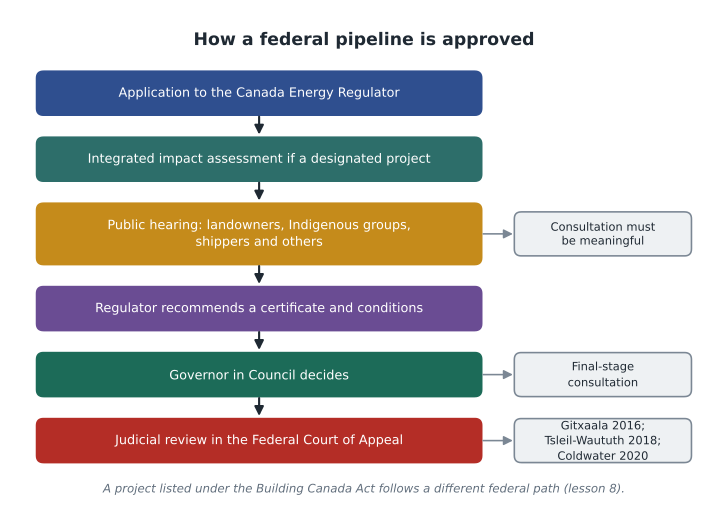
A new interprovincial pipeline needs a certificate from the regulator. For a large project, the regulator holds a public hearing, assesses the project, and makes a recommendation to the federal Cabinet, which decides whether the certificate should be issued. If the project is a designated project under the Impact Assessment Act, the assessment is integrated with the impact assessment. The Cabinet's decision is political, but it is subject to judicial review in the Federal Court of Appeal, and three decisions of that court have shaped how pipeline approvals are made.
In Gitxaala Nation v. Canada, 2016 FCA 187, the court quashed the approval of the Northern Gateway pipeline, which would have carried diluted bitumen from Alberta to the northern British Columbia coast. The majority held that the review process itself was reasonable, but that Canada had failed to engage in meaningful consultation with affected First Nations at the final stage, before the Cabinet decided. Canada's officials had largely listened and recorded concerns without engaging with them or explaining why they were rejected. The government later decided not to proceed with the project, and Parliament enacted the Oil Tanker Moratorium Act in 2019, which bars large crude oil tankers from loading or unloading on British Columbia's north coast.
In Tsleil-Waututh Nation v. Canada (Attorney General), 2018 FCA 153, the court quashed the first approval of the Trans Mountain expansion project, which would twin an existing pipeline from Edmonton to Burnaby. The court found two flaws. First, the regulator had unjustifiably excluded project-related marine shipping from the scope of its review, even though tanker traffic would significantly affect the endangered southern resident killer whales. Second, consultation at the final stage again fell short: the Crown's consultation team had acted largely as note-takers. The federal government, which had purchased the pipeline in 2018, sent the project back for reconsideration of marine shipping and renewed consultation, and approved it again in June 2019.
In Coldwater Indian Band v. Canada (Attorney General), 2020 FCA 34, the court dismissed challenges to the second approval. It held that the renewed consultation was reasonable, and it emphasized that the duty to consult does not give Indigenous groups a veto: the Crown must listen, engage and accommodate where appropriate, but it may approve a project over objections if it has consulted adequately. The Supreme Court of Canada refused leave to appeal. The expansion began commercial operation on May 1, 2024.
Daniel Whitecloud observes that the three cases form a pattern. 'In the first two, the Crown lost because it did not really talk,' he says. 'In the third, it talked, and it won even though people still said no.' Mawhinney agrees and says that this pattern explains how federal officials now approach consultation on every major energy project.
Rates, tolls and economic regulation
Most energy regulation is not about new pipelines but about money. Pipelines, gas distribution utilities and electricity transmission and distribution companies are natural monopolies: duplicating their networks would be wasteful, so each operates without direct competition in its area. In return, the law limits what they may charge. Federal and provincial statutes require that tolls and rates be just and reasonable and not unjustly discriminatory.
The traditional method is cost of service regulation. The regulator determines the utility's revenue requirement: its reasonable operating costs, depreciation, taxes and a fair return on the capital invested in its rate base. Rates are then designed to recover that revenue requirement from customers. The fair return standard, which developed in North American regulation, requires that the return be comparable to returns on investments of similar risk, enough to maintain the utility's financial integrity and attract capital.
Many regulators now use performance-based regulation, which sets rates by formula for several years and lets the utility keep some of the savings if it reduces costs. Alberta's utilities commission adopted performance-based regulation for distribution utilities in 2013, and the Ontario Energy Board uses incentive rate-setting for electricity distributors.
| Concept | Meaning | Why it matters |
|---|---|---|
| Revenue requirement | Operating costs, depreciation, taxes and a fair return on rate base | The total amount the utility is allowed to recover |
| Rate base | The utility's invested capital in used and useful assets | Return is earned only on this amount |
| Fair return | A return comparable to investments of similar risk | Too low and capital leaves; too high and customers overpay |
| Prudence | Whether costs were reasonable when incurred | Imprudent costs may be disallowed |
| Just and reasonable | The statutory standard for rates and tolls | Gives regulators broad discretion, reviewed for reasonableness |
The Supreme Court on utility regulation
Three Supreme Court decisions explain the limits of regulators' powers over utilities. In ATCO Gas & Pipelines Ltd. v. Alberta (Energy & Utilities Board), 2006 SCC 4, often called Stores Block, a gas utility sold buildings that were no longer needed. The board allocated part of the profit to customers, on the theory that customers had paid for the assets through rates. A majority of the Supreme Court held that the board had no jurisdiction to do so. Customers pay for a service, not for ownership of the utility's assets, and the profit on sale belonged to the utility's shareholders. The decision drew a line between regulating rates and redistributing property.
In Ontario (Energy Board) v. Ontario Power Generation Inc., 2015 SCC 44, the board disallowed part of the labour costs that Ontario Power Generation sought to recover, finding that its compensation levels were too high. The utility argued that the costs were committed under collective agreements and that the board could only disallow costs that were imprudent when incurred. The Supreme Court held that the statute did not require the board to use a particular method, and that it was reasonable for the board to assess some forecast costs without a strict prudence test. In the companion case, ATCO Gas and Pipelines Ltd. v. Alberta (Utilities Commission), 2015 SCC 45, the court upheld the Alberta commission's decision to disallow part of a pension cost-of-living adjustment.
Arjun Mehta finds the cases consistent. 'The regulator controls what goes into rates,' he says. 'It does not control what the company owns.' Mawhinney adds that the standard of review has since been restated in Canada (Minister of Citizenship and Immigration) v. Vavilov, 2019 SCC 65, which applies reasonableness review to most administrative decisions. Statutory appeals on questions of law, such as appeals from Alberta's commission and energy regulator to the Court of Appeal, are reviewed for correctness on those questions.
Provincial utility regulators
Each province has its own utility regulator. In Alberta, the Alberta Utilities Commission regulates electricity and gas utilities and approves power plants, transmission lines and gas utility pipelines, while the Alberta Energy Regulator regulates oil and gas development. In Ontario, the Ontario Energy Board sets rates and licenses electricity and gas companies. In British Columbia, the BC Utilities Commission sets utility rates, while the BC Energy Regulator regulates oil and gas activities. Quebec's Régie de l'énergie regulates Hydro-Québec's distribution rates and gas distributors.
Sophie Tremblay-Hart notes that Quebec's legislature has repeatedly limited the Régie's role over Hydro-Québec's rates, including by setting rate increases by statute or capping them by policy. Mawhinney says that is a reminder that rate regulation sits inside politics. 'A regulator is a delegate,' she says. 'The legislature can always take the decision back.'
Gannet's toll dispute and the Ruskovich pipeline
Mawhinney returns to the two problems. On the toll application, Gannet, as a shipper, can apply to intervene before the Canada Energy Regulator. It can argue that the proposed tolls are not just and reasonable, for example because the pipeline company seeks to recover costs that were imprudent or because the toll design shifts costs unfairly onto smaller shippers. It will need evidence from experts in rate design and finance. Many toll disputes are settled through negotiated settlements among the pipeline and its shippers, which the regulator then approves.
For the Ruskovich family, the new pipeline raises different questions. If the project is approved, the company will need to acquire rights across their land, by agreement or through the regulator's right of entry process under the federal statute. The family can participate in the hearing on the route and the detailed route, raise concerns about soil, water and farming operations, and claim compensation, which lesson 9 discusses. Whitecloud adds that the Ochre Lake First Nation will also be entitled to consultation if the route affects its treaty rights. Mawhinney agrees. 'Two different people can be affected by the same line in very different legal ways,' she says.
Worked problem
A challenge to a pipeline approval
Assume the federal Cabinet approves a new interprovincial gas pipeline that will cross the territory of the Ochre Lake First Nation. During the hearing, the First Nation raised concerns about impacts on moose habitat and harvesting areas. In the final stage before the Cabinet decision, federal officials held three meetings with the First Nation, summarized its concerns in a report and attached the report to the Cabinet submission without responding to the concerns or proposing changes. The First Nation asks whether it can challenge the approval.
Show solution
- Forum: judicial review of a federal Cabinet decision approving a pipeline under the Canadian Energy Regulator Act is brought in the Federal Court of Appeal, with leave.
- Duty to consult: the approval may adversely affect treaty harvesting rights, so the duty to consult is engaged. The depth will be significant if the impacts are serious.
- Final-stage consultation: Gitxaala (2016) and Tsleil-Waututh (2018) held that consultation is inadequate where officials merely record concerns without meaningful two-way dialogue, responses and consideration of accommodation. The facts here resemble those cases.
- No veto: Coldwater (2020) confirms that the Crown may approve a project over objections if consultation is adequate, so the First Nation must show a failure of process, not just disagreement with the result.
- Likely remedy: if the court finds the consultation inadequate, it may quash the approval and send the matter back for renewed consultation, as in Tsleil-Waututh.
Common mistakes
MistakeSaying that the National Energy Board still approves interprovincial pipelines.
InsteadThe Canada Energy Regulator replaced it on August 28, 2019 under the Canadian Energy Regulator Act.
MistakeThinking that Coldwater (2020) gives Indigenous groups a veto over pipelines.
InsteadColdwater held that adequate consultation does not require agreement; the Crown may approve a project over objections after meaningful consultation.
MistakeAssuming that customers own utility assets because they pay rates.
InsteadStores Block (2006) held that customers pay for service, not ownership, and that the regulator could not allocate gains on the sale of assets to customers.
MistakeTreating prudence as the only permissible test for disallowing costs.
InsteadOPG (2015) held that a regulator may use other reasonable methods for forecast costs, especially committed costs; the statute does not require a single test.
MistakeForgetting the federal tanker moratorium when discussing north coast pipelines.
InsteadThe Oil Tanker Moratorium Act (2019) bars large crude tankers from loading or unloading on British Columbia's north coast, which shapes route choices.
Practice problems
Work each problem on paper first, then reveal the answer to check.
Why did the Federal Court of Appeal quash the first Trans Mountain approval in 2018?
Show answer
Because the regulator unjustifiably excluded project-related marine shipping from its review, and because Crown consultation at the final stage was inadequate, with officials acting largely as note-takers rather than engaging meaningfully.
What is a revenue requirement?
Show answer
The total amount a regulated utility is allowed to recover through rates, consisting of reasonable operating costs, depreciation, taxes and a fair return on its rate base.
What did the Supreme Court decide in Stores Block (2006)?
Show answer
That the Alberta board had no jurisdiction to allocate part of the gain on the sale of utility assets to customers, because customers pay for service and do not acquire ownership of the assets.
Name two factors the Canada Energy Regulator must consider on major projects that the old statute did not list expressly.
Show answer
Any two of: the interests and concerns of Indigenous peoples; effects on the rights of Indigenous peoples; the extent to which the project contributes to or hinders Canada's ability to meet its environmental obligations and climate change commitments; and specified safety and environmental factors.
Summary and key terms
- The Canada Energy Regulator replaced the National Energy Board in 2019; it regulates interprovincial and international pipelines and power lines, energy exports and federal offshore renewables.
- Major pipeline approvals are made by Cabinet on the regulator's recommendation and are reviewed in the Federal Court of Appeal.
- Gitxaala (2016) and Tsleil-Waututh (2018) quashed approvals for inadequate final-stage consultation; Coldwater (2020) upheld the renewed Trans Mountain approval and confirmed there is no veto.
- Utility rates and tolls must be just and reasonable; regulators use cost of service and performance-based methods.
- Stores Block (2006) limits regulators to rates, not property; OPG and ATCO (2015) give regulators flexibility in reviewing costs.
- Certificate of public convenience and necessity
- The federal approval required to build and operate a major interprovincial pipeline or international power line.
- Toll
- The charge a pipeline levies on shippers for transporting oil or gas.
- Cost of service regulation
- Setting rates to recover a utility's reasonable costs plus a fair return on its rate base.
- Performance-based regulation
- Setting rates by formula for several years, allowing the utility to keep part of any savings.
- Rate base
- The capital invested in a utility's used and useful assets, on which it may earn a return.
- Prudence
- The standard that costs must have been reasonable when the utility incurred them.
- Shipper
- A company that contracts to move its product through a pipeline.
Lesson quiz · 5 questions
Score 60% or more to complete this lesson.
Create a free account to save your progress, take quizzes and earn a certificate.