
LAWC-304 · Lesson 10 of 12 · 22 min
Indigenous consultation
▶ Video coming soon A video version of this lesson is on the way.
Daniel Whitecloud has been quiet for most of the term about his own experience, but in the tenth class Professor Mawhinney asks him to start. 'When I worked in band administration,' he says, 'we would get a stack of referrals every week from the province. Well licences, pipeline applications, timber permits. Each one came with a form letter asking for comments within thirty days. We had two people to read them. That was consultation.' The room is quiet. Mawhinney nods. 'And that is why the law in this area has developed the way it has,' she says. 'Because consultation can be a real conversation or a stack of letters, and the difference matters.'
Mawhinney worked for five years at a First Nation's consultation office before teaching, and this is the lesson she clearly cares about most. The Gannet file now includes a letter from the Ochre Lake First Nation. The nation says that Gannet's proposed new wells and pipeline would cross an area its members use for moose hunting and medicine gathering, that Alberta has sent notice of the applications but has not responded to its concerns, and that it wants the applications put on hold.
This lesson explains the source and purpose of the duty to consult, when it is triggered, how deep it must be, who owes it and to whom, how it is delegated to companies, how it applies to regulators and to legislation, and the remedies when it is breached.
The source of the duty
The duty to consult was recognized by the Supreme Court of Canada in Haida Nation v. British Columbia (Minister of Forests), 2004 SCC 73. The Haida Nation claimed Aboriginal title to Haida Gwaii, and the province had transferred a tree farm licence over part of the islands to a forestry company without consulting the Haida. The court held that the honour of the Crown requires it to consult, and where appropriate accommodate, when it contemplates conduct that might adversely affect an Aboriginal right or title that has been asserted but not yet proven. The duty exists because reconciliation would be undermined if the Crown could use resources while claims were being negotiated or litigated, leaving nothing to reconcile.
Haida settled several points. The duty is owed by the Crown, not by third parties, although procedural aspects may be delegated. It arises from the honour of the Crown and is grounded in section 35. It does not give Indigenous groups a veto, and it does not require agreement. And its content varies with the circumstances. In the companion case, Taku River Tlingit First Nation v. British Columbia (Project Assessment Director), 2004 SCC 74, the court held that the province had met its duty through the participation of the First Nation in a provincial environmental assessment of a mine road, even though the outcome was not what the First Nation wanted.
The duty also applies to treaty rights. In Mikisew Cree First Nation v. Canada (Minister of Canadian Heritage), 2005 SCC 69, the federal government approved a winter road through Wood Buffalo National Park, in Treaty 8 territory, without consulting the Mikisew Cree. Canada argued that the treaty allowed it to take up land for settlement and other purposes. The court held that the Crown's right to take up land under the treaty must be exercised honourably, and that the Crown had to consult before taking up land in a way that would adversely affect the exercise of treaty hunting and trapping rights.
When is the duty triggered?
In Rio Tinto Alcan Inc. v. Carrier Sekani Tribal Council, 2010 SCC 43, the Supreme Court stated a three-part test. The duty is triggered when the Crown has real or constructive knowledge of a potential Aboriginal claim or right, the Crown contemplates conduct, and the contemplated conduct may adversely affect the claim or right. Crown conduct includes decisions that may not have an immediate impact on the land, such as strategic, higher-level decisions, and it includes authorizing a private party to act. But the adverse effect must be on the future exercise of the right: a past infringement, such as the original construction of a dam decades earlier without consultation, does not by itself trigger a duty to consult on a later decision that does not cause new harm. The remedy for past infringements lies elsewhere, such as in claims for damages.
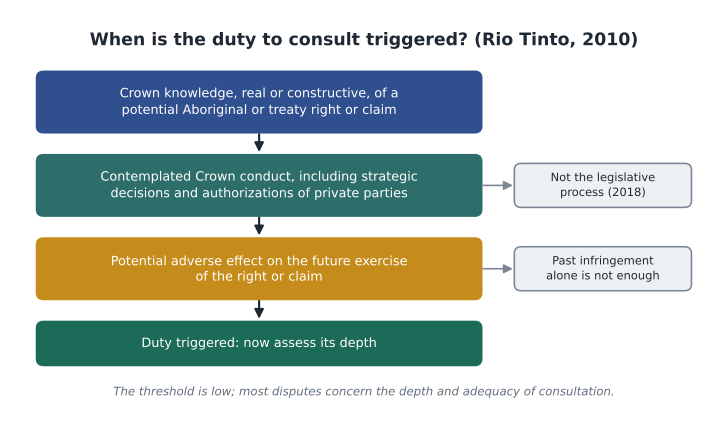
Theo Marchetti asks whether the threshold is high. Mawhinney says no. 'The trigger is low. Knowledge of a potential claim and a possible adverse effect are enough. The real argument is almost always about depth, not existence.' Whitecloud adds that First Nations often had to fight for years to get governments to accept that well licences triggered consultation at all. 'Now it is routine,' he says. 'The fight is about whether a thirty-day comment period is enough.'
How deep must consultation be?
Haida described a spectrum. At one end, where the claim is weak, the right limited or the potential infringement minor, the Crown may only need to give notice, disclose information and discuss any issues raised. At the other end, where there is a strong prima facie case for the claim, the right is of high significance and the potential harm is serious, deep consultation is required. Deep consultation may involve the opportunity to make submissions, formal participation in decision-making and written reasons that show that Aboriginal concerns were considered and reveal how they affected the decision. Between the two ends, the content of the duty is determined case by case.
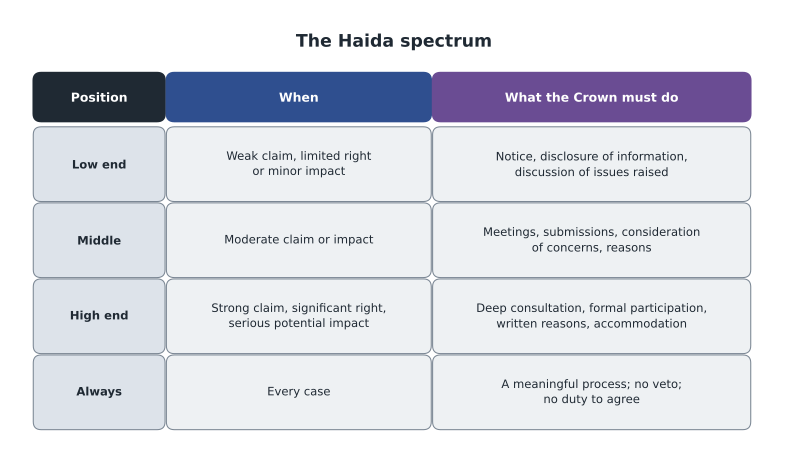
Accommodation is part of the duty where consultation reveals that the proposed conduct would seriously affect the right. Accommodation means seeking compromise to balance the interests, for example by changing a route, timing activities to avoid sensitive seasons or reducing the scale of a project. It does not mean that the Crown must do whatever the First Nation asks. The test, as the Federal Court of Appeal emphasized in Coldwater (2020), is whether the process was meaningful and reasonable, not whether it produced agreement.
Regulators and the duty
Most resource decisions are made by regulators, not by ministers, and the Supreme Court has held that a regulator's process can be used to fulfil the Crown's duty. In Clyde River (Hamlet) v. Petroleum Geo-Services Inc., 2017 SCC 40, the National Energy Board approved offshore seismic testing in Baffin Bay and Davis Strait that could affect Inuit harvesting of marine mammals. The court held that where a regulator is the final decision maker, its decision is Crown conduct that triggers the duty, and the Crown may rely on the regulator's process to fulfil it. But the process must be adequate to the depth required. In Clyde River it was not: the Inuit had a strong treaty right, the potential harm was serious, and the board's process involved no oral hearing, no participant funding and responses to questions that were inaccessible. The court quashed the authorization.
On the same day, in Chippewas of the Thames First Nation v. Enbridge Pipelines Inc., 2017 SCC 41, the court upheld the board's approval of changes to Enbridge's Line 9 pipeline in Ontario. The board had given the First Nation early notice, participant funding and an opportunity to present evidence and argument at an oral hearing, had considered its concerns and imposed conditions, and had explained its reasons. Given the limited potential impact of the changes, the process was adequate. Read together, the two cases show that a regulator can discharge the duty, but only if its process matches the depth that the circumstances require.
Hannah Kowalczyk notes that Alberta takes a different structural approach. The Responsible Energy Development Act provides that the Alberta Energy Regulator has no jurisdiction to assess the adequacy of Crown consultation. Instead, Alberta's Aboriginal Consultation Office, a provincial government office, manages consultation on energy applications and advises the regulator whether consultation is adequate. Mawhinney says that Alberta's model separates the regulatory decision from the assessment of consultation, which some see as preserving the regulator's neutrality and others see as weakening accountability. 'Either way,' she says, 'if consultation is inadequate, the decision that relies on it is vulnerable.'
| Case | Year | Point decided |
|---|---|---|
| Haida Nation | 2004 SCC 73 | Duty arises from the honour of the Crown for asserted rights; spectrum of depth; no veto; owed by the Crown |
| Mikisew Cree | 2005 SCC 69 | Duty applies to treaty rights when the Crown takes up land |
| Rio Tinto Alcan | 2010 SCC 43 | Three-part trigger; past infringement alone does not trigger the duty |
| Clyde River | 2017 SCC 40 | Regulator's process can fulfil the duty, but must match the required depth; authorization quashed |
| Chippewas of the Thames | 2017 SCC 41 | Board's process was adequate for a limited impact; approval upheld |
| Mikisew Cree | 2018 SCC 40 | No duty to consult in the legislative process |
Legislation and the duty
Does the duty apply when Parliament or a legislature makes law? In Mikisew Cree First Nation v. Canada (Governor General in Council), 2018 SCC 40, the court held that it does not. The case concerned omnibus federal legislation in 2012 that changed environmental assessment and fisheries protection. The majority held that the law-making process, including the development of legislation by ministers acting in their parliamentary capacity, is not subject to the duty to consult, because imposing it would interfere with parliamentary sovereignty and privilege. Several judges noted, however, that legislation enacted without consultation may still be challenged if it infringes section 35 rights, and that the honour of the Crown may be engaged in other ways.
That holding matters for statutes like Ontario's 2025 special economic zones law and the federal Building Canada Act. The legislature can pass them without consulting. But the decisions made under them, such as designating a zone or listing a project, are executive conduct that may trigger the duty. Sophie Tremblay-Hart puts it simply. 'The statute is safe. The decisions under it are not.'
Delegation to proponents
Haida allowed the Crown to delegate procedural aspects of consultation to industry proponents. In practice, much consultation is carried out by companies: they share project information, meet with communities, fund studies of traditional land use, and negotiate impact benefit agreements. But the Crown remains responsible. If the company's engagement is inadequate, the Crown's duty is not discharged, and the Crown's decision may be quashed. Mawhinney stresses this point for future corporate lawyers. 'A company does not owe the constitutional duty,' she says. 'But it bears the consequences when the duty is breached, because its approval is the thing that gets quashed.'
Remedies
When the duty has been breached, courts may quash the decision, suspend it, order consultation, or in some cases grant an injunction to prevent irreparable harm while consultation occurs. Damages may be available for breach of the honour of the Crown in some circumstances, although the courts have been cautious. The remedy depends on the stage: before a decision, a court may order the Crown to consult; after it, the court may set the decision aside and send it back. In Tsleil-Waututh (2018), discussed in lesson 6, the court quashed the first Trans Mountain approval and the federal government redid consultation; in Clyde River the authorization was simply quashed.
Answering the Ochre Lake letter
Mawhinney asks the class to advise Gannet and Alberta. The duty is triggered: Alberta knows of the treaty harvesting rights, it is contemplating licensing decisions, and the wells and pipeline may adversely affect the exercise of those rights. The depth depends on the seriousness of the impact. If the area is important for moose hunting and medicine gathering and the project would fragment it, the duty may be toward the deeper end, and a form letter with a thirty-day comment period would not be enough. The Aboriginal Consultation Office should engage directly, review the First Nation's information and consider accommodation, such as rerouting the pipeline, seasonal restrictions or habitat offsets. Gannet should offer to fund a traditional land use study and meet with the nation. Whitecloud adds one more suggestion: ask the nation what it needs. 'Most of the time,' he says, 'the first question nobody asks is the one that would solve the problem.'
Worked problem
Was the consultation adequate?
Alberta's Aboriginal Consultation Office sent the Ochre Lake First Nation notice of Gannet's applications for six new wells and a pipeline, with a summary of the project and a request for comments within twenty-one days. The First Nation replied with a detailed letter and maps showing harvesting sites. The office acknowledged receipt, did not meet with the nation, and advised the regulator that consultation was adequate because the project would occupy only twelve hectares. The regulator approved the applications. Can the First Nation challenge the approvals?
Show solution
- Trigger: the Crown knew of the treaty rights, contemplated licensing decisions, and the decisions may adversely affect the exercise of harvesting rights. The duty is triggered (Rio Tinto).
- Depth: the treaty rights are established. If the maps show that the project affects important harvesting sites, the potential impact may be more than minor even if the footprint is small; consider cumulative effects with other development in the area (discussed in lesson 11).
- Adequacy: a form notice, a short comment period and no response to detailed concerns resemble the deficiencies in Clyde River and the final-stage failures in Gitxaala and Tsleil-Waututh. Without engagement with the maps or any consideration of accommodation, the process may be inadequate for anything above the low end of the spectrum.
- Remedy: the First Nation can seek judicial review or an appeal of the regulator's decisions and a declaration that the duty was not met; the court may quash the approvals and order further consultation.
- Practical advice to Gannet: engage now, fund a land use study and propose route or timing changes. Its approvals are at risk regardless of who owed the duty.
Common mistakes
MistakeSaying that the duty to consult gives First Nations a veto over projects.
InsteadHaida and Coldwater confirm there is no veto; the duty requires a meaningful process and accommodation where appropriate, not agreement.
MistakeSaying that companies owe the duty to consult.
InsteadThe duty is owed by the Crown; procedural aspects may be delegated to proponents, but the Crown remains responsible.
MistakeTreating any past infringement as triggering consultation on a new decision.
InsteadRio Tinto holds that the new decision must have the potential to adversely affect the future exercise of the right.
MistakeAssuming that a regulator's hearing automatically discharges the duty.
InsteadClyde River holds that a regulator's process may fulfil the duty only if it matches the depth required.
MistakeSaying that the duty to consult applies to the passage of legislation.
InsteadMikisew Cree (2018) held that the law-making process is not subject to the duty, although executive decisions under statutes are.
Practice problems
Work each problem on paper first, then reveal the answer to check.
What are the three elements of the Rio Tinto test?
Show answer
Crown knowledge, real or constructive, of a potential Aboriginal claim or right; contemplated Crown conduct; and the potential for that conduct to adversely affect the claim or right.
What distinguished Clyde River from Chippewas of the Thames?
Show answer
In Clyde River, the Inuit had strong treaty rights and faced serious potential harm, but the board's process lacked an oral hearing, funding and accessible responses, so it was inadequate. In Chippewas of the Thames, the impact was limited and the board provided notice, funding, an oral hearing, consideration of concerns and reasons, so it was adequate.
Why does the Alberta Energy Regulator not assess the adequacy of Crown consultation?
Show answer
The Responsible Energy Development Act removes that jurisdiction from the regulator; Alberta's Aboriginal Consultation Office manages consultation and advises on its adequacy.
What did Mikisew Cree (2018) decide about legislation?
Show answer
That the law-making process, including ministers developing legislation in their parliamentary capacity, is not subject to the duty to consult, although legislation may still be challenged if it infringes section 35 rights.
Summary and key terms
- The duty to consult arises from the honour of the Crown and applies to asserted rights (Haida, 2004) and to treaty rights (Mikisew Cree, 2005).
- It is triggered by Crown knowledge, contemplated conduct and potential adverse effect on the future exercise of rights (Rio Tinto, 2010).
- Its depth varies along the Haida spectrum; accommodation may be required, but there is no veto.
- A regulator's process may fulfil the duty if adequate to the required depth (Clyde River and Chippewas of the Thames, 2017); in Alberta, the Aboriginal Consultation Office manages consultation.
- The duty does not apply to the legislative process (Mikisew Cree, 2018), but it applies to executive decisions made under statutes, and procedural aspects may be delegated to proponents while the Crown remains responsible.
- Duty to consult
- The Crown's constitutional obligation, grounded in the honour of the Crown and section 35, to consult and where appropriate accommodate before conduct that may adversely affect Aboriginal or treaty rights.
- Honour of the Crown
- The principle that the Crown must act honourably in all its dealings with Indigenous peoples.
- Haida spectrum
- The range of consultation depth, from notice and discussion to deep consultation, depending on the strength of the claim and the seriousness of the impact.
- Accommodation
- Changes to a proposed decision or project to address serious impacts on rights, such as rerouting or timing restrictions.
- Taking up
- The Crown's treaty right to use land for settlement, mining and other purposes, which must be exercised honourably.
- Impact benefit agreement
- An agreement between a proponent and an Indigenous community setting out benefits, protections and commitments for a project.
Lesson quiz · 5 questions
Score 60% or more to complete this lesson.
Create a free account to save your progress, take quizzes and earn a certificate.