
LAWC-304 · Lesson 3 of 12 · 22 min
Mineral tenure: staking, free entry and reform
▶ Video coming soon A video version of this lesson is on the way.
The third class begins with an old photograph that Professor Mawhinney projects at the front of the Lister Room: a prospector beside a wooden claim post in a burned-over forest, an axe in one hand and a notebook in the other. 'For a hundred and fifty years,' she says, 'this is how you got a mineral right in Canada. You walked into the bush, cut four posts, wrote your name on them and ran to the recording office. Today you click on a map. What has not changed, until very recently, is that nobody asked the people who lived there.'
Gannet Ridge has decided to diversify. Its geologists believe that the brines produced with its oil contain lithium, and its board wants to look at hard-rock lithium prospects in northern Ontario and northern British Columbia as well. Mawhinney uses this decision to introduce the law of mineral tenure, which governs how a person acquires the right to explore for and mine metallic and industrial minerals on Crown land. The rules for oil and gas, covered in lessons 2 and 4, are separate.
This lesson covers the traditional free entry system, how online staking changed it, the duty to consult at the claim stage, the Gitxaala litigation in British Columbia and the province's response, and Ontario's recent reforms. It ends with lithium in Alberta brines, which brings oil and gas and mineral law together.
The free entry system
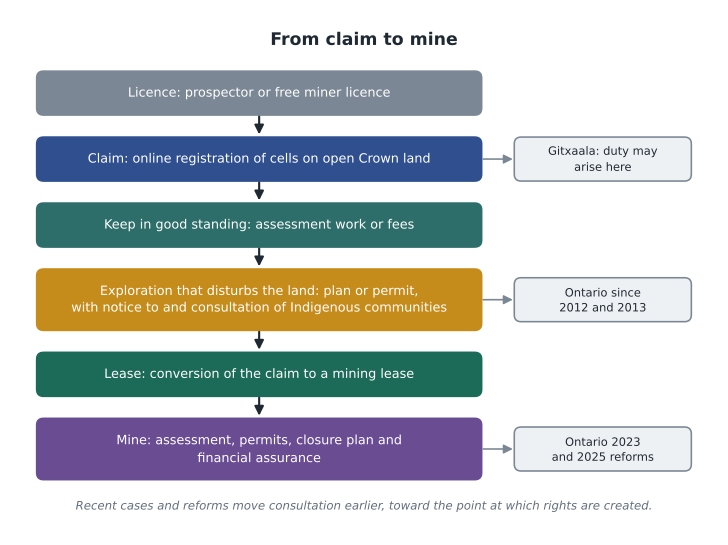
Free entry, sometimes called free mining, is the traditional basis of mineral tenure in most Canadian provinces and territories. It rests on three ideas. First, Crown land is open for prospecting and staking unless it has been specifically withdrawn, for example for a park or a reserve. Second, a person who meets minimal requirements, such as obtaining a prospector's or free miner's licence, is entitled as of right to register a claim on open land. Third, the holder of a claim in good standing has a right to proceed to a lease and, subject to environmental and safety approvals, to a mine.
Free entry was designed in the nineteenth century to encourage settlement and discovery. Its advantages are speed and certainty: a prospector does not need to persuade an official that a claim should be granted, and a discovery cannot be taken away by a government that changes its mind. Its disadvantages are equally clear. Claims can be registered over lands used by Indigenous communities, over private surface rights and over sensitive areas, without notice to anyone. Critics have long argued that free entry treats mineral development as the highest use of land by default.
Online staking
Every major mining jurisdiction in Canada has now moved from physical staking to online registration. Ontario replaced ground staking with its Mining Lands Administration System in April 2018, converting existing claims into cells on a provincial grid. British Columbia introduced online registration through its Mineral Titles Online system in 2005. Quebec, Manitoba and others have similar systems. Arjun Mehta notes that online staking makes the old free entry problem worse. 'If you can stake a hundred cells from a laptop in Toronto in an afternoon,' he says, 'nobody on the ground knows until the drill arrives.'
Mawhinney agrees that this is the key legal point. When a claim is registered automatically, there is no discretionary decision by an official at the moment of registration. Governments long argued that the duty to consult could not apply to a purely administrative act. The courts have increasingly rejected that argument where registration itself confers rights that may adversely affect Aboriginal or treaty rights.
The duty to consult at the claim stage
The first appellate decision on point was Ross River Dena Council v. Government of Yukon, 2012 YKCA 14. Yukon's Quartz Mining Act allowed claims to be staked and recorded as of right. The Ross River Dena Council argued that recording claims in its traditional territory, where it asserted Aboriginal title, triggered the duty to consult. The Yukon Court of Appeal agreed. It held that the Crown's duty to consult cannot be avoided by designing a regime that leaves no room for discretion, and that the Crown must at least provide notice to affected First Nations and have the ability to consult where appropriate. Yukon responded by creating a notification process and by withdrawing some lands from staking.
In Ontario, the issue arose in Wahgoshig First Nation v. Ontario, 2011 ONSC 7708. A junior company had begun exploration drilling on claims in the traditional territory of the Wahgoshig First Nation without any consultation. The Superior Court of Justice granted an interlocutory injunction stopping the drilling until consultation occurred. Shortly afterward, amendments to Ontario's Mining Act that came into force in 2012 and 2013 introduced a two-tier system of early exploration plans and permits, with notice to and consultation with affected Aboriginal communities before significant ground disturbance.
These developments placed consultation at the exploration stage rather than at registration. That compromise is what the Gitxaala litigation challenged.
Gitxaala v. British Columbia
British Columbia's Mineral Tenure Act allowed any holder of a free miner certificate, which can be obtained online for a fee, to register a mineral claim on available Crown land through Mineral Titles Online. Registration was automatic. There was no notice to, or consultation with, affected First Nations until the holder applied for a permit under the Mines Act to carry out work that disturbed the ground.
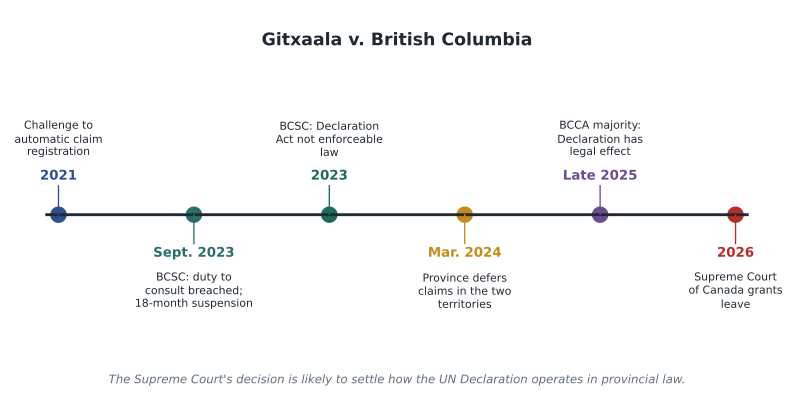
The Gitxaala Nation, whose territory includes islands on the north coast, and later the Ehattesaht First Nation on Vancouver Island, challenged the regime. In Gitxaala v. British Columbia (Chief Gold Commissioner), 2023 BCSC 1680, the Supreme Court of British Columbia held that the province's duty to consult was triggered by the registration of claims, because registration conferred rights, including a right to explore with minimal disturbance and a right to proceed toward a lease, that could adversely affect the First Nations' asserted rights and title. The court suspended its declaration for eighteen months so that the province could redesign the regime.
The trial judge, however, rejected a broader argument. The First Nations also argued that the Declaration on the Rights of Indigenous Peoples Act, which British Columbia enacted in 2019, had incorporated the United Nations Declaration into provincial law, so that the Mineral Tenure Act had to be interpreted consistently with it. The trial judge held that the Act did not give the Declaration the force of enforceable law.
The province deferred new claim registration in the two First Nations' territories in March 2024 and began work on a new mineral tenure framework. On appeal, in Gitxaala v. British Columbia (Chief Gold Commissioner), 2025 BCCA 430, released in late 2025, the Court of Appeal affirmed the finding that the regime breached the duty to consult. A majority also held that the Declaration Act gave the UN Declaration legal effect in British Columbia, so that provincial laws are presumed to be consistent with it and courts may consider whether they are. A dissenting judge would have held that the Act did not authorize courts to decide that question. The Supreme Court of Canada granted leave to appeal in 2026, and the appeal had not been decided as of November 2026.
Daniel Whitecloud sums up why the case matters. 'The duty to consult part is about mining,' he says. 'The Declaration part is about every statute in British Columbia.' Mawhinney agrees and notes that the Federal Court of Appeal took a narrower view of the federal Declaration statute in October 2026, which lesson 11 discusses. 'For the first time in a while, two appellate courts in this country disagree about something fundamental in this area. That is why the Supreme Court took the case.'
Ontario: speed, closure and special economic zones
Ontario has moved in a different direction. Its policy since 2023 has been to shorten the time needed to bring a mine into production, especially for critical minerals. The Building More Mines Act, 2023 amended the Mining Act to allow closure plans to be certified by qualified professionals and to give more flexibility in how plans are amended. In June 2025 the legislature passed the Protect Ontario by Unleashing our Economy Act, 2025, which received Royal Assent on June 5, 2025. It enacted the Special Economic Zones Act, 2025, allowing the province to designate zones in which specified projects may be exempted from provincial laws and municipal by-laws. It replaced the Endangered Species Act, 2007 with a narrower species protection regime, and it aimed to cut the time for mine approvals roughly in half.
The province identified the Ring of Fire, a region of mineral deposits in the far north within Treaty 9 territory, as a candidate for the first special economic zone. Several First Nations in the region announced legal challenges, arguing that the statute allowed the province to bypass consultation and environmental protections. Sophie Tremblay-Hart asks whether a special economic zone could exempt a project from the duty to consult. 'No,' Mawhinney says. 'The duty to consult is constitutional. A statute can change procedures and exempt projects from other statutes, but it cannot exempt the Crown from section 35. The real question is whether the procedures that remain are enough to discharge the duty.'
| Jurisdiction | How claims are acquired | When consultation occurs | Recent change |
|---|---|---|---|
| British Columbia | Online registration through Mineral Titles Online by a free miner | Traditionally at the Mines Act permit stage | Gitxaala (2023, 2025) found a duty at registration; deferrals and a new framework under development; Supreme Court appeal pending |
| Ontario | Online registration of cells in the Mining Lands Administration System (since 2018) | At early exploration plans and permits, and at later approvals | Building More Mines Act (2023); Bill 5 (2025) and the Special Economic Zones Act |
| Yukon | Staking and recording under the Quartz and Placer Mining Acts | Notification process after Ross River (2012); some lands withdrawn | Successor mineral resources legislation developed with First Nations |
| Alberta | Metallic and industrial mineral permits and leases issued by the Crown | Through Alberta's consultation policy for Crown decisions | Mineral Resource Development Act (2021) for lithium and other minerals |
Lithium in Alberta brines
Gannet Ridge's lithium idea brings the course back to Alberta. Lithium in Alberta is found mainly in saline brines in the same deep formations that produce oil and gas, rather than in hard rock. Alberta enacted the Mineral Resource Development Act in 2021 to regulate the development of minerals such as lithium, giving the Alberta Energy Regulator authority over brine-hosted mineral wells and facilities, and has since adopted tenure and regulatory rules for brine-hosted minerals. The practical effect is that a company like Gannet can drill a brine well, produce lithium-bearing brine, extract the lithium and reinject the brine under a regime modelled closely on oil and gas regulation.
Hannah Kowalczyk sees the policy logic. 'Alberta has thousands of kilometres of pipe, thousands of well bores and a regulator that knows how to license wells,' she says. 'Using that system for lithium makes sense.' Mawhinney adds a caution. 'It also inherits every problem that system has, including what happens to the wells when the company that drilled them goes under. That is lesson 5. And the capstone.'
What the reforms have in common
Mawhinney closes with three themes that run through modern mineral tenure reform. The first is that consultation is moving earlier, toward the point at which rights are first created, because that is when the Crown makes its most important decision. The second is that governments are trying to speed up the later stages of approval, especially for critical minerals, which creates pressure on the earlier stages to be thorough. The third is that the role of the UN Declaration in provincial and federal law is unsettled, and the Supreme Court's decision in Gitxaala is likely to shape mineral tenure, and much else, for a generation.
Worked problem
Advising Gannet on a British Columbia claim
Gannet wants to register claims over a hard-rock lithium showing on Crown land in northern British Columbia, in the territory of a First Nation that asserts Aboriginal title. A consultant tells Gannet it can register the claims online tonight and that consultation will only matter when it applies for a drilling permit. What should Gannet's lawyer advise?
Show solution
- Check whether the area is open: the province has deferred new claims in some territories since 2024, and other lands may be withdrawn or reserved. A claim cannot be registered over unavailable land.
- Explain Gitxaala: the British Columbia courts have held that registering claims without consultation breaches the duty to consult. Even if registration is technically possible, a claim registered under a regime found deficient may be challenged or affected by the new framework.
- Consider the pending appeal and the new framework: the Supreme Court of Canada's decision in Gitxaala, and any new provincial tenure rules, may change both the timing of consultation and the effect of the UN Declaration.
- Practical advice: engage early with the First Nation, even before registration, about the project and any agreement. Early engagement reduces legal risk and is often a condition of financing. The Crown, not Gannet, owes the duty to consult, but the Crown may delegate procedural aspects to Gannet.
Common mistakes
MistakeAssuming that automatic registration of a claim cannot trigger the duty to consult because no official exercises discretion.
InsteadRoss River (2012) and Gitxaala (2023 and 2025) held that the Crown cannot avoid the duty by designing a regime without discretion where registration confers rights that may adversely affect Aboriginal rights.
MistakeTreating the Gitxaala Court of Appeal decision as the final word on the UN Declaration.
InsteadThe Supreme Court of Canada granted leave in 2026, and the Federal Court of Appeal took a narrower view of the federal Declaration statute in Kebaowek (2026).
MistakeThinking that a special economic zone can exempt a project from the duty to consult.
InsteadThe duty to consult is a constitutional obligation under section 35; a provincial statute can change procedures but cannot remove the Crown's constitutional duty.
MistakeTreating lithium in Alberta as subject to the same tenure rules as hard-rock minerals in British Columbia.
InsteadAlberta regulates brine-hosted minerals under the Mineral Resource Development Act and the Alberta Energy Regulator, using a regime modelled on oil and gas.
Practice problems
Work each problem on paper first, then reveal the answer to check.
What are the three main features of the free entry system?
Show answer
Crown land is open for staking unless withdrawn; a qualified person is entitled as of right to register a claim; and a claim in good standing carries a right to proceed toward a lease and, subject to approvals, a mine.
What did the Yukon Court of Appeal hold in Ross River Dena Council (2012)?
Show answer
That the recording of quartz claims in an area of asserted Aboriginal title triggered the duty to consult, and that the Crown could not avoid the duty by adopting a regime that left no room for discretion; at minimum, notice to affected First Nations was required.
On what point did the British Columbia Court of Appeal in Gitxaala (2025) differ from the trial judge?
Show answer
The trial judge held that the Declaration Act did not make the UN Declaration enforceable law. The Court of Appeal majority held that the Act gave the Declaration legal effect, so that provincial law is presumed to be consistent with it.
Name two features of Ontario's Protect Ontario by Unleashing our Economy Act, 2025.
Show answer
Any two of: it enacted the Special Economic Zones Act, 2025, allowing exemptions from provincial laws and municipal by-laws in designated zones; it replaced the Endangered Species Act, 2007 with a narrower regime; and it aimed to shorten mine approval times.
Summary and key terms
- Free entry lets qualified persons register mineral claims as of right on open Crown land; online staking has made registration faster and less visible.
- Ross River (2012) and Wahgoshig (2011) pushed consultation into mineral tenure, and Ontario moved it to the early exploration stage.
- Gitxaala (2023 BCSC; 2025 BCCA) held that British Columbia's automatic registration breached the duty to consult; the Court of Appeal majority also held that the UN Declaration has legal effect in British Columbia law. The Supreme Court of Canada granted leave in 2026.
- Ontario has prioritized speed, through the Building More Mines Act (2023) and the 2025 statute creating special economic zones, which is being challenged by First Nations.
- Alberta regulates brine-hosted lithium through the Mineral Resource Development Act and the Alberta Energy Regulator, using its oil and gas system.
- Free entry
- The traditional system under which qualified persons may acquire mineral claims on open Crown land as of right.
- Mining claim
- A registered right to explore for minerals in a defined area of Crown land, which may later be converted to a lease.
- Assessment work
- Exploration work or payments required to keep a claim in good standing.
- Early exploration permit
- In Ontario, a permit for exploration activities with greater ground disturbance, issued after notice to and consultation with Indigenous communities.
- Withdrawal
- An order removing land from the area open for staking, for example to protect a sensitive area or pending consultation.
- Brine-hosted mineral
- A mineral such as lithium dissolved in underground saline water, produced through wells.
Lesson quiz · 5 questions
Score 60% or more to complete this lesson.
Create a free account to save your progress, take quizzes and earn a certificate.