
LAWC-304 · Lesson 8 of 12 · 22 min
Federal impact assessment and major projects
▶ Video coming soon A video version of this lesson is on the way.
Professor Mawhinney begins the eighth class with two dates on the board: October 13, 2023 and October 1, 2026. 'On the first date,' she says, 'the Supreme Court told Parliament that most of its federal assessment law went too far into provincial jurisdiction. On the second, the federal government listed an oil pipeline to the Pacific coast as a project of national interest under a statute that did not exist two years earlier. If you want to understand how Canada decides whether to build big things, you need to understand both dates.'
Gannet Ridge has no project large enough to trigger federal assessment, but Mawhinney uses the course file anyway. The Ruskovich family's neighbour has been approached by a company proposing a large in situ oil sands project in a neighbouring county; the Ochre Lake First Nation has received a letter from the Major Projects Office about a new transmission line; and Gannet's board wants to know whether a joint lithium project with a larger partner could become a project of national interest. Each question needs this lesson.
This lesson covers the history of federal environmental assessment, the Impact Assessment Act and the 2023 reference, the 2024 amendments, cooperation with the provinces, and the Building Canada Act and its first listing.
From the 1990s to 2019
Federal environmental assessment began with guidelines in the 1970s and 1980s. In Friends of the Oldman River Society v. Canada (Minister of Transport), [1992] 1 S.C.R. 3, the Supreme Court held that the federal guidelines were binding and applied to a provincial dam that required a federal navigation approval, and that the environment is not a separate head of power but a subject that both orders of government may address through their own powers. Federal assessment, the court said, must be tied to a federal head of power, but once it is triggered it may consider environmental effects broadly.
Parliament enacted the Canadian Environmental Assessment Act in 1992, replaced it in 2012 with a narrower statute, and in 2019 replaced that with the Impact Assessment Act, which came into force on August 28, 2019, the same day as the Canadian Energy Regulator Act. The 2019 Act broadened assessment from environmental effects to impacts on health, social and economic conditions, Indigenous peoples and climate commitments. Projects were caught if they were listed in the Physical Activities Regulations, often called the project list, or designated by the minister. Alberta's government called the bill the no more pipelines act and referred it to the Court of Appeal of Alberta.
The 2023 reference
In Reference re Impact Assessment Act, 2022 ABCA 165, a majority of the Court of Appeal of Alberta held that the whole designated projects scheme was unconstitutional. On appeal, in Reference re Impact Assessment Act, 2023 SCC 23, decided October 13, 2023, the Supreme Court agreed in large part. Chief Justice Wagner, writing for a majority of five, held that the part of the Act dealing with projects on federal lands and outside Canada was valid, but that the designated projects scheme was not.
The majority's reasoning had two parts. First, the scheme's definition of effects within federal jurisdiction was too broad. It included effects that did not correspond to federal heads of power, such as any change to the environment or to health, social or economic conditions of Indigenous peoples, without limits that tied them to federal subjects. Second, the scheme's decision-making function was not focused on federal effects. Once a project was designated, the minister or Cabinet decided whether its adverse effects within federal jurisdiction were in the public interest, but that public interest determination allowed decision makers to consider the project's effects as a whole, including on matters within provincial jurisdiction, and so in effect to regulate the project itself. The scheme was therefore not anchored in federal jurisdiction.
Justices Karakatsanis and Jamal, dissenting in part, would have upheld the scheme. They read the statute as focused on federal effects and emphasized that cooperative federalism allows both orders of government to assess the same project. Both the majority and dissent agreed that Parliament can validly enact a federal assessment regime, and that the environment is a shared field.
Hannah Kowalczyk recalls watching the decision come out from Calgary. 'People at home thought it was the end of federal assessment,' she says. 'It was not. It was an instruction to rewrite it.' Mawhinney agrees. 'The court told Parliament where the line was. Parliament redrew its map.'
The 2024 amendments
Parliament responded in the Budget Implementation Act, 2024, No. 1, which received Royal Assent and came into force on June 20, 2024. The amendments were described as surgical. The main changes were these. The definition of effects within federal jurisdiction was narrowed and tied more closely to federal subjects, such as fish and fish habitat, aquatic species at risk, migratory birds, federal lands, transboundary effects and effects on Indigenous peoples resulting from federal decisions. The screening decision now asks whether a project may cause non-negligible adverse effects within federal jurisdiction. The final decision asks whether those adverse effects, and adverse direct or incidental effects tied to federal decisions, are likely to be justified in the public interest. The amendments also gave more room for cooperation with provinces, including substitution, in which a provincial assessment is accepted in place of a federal one.
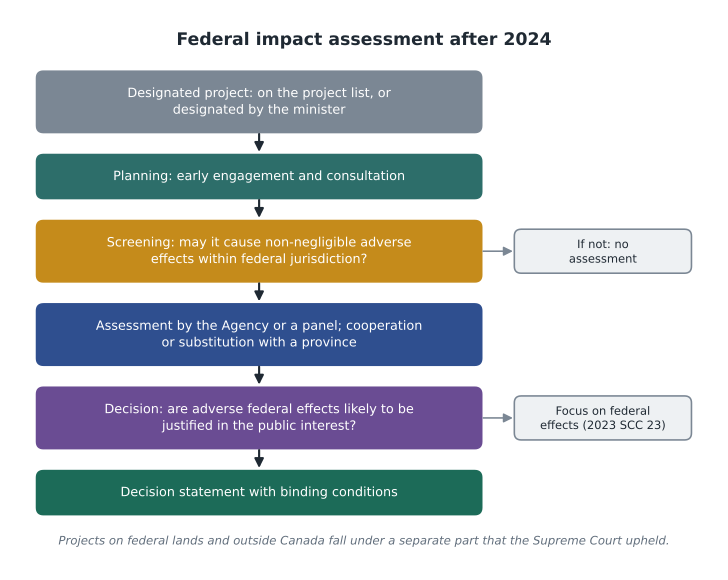
Critics on both sides questioned whether the amendments were enough. Some argued that the Act still allowed federal decision makers to influence provincial projects too heavily; others argued that the narrower definitions would let significant impacts escape federal scrutiny. No court had ruled on the amended Act by November 2026. In April 2026, Canada and Alberta signed a co-operation agreement on environmental impact assessment, designed to produce a single assessment for projects that both governments would otherwise review.
Cooperation and substitution
Most large projects in Canada need both federal and provincial approval. In Alberta, the provincial Environmental Protection and Enhancement Act requires environmental impact assessments for major projects, and the Alberta Energy Regulator or other provincial bodies decide on them. Duplication is costly. The tools for avoiding it are cooperation, in which the two governments run a joint process, and substitution, in which the federal minister accepts a provincial assessment as meeting federal requirements, although the federal decision remains federal. The principle of one project, one assessment has been endorsed by both governments, but how it works depends on agreements and on whether the provincial process covers the matters the federal statute requires, including consultation with Indigenous peoples.
The Building Canada Act
In June 2025, Parliament enacted the One Canadian Economy Act, which received Royal Assent on June 26, 2025. Part 2 of that statute is the Building Canada Act. It creates a new path for projects the federal government considers to be in the national interest. The Governor in Council may list a project in Schedule 1 to the Act after considering factors such as the project's contribution to national security, economic benefits, the interests of Indigenous peoples, clean growth and the likelihood of successful completion. A notice must be published in the Canada Gazette at least thirty days before listing, and the government must consult affected Indigenous rights holders before listing.
Listing has a powerful effect. For federal statutes set out in Schedule 2, such as the Impact Assessment Act, the Fisheries Act and the Canadian Energy Regulator Act, the listing is treated as deciding the question that each statute would otherwise ask about whether the project may proceed. The project then goes through a single review coordinated by the Major Projects Office, after which the minister issues one document setting out binding conditions, taking the place of separate federal approvals. Consultation is required before the conditions document is issued and before it is amended. Treaty-based assessment processes in Yukon, the Northwest Territories and Nunavut must be completed before conditions are issued.
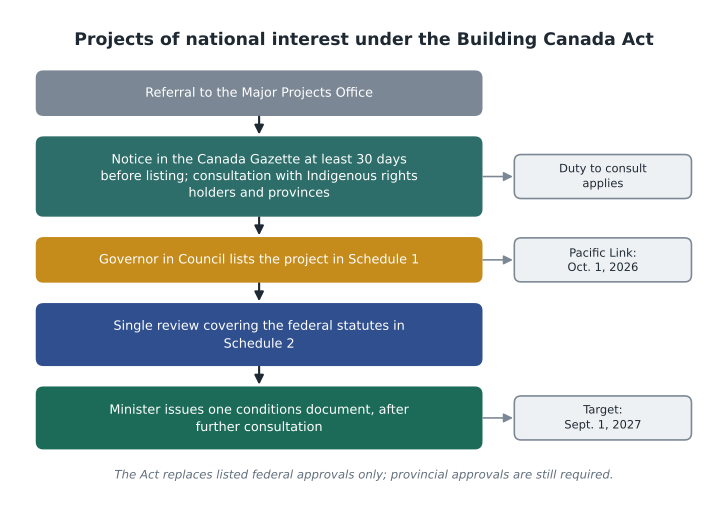
The Major Projects Office was created in August 2025 as a single window for proponents of large projects. In early 2026 the government referred the Mackenzie Valley Highway and the Grays Bay Road and Port to the office, and in June 2026 the nuclear waste deep geological repository proposed in Ontario. Under the Canada and Alberta agreements, Alberta submitted a proposal for a crude oil pipeline to the Pacific coast, and on October 1, 2026, the federal government listed it as a project of national interest under Schedule 1, under the name Pacific Link. The government announced that the pipeline would follow a southern route that avoids British Columbia's north coast, that Canada and Alberta would hold equal ownership, that Indigenous communities would be offered at least a ten percent ownership interest supported by loan guarantees, and that the office aimed to issue conditions by September 1, 2027.
Challenges and criticism
The Building Canada Act was criticized during its passage for concentrating power in Cabinet and for allowing a listing to decide in advance questions that independent regulators would normally answer. A group of First Nations in Ontario filed a challenge in 2025 to both the federal statute and Ontario's 2025 statute creating special economic zones, arguing that they allow governments to bypass the duty to consult and treaty obligations. Daniel Whitecloud notes that the statute itself requires consultation before listing and before conditions are issued. 'So the fight will be about whether the consultation was real,' he says. 'Just like Trans Mountain.' Mawhinney agrees that the duty to consult does not change with the statute; what changes is the stage at which the key decision is made, and the earlier that stage, the deeper consultation may need to be.
Theo Marchetti raises an administrative law point. 'If Cabinet lists a project, is that reviewable?' Mawhinney says that decisions of the Governor in Council under statute are reviewable, generally on the reasonableness standard from Vavilov, although courts give considerable latitude to policy-laden decisions. The narrower the statutory factors and the clearer the record, the more meaningful review becomes. Constitutional challenges, such as arguments that a listing intrudes on provincial jurisdiction or that consultation was inadequate, are reviewed differently, and adequacy of consultation is reviewed for correctness on the existence and extent of the duty and for reasonableness on the process.
| Path | Trigger | Who decides | Output |
|---|---|---|---|
| Impact Assessment Act (as amended 2024) | Project list or ministerial designation; screening for non-negligible federal effects | Minister or Governor in Council | Decision statement with conditions |
| Canadian Energy Regulator Act | Interprovincial or international pipeline or power line | Regulator recommends; Governor in Council decides on major projects | Certificate with conditions |
| Building Canada Act | Listing in Schedule 1 as a project of national interest | Governor in Council lists; minister issues conditions | Single conditions document replacing listed federal approvals |
| Provincial assessment | Provincial statute, such as Alberta's Environmental Protection and Enhancement Act | Provincial regulator or minister | Provincial approval; may be substituted for federal assessment |
Applying the lesson
Mawhinney asks the class about Gannet's joint lithium idea. The class concludes that a lithium brine project in Alberta is mainly provincial: the Alberta Energy Regulator would license the wells and facilities, and Alberta's environmental assessment rules would apply if the project were large enough. The project would probably not be on the federal project list, and the screening question would focus on federal effects such as fish habitat if it affected a river. A listing under the Building Canada Act would be possible only if the federal government considered it to be in the national interest, which for a critical mineral is conceivable. Sophie Tremblay-Hart adds that listing would require consultation with the Ochre Lake First Nation before the decision, and that a partner of national scale would be much more likely to be listed than a junior.
Worked problem
Is a federal assessment required?
A company proposes an in situ oil sands project in Alberta producing 2,000 cubic metres of bitumen a day, with a new water intake from a river that supports a fish species listed under the Species at Risk Act. The project needs approval from the Alberta Energy Regulator. Does the federal Impact Assessment Act apply, and what questions will the federal decision maker ask?
Show solution
- Designated project: check the Physical Activities Regulations. In situ oil sands projects above a production threshold are listed unless the province has a legislated cap on oil sands emissions, which Alberta has had since 2016, so the project may not be on the list. The minister may still designate an unlisted project, including on request, if it may cause adverse effects within federal jurisdiction. Students should check the current regulations and any designation request.
- Screening: if the project is designated, the Agency decides, after the 2024 amendments, whether it may cause non-negligible adverse effects within federal jurisdiction. Effects on fish and an aquatic species at risk are federal effects, so an assessment would be likely.
- Cooperation: the Agency and Alberta can conduct a joint or substituted assessment under their 2026 co-operation agreement.
- Decision: the minister decides whether the adverse federal effects, and adverse direct or incidental effects, are likely to be justified in the public interest, considering mitigation, Indigenous rights and climate commitments. After the 2023 reference, the decision must stay focused on federal effects, not on the project as a whole.
- Consultation: the federal Crown must consult the Ochre Lake First Nation and others whose rights may be affected, and may coordinate with Alberta's consultation.
Common mistakes
MistakeSaying that the Supreme Court struck down the whole Impact Assessment Act in 2023.
InsteadThe court struck down the designated projects scheme but upheld the provisions on federal lands and projects outside Canada; Parliament amended the scheme in 2024.
MistakeTreating the environment as an exclusively federal or provincial subject.
InsteadOldman River (1992) held that the environment is a shared subject that each order of government addresses through its own heads of power.
MistakeThinking that a Building Canada Act listing removes the duty to consult.
InsteadThe Act requires consultation before listing and before issuing conditions, and the constitutional duty applies regardless of the statute.
MistakeSaying that the Building Canada Act replaces provincial approvals.
InsteadIt replaces approvals under the federal statutes in Schedule 2; provincial approvals are still required unless the province adopts its own fast-track process.
Practice problems
Work each problem on paper first, then reveal the answer to check.
What were the two main reasons the majority in Reference re Impact Assessment Act (2023) found the designated projects scheme unconstitutional?
Show answer
First, its definition of effects within federal jurisdiction was too broad and not tied to federal heads of power. Second, its decision-making function was not focused on federal effects, because the public interest determination allowed decision makers to consider the project as a whole, including provincial matters.
What did the 2024 amendments change in the screening and decision stages?
Show answer
Screening now asks whether the project may cause non-negligible adverse effects within federal jurisdiction, and the final decision asks whether adverse federal effects, and adverse direct or incidental effects, are likely to be justified in the public interest; the definitions were narrowed and cooperation and substitution expanded.
What is the effect of listing a project in Schedule 1 of the Building Canada Act?
Show answer
The listing is treated as deciding the threshold question under the federal statutes in Schedule 2, and the project proceeds to a single review that results in one conditions document replacing separate federal approvals.
What project was listed on October 1, 2026, and what conditions timeline was announced?
Show answer
The West Coast oil pipeline from Alberta, named Pacific Link, was listed as a project of national interest; the Major Projects Office aims to finalize conditions by September 1, 2027.
Summary and key terms
- Federal assessment must be anchored in federal heads of power (Oldman River, 1992).
- The Impact Assessment Act (2019) broadened assessment; in Reference re Impact Assessment Act (2023 SCC 23) the Supreme Court struck down its designated projects scheme as not focused on federal effects, while upholding the federal lands provisions.
- The 2024 amendments, in force June 20, 2024, narrowed federal effects, added a non-negligible screening test and expanded cooperation and substitution; Canada and Alberta signed an assessment co-operation agreement in April 2026.
- The Building Canada Act (Royal Assent June 26, 2025) lets Cabinet list projects of national interest and replaces listed federal approvals with a single conditions document after consultation.
- Pacific Link, a crude oil pipeline to the Pacific coast, was listed on October 1, 2026; First Nations challenges to the Act and to Ontario's 2025 statute were pending.
- Designated project
- A project listed in the Physical Activities Regulations or designated by the minister, which may require federal impact assessment.
- Effects within federal jurisdiction
- Effects on subjects within federal authority, such as fish, aquatic species at risk, migratory birds, federal lands and transboundary matters.
- Public interest determination
- The final federal decision on whether a project's adverse federal effects are likely to be justified in the public interest.
- Substitution
- Acceptance of a provincial assessment process in place of a federal one, while the federal decision remains federal.
- Project of national interest
- A project listed in Schedule 1 of the Building Canada Act by the Governor in Council.
- Conditions document
- The single set of binding federal conditions issued for a project of national interest.
- Major Projects Office
- The federal office that coordinates review of large projects and serves as a single window for proponents.
Lesson quiz · 5 questions
Score 60% or more to complete this lesson.
Create a free account to save your progress, take quizzes and earn a certificate.