
LAWC-304 · Lesson 4 of 12 · 23 min
Oil and gas leases
▶ Video coming soon A video version of this lesson is on the way.
Professor Mawhinney brings a box to the fourth class. It contains photocopies of a dozen old freehold leases from the 1950s to the 1990s, all on the printed forms that the industry used for decades. 'You will notice,' she says, 'that almost every one of these leases was drafted by the oil company and signed by a farmer without a lawyer. And you will notice that almost every reported case about them was won by the farmer.' She smiles. 'The courts have been suspicious of these documents for seventy years. That suspicion is the doctrine.'
Gannet Ridge holds freehold leases on four of the Ruskovich quarter sections. Three of them were granted in 1979 to a company that Gannet later acquired, and one in 2019 to Gannet itself. In September, the Ruskovich family's lawyer wrote to Gannet to say that one of the 1979 leases had terminated years ago, because a well on the land had been shut in from 2016 to 2019 and Gannet's predecessor had not made shut-in payments on time. If the lease has ended, the Ruskovich family can lease the minerals to someone else, and Gannet may be liable to them for the value of the oil and gas it produced after the termination.
This lesson explains the structure of a freehold petroleum and natural gas lease, the habendum clause and its primary and secondary terms, the leading cases on automatic termination, shut-in clauses and the third proviso, how courts interpret these leases today, and the remedies when a lease has ended.
The structure of a freehold lease
A freehold petroleum and natural gas lease is a grant by the owner of the minerals, the lessor, to an operator, the lessee. As lesson 2 explained, it grants a profit a prendre: the right to enter, explore, drill for, produce and remove the leased substances, and to own them once produced. In return, the lessor receives a bonus on signing, rental until production begins, and a royalty on production, typically a fraction such as one sixth or one eighth.
The most important clause is the habendum, which defines how long the lease lasts. A typical habendum grants the lease for a primary term, often five or ten years, 'and so long thereafter as the leased substances or any of them are produced from the said lands.' The primary term gives the lessee time to explore and drill. The secondary term, which follows, lasts as long as there is production. The lease is therefore of indefinite length, but it is conditional: if production stops, the lease may end.
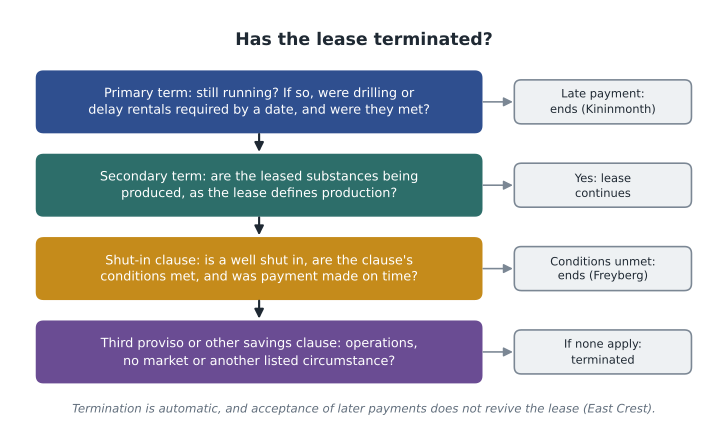
Because the habendum is so strict, leases contain a series of clauses designed to keep them alive in situations where production has stopped or never began for reasons the lessee cannot control. These include the delay rental clause, which allows the lessee to defer drilling during the primary term by paying rental; the shut-in clause, which treats a shut-in well as producing if the lessee makes a payment; and the third proviso, a long savings clause that continues the lease in defined circumstances, such as where a well is capable of production but there is no market, or where operations are being conducted.
Automatic termination
Canadian courts have treated freehold leases as conditional grants that end automatically when their conditions are not met. Two old cases established the principle.
In East Crest Oil Co. v. Strohschein, [1952] 2 D.L.R. 432 (Alta. C.A.), the lessee failed to pay the delay rental by the date required. The lease said that if drilling did not begin and rental was not paid by that date, the lease would terminate. The lessee later tendered the rental, and the lessor's acceptance of it was argued to have revived the lease. The Alberta Court of Appeal held that the lease had terminated automatically on the date of default and could not be revived by later acceptance of money, which created at most a new agreement, not a continuation of the old one.
In Canada-Cities Service Petroleum Corp. v. Kininmonth, [1964] S.C.R. 439, the Supreme Court of Canada confirmed the approach. The lease required the lessee to begin drilling within a year or pay rental to keep it alive. The rental payment was not made on time. The court held that the lease, which used language making continuation depend on the payment, ended automatically on default. The lessee's failure could not be cured by later conduct.
Theo Marchetti calls this harsh. 'A company spends millions on a well and loses the lease because a cheque was a day late?' Mawhinney says the courts have been open about why they take that view. A freehold lease is an option, in substance: the lessee can decide whether to keep it alive by drilling or paying, and the lessor is locked in. 'If the lessee holds all the choices,' she says, 'the courts expect it to exercise them on time. The lessor is usually a farmer who cannot lease to anyone else while the option is open.'
Production and the shut-in clause
In the secondary term, the key question is whether the leased substances are being 'produced'. Courts have generally read this as requiring actual production, not just the capability to produce, unless the lease says otherwise. A well that has been drilled and capped, or a well that has stopped flowing, will not keep the lease alive by itself. That is why the shut-in clause matters.
A shut-in clause provides that if a well capable of producing is shut in or suspended, the lessee may pay a shut-in royalty, and the well is deemed to be producing for the purposes of the lease. The courts have applied these clauses literally. In Freyberg v. Fletcher Challenge Oil and Gas Inc., 2005 ABCA 46, the lease's shut-in clause applied only where gas was shut in for lack of a market. The court found that the gas was not shut in for lack of a market, because a market was available, even though the lessee had made shut-in payments. The Alberta Court of Appeal held that the payments did not save the lease, because the conditions of the clause were not met, and that the lease had terminated.
Three years later, in Kensington Energy Ltd. v. B & G Energy Ltd., 2008 ABCA 151, a majority of the Alberta Court of Appeal reached a different result on different wording. The lease contained a shut-in clause and a third proviso, and the trial judge had held that the lessee had to satisfy the conditions of the third proviso before relying on the shut-in clause. The majority held that, on the wording of that lease, the shut-in clause operated independently: a proper shut-in payment deemed the well to be producing, and the lease continued. Justice Romaine, dissenting, would have read the two clauses together. Freyberg was distinguished because its shut-in clause and third proviso both turned on the absence of a market.
Hannah Kowalczyk points out the practical lesson. 'You cannot answer a termination question from memory,' she says. 'You have to read the exact clause in the exact lease.' Mawhinney agrees. 'Every one of these cases turns on a word: "capable", "market", "operations", "subject to". The general principles tell you where to look. The lease tells you the answer.'
The third proviso
The third proviso is so named because it was the third of several provisos to the habendum in the standard Canadian Association of Petroleum Landmen form of lease used for decades. It typically provides that if, at the end of the primary term, the leased substances are not being produced but the lessee is conducting drilling or working operations, or a well is capable of production but is shut in because of lack of a market or for other stated reasons, the lease continues as long as those conditions continue. Some versions also require the lessee to act in accordance with good oil field practice.
The courts have read the third proviso as a set of conditions that must be strictly met. A lessee that relies on it must prove that the facts it describes existed at the relevant time. Evidence of 'good oil field practice' may be relevant to whether a well was reasonably shut in, which is why expert evidence often decides these cases. Because the form has changed over time, and because many leases were modified by hand, the starting point is always the text of the particular lease.
How courts interpret these leases today
Older cases sometimes applied the contra proferentem rule against the drafter, which was almost always the oil company. Modern Canadian contract law has changed the analysis. In Sattva Capital Corp. v. Creston Moly Corp., 2014 SCC 53, the Supreme Court held that contractual interpretation is a question of mixed fact and law, to be decided by reading the words in light of the surrounding circumstances known to both parties when they contracted. The surrounding circumstances cannot overwhelm the words, but they shape their meaning. Contra proferentem remains available as a last resort where ambiguity remains after the ordinary approach.
Lessons from Varga's first-year contracts course apply here. Sophie Tremblay-Hart asks whether the duty of good faith from Bhasin v. Hrynew, 2014 SCC 71, and C.M. Callow Inc. v. Zollinger, 2020 SCC 45, might help a lessee who missed a deadline. Mawhinney says the duty of honest performance would prevent a lessor from actively misleading a lessee about whether payments had been received, and a lessor who knowingly encouraged a lessee to keep spending on a dead lease might face an estoppel argument. But good faith does not rewrite a condition the lessee simply failed to meet. 'Bhasin is about honesty,' she says. 'Kininmonth is about time. They can live together.'
| Case | Court and year | Issue | Result |
|---|---|---|---|
| East Crest Oil v. Strohschein | Alta. C.A., 1952 | Late delay rental; lessor accepted payment | Lease terminated automatically; acceptance did not revive it |
| Canada-Cities Service v. Kininmonth | S.C.C., 1964 | Rental not paid on time | Lease ended automatically on default |
| Freyberg v. Fletcher Challenge | Alta. C.A., 2005 | Shut-in payments where a market for the gas was available | Clause conditions not met; lease terminated |
| Kensington Energy v. B & G Energy | Alta. C.A., 2008 | Relationship between shut-in clause and third proviso | On its wording, shut-in clause operated independently; lease continued |
| Sattva v. Creston Moly | S.C.C., 2014 | General approach to contract interpretation | Read words in light of surrounding circumstances; mixed fact and law |
Remedies when a lease has ended
If a lease has terminated, the lessee has no right to remain on the land or to produce. A lessee that keeps producing after termination is a trespasser in relation to the minerals. The lessor may claim the value of the oil and gas produced. Canadian courts distinguish between innocent and wilful trespassers. An innocent trespasser, one that honestly and reasonably believed it had the right to produce, is usually allowed to deduct its reasonable costs of production and pays only the net value. A wilful trespasser may be required to pay the full value without deductions. Limitation periods also matter, and in Alberta claims are generally subject to the two-year discoverability period and ten-year ultimate period under the Limitations Act.
The lessor may also need to clear the title. A terminated lease often remains registered by caveat at Land Titles. The lessor can apply to have the caveat discharged, and the court may order the lessee to remove it. If the lessor has already granted a new lease to another company, the two lessees may fight over priority, which is why careful title searches matter in every acquisition.
The Ruskovich lease
Mawhinney returns to the Ruskovich letter and asks the class how they would approach it. The class identifies the steps. First, find and read the 1979 lease, including any amendments, and identify the habendum, the shut-in clause and any third proviso. Second, establish the facts: when production stopped, why the well was shut in, whether it was capable of production, and when shut-in payments were due and made. Third, apply the clauses strictly in light of Freyberg and Kensington. Fourth, if the lease ended, assess Gannet's exposure: whether it was an innocent trespasser, the value of production since the termination date, and limitation periods. Fifth, consider settlement, because a top lease or a new lease with the Ruskovich family may be cheaper than litigation.
Worked problem
Did the 1979 lease survive?
The 1979 Ruskovich lease has a five-year primary term and continues "so long thereafter as the leased substances are produced." Its shut-in clause provides that if a well capable of production is shut in "for lack of a market or any other cause beyond the lessee's reasonable control," the lessee may pay an annual shut-in payment on or before the anniversary date, and the well is deemed producing. Gannet's predecessor shut the well in from March 2016 to April 2019 because low prices made production uneconomic. It paid the shut-in payment for 2016 on time, for 2017 two weeks late, and for 2018 on time. The Ruskovich family cashed every cheque. Did the lease terminate?
Show solution
- Secondary term: the lease was in its secondary term in 2016, so it continued only while the substances were produced or deemed produced.
- Shut-in clause conditions: was the well "capable of production"? Probably yes, if it was shut in only for economic reasons. Was it shut in for "lack of a market or any other cause beyond the lessee's reasonable control"? Low prices may not be a cause beyond the lessee's control: the lessee chose to stop producing. Following Freyberg, a court may find the condition was not met at all.
- Timing: even if the clause applied, the 2017 payment was late. Kininmonth and East Crest suggest that if the clause requires payment by a date, a late payment does not deem production, and the lease would have terminated on the 2017 anniversary.
- Acceptance of payment: under East Crest, the Ruskovich family's cashing of the late cheque does not revive a terminated lease, although Gannet may argue estoppel or a new agreement on the facts. Honest performance (Bhasin) is relevant only if the lessors misled Gannet.
- Conclusion and remedies: there is a strong argument that the lease terminated in 2016 or 2017. If so, production since April 2019 was a trespass; Gannet will argue it was innocent and may deduct its costs, and will raise limitation defences. A negotiated new lease is likely the practical outcome.
Common mistakes
MistakeAssuming that a freehold lease continues as long as a well exists on the land.
InsteadIn the secondary term, the habendum usually requires actual production, unless a shut-in clause or third proviso deems production or continues the lease.
MistakeBelieving that a lessor's acceptance of a late payment revives a terminated lease.
InsteadEast Crest and Kininmonth hold that a lease that has terminated automatically cannot be revived by accepting money; at most a new agreement may arise.
MistakeTreating any shut-in payment as saving the lease.
InsteadThe payment saves the lease only if the conditions of the shut-in clause are met (Freyberg); the result depends on the exact wording (Kensington).
MistakeStarting with contra proferentem.
InsteadUnder Sattva, courts read the words in light of the surrounding circumstances; contra proferentem is a last resort for remaining ambiguity.
MistakeAssuming that a lessee producing after termination always pays the full value of production.
InsteadAn innocent trespasser is usually allowed to deduct reasonable costs; only a wilful trespasser pays the gross value.
Practice problems
Work each problem on paper first, then reveal the answer to check.
What is the difference between the primary and secondary term of a freehold lease?
Show answer
The primary term is a fixed period, often five or ten years, during which the lessee may explore and drill. The secondary term follows and continues only so long as the leased substances are produced or deemed produced under the lease.
Why did the lease in Freyberg terminate despite shut-in payments?
Show answer
The shut-in clause applied only where gas was shut in for lack of a market. A market was available, so the clause's conditions were not met and the payments did not deem production.
How did Kensington (2008) differ from Freyberg?
Show answer
On the wording of the Kensington lease, the majority held that the shut-in clause operated independently of the third proviso, so a proper shut-in payment deemed production and the lease continued. Freyberg was distinguished because its clauses both turned on the absence of a market.
What is the remedy against a lessee that produced after its lease terminated?
Show answer
Damages for trespass measured by the value of the production; an innocent trespasser may deduct reasonable costs of production, while a wilful trespasser may have to pay the gross value. Limitation periods may restrict recovery.
Summary and key terms
- A freehold lease grants a profit a prendre for a primary term and so long thereafter as the leased substances are produced.
- Courts treat freehold leases as conditional grants that end automatically on default (East Crest, 1952; Kininmonth, 1964); acceptance of late payment does not revive them.
- Shut-in clauses deem production only if their exact conditions are met (Freyberg, 2005); the relationship with the third proviso depends on the wording (Kensington, 2008).
- Modern interpretation follows Sattva (2014); good faith (Bhasin, Callow) prevents dishonesty but does not rewrite conditions.
- A lessee that produces after termination is liable in trespass for the value of production, with cost deductions usually allowed for an innocent trespasser.
- Habendum
- The clause that sets the duration of the lease, usually a primary term and so long thereafter as production continues.
- Primary term
- The fixed initial period of a lease during which production is not required.
- Delay rental
- A payment that allows the lessee to defer drilling during the primary term.
- Shut-in clause
- A clause under which a payment deems a shut-in well to be producing, if the clause's conditions are met.
- Third proviso
- A savings clause in many Canadian leases that continues the lease after the primary term in defined circumstances, such as operations or lack of a market.
- Top lease
- A lease granted over minerals that are already under lease, to take effect if the existing lease terminates.
- Innocent trespasser
- A party that produced minerals in the honest and reasonable belief that it had the right to do so, and may deduct its costs.
Lesson quiz · 5 questions
Score 60% or more to complete this lesson.
Create a free account to save your progress, take quizzes and earn a certificate.