
HSE-212 · Lesson 2 of 12 · 23 min
Working at heights law and standards in Canada
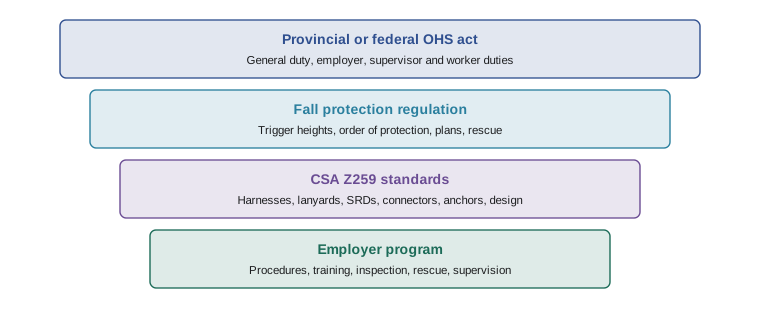
In Canada, occupational health and safety is mostly a provincial and territorial responsibility. Each province and territory has its own act and regulations, and federally regulated workplaces, such as interprovincial transportation, banks, telecommunications and federal government operations, follow the Canada Labour Code and its regulations. Fall protection rules therefore differ in detail across the country, even though they share the same principles and rely on the same family of CSA standards. This lesson explains how the rules are organized, compares the main requirements and shows how the CSA Z259 standards fit in.
The general duty
Every Canadian occupational health and safety act places a general duty on employers to take every precaution reasonable in the circumstances to protect workers. The specific fall protection rules sit on top of that duty. An employer that meets the letter of a regulation but ignores an obvious fall hazard can still be prosecuted under the general duty clause. Supervisors have their own duties to ensure workers use the protection required, and workers must use the equipment provided and report hazards. Since 2004, section 217.1 of the Criminal Code has also placed a legal duty on anyone who directs work to take reasonable steps to prevent bodily harm, which opened the door to criminal negligence charges after serious workplace deaths.
Trigger heights
The trigger height is the fall distance at or above which a regulation requires fall protection. It is the most frequently quoted number in fall protection law, but it is only part of the story. Most regulations also require protection below the trigger height where a fall would land on something that makes injury more likely.
| Jurisdiction | General trigger height | Notes |
|---|---|---|
| Ontario (construction, O. Reg. 213/91) | 3 m | Also below 3 m into operating machinery, water, hazardous substances or onto objects; 1.2 m where a wheelbarrow or similar is used at an edge; guardrails at many edges of 2.4 m or more |
| Ontario (industrial, Reg. 851) | 3 m | Section 85 requires protection where a worker could fall more than 3 m, and lower in some situations |
| British Columbia (OHSR Part 11) | 3 m | Or less where the risk of injury is greater than landing on a flat surface; written fall protection plan at 7.5 m without permanent guardrails |
| Alberta (OHS Code Part 9) | 3 m | Or less with an unusual possibility of injury; written plan at 3 m where guardrails are not used |
| Quebec (Safety Code for the construction industry) | 3 m | Hierarchy of protection set out in section 2.9.1 and related sections; check recent amendments |
| Federal (COHSR Part XII) | 3 m | Also from a ladder at 3 m where a hand cannot be kept on the ladder, and lower where the surface below is more dangerous; older versions used 2.4 m |
Note that the trigger height alone does not settle the question. A worker 2.5 m above an open tank of hot liquid, a conveyor or a row of rebar needs protection in every province.
The order of protection
Canadian regulations generally require employers to choose fall protection in an order of preference. British Columbia, for example, requires guardrails or a similar fall restraint where practicable, then another fall restraint system, then a fall arrest system or rope access system, and only then work procedures acceptable to WorkSafeBC. Alberta's code requires guardrails first, then travel restraint, then personal fall arrest, then an equally effective means. Ontario's construction regulation lists guardrails, then travel restraint, fall restricting, fall arrest and safety nets. The federal regulation ranks passive systems, then fall restraint, then fall arrest, then a fall hazard zone system. The wording varies, but every jurisdiction puts physical barriers ahead of personal equipment.
Key provisions
The provincial regulations cover similar ground. Using Ontario's construction regulation as an example, sections 26 to 26.9 set out when protection is required, the training required for workers who use fall protection systems, the requirements for guardrails, protective covers, safety nets, fall arrest systems, the fixed supports and anchors they connect to, and horizontal lifelines. The regulation also requires written emergency procedures, which must address rescuing a worker who has fallen. Ontario's industrial regulation, Reg. 851, covers factories, warehouses and other industrial establishments, with section 85 addressing fall protection.
Other provinces follow the same pattern with their own section numbers. British Columbia's Part 11 requires a written fall protection plan where work is done 7.5 m or more above grade without permanent guardrails, sets anchor strengths, requires equipment to meet CSA or ANSI standards, requires inspection before each shift and requires equipment that has arrested a fall to be removed from service until inspected. Alberta's Part 9 requires a written plan where workers could fall 3 m or more without guardrails, limits the arresting force on the worker, sets anchor strengths, and permits control zones and procedures in place of equipment in narrow circumstances. Quebec's construction code sets out the required protection and the order in which it is chosen. The federal Part XII requires a written fall protection plan, developed with the workplace committee or health and safety representative, that covers the hazards, the systems chosen, the anchors, clearance for fall arrest and rescue.
Equipment standards
Canadian regulations refer to the CSA Z259 family of standards for fall protection equipment and systems. The federal regulation, for example, requires systems to be designed according to CSA Z259.16 and Z259.17 and components to meet standards including Z259.1, Z259.2.2, Z259.2.3, Z259.2.4, Z259.2.5, Z259.10, Z259.11, Z259.12, Z259.13, Z259.14 and Z259.15. British Columbia accepts equipment that meets CSA or ANSI standards. The main standards are:
| Standard | Subject |
|---|---|
| CSA Z259.10 | Full body harnesses, with classes such as A for fall arrest, D for suspension and controlled descent, E for limited access, L for ladder climbing and P for work positioning |
| CSA Z259.11 | Personal energy absorbers and lanyards; the 2017 edition specifies performance by user mass range rather than the older E4 and E6 classes |
| CSA Z259.2.2 | Self-retracting devices, in classes SRL, SRL-R (with rescue), SRL-LE (leading edge) and SRL-LE-R |
| CSA Z259.2.5 and Z259.2.4 | Fall arresters and vertical rigid rails, and fall arresters and vertical lifelines |
| CSA Z259.12 | Connecting components such as snap hooks, carabiners and D-rings |
| CSA Z259.13 | Manufactured horizontal lifeline systems |
| CSA Z259.15 | Anchorage connectors |
| CSA Z259.16 | Design of active fall protection systems |
| CSA Z259.17 | Selection and use of active fall protection equipment and systems |
Who is responsible
Responsibility for fall protection is shared. On construction projects, the constructor or prime contractor has overall responsibility for coordinating safety on the project, including making sure that each employer's fall protection measures fit together and that guardrails removed by one trade are replaced. Each employer must provide the equipment, training and supervision its own workers need. Supervisors must be competent, which in most provinces means they know the hazards and the law and have the training and experience to organize the work. Owners can have duties too, for example to share information about permanent anchors, fragile roofs and other hazards on their property. Workers must use the protection provided, report missing or damaged equipment, and have the right to refuse work they believe is dangerous, without reprisal.
Several provinces also have rules about who may design or approve parts of a fall protection system. Permanent anchors and multi-point anchors usually must be certified by a professional engineer. Engineered horizontal lifelines and anchors designed to the two-times arresting force option must follow the manufacturer's or an engineer's specifications. These rules exist because the forces in a fall are large and easy to underestimate.
Provincial ministries publish guidance that interprets the regulations, such as Ontario's guidance on fall protection and WorkSafeBC's guidelines for Part 11. Health and safety associations, such as the Infrastructure Health and Safety Association in Ontario, publish practical manuals. These documents are not law, but inspectors and courts use them to judge what is reasonable.
Recordkeeping and documentation
Fall protection creates paperwork, and inspectors ask for it. Expect to keep written fall protection plans where required, training records, including Working at Heights certificates in Ontario, equipment inspection records, engineering certifications for anchors and lifelines, rescue procedures and records of drills. Good records also help the employer show due diligence: that it took every reasonable precaution, which is the main defence to a charge under occupational health and safety legislation.
Training requirements
Every jurisdiction requires workers who use fall protection to be trained, but the details differ. Ontario is the most prescriptive: since April 2015, workers on construction projects who may use travel restraint, fall restricting, fall arrest, safety nets, work belts or safety belts must complete a Working at Heights program approved by the Chief Prevention Officer and delivered by an approved training provider, before they use the equipment. The program has a theory module and a practical module. Training is valid for three years, after which the worker must complete an approved refresher. Employers must keep proof of completion for each worker and show it to an inspector on request. Ontario also accepts fall protection training from WorkplaceNL in Newfoundland and Labrador, combined with awareness and site-specific training. In addition, section 26.2 of the construction regulation requires training on the specific equipment the worker will use. Ontario has warned employers about fraudulent providers that issue cards without valid training, so employers should confirm that the provider was approved when the worker trained.
A case that changed the law
Ontario's mandatory training grew out of a tragedy. On December 24, 2009, a swing stage collapsed on a high-rise balcony repair project in Toronto. Four workers fell 13 storeys and died; a fifth was seriously injured. Six workers had been on the stage, but only two lifelines were available, and the stage itself was defective. The company was convicted of criminal negligence causing death, and on appeal its fine was increased to $750,000. The project manager was later convicted of criminal negligence and sentenced to three and a half years in prison. An expert advisory panel reviewed Ontario's prevention system after the deaths, and its recommendations led to the Chief Prevention Officer role and to mandatory, standardized Working at Heights training for construction workers.
Enforcement and penalties
Inspectors can issue orders requiring compliance, stop work immediately where there is a danger, and recommend prosecution. Fines are substantial. In Ontario, the maximum fine for a corporation convicted under the Occupational Health and Safety Act is $2 million per count, directors and officers face fines of up to $1.5 million, other individuals face fines of up to $500,000, and individuals can also be jailed for up to 12 months. Courts may add a victim fine surcharge. Other provinces have their own maximums and administrative penalty systems. Check the current figures in your province, because they change.
Common mistakes
MistakeTreating the trigger height as the only test for fall protection.
InsteadMost rules also require protection at lower heights above machinery, water, hazardous substances or projecting objects.
MistakeAssuming the fall protection rules are the same in every province.
InsteadTrigger heights, plan requirements and training rules differ; check the regulation where the work is done.
MistakeBuying equipment without checking which standard it meets.
InsteadUse equipment certified to the CSA Z259 standards your regulation names, or to ANSI where your province accepts it.
MistakeAccepting any Working at Heights card without checking the provider.
InsteadConfirm that the provider was approved by the Chief Prevention Officer and that the training is less than three years old.
MistakeThinking a general duty does not apply if a specific rule is met.
InsteadEmployers must still take every reasonable precaution against obvious fall hazards.
Summary and key terms
- Fall protection law in Canada is mainly provincial, with federal rules for federally regulated workplaces.
- The general trigger height is 3 m in most jurisdictions, including the current federal rules.
- Protection is also required at lower heights where the surface below makes injury more likely.
- Regulations favour guardrails and other physical barriers over personal equipment.
- The CSA Z259 standards cover harnesses, lanyards, self-retracting devices, connectors, anchors and system design.
- Ontario requires approved Working at Heights training for construction workers, valid for three years.
- Penalties for fall protection violations are significant and can include criminal charges after deaths.
- General duty
- The broad legal obligation to take every reasonable precaution to protect workers.
- CSA Z259 and ANSI/ASSP Z359
- The family of Canadian standards for fall protection equipment and systems; the American equivalent is ANSI/ASSP Z359.
- Competent person
- A person with the knowledge, training and experience to identify hazards and take corrective action.
- Fall protection plan
- A written plan describing the fall hazards, the systems used, anchors, clearance and rescue.
- Trigger height
- The fall distance at or above which a regulation requires protection.
- Fall hazard zone or controlled access zone
- A federal option: a marked area at least 2 m wide in which only authorized workers may work.
- Order of preference
- The ranking of protection methods in a regulation, from physical barriers to personal equipment.
- State plan
- An OSHA-approved state occupational safety and health program.
- Criminal negligence
- Wanton or reckless disregard for the lives or safety of others, which can lead to criminal charges.
- Refresher training
- Training that renews an earlier qualification before it expires.
Practice problems
Work each problem on paper first, then reveal the answer to check.
What is the general fall protection trigger height in British Columbia?
Show answer
3 m, or less where the surface below increases the risk of injury.
When does BC require a written fall protection plan?
Show answer
Where work is done 7.5 m or more above grade without permanent guardrails, among other cases.
How long is Ontario Working at Heights training valid?
Show answer
Three years, after which an approved refresher is required.
Which standard covers the design of active fall protection systems in Canada?
Show answer
CSA Z259.16.
Why can a worker below the trigger height still need protection?
Show answer
The landing surface, such as machinery or rebar, can make serious injury likely.
What federal height triggers fall protection under the current COHSR?
Show answer
3 m; older versions used 2.4 m.
What do regulations generally prefer over personal fall arrest?
Show answer
Guardrails and other physical barriers, then travel restraint.
What does the federal fall protection plan have to cover?
Show answer
Hazards, systems chosen, anchors, clearance for fall arrest and rescue procedures.
Which 2009 Toronto incident led to mandatory Working at Heights training?
Show answer
The Christmas Eve swing stage collapse that killed four workers.
Why should employers check the current penalty amounts?
Show answer
They change, often every year.
Lesson quiz · 5 questions
Score 60% or more to complete this lesson.
Create a free account to save your progress, take quizzes and earn a certificate.