
HSE-212 · Lesson 5 of 12 · 25 min
Travel restraint, warning lines and control zones
When guardrails are not practicable, the next best option is usually to stop workers from reaching the edge at all. Travel restraint does this with personal equipment: a harness or belt, a lanyard or lifeline, and an anchor placed so that the worker runs out of line before reaching the hazard. Marked warning lines, control zones and safety monitors try to do the same thing with markings and supervision. This lesson explains how each method works, how to set it up correctly and where its limits lie.
How travel restraint works
A travel restraint system is a tether. The worker wears a full body harness or, where the rules allow, a safety belt, connected by a lanyard or a rope lifeline to an anchor. The total length from the anchor to the worker's attachment point is set so that the worker can reach the work but not the edge. If the system is set up correctly, the worker can lean against the tether at the end of its reach without being able to fall over the edge, so no fall ever starts.
Because no fall occurs, a travel restraint system does not need the energy absorbers, clearance distances or rescue arrangements that fall arrest needs, and its anchors can be lighter. That makes restraint attractive on flat roofs, around floor openings and near loading edges. But the advantage disappears if the system is set up so that the worker can reach the edge. Then it becomes an improvised fall arrest system, with an anchor, lanyard and harness that may not be designed for the forces of a fall.
Setting the length
The key calculation for travel restraint is the maximum length of the tether. Measure the shortest distance from the anchor to the edge, in any direction the worker could move, and subtract a margin so that the worker's body cannot reach or lean over the edge.
Here \( L_{\text{max}} \) is the total length from the anchor point to the harness attachment, including connectors, anchorage straps and any slack, \( D_{\text{edge}} \) is the shortest horizontal distance from the anchor to the edge, and \( m \) is a safety margin that accounts for the worker's reach, body position and stretch of the equipment. Many employers use a margin of at least the worker's arm-and-body reach beyond the harness attachment.
Worked problem
Setting a restraint lanyard length
A permanent restraint anchor is installed 5.0 m from the nearest roof edge. The anchorage connector adds 0.3 m and the snap hooks add 0.1 m. The employer uses a 1.0 m margin for the worker's reach and body. What is the longest lanyard that can be used?
Show solution
- Maximum total tether: \( 5.0 - 1.0 = 4.0 \) m.
- Subtract the connector and hardware: \( 4.0 - 0.3 - 0.1 = 3.6 \) m.
- So the lanyard can be at most 3.6 m. A fixed 3 m lanyard would work; an adjustable rope lanyard must be locked at or below 3.6 m.
- Check the reach in every direction. If the roof has a corner, the shortest distance to the edge may be on a diagonal.
Answer: No more than 3.6 m, checked in every direction the worker can move.
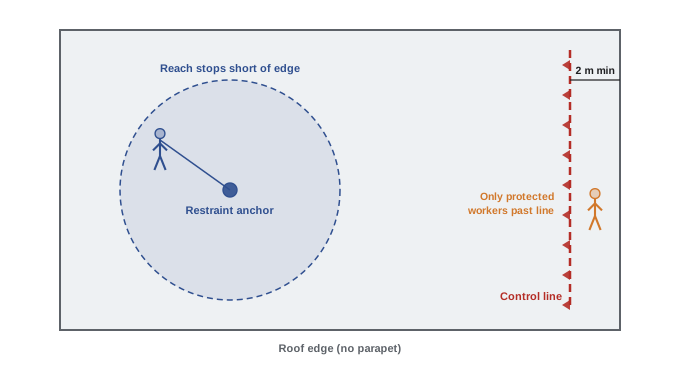
Corners and irregular roofs matter. An anchor placed in the middle of a long, narrow roof may allow a worker to reach the near edge if they walk sideways. Draw the reach circle on a roof plan, as in the figure, and check that it stays inside the edge everywhere the worker can go. Where one anchor cannot cover the work area safely, use several anchors, a horizontal lifeline set back from the edge, or a rail system with a trolley that keeps the worker inside a safe band.
Adjustable lanyards and rope grabs
Many restraint systems use an adjustable rope lanyard or a rope lifeline with a rope grab, so that the worker can shorten the tether near an edge and lengthen it in the middle of the roof. This flexibility is useful but creates a risk: a worker who lets out too much rope can reach the edge. Train workers to adjust the length as they move, mark maximum lengths on the rope, or use fixed-length lanyards where possible. Self-retracting devices are sometimes used for restraint, but they extend as the worker walks away, so they do not restrain unless they are fitted with a length limiter or the anchor is placed so that their full length cannot reach the edge.
Anchors for restraint
Because a restraint system should never arrest a fall, its anchors can be lighter than fall arrest anchors, but only if the system truly prevents a fall. British Columbia and Alberta require temporary restraint anchors to have an ultimate capacity of at least 3.5 kN, or four times the worker's weight in British Columbia. Ontario requires 2 kN for temporary travel restraint anchors and 6 kN for fall restricting systems. Alberta requires temporary restraint-only anchors to be permanently marked for restraint only and removed when the work is finished. Never use a restraint anchor for fall arrest.
Fall restriction and positioning
Two related systems allow a small amount of movement or fall:
- work positioning systems hold a worker in place while leaving the hands free, for example a pole strap for a line worker or a positioning lanyard for a rebar worker on a wall. They are not designed to arrest a fall from an edge and are usually combined with a separate fall arrest system;
- fall restricting systems, recognized in Ontario, allow a fall of no more than about 0.6 m before stopping the worker. Examples include some pole-climbing devices and ladder climbing systems.
Marked lines and control zones
A warning line or control line is a rope, wire or chain, flagged so that it is easy to see, set up at a distance from an unprotected edge. Workers outside the line, away from the edge, may work without personal fall protection under specific conditions. Anyone who crosses the line, into the zone next to the edge, must use guardrails, restraint or fall arrest. The idea is to keep most of the work and the traffic well back from the edge.
Canadian jurisdictions treat these systems differently. Alberta permits control zones on certain work surfaces, with the boundary set at least 2 m from the unguarded edge and strict rules about who may enter. British Columbia permits warning line systems on low-slope roofs in limited circumstances, set back at least 2 m from the edge. The federal regulation allows a fall hazard zone system, the last choice in its order of protection, with a zone at least 2 m wide in which only authorized workers may enter and work. Ontario's construction regulation does not generally accept warning lines as a substitute for guardrails, restraint or arrest. Check your provincial rules before relying on a line on the roof.
| System | Typical setback | Main limits |
|---|---|---|
| Alberta control zone | At least 2 m from the edge | Limited surfaces and work; strict entry rules |
| BC warning line | At least 2 m from the edge | Low-slope roofs; limited circumstances |
| Federal fall hazard zone | Zone at least 2 m wide | Last in the order of protection; authorized workers only |
| Ontario | Not a general substitute | Use guardrails, restraint or arrest |
Safety monitors and controlled access zones
A safety monitor is a competent person who watches workers near an edge and warns them when they are in danger. Monitoring alone is weak protection, because a warning does nothing for a worker who has already stepped off. Canadian regulations rarely accept monitoring as the only protection, and where they mention it, it supplements physical controls rather than replacing them.
Why these are the weakest options
Marked lines, control zones and monitors do not physically stop a fall. They depend on workers noticing the line, respecting it and not stepping over it while carrying materials, walking backward or working in poor light. They work best where the work is far from the edge, the line is highly visible, and anyone crossing it must use real protection. They work poorly where workers frequently need to go near the edge, where materials must be moved to and from the edge, or where the roof is crowded. In those situations, guardrails or restraint are almost always the better choice.
Restraint on slopes and around openings
Travel restraint works best on flat or low-slope surfaces, where a worker who leans against the tether can stand steadily. On steeper roofs, a worker may slide down the roof surface until the tether comes taut, and if the tether is long enough to reach the edge, the system becomes fall arrest by default. On steep roofs, use anchors placed so that the tether stops the worker well up the slope, combined with fall arrest equipment rated for the anchor position, or use scaffolds and guardrails at the eaves.
Restraint is also useful around floor openings, roof hatches and open loading edges, where a worker must work near a hole for a short time. Place the anchor so that the reach circle stops short of the opening on every side, and remember that the worker may need to step around the opening to reach the far side. Two anchors on opposite sides, or a short rail with a trolley, may be needed.
Common set-up errors
Investigations of falls involving restraint systems point to a few recurring errors: an anchor placed for one task and used for another without rechecking the reach; an adjustable lanyard let out to reach a tool and never shortened; a lanyard connected to a side D-ring rather than the attachment point the manufacturer specifies; two lanyards clipped end to end to reach farther; and a self-retracting device used as if it were a fixed tether. A simple check before each task, measuring or pacing the reach to the nearest edge, prevents most of them.
Common mistakes
MistakeUsing a restraint lanyard long enough to reach the edge.
InsteadSet the total tether so that the worker cannot reach or lean over the edge in any direction.
MistakeLetting out an adjustable lanyard without rechecking the reach.
InsteadShorten the tether near edges and mark maximum lengths on the rope.
MistakeClipping a fall arrest lanyard to an anchor rated only for restraint.
InsteadRestraint anchors are not designed for fall forces. Use a fall arrest anchor.
MistakeTreating a warning line as a barrier.
InsteadLines only mark a zone. Anyone working between the line and the edge needs real protection.
MistakeGiving the safety monitor other jobs to do.
InsteadA monitor must watch the workers continuously and do nothing else.
Summary and key terms
- Travel restraint prevents a worker from reaching the edge, so no fall begins.
- The total tether from anchor to harness must be shorter than the distance to the edge minus a margin.
- Check reach in every direction, especially at corners and on irregular roofs.
- Restraint anchors may be lighter, for example 2 kN temporary in Ontario or 3.5 kN in Alberta and BC.
- Positioning and fall restricting systems hold or limit a worker but are not general fall arrest systems.
- Marked warning lines and control zones are permitted only in some provinces and under strict conditions.
- Lines and monitors do not physically stop a fall; they are the weakest options.
- Travel restraint system
- A tether that keeps the worker from reaching a fall hazard.
- Total tether length
- The full distance from the anchor point to the harness attachment, including connectors.
- Rope grab
- A device that slides on a lifeline and locks to set the tether length or to arrest a fall.
- Work positioning system
- A system that holds a worker in place with hands free, such as a pole strap.
- Fall restricting system
- A system that limits a fall to a short distance, about 0.6 m in Ontario.
- Control or warning line
- A flagged rope or wire set back from an edge to mark where protection is required.
- Control zone
- A marked area next to an edge that only authorized, protected workers may enter.
- Designated area
- In OSHA general industry rules, a marked area on a low-slope roof set back from the edge.
- Safety monitor
- A competent person who watches workers near an edge and warns them of danger.
- Setback
- The distance from an edge to a warning line, anchor or work area.
Practice problems
Work each problem on paper first, then reveal the answer to check.
What is the main advantage of travel restraint over fall arrest?
Show answer
No fall begins, so clearance, energy absorbers and rescue are not needed.
An anchor is 6 m from the edge with a 1 m margin and 0.4 m of hardware. What is the longest lanyard?
Show answer
4.6 m.
Why should reach be checked on a roof plan?
Show answer
The shortest distance to an edge may be at a corner or on a diagonal.
Why is a self-retracting device a poor restraint device on its own?
Show answer
It extends as the worker moves away, so it may allow the worker to reach the edge.
Can a restraint anchor be used for fall arrest?
Show answer
No. It is not designed for the forces of a fall.
What is a work positioning system?
Show answer
A system, such as a pole strap, that holds the worker in place with hands free.
How far from the edge must Alberta and BC control lines be set?
Show answer
At least 2 m.
Why are warning lines weaker than guardrails?
Show answer
They do not physically stop a worker who steps over them.
Does Ontario construction accept warning lines in place of guardrails?
Show answer
Not as a general substitute; use guardrails, restraint or arrest.
What must a safety monitor avoid?
Show answer
Any other duties that would distract from watching the workers.
Lesson quiz · 5 questions
Score 60% or more to complete this lesson.
Create a free account to save your progress, take quizzes and earn a certificate.