
HSE-212 · Lesson 3 of 12 · 27 min
Assessing fall hazards and the hierarchy of controls
Good fall protection starts long before anyone puts on a harness. It starts when a job is planned, with a careful look at where people will work at height, what could make them fall, how far they could fall and what they would hit. This lesson shows how to assess fall hazards and how to apply the hierarchy of controls, introduced in HSE-103, to work at height. The goal is to choose the most reliable protection that is practicable, not simply the equipment that happens to be in the truck.
Finding the fall hazards
A fall hazard assessment looks at the work area and the task together. Walk the site, look at the drawings and talk to the people doing the work. For each task, ask:
- Where will people stand, walk, reach and carry materials?
- Where are the unprotected edges, openings, holes, skylights and fragile surfaces?
- How far could someone fall, and onto what?
- How long will people be exposed, how often, and how many people?
- What equipment, tools and materials will be used at height?
- Will the hazard change as the work progresses, as with a leading edge, demolition or roof replacement?
- What happens in bad weather, at night or when the work is rushed?
Look especially for hazards that are easy to miss: a roof hatch left open, a gap between a scaffold and a building, a loading dock where trucks come and go, a mezzanine with removable rails for forklift loading, a pit under a press, or a floor opening covered by a sheet of plywood that someone will eventually lift.
Rating the risk
Most workplaces rate fall hazards with the same likelihood and severity approach used for other hazards. Severity for falls is usually high, because even short falls can kill. Likelihood depends on how close the work is to the edge, how long people are exposed, the surface condition, the weather, the task and the people. A simple scoring matrix helps compare hazards and decide which to tackle first, but it should never be used to justify leaving a serious fall hazard unprotected because its likelihood seems low.
Worked problem
Scoring two fall hazards
A building owner wants to rank two tasks on a 5 × 5 matrix where risk = likelihood × severity. Task A: changing filters on a rooftop unit 2 m from an unguarded edge, monthly, 30 minutes each time. Task B: inspecting a roof drain 15 m from the edge, twice a year. Both roofs are 6 storeys high.
Show solution
- Severity is the same for both: a fall from six storeys would almost certainly be fatal, so severity = 5.
- Task A is close to the edge, frequent and involves handling filters that block the view of the feet: likelihood = 3.
- Task B is far from the edge and rare, but the worker must cross the roof, perhaps near skylights: likelihood = 2.
- Risk A = 3 × 5 = 15 (high). Risk B = 2 × 5 = 10 (medium to high).
- Both need protection. Task A is the priority: a permanent guardrail around the unit or along the roof edge, or relocating the unit, would remove the hazard for every future visit.
Answer: Task A scores 15 and Task B scores 10. Both require protection, and the scores help decide where permanent guardrails give the most benefit first.
The hierarchy of controls applied to height
The hierarchy of controls ranks protection from most to least reliable. For work at height it looks like this:
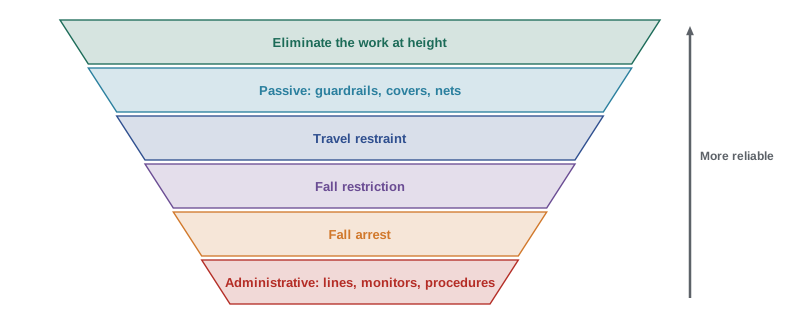
1. Eliminate the work at height
The best fall protection is not needing it. Ask whether the task can be done from the ground or from a permanent safe surface:
- prefabricate roof trusses, wall panels, guardrails and handrails at ground level and lift them into place;
- use long-handled tools, poles and extendable cameras to clean, paint, inspect or change bulbs from the ground;
- lower light fixtures on winches, or install fixtures that can be serviced from below;
- move rooftop equipment such as units, valves and gauges to ground level or to areas inside parapets;
- use drones or remote cameras for inspections of roofs, towers and structures;
- install permanent guardrails, parapets and walkways during construction so that later maintenance never involves an exposed edge.
Elimination is often a design decision. Designers, architects and engineers who think about how a building will be built and maintained can remove fall hazards before they exist. Prevention through design is far cheaper than retrofitting anchors or guardrails later.
2. Passive fall protection
Passive protection works without any action from the worker. Guardrails, parapets, protective covers over openings and safety nets protect everyone in the area, all the time, regardless of training or attention. They do not depend on the worker clipping in or choosing the right anchor. Lesson 4 covers them in detail.
3. Travel restraint
A travel restraint system uses a harness or belt and a lanyard or lifeline, connected to an anchor, to physically prevent the worker from reaching the edge. If set up correctly, the worker cannot fall at all. Travel restraint depends on the worker wearing and connecting the equipment and on the lanyard length being right for the anchor location. Lesson 5 covers it.
4. Fall restriction
Some Canadian regulations recognize fall restricting systems, which allow a short fall, typically no more than about 0.6 m, before stopping the worker. A common example is a climbing system on a wood pole or a ladder safety device on a fixed ladder. Ontario's construction regulation lists fall restricting systems between travel restraint and fall arrest.
5. Fall arrest
A personal fall arrest system lets the worker fall but stops them before they hit the level below. It is the most common form of personal fall protection, and it is the least reliable of the engineering options because it depends on correct anchors, equipment, fit, clearance, inspection and a rescue plan. Lessons 6 to 9 cover it.
6. Administrative controls
Administrative controls rely on people following rules: warning lines or control zones that mark a distance from the edge, safety monitors who watch workers and warn them, permits, procedures and signs. They are permitted only in specific situations and usually in combination with other measures. They are the least reliable option because they do nothing to stop a worker who steps over the line.
Why the order matters
Each step down the hierarchy adds more ways for protection to fail. A guardrail fails only if it is removed or damaged. A travel restraint system can fail if the worker forgets to connect, uses the wrong lanyard or chooses the wrong anchor. A fall arrest system can fail for all those reasons plus inadequate clearance, swing falls, anchor overload, worn equipment, poor harness fit and delayed rescue. The table below shows how the failure modes accumulate.
| Control | Depends on the worker? | Typical failure modes |
|---|---|---|
| Eliminate | No | Few; the work at height does not happen |
| Guardrails and covers | No | Removed and not replaced, unsecured cover, damaged rail |
| Travel restraint | Yes | Not connected, lanyard too long, anchor in the wrong place |
| Fall restriction | Yes | Wrong device, worn rail or lifeline |
| Fall arrest | Yes | Short clearance, swing fall, weak anchor, poor fit, no rescue |
| Administrative | Entirely | Line crossed, monitor distracted, procedure skipped |
Practicability
Regulations often say an employer must use a higher-level control where it is practicable. Practicable means that it can be done with the technology and resources reasonably available, not merely that it is cheaper or more convenient to do something else. If a guardrail can reasonably be installed, a harness is not an acceptable substitute. Where a higher-level control is not practicable for part of a job, the assessment should record why, and the reasons should be reviewed as the job progresses. A guardrail that was impracticable on day one, when the floor edge was still moving, may be easy to install on day five.
Combining controls
Many jobs use several controls at once. A roof replacement might combine a permanent parapet on two sides, temporary guardrails on the other two, covers over skylights, travel restraint for workers near a hatch and a fall arrest system for the crew installing the last section of guardrail. Each worker and each task needs protection that matches the hazard they face at that moment.
Planning for the whole job
Fall protection planning covers the whole sequence of work, not just the main task:
- getting to the work area, for example climbing a ladder or crossing a roof;
- setting up and taking down the protection itself, which is often the most dangerous step;
- moving materials and tools up and down;
- changing tasks and positions during the day;
- rescue if someone does fall.
The first person installing a guardrail or anchor faces a hazard that the guardrail will later control. Plans must protect that worker too, for example by installing anchors from an elevating work platform, by working from inside a parapet, or by using a temporary anchor that is approved for that purpose.
Worked problem
Choosing controls for a mezzanine
A warehouse mezzanine 3.5 m above the floor has a 6 m section of railing that is removed whenever a forklift loads pallets onto it. Workers on the mezzanine pick pallets from the edge. Choose controls using the hierarchy.
Show solution
- Eliminate: can loading be done another way, such as a pallet lift? If not, move to the next level.
- Passive: replace the removable rail with a pallet safety gate, which always keeps a barrier between the worker and the edge. The gate opens to the forklift side while closing to the worker side, and back again.
- Restraint: if a gate is not practicable, provide a restraint anchor and a lanyard short enough that workers cannot reach the open edge.
- Administrative: add floor markings, training and a rule that the rail is never left open, as a supplement, not a substitute.
Answer: A pallet safety gate is the right control: it keeps a barrier in place at all times. Restraint and rules are fallbacks if a gate cannot be installed.
Common mistakes
MistakeStarting the plan by asking which harness to use.
InsteadStart by asking whether the work at height can be eliminated, then consider guardrails and covers.
MistakeCalling a guardrail impracticable because a harness is cheaper.
InsteadPracticable means reasonably achievable; cost alone does not justify a lower control.
MistakeForgetting the worker who installs the guardrail or anchor.
InsteadPlan protection for set-up and take-down, which are often the riskiest steps.
MistakeUsing a low risk score to leave a serious fall hazard unprotected.
InsteadFall severity is high; any credible fall from height needs protection.
MistakeRelying on a warning line alone near an edge.
InsteadAdministrative controls are the weakest; use them only where permitted and with other measures.
Summary and key terms
- Fall hazard assessment looks at the work area, the task, the fall distance and what the worker would hit.
- Severity is usually high for falls; likelihood depends on proximity, exposure, conditions and the task.
- The hierarchy runs from elimination to passive protection, restraint, restriction, arrest and administrative controls.
- Elimination often happens at the design stage, for example permanent guardrails and ground-level equipment.
- Each step down the hierarchy adds more ways for protection to fail.
- Use a higher control wherever it is practicable, and record why it is not when it is not.
- Plan protection for access, set-up, materials handling and rescue, not just the main task.
- Fall hazard assessment
- A review of where and how workers could fall and how far.
- Hierarchy of controls
- A ranking of controls from the most reliable to the least reliable.
- Elimination
- Removing the need to work at height.
- Prevention through design
- Removing hazards during the design of buildings, equipment and work.
- Passive fall protection
- Protection that works without worker action, such as guardrails and covers.
- Fall restricting system
- A system that limits a fall to a short distance before stopping the worker.
- Practicable
- Reasonably achievable with available technology and resources.
- Pallet safety gate
- A gate that keeps a barrier between workers and an open loading edge at all times.
- Administrative control
- A rule, procedure, sign or monitor that depends on people following it.
- Exposure
- How often, how long and how many people face a hazard.
Practice problems
Work each problem on paper first, then reveal the answer to check.
List four questions to ask when assessing a fall hazard.
Show answer
Where people will work, where the edges and openings are, how far they could fall and onto what, and how long they are exposed.
Give two ways to eliminate work at height.
Show answer
Prefabricate at ground level and use long-handled tools; also move equipment to the ground or use drones.
Why are guardrails preferred over fall arrest?
Show answer
They protect everyone without any action by the worker and have fewer failure modes.
What does practicable mean?
Show answer
Reasonably achievable with the technology and resources available, not just cheaper or easier.
Which part of a job is often the most dangerous for falls?
Show answer
Setting up and taking down the fall protection itself.
Score a task with likelihood 4 and severity 5.
Show answer
20, a high risk.
Why is a fall arrest system the least reliable engineering option?
Show answer
It depends on anchors, fit, clearance, inspection, connection and rescue.
What is a pallet safety gate?
Show answer
A gate that keeps a barrier between workers and an open loading edge at all times.
How can designers reduce fall hazards?
Show answer
By including permanent guardrails, parapets, walkways and ground-level access to equipment.
Why should the plan be reviewed as work progresses?
Show answer
A higher-level control may become practicable as the structure takes shape.
Lesson quiz · 5 questions
Score 60% or more to complete this lesson.
Create a free account to save your progress, take quizzes and earn a certificate.