
HSE-212 · Lesson 1 of 12 · 25 min
Falls from height: why they happen and why they kill
Falls from height are one of the oldest and most predictable ways to die at work. A roofer steps backward off an edge while measuring. An electrician leans out from a ladder to reach a fixture. A labourer lifts a plywood sheet that was covering a floor opening and steps into the hole. A maintenance worker crosses a warehouse roof and puts a foot through a skylight. Each of these falls takes less than two seconds, and each was preventable with equipment and methods that have existed for decades.
This course is about preventing falls from height and protecting workers when a fall cannot be ruled out. It explains how fall hazards are assessed, how guardrails, covers, nets, travel restraint and fall arrest systems work, how to choose anchors and calculate clearance, how to plan rescue, and how the law and standards apply in your country. It builds on HSE-103 Hazard Recognition and Risk Assessment, and it picks up where HSE-106 left off: that course covered slips, trips and same-level falls and introduced ladders, while this one covers falls to a lower level.
This is an awareness course. In Ontario, for example, workers on construction projects who use fall protection must complete a Working at Heights program approved by the Chief Prevention Officer and delivered by an approved provider, and that training is valid for three years. Every province also requires employers to train workers on the specific fall protection systems and procedures at their site. Designing anchors and horizontal lifelines, writing rescue procedures and inspecting equipment each require a competent person or, for some systems, a professional engineer.
What counts as a fall from height?
A fall from height, or a fall to a lower level, is any fall in which the worker ends up below the surface they started on. It includes falls from roofs, floors, mezzanines, platforms, ladders, scaffolds, vehicles, trailers, loading docks, equipment, machinery and stacked material, and falls into holes, pits, shafts, excavations and openings. It also includes falls through fragile surfaces such as skylights, roof panels, ceiling tiles and rotten decking.
The law sets trigger heights above which fall protection is required. Lesson 2 compares them. But trigger heights describe when the law demands specific equipment, not when a fall becomes dangerous. Workers die every year from falls of 2 or 3 m, and some from much less, especially when they land on their head, on concrete, on rebar or into machinery. Many regulations therefore require protection at any height where the surface below would cause more serious injury than a flat floor, for example open machinery, water, a hazardous substance or projecting objects.
The physics of a fall
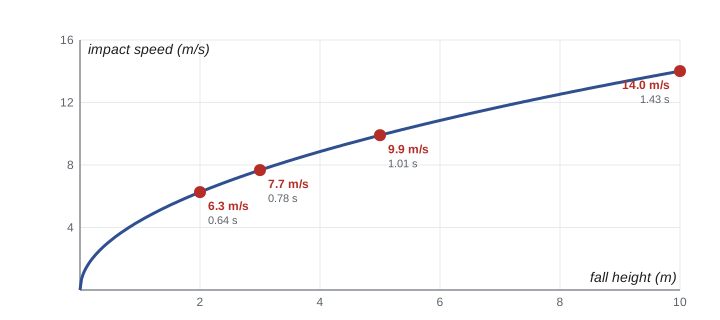
Falls are dangerous because gravity accelerates the body quickly and the body has very little time to react. Ignoring air resistance, which is small over the heights involved in most work falls, a falling body gains speed at about 9.8 m/s² (32.2 ft/s²). The time to fall a height \( h \) and the speed at impact are:
Human reaction time to an unexpected event is typically somewhere between 0.2 and 0.5 seconds, and a surprised worker usually takes longer than that to do anything useful. In the time it takes to recognize that you are falling, you have already fallen about a metre. There is no time to grab anything, and the arms rarely protect the head.
Worked problem
Speed at impact from a 3 m fall
A worker falls 3 m from the edge of a flat roof to a concrete pad. How long does the fall take, and how fast is the worker moving when they hit the ground?
Show solution
- Time: \( t = \sqrt{2 \times 3 / 9.81} = \sqrt{0.612} \approx 0.78 \) s.
- Speed: \( v = \sqrt{2 \times 9.81 \times 3} = \sqrt{58.9} \approx 7.7 \) m/s.
- Convert: 7.7 m/s × 3.6 ≈ 28 km/h.
- The worker hits the ground in under a second, at the speed of a car moving through a parking lot, with no time to react.
Answer: About 0.8 seconds and 7.7 m/s (28 km/h). A short fall is fast and gives no time to recover.
The damage depends on how quickly the body stops. A worker who lands on concrete stops in a few centimetres, so the forces on the skull, spine and organs are enormous. The same physics explains how fall arrest equipment works: an energy absorber or a self-retracting device lengthens the stopping distance to around a metre, which cuts the force on the body to a level a healthy person can survive. Lesson 7 returns to this idea.
How often falls happen
Falls are a leading cause of serious injury and death in Canadian workplaces, and they dominate construction fatality statistics. The Association of Workers' Compensation Boards of Canada reports fatalities and lost-time claims by event, and falls to a lower level appear in every year's data among the leading causes of traumatic death in construction. Ontario's Ministry of Labour has repeatedly identified falls from heights as the leading cause of critical injuries and deaths on construction projects, and falls are a perennial focus of provincial inspection blitzes. The figures vary from year to year and between provinces, so check the current reports from your workers' compensation board for exact numbers.
Behind the fatalities are many more serious injuries: fractured skulls, spinal cord injuries, broken pelvises, heels and wrists, and internal injuries. Survivors of serious falls often never return to their old work. For employers, a single fall can mean prosecution, large fines, higher compensation premiums, project delays and the loss of experienced workers.
Where and why falls happen
Falls cluster around a few situations:
- unprotected edges of roofs, floors, mezzanines, balconies, loading docks and platforms;
- openings in floors and roofs, including stairwells, shafts, hatches, skylights and holes left for ducts and services;
- fragile surfaces that look solid, such as skylights, plastic roof panels, corroded metal roofing and ceilings;
- ladders and step stools used for the wrong task, set up badly or climbed while carrying materials;
- scaffolds and work platforms with missing guardrails, planks or ties;
- vehicles, trailers and equipment, where workers climb onto loads, cabs and machinery;
- leading edges, where a floor or roof is still being built and the edge moves as work progresses.
Investigations into fatal falls show recurring causes. Fall protection was not provided at all. It was provided but not used, because it slowed the job, was uncomfortable, or the worker thought the task would take only a minute. It was used incorrectly: the lanyard was tied to something that failed, the clearance was too short, the harness was badly fitted, or the worker unhooked to move past an obstruction. Covers were not secured or not marked. Guardrails were removed for a delivery and not replaced. No one had planned how to rescue a worker who fell and was left hanging.
The human side
Falls rarely happen because workers want to take risks. They happen because of ordinary pressures and assumptions:
- the job is expected to take only a few minutes;
- the worker has done it many times before without falling;
- the anchor is in the wrong place, so tying off would mean climbing down and moving it;
- the harness is in the truck, or is shared and does not fit;
- the schedule is tight and everyone is behind;
- no one has told the worker exactly where the edge or the opening is.
Good fall protection is planned before anyone goes up, so that the safe way is also the practical way. That means guardrails that are already in place, anchors located where the work is, equipment that fits, and supervisors who stop work when protection is missing.
What fall protection tries to achieve
Every fall protection measure in this course does one of three things:
- it prevents the worker from reaching an edge or opening at all, for example guardrails, covers, travel restraint and working from the ground;
- it limits how far a worker can fall, for example fall restricting systems and some positioning systems;
- it stops a fall that has already started, safely and without the worker hitting anything, for example fall arrest systems and safety nets.
Preventing a fall is always better than arresting one. A fall arrest system that works perfectly still exposes the worker to forces, possible swing into structures, suspension in a harness and the risks of rescue. Lesson 3 explains the hierarchy of controls that puts these options in order.
| Approach | Examples | What can still go wrong |
|---|---|---|
| Eliminate the hazard | Prefabricate at ground level, use long-handled tools, move equipment off the roof | Very little; the work at height no longer happens |
| Passive protection | Guardrails, covers, parapets, safety nets | Guardrails removed and not replaced, covers not secured |
| Travel restraint | Harness and lanyard that stop the worker short of the edge | Lanyard too long, wrong anchor location |
| Fall arrest | Harness, energy-absorbing lanyard or self-retracting device, anchor | Insufficient clearance, swing falls, anchor failure, suspension |
| Administrative controls | Marked warning lines, control zones, safety monitors, procedures | Depends entirely on people following the rules |
Related courses
Ladders and scaffolds are covered in detail in HSE-213 Ladder and Scaffold Safety. Elevating work platforms, scissor lifts and boom lifts are covered in HSE-217. Same-level slips and trips are covered in HSE-106, and personal protective equipment in general in HSE-104. This course points to those courses rather than repeating them.
Short exposures, big consequences
Many fatal falls happen during tasks that last only minutes: checking a gauge, retrieving a dropped tool, taking a measurement, adjusting a ladder or covering an opening at the end of the day. Because these tasks are short, they are often left out of planning. The physics does not care how long the task takes. A fall during a two-minute task is exactly as fast and as hard as a fall during a two-day job, which is why fall protection planning must cover every task at height, however brief.
Common mistakes
MistakeBelieving that falls below the legal trigger height are harmless.
InsteadPeople die from falls of a few metres or feet, especially onto concrete, machinery or rebar. Protect any fall where serious injury is likely.
MistakeExpecting to catch yourself if you slip at an edge.
InsteadA fall from roof height is over in under a second, faster than most people can react.
MistakeSkipping fall protection because the job will take only a minute.
InsteadShort jobs at unprotected edges are exactly when many fatal falls happen. Plan protection for every task.
MistakeTreating fall arrest as the first choice.
InsteadEliminate the work at height or use guardrails and covers first. Fall arrest is a last line of defence.
MistakeAssuming this awareness course meets the legal training requirement.
InsteadWorkers need the training their jurisdiction requires and training on the specific systems at their site.
Summary and key terms
- A fall from height is any fall to a lower level, including falls through openings and fragile surfaces.
- Falls happen in under a second, so workers cannot react or save themselves.
- Impact speed rises with the square root of height; a 3 m (10 ft) fall reaches about 28 km/h (17 mph).
- Falls are a leading cause of workplace death, especially in construction.
- Most fatal falls involve missing, unused or misused fall protection, unsecured covers or fragile surfaces.
- Fall protection prevents access to the edge, limits the fall, or arrests it safely.
- Preventing a fall is always better than arresting one.
- Fall from height
- A fall in which a worker ends up below the level they started on.
- Trigger height
- The fall distance at or above which the law requires specific fall protection.
- Unprotected edge
- An edge of a floor, roof or platform without a guardrail or wall that would stop a fall.
- Opening
- A gap or hole in a floor, roof or wall through which a worker could fall.
- Fragile surface
- A surface, such as a skylight or roof panel, that will not support a person.
- Leading edge
- The edge of a floor or roof that moves as construction progresses.
- Passive protection
- Protection that works without the worker doing anything, such as guardrails and covers.
- Travel restraint
- A system that stops a worker from reaching a fall hazard.
- Fall arrest
- A system that stops a worker who has already fallen.
- Competent person
- A person with the knowledge, training and experience to identify hazards and take corrective action.
Practice problems
Work each problem on paper first, then reveal the answer to check.
List three places where workers commonly fall to a lower level.
Show answer
Roof edges, floor openings and ladders; also skylights, loading docks, scaffolds and vehicles.
How fast is a worker moving after falling 5 m?
Show answer
About 9.9 m/s, or roughly 36 km/h.
Why do falls happen too quickly for workers to save themselves?
Show answer
A short fall takes under a second, and reaction time alone uses up a large part of that.
Why can a fall below the trigger height still require protection?
Show answer
Landing on machinery, rebar, water or a hazardous substance can cause serious injury even from a low height.
Give two reasons fall protection is provided but not used.
Show answer
The job is expected to be quick, or the anchor is in the wrong place; also discomfort or poor fit.
What are the three things fall protection can do?
Show answer
Prevent access to the edge, limit the fall distance, or arrest a fall safely.
Why is fall arrest a last resort?
Show answer
The worker still falls and can be hurt by forces, swing, suspension and rescue.
What makes a skylight especially dangerous?
Show answer
It looks like part of the roof but will not support a person.
How does an energy absorber protect the body?
Show answer
It lengthens the stopping distance, which reduces the force on the body.
Which course covers ladders and scaffolds in detail?
Show answer
HSE-213 Ladder and Scaffold Safety.
Lesson quiz · 5 questions
Score 60% or more to complete this lesson.
Create a free account to save your progress, take quizzes and earn a certificate.