
HSE-212 · Lesson 6 of 12 · 25 min
Personal fall arrest systems: anchorage, body support and connectors
A personal fall arrest system lets a worker fall but stops them before they hit the level below, and does so with forces the body can survive. It is the most widely used form of personal fall protection and also the most demanding: every part must be right, and the parts must work together. This lesson introduces the system as a whole using the familiar ABC of fall arrest, then looks in detail at harnesses and connectors. Lesson 7 covers lanyards and self-retracting devices, lesson 8 covers anchors and lesson 9 covers clearance and swing falls.
The ABCs of fall arrest
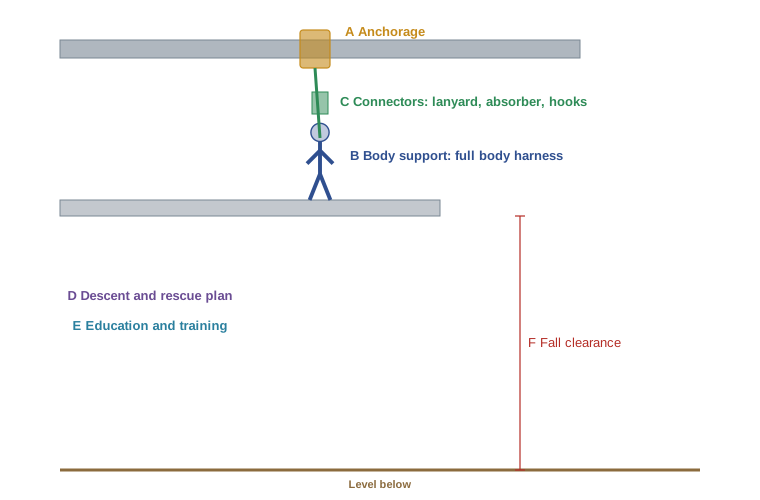
Trainers often describe a personal fall arrest system with three letters, sometimes extended to five or six:
- A for anchorage: a secure point of attachment, strong enough for the forces of a fall, in the right place;
- B for body support: a full body harness that distributes the arrest forces across the thighs, pelvis, chest and shoulders;
- C for connectors: the lanyard, self-retracting device, lifeline, snap hooks, carabiners and anchorage connectors that link the harness to the anchor and absorb energy;
- D for descent and rescue: a plan and equipment to bring a fallen worker down quickly;
- E for education: training in selection, inspection, use and rescue;
- F for fall clearance: enough space below the worker that they stop before hitting anything.
Every letter must be right. A perfect harness clipped to a weak anchor is no protection. A perfect anchor with too little clearance below is no protection. A system that catches the worker but leaves them hanging for an hour can still kill them.
Full body harnesses
A full body harness is the only body support permitted for fall arrest. It holds the worker by straps over the shoulders, around the thighs and under the buttocks, so that the arrest force is spread across the strongest parts of the body and the worker stays upright, or nearly so, after the fall. Body belts, which wrap only around the waist, were once common for fall arrest but concentrate force on the abdomen and spine and allow the worker to slip out or hang jackknifed. They are no longer permitted for fall arrest, although some rules allow them for positioning or restraint.
Key parts of a harness include:
- the dorsal D-ring between the shoulder blades, the main attachment point for fall arrest;
- shoulder straps and a chest strap that keep the shoulder straps in place;
- leg straps and a sub-pelvic strap that carry most of the load in a fall;
- buckles, which may be pass-through, tongue or quick-connect types;
- optional attachment points: a sternal or front D-ring for ladder climbing systems and some rescue applications, side D-rings for positioning, and shoulder D-rings for confined space retrieval;
- labels that show the standard, class, capacity, size, serial number, date of manufacture and inspection record.
CSA Z259.10 classifies harnesses by use with letters. Class A harnesses have a dorsal attachment for fall arrest and are the basic requirement. Additional classes add capabilities: D for suspension and controlled descent, E for limited access such as confined space retrieval, L for ladder climbing, and P for work positioning. A harness can carry several letters, for example Class AP or Class ADP.
Capacity
Harnesses and the rest of a fall arrest system are rated for a range of user weights, including clothing, tools and equipment. Older standards assumed a worker of about 100 kg (220 lb). Modern standards and products cover a wider range, commonly up to about 140 kg (310 lb), and some products are rated higher. A heavier worker in a system rated for less may experience higher forces, longer deceleration and less clearance than the system was designed for.
Worked problem
Checking a worker against a harness rating
A worker weighs 118 kg. On the job they wear boots, clothing and a tool belt totalling 14 kg, and they carry a 6 kg drill. The harness and lanyard are rated for a total user mass of 45 to 140 kg. Is the system within its rating?
Show solution
- Total user mass = 118 + 14 + 6 = 138 kg.
- Rated range: 45 to 140 kg. 138 kg is within the range, but only by 2 kg.
- If the worker adds a full tool pouch or heavier tool, the total exceeds the rating.
- Consider equipment rated for a higher capacity, and check that the energy absorber, self-retracting device and anchors are rated for the same mass.
Answer: Yes, barely: 138 kg against a 140 kg limit. Every component in the system must be rated for the total user mass.
Fitting a harness
A harness that fits badly can injure the worker in a fall, let them slip out, or leave them hanging in a dangerous position. Fit it every time:
- hold the harness by the dorsal D-ring and shake it so the straps fall into place;
- put on the shoulder straps like a jacket, with the D-ring at the back;
- connect the leg straps and adjust them so that you can fit a flat hand, but not a fist, between the strap and the leg;
- connect the chest strap and position it in the middle of the chest, roughly at armpit level, not at the throat or the stomach;
- adjust the shoulder straps so the dorsal D-ring sits between the shoulder blades;
- tuck loose strap ends into keepers so they do not snag.
Leg straps that are too loose are the most common fit problem. In a fall, a loose strap can slide toward the groin and cause serious injury, and the worker may slip partly out. Harnesses come in sizes and in designs for different body shapes, including models designed for women. Shared, one-size harnesses that are rarely adjusted are a recurring factor in poor fit.
Inspecting a harness
Inspect your harness before each use and have it inspected formally by a competent person at regular intervals, usually at least once a year, or more often in harsh conditions as the manufacturer directs. Before each use, check:
- webbing for cuts, fraying, burns, melted fibres, chemical damage, mould, broken stitching and excessive wear;
- hardware for cracks, sharp edges, deformation, corrosion and buckles that do not close properly;
- labels, which must be present and readable, showing the standard and the inspection record;
- fall indicators, which are stitches or tags that tear or deploy when the harness has arrested a fall.
Remove a harness from service if it fails any check, if it has arrested a fall, or if the manufacturer's service life has been reached. Most regulations require equipment that has arrested a fall to be removed from service until it is inspected and recertified by the manufacturer or a competent person, and many manufacturers require harnesses to be destroyed after a fall. Store harnesses clean, dry, out of sunlight and away from chemicals and heat.
| Check | What to look for | Remove from service if |
|---|---|---|
| Webbing | Cuts, fraying, burns, discolouration, stiffness, chemical damage | Any cut, burn or melted fibre; damage you cannot explain |
| Stitching | Broken, pulled or cut threads, especially at load points | Any broken stitching in a load-bearing area |
| D-rings and buckles | Cracks, distortion, corrosion, sharp edges, poor operation | Any deformation or cracking; buckles that will not lock |
| Fall indicator | Torn stitching or deployed tag | Deployed: the harness has arrested a fall |
| Labels | Standard, class, capacity, serial number, inspection record | Missing or unreadable labels |
Connectors
Connectors join the harness to the lanyard or self-retracting device and the lanyard to the anchor. They include snap hooks, carabiners, D-rings, O-rings and anchorage connectors such as beam clamps, cross-arm straps and roof anchors. Modern snap hooks and carabiners must be self-closing and self-locking, so that the gate cannot open unless the user deliberately unlocks it. Older non-locking snap hooks are no longer permitted for fall protection.
Connectors can fail in surprising ways:
- rollout: a snap hook connected to a ring or bar that is too small can rotate so that the ring presses the gate open and slips out;
- gate loading: a carabiner loaded across its gate, rather than along its spine, is much weaker;
- incompatibility: a large rebar hook connected to a small D-ring, or two snap hooks connected to each other, can load in ways the manufacturer never tested;
- tie-back misuse: wrapping a lanyard around a beam and hooking it back onto itself is permitted only with lanyards specifically designed for tie-back use;
- side loading: hooks loaded sideways over an edge can bend or open.
Use only connectors that the manufacturer says are compatible, connect each hook to a suitable attachment point, never clip two hooks together unless the manufacturer allows it, and never connect more than one snap hook to a single D-ring unless both the hook and the ring are designed for it.
CSA Z259.12 sets the requirements for connecting components in Canada, including gate strength and locking requirements.
Putting the system together
A fall arrest system is only as good as its weakest link and its worst mismatch. Before work begins, the competent person planning the work should check that the harness, connectors, lanyard or self-retracting device and anchor are compatible, rated for the worker's total mass, suitable for the anchor position, and able to stop the worker within the available clearance. Lessons 7 to 9 explain those checks in detail.
Harnesses for special conditions
Standard polyester or nylon webbing can melt or burn, so workers doing hot work such as welding, cutting or grinding at height need harnesses with webbing designed for heat and sparks, such as aramid fibres, and lanyards with heat-resistant covers. Electrical workers exposed to arc flash need harnesses tested for arc flash, with dielectric or coated hardware where required. Workers in cold climates need harnesses that can be adjusted over bulky winter clothing and rechecked when layers are removed. High-visibility harnesses help in traffic and on construction sites. In each case, choose equipment certified for the condition and follow the manufacturer's limits.
Comfort and acceptance
Workers wear harnesses that are comfortable and take off harnesses that are not. Padded shoulder and leg straps, quick-connect buckles, lighter materials, sizes that fit and designs for different body shapes all increase the chance that workers will wear and adjust their harnesses properly for a whole shift. Issuing harnesses to individuals, rather than sharing them, also improves fit and care. The cost of a better harness is small compared with the cost of one fall.
Common mistakes
MistakeUsing a body belt for fall arrest.
InsteadUse a full body harness; body belts are not permitted for fall arrest.
MistakeWearing leg straps loose for comfort.
InsteadAdjust them so a flat hand, not a fist, fits under the strap.
MistakeWearing the chest strap at the throat or stomach.
InsteadPosition it in the middle of the chest so the shoulder straps stay in place.
MistakeContinuing to use a harness after it arrested a fall.
InsteadRemove it from service; follow the manufacturer's instructions, which often require destruction.
MistakeClipping two snap hooks together or onto an undersized ring.
InsteadUse compatible connectors only; incompatible connections can roll out.
Summary and key terms
- A personal fall arrest system needs anchorage, body support and connectors, plus descent and rescue, education and clearance.
- A full body harness is the only body support permitted for fall arrest.
- The dorsal D-ring between the shoulder blades is the main fall arrest attachment.
- Every component must be rated for the worker's total mass, including tools and clothing.
- Fit the harness every time, with snug leg straps and the chest strap mid-chest.
- Inspect before each use; remove damaged harnesses and any harness that has arrested a fall.
- Use self-locking connectors and check compatibility to prevent rollout and gate loading.
- Personal fall arrest system
- A harness, connectors and anchor that stop a worker who has fallen.
- Full body harness
- Body support with shoulder, chest, leg and sub-pelvic straps that spreads arrest forces.
- Body belt
- A waist belt; no longer permitted for fall arrest.
- Dorsal D-ring
- The attachment point between the shoulder blades used for fall arrest.
- Sternal attachment
- A front attachment point used with ladder climbing systems and some rescue systems.
- Fall indicator
- Stitching or a tag that shows a harness or lanyard has arrested a fall.
- Self-locking snap hook
- A hook whose gate closes and locks automatically and opens only with deliberate action.
- Rollout
- Unintentional disengagement of a hook when a ring presses its gate open.
- Compatibility
- The ability of connected components to work together as the manufacturer intended.
- Total user mass
- The weight of the worker plus clothing, tools and equipment.
Practice problems
Work each problem on paper first, then reveal the answer to check.
What do A, B and C stand for in fall arrest?
Show answer
Anchorage, body support and connectors.
Why are body belts not permitted for fall arrest?
Show answer
They concentrate force on the abdomen and spine and allow the worker to slip out or hang jackknifed.
Where should the dorsal D-ring sit?
Show answer
Between the shoulder blades.
How tight should leg straps be?
Show answer
Snug enough that a flat hand, but not a fist, fits underneath.
What does a deployed fall indicator mean?
Show answer
The equipment has arrested a fall and must be removed from service.
A worker of 95 kg carries 20 kg of tools and clothing. What total mass must the system be rated for?
Show answer
115 kg.
Name three things to check on harness webbing.
Show answer
Cuts, burns and broken stitching; also fraying and chemical damage.
What is rollout?
Show answer
A hook disengaging when a small ring or bar presses its gate open.
Why must connectors be compatible?
Show answer
Mismatched connectors can load in untested ways and fail.
How often should a harness have a formal competent person inspection?
Show answer
Usually at least once a year, or as the manufacturer directs.
Lesson quiz · 5 questions
Score 60% or more to complete this lesson.
Create a free account to save your progress, take quizzes and earn a certificate.