
HSE-212 · Lesson 11 of 12 · 27 min
Rescue planning and suspension intolerance
A fall arrest system that works perfectly leaves a worker hanging in a harness, sometimes many metres above the ground, sometimes against the face of a building, sometimes injured and sometimes unconscious. Getting them down quickly and safely is part of fall protection, not an optional extra. Every jurisdiction requires a rescue plan before work with fall arrest begins. This lesson explains why rescue is urgent, what suspension does to the body, and how to plan a rescue that will actually work on the day.
Why rescue is urgent
There are three reasons to plan for fast rescue. First, the fall itself may have injured the worker, through the arrest forces, a swing into a structure or contact with objects on the way down. Second, a worker hanging in a harness is exposed to the weather, to whatever caused the fall and sometimes to further hazards such as a moving machine or a fire. Third, motionless suspension in a harness can itself lead to fainting and, in some cases, death, a condition known as suspension intolerance, suspension trauma or orthostatic intolerance.
Suspension intolerance
When a person stands still for a long time, blood pools in the legs. Normally the leg muscles pump it back toward the heart as we move. A worker hanging in a harness, especially one who is still because they are injured, exhausted or unconscious, has the leg straps pressing on the thighs and little muscle activity in the legs. Blood pools in the legs, the return of blood to the heart falls, blood pressure drops and the brain receives less oxygen. The result can be fainting, and if the worker remains upright and suspended, the reduced blood flow can become dangerous.
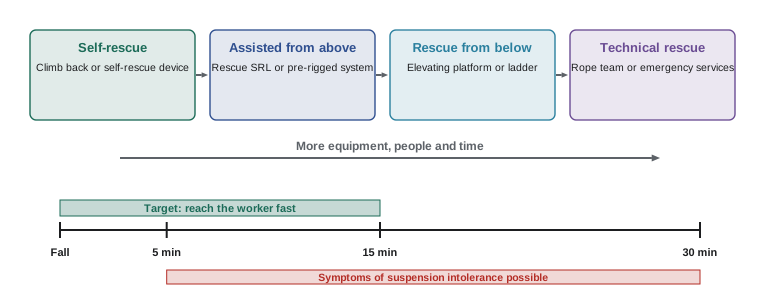
OSHA's 2004 Safety and Health Information Bulletin on suspension trauma lists early symptoms that include light-headedness, dizziness, nausea, sweating, weakness, paleness, breathlessness, a racing heart and greying or loss of vision, with later signs including an unusually slow heart rate, low blood pressure and fainting. It cites research indicating that suspension in a fall arrest harness can lead to unconsciousness and death in less than 30 minutes. How quickly symptoms appear varies widely between people and situations: some people feel faint within minutes, others tolerate suspension much longer. Injury, dehydration, heat, cold, blood loss and heart or lung conditions all make things worse, and a poorly fitted harness makes things worse still.
Workers who remain conscious can slow the onset of symptoms by moving their legs, pushing against the structure, or standing in a trauma relief strap. Many harnesses now include trauma relief straps, small loops of webbing stored in pouches on the harness that the suspended worker can deploy and stand in. These buy time, but they are not a rescue. A worker who is unconscious cannot use them.
After the rescue
Older advice said that a rescued worker should be kept sitting up for 30 minutes rather than laid flat, because laying them down might suddenly return pooled blood to the heart. That advice was based on limited and largely theoretical evidence. A 2009 evidence review for the UK Health and Safety Executive found no good evidence to support it, and current first aid practice is to treat a rescued worker like any other casualty: check breathing and circulation, place an unconscious breathing casualty in the recovery position, provide standard first aid for injuries, and call emergency services. OSHA's bulletin similarly calls for standard trauma resuscitation and first aid. Every worker who has been suspended after a fall should be evaluated by a health care professional, because complications can develop later.
First aid for injuries from falls is covered in HSE-110 First Aid Awareness, and CPR in HSE-111.
What the law requires
Canadian regulations require rescue to be planned before work begins. The federal regulation requires the fall protection plan to include rescue procedures. Alberta's code requires the fall protection plan to describe the procedures for rescuing a worker who has fallen and is suspended in a harness. British Columbia requires rescue to be addressed in its fall protection plans and in its evacuation and rescue requirements. Ontario's construction regulation requires written emergency procedures, which must address rescue of a worker who has fallen. The common thread: a written plan, the equipment to carry it out, and trained people available whenever workers are using fall arrest.
Types of rescue
Rescue options range from simple to complex. Choose the simplest one that will work for the situation, and plan a backup.
Self-rescue
A conscious, uninjured worker may be able to rescue themselves: climbing back onto the structure, climbing onto a ladder placed by a coworker, or lowering themselves with a self-rescue device built into the harness or lanyard. Self-rescue depends on the worker's condition, so it should never be the only plan.
Assisted rescue from the structure
Coworkers on the structure can rescue the fallen worker without anyone else going over the edge, using:
- a self-retracting device with integral rescue, which can be switched to raise or lower the suspended worker;
- a pre-rigged rescue system, such as a pulley system or a descent device attached to an anchor above the worker;
- a rescue pole to reach and connect a rescue line to the worker's harness.
These systems need trained users, regular practice and equipment that is on site and ready.
Rescue from below
An elevating work platform, scissor lift or boom lift can often reach a suspended worker quickly, if one is on site, has enough reach, and can get under the worker. Rescuers on the platform must use their own fall protection and must be able to take the weight of the casualty without overloading the platform. A ladder can sometimes be used for a conscious worker hanging a short distance above a floor. Rescue from below is often the fastest option on construction sites where lifts are already in use.
Technical rope rescue and emergency services
Some situations, such as rescue from towers, from the face of tall buildings or from inside structures, need a trained technical rescue team with rope rescue equipment. Some large employers have their own teams; others contract specialist rescue services. Public fire departments may have high-angle rescue teams, but not all do, and their response time may be too long. Before relying on emergency services as the plan, confirm that they can reach the site, have the equipment and training for the rescue, and can arrive in time.
Planning a rescue
A good rescue plan answers practical questions for each work location:
- Who will notice that a worker has fallen, and how quickly? Workers should never work at height alone with fall arrest unless their condition is monitored.
- How will they raise the alarm, and who will respond?
- What method will be used to reach the worker, and what is the backup?
- What equipment is needed, where is it kept, and who is trained to use it?
- How long will each step take, and is the total short enough?
- How will the rescuers be protected from falling themselves?
- How will the casualty be brought to the ground and handed over to first aid and emergency services?
- How often will the plan be practised?
Worked problem
A rescue time budget
A crew installs cladding from a mast climber, with workers tied off to the structure. The plan uses a boom lift kept at the base of the building to reach a suspended worker. Estimate the time from the fall to the worker being relieved of suspension: noticing the fall 1 minute, raising the alarm and reaching the lift 2 minutes, starting the lift and doing pre-use checks 2 minutes, raising and positioning the platform 6 minutes, connecting to the worker and taking their weight 3 minutes.
Show solution
- Total = 1 + 2 + 2 + 6 + 3 = 14 minutes.
- That is within a target of about 15 minutes that many employers use, but with little margin.
- Improvements: keep the lift pre-checked and ready at the start of each shift, saving 2 minutes; position the lift closer to the work area as it moves, cutting raising time; train two operators so one is always available.
- With those changes the estimate falls to about 9 minutes, and a backup plan, such as a rescue kit at the roof edge, should still be in place.
Answer: About 14 minutes as planned, reducible to about 9 minutes with a ready lift and better positioning. Test the estimate in a drill rather than trusting it on paper.
Rescue systems and mechanical advantage
Raising a suspended worker by hand requires lifting their whole weight, which is beyond most people over any distance. Rescue systems use pulleys to provide mechanical advantage, so that a smaller pull lifts the load. Friction in the pulleys and rope reduces the advantage, so efficiency is included in the calculation.
Worked problem
Pull needed on a rescue system
A rescue kit uses a 3:1 mechanical advantage with an efficiency of 0.8. The casualty and their equipment weigh 110 kg. What pull is needed to raise them?
Show solution
- Weight: 110 × 9.81 ≈ 1,079 N.
- Pull = 1,079 / (3 × 0.8) = 1,079 / 2.4 ≈ 450 N, about the weight of a 46 kg mass.
- One rescuer can manage this for a short raise, but a 5:1 system or two rescuers would make it easier, and lowering is usually easier than raising.
Answer: About 450 N of pull. Plan the mechanical advantage and the number of rescuers before you need them.
Drills
A rescue plan that has never been tried is a guess. Practise rescues at least once a year, and whenever the work location, the equipment or the crew changes significantly, using a dummy or a volunteer in a controlled setting with backup protection. Drills reveal the problems that plans miss: the rescue kit is locked in a trailer, the boom lift battery is flat, nobody knows the radio channel, the anchor for the rescue system is in the wrong place, or the casualty cannot be manoeuvred past a beam. Time each step, record what went wrong and fix it.
| Plan element | Questions to test in a drill |
|---|---|
| Detection | Would anyone notice the fall immediately? Is anyone working alone? |
| Alarm | Do radios work at that location? Does everyone know who to call? |
| Access | Can the lift, ladder or rescue system actually reach the casualty? |
| Equipment | Is it on site, inspected, charged and unlocked? |
| People | Are trained rescuers on every shift? |
| Time | How long did each step really take? |
| Handover | Where will first aid and emergency services meet the casualty? |
Common mistakes
MistakeWriting "call 911" as the whole rescue plan.
InsteadConfirm emergency services can reach and rescue a suspended worker in time, and plan an on-site method.
MistakeAssuming the fallen worker will rescue themselves.
InsteadInjured or unconscious workers cannot; plan assisted rescue.
MistakeKeeping rescue equipment locked away off site.
InsteadKeep it at the work area, inspected and ready, with trained users on every shift.
MistakeKeeping a rescued worker propped upright for 30 minutes.
InsteadTreat them like any casualty with standard first aid and get medical evaluation.
MistakeNever practising the rescue.
InsteadDrill at least yearly and after changes; drills expose problems plans miss.
Summary and key terms
- Rescue is part of fall protection and must be planned before fall arrest is used.
- Suspension in a harness can lead to fainting and, in some cases, death within a short time.
- Trauma relief straps and leg movement buy time but are not a rescue.
- After rescue, give standard first aid and get every suspended worker medically evaluated.
- Rescue options include self-rescue, assisted rescue from above, rescue from below and technical rescue.
- Emergency services are a valid plan only if they can reach and rescue in time.
- Time the steps, practise the plan in drills and fix what goes wrong.
- Suspension intolerance
- Fainting and circulatory problems caused by motionless suspension in a harness.
- Orthostatic intolerance
- A drop in blood pressure and brain blood flow when upright and still.
- Trauma relief strap
- A loop of webbing on a harness that a suspended worker can stand in.
- Self-rescue
- A fallen worker rescuing themselves, for example with a self-rescue device.
- Assisted rescue
- Rescue of a fallen worker by others using rescue equipment.
- Rescue SRL
- A self-retracting device with an integral means of raising or lowering a worker.
- Mechanical advantage
- The ratio of the load lifted to the force applied in a pulley system.
- Technical rope rescue
- Rescue by a trained team using rope systems in difficult locations.
- Prompt rescue
- Rescue quickly enough to prevent harm from suspension and injury.
- Rescue drill
- A practice rescue used to test and improve the plan.
Practice problems
Work each problem on paper first, then reveal the answer to check.
Give three reasons rescue is urgent after a fall.
Show answer
Possible injury, exposure to hazards and weather, and suspension intolerance.
What causes suspension intolerance?
Show answer
Blood pooling in the legs of a motionless suspended worker, reducing blood flow to the brain.
Name three early symptoms of suspension intolerance.
Show answer
Light-headedness, nausea and sweating; also paleness, racing heart and greying vision.
What do trauma relief straps do?
Show answer
Let a conscious suspended worker stand in a loop to relieve pressure and buy time.
What is current first aid advice after rescue?
Show answer
Treat the worker like any casualty, use the recovery position if unconscious and breathing, and get medical evaluation.
When is calling emergency services an acceptable plan?
Show answer
Only if they can reach, rescue and arrive in time, confirmed in advance.
What pull does a 4:1 system at 0.75 efficiency need for a 100 kg casualty?
Show answer
About 981 / 3 ≈ 327 N.
Why should workers not use fall arrest while working alone?
Show answer
No one would notice the fall or start the rescue.
How often should rescue drills be held?
Show answer
At least yearly and after significant changes.
What is a rescue SRL?
Show answer
A self-retracting device that can be switched to raise or lower the fallen worker.
Lesson quiz · 5 questions
Score 60% or more to complete this lesson.
Create a free account to save your progress, take quizzes and earn a certificate.