
HSE-212 · Lesson 7 of 12 · 27 min
Lanyards, energy absorbers and self-retracting devices
The connecting device between the harness and the anchor does two jobs in a fall arrest system: it links the worker to the anchor, and it controls the forces when the fall is stopped. This lesson explains why a plain rope or webbing lanyard is not enough, how energy absorbers and self-retracting devices limit the force on the body, how to choose between them, and how to inspect them. The choice of connecting device also determines how much clearance the system needs below the worker, which lesson 9 calculates in detail.
Why energy absorption matters
When a falling worker is stopped, the kinetic energy gained during the free fall has to go somewhere. If it is absorbed over a very short distance, the force is huge; if it is absorbed over a longer distance, the force is smaller. A simple energy balance shows the relationship. The work done by the average arrest force \( F \) over the deceleration distance \( d \) equals the loss of potential energy over the free fall \( h \) plus the deceleration distance:
This is a simplification, because real arrest forces rise and fall during the stop and the peak is higher than the average, but it shows the essential point: the shorter the stopping distance, the higher the force.
Worked problem
Why a plain lanyard is dangerous
A 100 kg worker falls 1.8 m before a lanyard comes taut. Compare the average arrest force if (a) a plain webbing lanyard stretches only 0.10 m, and (b) an energy absorber limits the average force to about 4 kN. How far does the absorber deploy?
Show solution
- Weight: \( mg = 100 \times 9.81 \approx 981 \) N.
- (a) Plain lanyard: \( F = 981 \times (1.8 + 0.10) / 0.10 \approx 18{,}600 \) N, or about 18.6 kN.
- That is more than twice the 8 kN commonly used as the upper limit on peak arrest force with a full body harness, and enough to cause serious internal injury.
- (b) With an absorber at 4 kN: rearrange to \( d = mgh / (F - mg) = 981 \times 1.8 / (4000 - 981) \approx 0.58 \) m.
- The absorber spreads the stop over more than half a metre and keeps the force near 4 kN.
Answer: About 18.6 kN without an absorber against about 4 kN with one, at the cost of about 0.6 m of deployment.
That trade-off, lower force for more distance, is the central idea of fall arrest. Energy absorbers and self-retracting devices reduce forces to survivable levels, but they need clearance below the worker to do it.
Arrest force limits
Canadian rules and the CSA standards limit the force a fall arrest system may put on the worker. Many provincial regulations set a maximum arresting force of 8 kN with a full body harness, and several, including Alberta, expect systems to keep the force to about 6 kN or less in normal conditions, noting that a wet or frozen energy absorber can reach 8 kN. Older CSA editions classified energy absorbers as E4 or E6 according to the worker mass and free fall they were designed for, with E4 giving lower forces for lighter workers and shorter falls. The 2017 edition of CSA Z259.11 instead requires each absorber to be marked with its user mass range, its maximum free fall and its maximum deployment, and to keep average deceleration within set limits. You will still see older E4 and E6 equipment in use.
Energy-absorbing lanyards
An energy-absorbing lanyard combines a webbing, rope or cable lanyard with an energy absorber, usually a pack of webbing stitched or woven so that it tears apart gradually under load, or a stretching tubular webbing. Common types include:
- single-leg lanyards, typically 1.8 m (6 ft) long;
- twin-leg or Y lanyards, which let the worker connect the second leg before disconnecting the first, so they are always connected while moving past obstructions;
- adjustable lanyards, which can be shortened to reduce free fall;
- tie-back lanyards, designed to wrap around a beam and hook back onto themselves, which must be used only where the manufacturer permits;
- leading edge lanyards, with abrasion-resistant materials and absorbers tested for falls over an edge.
Twin-leg lanyards bring a specific risk: the unused leg must be stored on a lanyard keeper designed for it, not clipped back to a harness D-ring or webbing. If the unused leg is clipped to the harness and the worker falls, the forces can bypass the energy absorber.
Self-retracting devices
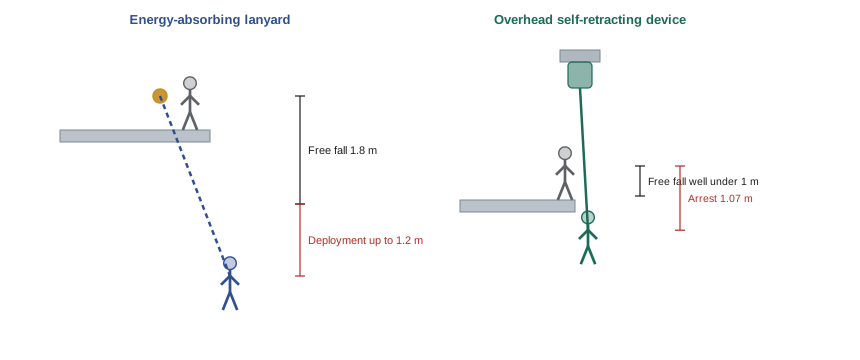
A self-retracting device, often called a self-retracting lifeline or SRL, contains a drum of webbing or cable with a spring that keeps it taut and a brake that locks when the line pays out quickly, as in a fall. Because the line stays taut, free fall is very short, usually well under a metre, and the device stops the fall within a short distance. SRLs give the worker freedom to move while keeping free fall and clearance small, which makes them popular for work below an overhead anchor.
CSA Z259.2.2 classifies self-retracting devices into four classes: SRL, for anchors that limit free fall to the device's activation distance and where the line will not bear on an edge; SRL-R, with an integral means of assisted rescue; SRL-LE, for leading edge use, anchors below the dorsal D-ring, or where the line can bear against an edge; and SRL-LE-R, combining leading edge capability and rescue. The 2017 edition also introduced revalidation: a competent person categorizes each device by how severely it is used, and the device must be returned to the manufacturer or an authorized service centre for revalidation at intervals that depend on that category.
Leading edges and sharp edges
A leading edge is any edge the lifeline could pass over in a fall, such as the edge of a roof deck, a floor slab or a steel beam, especially when the anchor is at foot level. When a cable or webbing lifeline is loaded over an edge, the edge can cut or crush it, and the angle changes the forces on the device. Use only devices rated for leading edge use where the line could contact an edge, follow the manufacturer's limits on edge radius, setback and anchor height, and plan for the swing that occurs when a worker falls off an edge some distance to the side of the anchor. Lesson 9 calculates swing falls.
Choosing a connecting device
| Situation | Better choice | Why |
|---|---|---|
| Anchor overhead, worker moving around below | SRL | Short free fall and small clearance |
| Anchor at D-ring height, plenty of clearance | Energy-absorbing lanyard | Simple, light, low cost |
| Anchor at foot level on a roof or deck | SRL-LE or lanyard rated for the anchor height | Longer free fall and edge contact |
| Moving past obstructions | Twin-leg energy-absorbing lanyard | Always connected while transferring |
| Low clearance below the work | Overhead SRL or restraint instead of arrest | Lanyards may need about 5.5 to 6 m of clearance |
| Rescue needed quickly | SRL-R or rescue system | Integral raising or lowering |
Vertical lifelines and rope grabs
Where workers move up and down rather than sideways, for example on a sloped roof or a face of a structure, a vertical lifeline with a rope grab, or fall arrester, can be used. The rope grab slides along the lifeline as the worker moves and locks if the worker falls. Each worker needs their own vertical lifeline, the lifeline must be compatible with the rope grab, and the rope grab must be installed the right way up. Rigid rail and cable systems on fixed ladders work on the same principle and are covered in HSE-213.
Inspecting lanyards and SRLs
Before each use, check lanyards for cuts, burns, fraying, broken stitching, chemical damage and deployed energy absorbers, and check hooks for damage and correct locking. For SRLs, check the housing for cracks, the line for damage, the hook and swivel, and that the line pulls out smoothly, retracts fully and locks firmly when jerked. Many SRLs have an impact indicator that shows when the device has arrested a fall. Remove any device that has arrested a fall or fails inspection, and send SRLs for manufacturer service as required. Keep records of formal inspections by a competent person.
Personal self-retracting devices
Personal self-retracting devices, sometimes called personal SRLs or SRL-P devices, are small units that attach directly to the dorsal D-ring and connect to the anchor with their short line, often in a twin configuration that works like a twin-leg lanyard. They combine the short free fall of a self-retracting device with the portability of a lanyard. Because the device is on the worker's back, the anchor end of the line moves with the worker, and the manufacturer's instructions on anchor height, leading edges and clearance must be followed closely. Do not assume that a personal device behaves like an overhead SRL; check its clearance chart.
Worked problem
Comparing clearance for two devices
A worker on a platform has an overhead anchor directly above, 1.0 m above the D-ring. Compare the clearance needed below the platform with (a) a 1.8 m energy-absorbing lanyard with 1.2 m maximum deployment, and (b) an overhead SRL with a stated arrest distance of 1.07 m. Allow 0.3 m for harness stretch, 1.5 m from D-ring to feet and a 0.9 m margin. The D-ring is 1.5 m above the platform.
Show solution
- (a) Free fall = 1.8 − 1.0 = 0.8 m. Below the D-ring's starting point the worker drops 0.8 + 1.2 + 0.3 = 2.3 m, so the feet end 2.3 m below where they started, at platform level minus 2.3 m. Add the 0.9 m margin: about 3.2 m below the platform.
- (b) The SRL stops the worker within 1.07 m. Add harness stretch: 1.37 m. The feet end about 1.4 m below the platform. Add the margin: about 2.3 m below the platform.
- The overhead SRL saves almost a metre of clearance, and much more compared with a lanyard anchored at D-ring height.
Answer: About 3.2 m with the lanyard against about 2.3 m with the SRL.
Common mistakes
MistakeUsing a plain rope or webbing lanyard for fall arrest.
InsteadUse an energy absorber or self-retracting device so the arrest force stays within safe limits.
MistakeClipping the unused leg of a twin lanyard back to a harness D-ring.
InsteadStore it on a lanyard keeper designed for that purpose.
MistakeAnchoring an ordinary SRL at foot level near a roof edge.
InsteadUse a leading edge device rated for that anchor position and edge.
MistakeIgnoring the clearance an energy-absorbing lanyard needs.
InsteadCalculate total fall distance before choosing; use an overhead SRL where clearance is short.
MistakeKeeping a lanyard in service after its absorber has partly deployed.
InsteadRemove it; a deployed absorber shows the lanyard has taken a fall load.
Summary and key terms
- Stopping a fall over a short distance creates very high forces; energy absorbers lengthen the stop.
- Average arrest force rises as stopping distance falls: F = mg(h + d)/d.
- Many provinces cap arrest force at 8 kN, with systems normally designed for about 6 kN or less.
- Energy-absorbing lanyards are simple but need more clearance; twin legs keep workers connected while moving.
- Self-retracting devices keep free fall short and suit overhead anchors.
- Leading edge use requires devices rated for edges and anchors below the D-ring.
- Inspect before each use and remove any device that has arrested a fall.
- Energy absorber
- A device that tears or stretches to absorb energy and reduce arrest force.
- Arrest force
- The force on the worker while a fall is being stopped.
- Deceleration distance
- The distance over which a fall is stopped once the system begins to act.
- Free fall
- The distance a worker falls before the fall arrest system begins to slow them.
- Twin-leg lanyard
- A Y-shaped lanyard that keeps the worker connected while moving between anchors.
- Self-retracting device (SRL)
- A device with a retracting line that locks when a fall occurs.
- Leading edge device
- A device tested for falls over an edge with anchors below the D-ring.
- Lanyard keeper
- A harness fitting designed to hold an unused lanyard leg safely.
- Rope grab
- A fall arrester that travels on a vertical lifeline and locks in a fall.
- Impact indicator
- A visible sign that a device has arrested a fall.
Practice problems
Work each problem on paper first, then reveal the answer to check.
Why does a plain lanyard create such high forces?
Show answer
It stops the fall over a very short distance, so the force is large.
Estimate the average arrest force for a 90 kg worker who falls 1.2 m and stops in 0.6 m.
Show answer
About 883 × 1.8 / 0.6 ≈ 2.6 kN.
What is the trade-off in using an energy absorber?
Show answer
Lower force in exchange for a longer stopping distance and more clearance.
Why use a twin-leg lanyard?
Show answer
To stay connected at all times while moving past obstructions.
Where should the unused leg of a twin lanyard go?
Show answer
On a lanyard keeper designed for it, never on a harness D-ring.
Why are SRLs popular with overhead anchors?
Show answer
They keep free fall and total fall distance short while allowing movement.
What special rating is needed when the lifeline may pass over an edge?
Show answer
A leading edge rating for the device.
What did the 2017 CSA Z259.11 edition change about energy absorbers?
Show answer
It replaced E4 and E6 classes with markings for user mass range, maximum free fall and deployment.
What should happen when an SRL impact indicator shows a fall?
Show answer
Remove the device from service and send it for inspection or replacement.
Name two SRL checks before use.
Show answer
Line pulls out and retracts smoothly, and locks firmly when jerked; also housing and hook condition.
Lesson quiz · 5 questions
Score 60% or more to complete this lesson.
Create a free account to save your progress, take quizzes and earn a certificate.