
HSE-212 · Lesson 2 of 12 · 23 min
OSHA fall protection standards and the law in the US
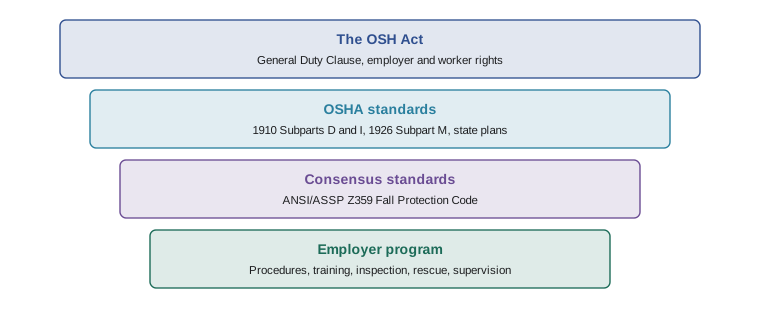
In the United States, the Occupational Safety and Health Administration (OSHA) sets federal standards under the Occupational Safety and Health Act of 1970. About half the states run their own OSHA-approved state plans, which must be at least as effective as federal OSHA and sometimes go further. Fall protection rules are split between the general industry standards in 29 CFR 1910 and the construction standards in 29 CFR 1926, with separate rules for shipyards, marine terminals and longshoring. This lesson explains how the rules are organized, compares the main requirements and shows how the voluntary ANSI/ASSP Z359 Fall Protection Code fits in.
The general duty
Section 5(a)(1) of the OSH Act, the General Duty Clause, requires every employer to keep the workplace free of recognized hazards that are causing or likely to cause death or serious physical harm. OSHA's specific fall protection standards sit on top of that duty. Employers must also train workers, keep records and report fatalities and serious injuries: a work-related fatality within 8 hours, and an in-patient hospitalization, amputation or loss of an eye within 24 hours, under 29 CFR 1904.39. Willful violations that cause a death can be referred for criminal prosecution under the OSH Act, and some states also prosecute employers under their own criminal laws.
Trigger heights
The trigger height is the fall distance at or above which a regulation requires fall protection. It is the most frequently quoted number in fall protection law, but it is only part of the story. Most regulations also require protection below the trigger height where a fall would land on something that makes injury more likely.
| Setting | Trigger height | Standard |
|---|---|---|
| General industry | 4 ft | 29 CFR 1910.28(b)(1) |
| Shipyards | 5 ft | 29 CFR 1915 |
| Construction | 6 ft | 29 CFR 1926.501(b)(1) |
| Scaffolds in construction | 10 ft | 29 CFR 1926.451(g) |
| Longshoring and marine terminals | 8 ft | 29 CFR 1917 and 1918 |
| Any height above dangerous equipment or machinery | Any height | 1910.28(b)(6) and 1926.501(b)(7) |
Note that the trigger height alone does not settle the question. A worker above dangerous machinery, an open tank or exposed rebar needs protection at any height under both the general industry and construction rules.
The order of protection
OSHA's construction standard lets employers choose among guardrail systems, safety net systems and personal fall arrest systems for most unprotected edges, with alternatives such as controlled access zones, warning lines and safety monitoring permitted only in specific situations. The general industry standard similarly lists guardrails, safety nets, personal fall arrest systems, travel restraint and, in limited cases, designated areas. OSHA does not impose a strict ranking in the text, but its guidance and the ANSI/ASSP Z359.2 standard on managed fall protection programs both apply the hierarchy of controls: eliminate the hazard first, then use passive protection, then restraint, then arrest.
Key provisions
Subpart M of 29 CFR 1926 covers fall protection in construction. Section 1926.501 says when protection is required: unprotected sides and edges, leading edges, hoist areas, holes and skylights, formwork and rebar, ramps and walkways, excavations, dangerous equipment, overhand bricklaying, roofing, precast concrete erection and residential construction. Section 1926.502 sets the design and performance criteria for guardrails, safety nets, personal fall arrest systems, positioning devices, warning lines, controlled access zones, safety monitoring, covers and fall protection plans. Section 1926.503 sets the training and certification requirements.
In general industry, Subpart D of 29 CFR 1910, rewritten in a 2016 rule that took effect in January 2017, covers walking-working surfaces. Section 1910.28 says when protection is required, including unprotected edges, holes, dockboards, runways, repair pits, stairs, scaffolds, slaughtering platforms, low-slope roofs, fixed ladders and walls with openings. Section 1910.29 covers the criteria for guardrails, safety nets, designated areas, covers, handrails and other systems. Section 1910.30 covers training. Subpart I, in 1910.140, sets the criteria for personal fall protection systems, including personal fall arrest, travel restraint and positioning systems.
Equipment standards
OSHA's rules set performance criteria directly, for example a maximum arresting force of 1,800 lb and anchors of 5,000 lb, rather than requiring equipment to meet a named consensus standard. In practice, most equipment sold in the United States is certified to the ANSI/ASSP Z359 Fall Protection Code, which is more detailed and more current than the OSHA text. OSHA can use the Z359 standards as evidence of recognized good practice. The main parts are:
| Standard | Subject |
|---|---|
| ANSI/ASSP Z359.0 | Definitions and nomenclature |
| ANSI/ASSP Z359.1 and Z359.2 | The Fall Protection Code and the minimum requirements for a managed fall protection program |
| ANSI/ASSP Z359.6 | Specifications and design requirements for active fall protection systems |
| ANSI/ASSP Z359.11 | Full body harnesses (2021 edition) |
| ANSI/ASSP Z359.12 | Connecting components |
| ANSI/ASSP Z359.13 | Personal energy absorbers and energy-absorbing lanyards |
| ANSI/ASSP Z359.14 | Self-retracting devices, in Class 1 (overhead anchors) and Class 2 (anchors up to 5 ft below the D-ring, including leading edge) |
| ANSI/ASSP Z359.15 and Z359.18 | Single and twin-leg self-retracting lanyards, and anchorage connectors |
| ANSI/ASSP A10.32 | Personal fall protection used in construction and demolition |
Who is responsible
Responsibility for fall protection is shared. On construction sites with several contractors, OSHA's multi-employer citation policy allows inspectors to cite the creating employer, which caused the hazard, the exposing employer, whose workers were exposed, the correcting employer, responsible for fixing it, and the controlling employer, with general authority over the site, such as a general contractor. A roofing subcontractor that removes a guardrail and leaves it down can be cited along with the general contractor that failed to notice. Employers must provide equipment at no cost to workers, with narrow exceptions for ordinary items such as some footwear, under 29 CFR 1910.132(h) and 1926.95(d). Workers have the right to report hazards and to file complaints with OSHA without retaliation under section 11(c) of the OSH Act, and in limited circumstances to refuse work that presents an imminent danger of death or serious injury.
State plans can go further than federal OSHA. California's Division of Occupational Safety and Health (Cal/OSHA), for example, has its own construction safety orders in Title 8 of the California Code of Regulations, with requirements that differ from federal OSHA in places; its general construction trigger height, for example, has long been 7.5 ft rather than 6 ft, with different rules for some trades. Washington, Oregon, Michigan and other state plans also write their own fall protection rules. Employers working in state-plan states must follow the state rules, which are often stricter or more specific than federal OSHA. Federal agencies and some public owners, such as the US Army Corps of Engineers with its EM 385-1-1 safety manual, also impose their own fall protection requirements on contractors.
OSHA publishes letters of interpretation that answer specific questions about how its standards apply, for example whether a particular anchor arrangement or roof task needs protection. They are not regulations, but they show how OSHA reads its own rules and are often decisive in disputes. OSHA's national emphasis program on falls, in effect since May 2023, directs inspectors to open an inspection or expand an existing one whenever they see workers at height without fall protection, even if they came to the site for another reason. Area offices also run local emphasis programs on roofing, residential construction and other high-risk work. Consensus standards, manufacturer instructions and industry guidance from groups such as the American Society of Safety Professionals and the National Roofing Contractors Association all help define what is reasonable.
Recordkeeping and documentation
Fall protection creates paperwork, and inspectors ask for it. Expect to keep training certification records under 1926.503 or training documentation under 1910.30, written fall protection plans where they are used under 1926.502(k), certification of anchors and horizontal lifelines designed by qualified persons, inspection records for fixed ladders and anchors where required, rescue procedures, and the injury and illness logs required by 29 CFR 1904. Good records also help the employer show that it trained its workers and enforced its rules, which matters if it raises an unpreventable employee misconduct defense to a citation. To succeed with that defense, an employer must show that it had work rules designed to prevent the violation, communicated them to workers, took steps to discover violations and enforced the rules when violations were found.
Training requirements
OSHA's construction training standard, 1926.503, requires employers to train each worker who might be exposed to fall hazards, using a competent person. Training must cover the nature of the fall hazards in the work area, the correct procedures for erecting, maintaining, disassembling and inspecting the fall protection systems used, the use and operation of guardrails, personal fall arrest systems, safety nets, warning lines, safety monitoring, controlled access zones and other protection, the role of each employee in the safety monitoring system, the limits on mechanical equipment during roofing, the procedures for handling and storing equipment and materials, and the standards themselves. Employers must keep a written certification record showing who was trained, when, and who certified the training. Retraining is required when changes in the workplace or equipment make earlier training obsolete, or when a worker's actions show they did not retain the training. Section 1910.30 sets similar requirements in general industry, using a qualified person.
A case that changed the law
OSHA's fall protection rules have also been shaped by tragedy and data. The construction standard was rewritten in 1994 after years of high fall fatality rates, and the 2016 general industry rule followed decades of study of falls in warehouses, plants and on rooftops. In recent years OSHA has run a national emphasis program on falls, launched in 2023, that lets inspectors open an inspection whenever they observe workers at height without protection, and it supports an annual National Safety Stand-Down to prevent falls in construction, held each spring with employers and workers across the country.
Enforcement and penalties
OSHA inspectors issue citations with proposed penalties. The maximum penalties are adjusted each January for inflation. As of January 2025, they were $16,550 per serious violation and $165,514 per willful or repeated violation. Check the current amounts, because they change every year. State plans set their own penalties, which must be at least as effective as federal OSHA. Employers can contest citations before the Occupational Safety and Health Review Commission.
Common mistakes
MistakeTreating the trigger height as the only test for fall protection.
InsteadMost rules also require protection at lower heights above machinery, water, hazardous substances or projecting objects.
MistakeAssuming general industry and construction use the same trigger height.
InsteadGeneral industry triggers at 4 ft and construction at 6 ft, with other limits for scaffolds and marine work.
MistakeBuying equipment without checking which standard it meets.
InsteadUse equipment certified to ANSI/ASSP Z359 and check that it meets the OSHA performance criteria.
MistakeTraining workers once and never again.
InsteadRetrain when equipment, the workplace or a worker's performance shows the earlier training is no longer enough.
MistakeThinking a general duty does not apply if a specific rule is met.
InsteadEmployers must still take every reasonable precaution against obvious fall hazards.
Summary and key terms
- OSHA sets federal standards; about half the states run their own state plans.
- Trigger heights are 4 ft in general industry, 6 ft in construction and 10 ft on construction scaffolds.
- Protection is also required at lower heights where the surface below makes injury more likely.
- Regulations favor guardrails and other physical barriers over personal equipment.
- ANSI/ASSP Z359 is the main consensus code for equipment, design and fall protection programs.
- Training must be delivered by a competent or qualified person and certified in writing.
- Penalties for fall protection violations are significant and can include criminal charges after deaths.
- General duty
- The broad legal obligation to take every reasonable precaution to protect workers.
- CSA Z259 and ANSI/ASSP Z359
- The family of American consensus standards for fall protection equipment, systems and programs; the Canadian equivalent is CSA Z259.
- Competent person
- A person with the knowledge, training and experience to identify hazards and take corrective action.
- Fall protection plan
- A written plan describing the fall hazards, the systems used, anchors, clearance and rescue.
- Trigger height
- The fall distance at or above which a regulation requires protection.
- Fall hazard zone or controlled access zone
- A marked area where certain work may be done without conventional fall protection, under strict conditions.
- Order of preference
- The ranking of protection methods in a regulation, from physical barriers to personal equipment.
- State plan
- An OSHA-approved state occupational safety and health program.
- Criminal negligence
- Wanton or reckless disregard for the lives or safety of others, which can lead to criminal charges.
- Refresher training
- Training that renews an earlier qualification before it expires.
Practice problems
Work each problem on paper first, then reveal the answer to check.
What is the fall protection trigger height in construction?
Show answer
6 ft.
What is the trigger height in general industry?
Show answer
4 ft.
What does 1926.503 require employers to keep?
Show answer
A written certification record of fall protection training.
Which ANSI/ASSP standard covers self-retracting devices?
Show answer
ANSI/ASSP Z359.14.
Why can a worker below the trigger height still need protection?
Show answer
The landing surface, such as machinery or rebar, can make serious injury likely.
What is the trigger height for scaffolds in construction?
Show answer
10 ft.
What do regulations generally prefer over personal fall arrest?
Show answer
Guardrails and other physical barriers, then travel restraint.
How quickly must a work-related fatality be reported to OSHA?
Show answer
Within 8 hours.
What does a state plan have to be?
Show answer
At least as effective as federal OSHA.
Why should employers check the current penalty amounts?
Show answer
They change, often every year.
Lesson quiz · 5 questions
Score 60% or more to complete this lesson.
Create a free account to save your progress, take quizzes and earn a certificate.