
HSE-212 · Lesson 9 of 12 · 30 min
Fall clearance, swing falls and horizontal lifelines
A fall arrest system that stops a worker one metre too low is no better than no system at all. Clearance, the space below the worker into which they fall while the system stops them, is the most frequently overlooked part of fall arrest planning. Swing falls, where a worker falls to the side of the anchor and pendulums into a structure or the ground, are the second. This lesson shows how to calculate required clearance, how to recognize and limit swing falls, and how horizontal lifelines change both.
The parts of a fall
When a worker connected to a fall arrest system falls, their body travels downward through several stages. Each adds distance:
- free fall: the distance the worker falls before the system begins to act. With a lanyard, it depends on the lanyard length and where the anchor is relative to the dorsal D-ring;
- deceleration distance: the distance over which the energy absorber deploys or the self-retracting device brakes;
- harness stretch and D-ring shift: the harness stretches and the D-ring slides up the worker's back as the straps take the load, typically about 0.3 m (1 ft);
- the worker's height below the D-ring: the distance from the dorsal D-ring to the soles of the feet, often taken as about 1.5 m (5 ft);
- a safety margin: extra space so that the worker stops above the next level or obstruction, commonly at least 0.6 to 1.0 m (2 to 3 ft).
The sum of these, measured from the anchor, is the total fall clearance required below the anchor point. Anything the worker could hit in that space, such as the floor, equipment, a lower roof, a scaffold or a vehicle, counts.
Worked problem
Clearance for an energy-absorbing lanyard
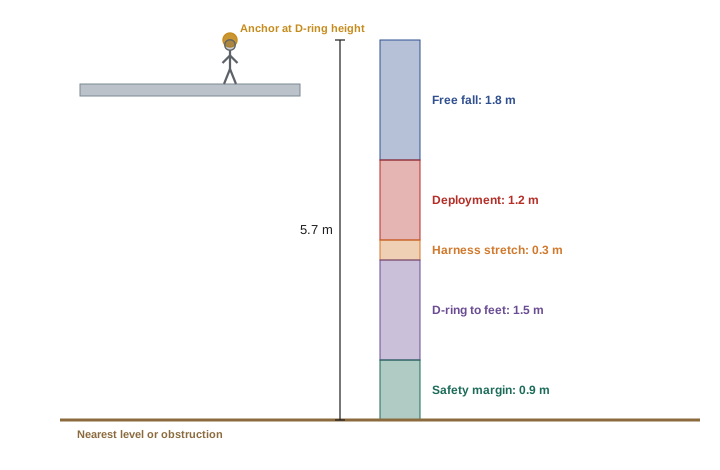
A worker on a mezzanine uses a 1.8 m energy-absorbing lanyard connected to an anchor at the height of their dorsal D-ring, 1.5 m above the mezzanine floor. The absorber's label gives a maximum deployment of 1.2 m. Allow 0.3 m for harness stretch and a 0.9 m safety margin. The floor below is 4.0 m beneath the mezzanine. Is there enough clearance?
Show solution
- Free fall: with the anchor at D-ring height, free fall equals the lanyard length, 1.8 m.
- Required clearance below the anchor: 1.8 + 1.2 + 0.3 + 1.5 + 0.9 = 5.7 m.
- The anchor is 1.5 m above the mezzanine floor, so the clearance required below the mezzanine floor is 5.7 − 1.5 = 4.2 m.
- Available: 4.0 m. Required: 4.2 m. The worker could hit the floor below.
- Options: move the anchor overhead, use a shorter lanyard or a self-retracting device with a known arrest distance, or use travel restraint instead of arrest.
Answer: No. The lanyard needs 4.2 m below the mezzanine and only 4.0 m is available. Change the anchor, the device or the method.
Note how much of the clearance comes from the lanyard itself. That is why a 1.8 m (6 ft) energy-absorbing lanyard is a poor choice for work just above a floor, a lower roof or a truck bed. Raising the anchor is the most effective fix: every metre the anchor moves above the D-ring reduces free fall by the same amount.
Anchors below the D-ring
When the anchor is below the dorsal D-ring, for example at foot level on a roof or deck, free fall increases by the distance between the D-ring and the anchor:
Worked problem
A lanyard anchored at foot level
A roofer connects a 1.8 m energy-absorbing lanyard to an anchor at foot level. The dorsal D-ring is 1.5 m above the roof surface. What is the free fall, and can an ordinary absorber rated for 1.8 m of free fall be used?
Show solution
- Free fall = 1.8 + (1.5 − 0) = 3.3 m.
- That exceeds the 1.8 m free fall the ordinary absorber is designed for, so forces could exceed the limits.
- Use a device rated for anchors at foot level, such as a leading edge self-retracting device, or an absorber marked for the longer free fall, and recalculate clearance.
Answer: About 3.3 m of free fall. An ordinary 1.8 m absorber is not suitable; use equipment rated for foot-level anchors.
Self-retracting devices and clearance
Self-retracting devices with overhead anchors need much less clearance because free fall is short. The manufacturer states a maximum arrest distance for the device, measured from the point where the fall begins. Required clearance below the working surface is then roughly the arrest distance plus harness stretch plus a safety margin, provided the anchor is overhead and the worker is directly below it. With an arrest distance of about 1.07 m (42 in), harness stretch of 0.3 m (1 ft) and a 0.6 m (2 ft) margin, about 2.0 m (6.5 ft) below the working surface may be enough. Always use the manufacturer's clearance charts, which account for worker weight, anchor position and swing.
Swing falls
If a worker falls while to the side of the anchor rather than directly below it, the lifeline swings like a pendulum. The worker drops lower than they would have if they were directly below the anchor, and they swing sideways into anything in their path: a column, a wall, the edge of the building, equipment, or the ground. Swing falls are especially common with self-retracting devices, because the line extends as the worker walks away from the anchor.
Worked problem
How far does a swing fall drop?
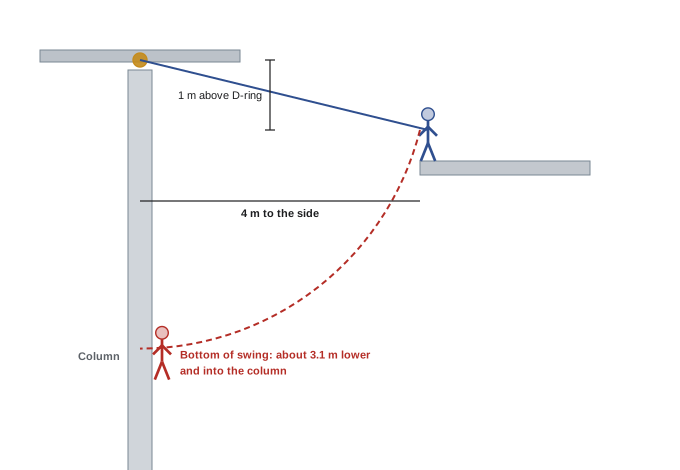
A worker on a self-retracting device is 4.0 m horizontally from the point below the anchor, which is 1.0 m above their dorsal D-ring. If they fall off the edge, how much lower is their D-ring at the bottom of the swing than where it started, and how fast are they moving there, ignoring the arrest?
Show solution
- Line length when taut: \( L = \sqrt{1.0^2 + 4.0^2} = \sqrt{17} \approx 4.12 \) m.
- At the bottom of the swing, the D-ring is 4.12 m below the anchor, which was 1.0 m above it, so the drop is 4.12 − 1.0 = 3.12 m.
- Speed at the bottom: \( v = \sqrt{2 \times 9.81 \times 3.12} \approx 7.8 \) m/s, mostly sideways.
- Hitting a wall at 7.8 m/s is like falling more than 3 m onto it. The arrest distance of the device adds further drop.
Answer: About 3.1 m of extra drop and a sideways speed of nearly 8 m/s. Keep work close to the area directly below the anchor.
To limit swing falls:
- keep the anchor as directly overhead as possible and move it as the work moves;
- respect the manufacturer's limit on working angle or lateral distance from the anchor, often expressed as an angle from vertical;
- use horizontal lifelines or overhead rail systems so that the anchor point travels with the worker;
- add a second anchor or redirect point to keep the line close to vertical;
- check what the worker would hit at the bottom of the swing, and include the swing drop in the clearance calculation.
Horizontal lifelines
A horizontal lifeline is a cable, rope or rail stretched between two or more anchors, to which workers connect with a lanyard or self-retracting device. It lets workers move along a beam, a roof edge or a crane runway while staying connected, and it can keep the anchor point overhead along the whole length of the work. But horizontal lifelines behave very differently from single anchors, for two reasons.
First, the line sags when loaded, which adds to the fall distance. Second, the tension in a nearly straight line under a load in the middle is many times the load itself, so the end anchors must be very strong. The tension in each half of a line loaded at mid-span is:
where \( P \) is the load from the falling worker and \( \theta \) is the angle of the sagging line from the horizontal. The flatter the line, the higher the tension.
Worked problem
Tension in a horizontal lifeline
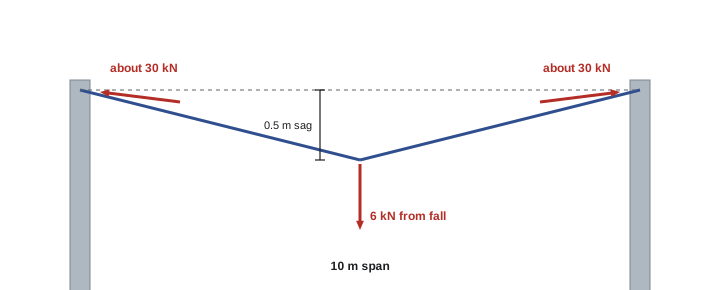
A 10 m horizontal lifeline sags 0.5 m at mid-span when a falling worker applies a peak load of 6 kN there. Estimate the tension at each end anchor.
Show solution
- Half span: 5 m. Sag: 0.5 m.
- \( \sin\theta = 0.5 / \sqrt{5^2 + 0.5^2} = 0.5 / 5.025 \approx 0.0995 \).
- \( T = 6 / (2 \times 0.0995) \approx 30 \) kN.
- Each end anchor must hold about 30 kN, five times the force on the worker, before any safety factor. Halving the sag would roughly double it.
Answer: About 30 kN at each end. This is why horizontal lifelines must be engineered.
Because of these forces, Canadian rules generally require horizontal lifelines to be designed by a professional engineer or to be manufactured systems certified to CSA Z259.13 and installed exactly as the manufacturer specifies. CSA Z259.16 covers the design of active fall protection systems, including horizontal lifelines. The design must state the maximum number of workers, the span, the required clearance including sag, the anchor loads and the installation tension.
Never improvise a horizontal lifeline by tying a rope between two columns. The tension calculation shows why: an apparently strong rope and anchors can be overloaded, and the sag can drop the worker onto the level below.
| Arrangement | Typical free fall | Typical clearance below the anchor |
|---|---|---|
| 1.8 m energy-absorbing lanyard, anchor at D-ring height | 1.8 m | About 5.7 m |
| 1.8 m energy-absorbing lanyard, anchor 1 m above D-ring | 0.8 m | About 4.7 m |
| 1.8 m lanyard, anchor at foot level | 3.3 m | Much more; needs equipment rated for low anchors |
| Overhead SRL, worker directly below | Well under 1 m | Arrest distance plus about 1.2 m below the working surface |
| Horizontal lifeline | Depends on device and sag | Per the engineered design, including sag |
Common mistakes
MistakeChoosing a long lanyard without calculating clearance.
InsteadAdd free fall, deceleration, harness stretch, body length and margin, and compare with the space available.
MistakeAnchoring an ordinary lanyard at foot level.
InsteadFree fall increases by the D-ring height; use equipment rated for low anchors.
MistakeWalking far to the side of an overhead anchor on a self-retracting device.
InsteadStay within the manufacturer's working angle or move the anchor to avoid swing falls.
MistakeStringing a rope between two columns as a horizontal lifeline.
InsteadUse an engineered or certified system; tension can be many times the fall load.
MistakeForgetting lower obstructions such as equipment, scaffolds or truck beds.
InsteadClearance is measured to the first thing the worker could hit, not just the floor.
Summary and key terms
- Total fall clearance = free fall + deceleration + harness stretch + body below D-ring + safety margin.
- A 1.8 m energy-absorbing lanyard at D-ring height needs about 5.7 m below the anchor.
- Raising the anchor reduces free fall and clearance; anchors below the D-ring increase them.
- Overhead self-retracting devices need much less clearance; use the manufacturer's charts.
- Working to the side of an anchor causes swing falls with extra drop and sideways impact.
- Horizontal lifeline tension is many times the fall load, and sag adds to fall distance.
- Horizontal lifelines must be engineered or certified and installed exactly as designed.
- Fall clearance
- The space below a worker needed to stop a fall without hitting anything.
- Free fall distance
- The distance fallen before the system begins to act.
- Deceleration distance
- The distance over which the system slows the worker to a stop.
- D-ring shift
- The upward movement of the dorsal D-ring along the back as the harness takes load.
- Safety margin
- Extra clearance added so that the worker stops above any obstruction.
- Swing fall
- A pendulum fall that occurs when the worker falls to the side of the anchor.
- Working angle
- The maximum angle from vertical at which a manufacturer allows a device to be used.
- Horizontal lifeline
- A line stretched between anchors to which workers connect as they move.
- Sag
- The downward deflection of a horizontal lifeline under load.
- Arrest distance
- The total distance from the start of a fall to the stop, as stated for a device.
Practice problems
Work each problem on paper first, then reveal the answer to check.
List the five parts of the total fall clearance calculation.
Show answer
Free fall, deceleration, harness stretch, body length below the D-ring and safety margin.
What is the free fall for a 1.8 m lanyard anchored 0.6 m above the D-ring?
Show answer
1.2 m.
What is the free fall for a 1.8 m lanyard anchored at foot level with the D-ring 1.5 m up?
Show answer
3.3 m.
What is the most effective way to reduce required clearance?
Show answer
Raise the anchor above the D-ring or use an overhead self-retracting device.
Why do swing falls happen?
Show answer
The worker falls while to the side of the anchor and the line swings like a pendulum.
A worker is 3 m to the side of a point below an anchor that is level with the D-ring. What is the swing drop?
Show answer
3 m, because the line length is 3 m and the anchor is level with the D-ring.
Name two ways to limit swing falls.
Show answer
Keep the anchor overhead and move it with the work; use a horizontal lifeline or rail.
Why are horizontal lifeline end forces so high?
Show answer
A nearly flat line under a mid-span load has very high tension.
What happens to lifeline tension if the sag is halved?
Show answer
It roughly doubles.
What should a horizontal lifeline design state?
Show answer
Number of workers, span, clearance including sag, anchor loads and installation tension.
Lesson quiz · 5 questions
Score 60% or more to complete this lesson.
Create a free account to save your progress, take quizzes and earn a certificate.