
HSE-212 · Lesson 10 of 12 · 27 min
Roofs, leading edges, skylights and openings
Roofs and unfinished floors account for a large share of fatal falls. Roofers, roof-top maintenance workers, solar installers, HVAC technicians, inspectors and general labourers all work on surfaces with long unprotected edges, openings and fragile panels. Construction floors and decks change from day to day as forms, decking and openings come and go. This lesson applies the earlier lessons to these situations: low-slope and steep roofs, skylights and fragile surfaces, leading edges, floor openings and shafts, and residential construction.
Low-slope and steep roofs
Roofs are commonly divided by slope. Slope is expressed as rise over run, for example 4 in 12 or 4:12, meaning a rise of 4 units for every 12 units of horizontal distance. In metric terms it may be expressed as a ratio, a percentage or an angle.
Low-slope roofs, generally 4:12 or flatter, allow workers to walk normally, so the main hazard is the edge, openings and skylights. Steep roofs, steeper than about 4:12, add the hazard of sliding down the roof surface itself, so workers need protection anywhere on the roof, not just at the edge. Several provinces set specific requirements by slope, for example permitting warning lines or control zones only on low-slope roofs, and requiring roof anchors or fall arrest on steeper roofs. Toe boards or slide guards fixed to the roof can help on moderately steep roofs but do not replace fall protection.
Worked problem
Classifying a roof by slope
A roof rises 1.5 m over a horizontal run of 6.0 m. Express its slope as a ratio in 12, a percentage and an angle, and decide whether it is low-slope or steep.
Show solution
- Ratio: 1.5 / 6.0 = 0.25. In 12: 0.25 × 12 = 3, so 3 in 12.
- Percentage: 100 × 0.25 = 25 per cent.
- Angle: arctan(0.25) ≈ 14.0°.
- The dividing line, 4 in 12, is 33 per cent or about 18.4°. This roof is flatter, so it is low-slope.
Answer: 3 in 12, 25 per cent, about 14°: a low-slope roof. Edges, openings and skylights remain the main hazards.
Hazards on roofs
Typical roof hazards include:
- unprotected edges, including the edges of lower roofs and roof steps;
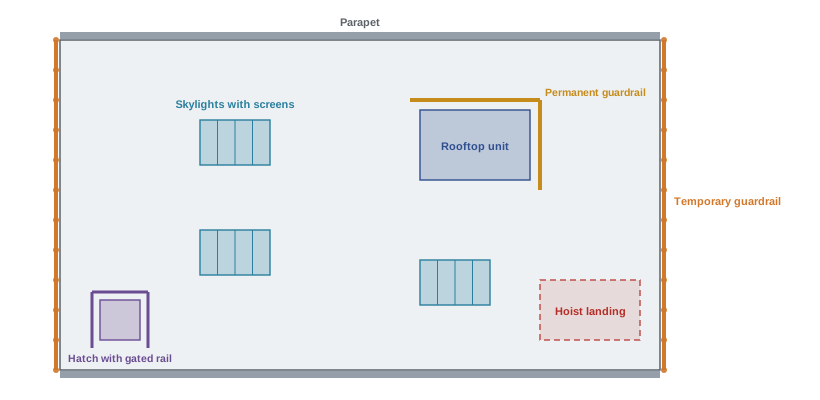
- roof hatches, which can be walked into from behind when open;
- skylights and smoke vents, which look like roof but will not support a person;
- fragile roofing such as fibreglass, plastic and corrugated cement panels, and corroded metal decks;
- ice, snow, frost, rain, moss and loose granules that reduce traction;
- wind, which can push workers and blow sheets of material out of their hands;
- access points, such as ladders and the transition from a ladder onto the roof, covered in HSE-213;
- materials stored near edges, hoisting areas and roof-top equipment that blocks the view of edges.
Skylights and fragile surfaces
Falls through skylights are a recurring cause of death, and they are often described as freak accidents when they are entirely predictable. Workers step back onto a skylight while working, sit or lean on one to rest, trip and fall onto one, or walk across a roof where skylights are hidden by snow, dust or roofing paper. Most skylight domes and panels are designed to keep out weather, not to hold a person, and older plastic becomes brittle in sunlight.
Protect every skylight on a roof where people work by one of the following:
- a guardrail around the skylight;
- a screen or grille, fixed over or under the skylight, that is strong enough to stop a falling person;
- a secured, marked cover strong enough for the loads expected, as described in lesson 4;
- keeping workers away from skylights with restraint, where the other options are not practicable.
Treat whole roofs of fragile material, such as fibreglass sheeting or old cement panels, as one large opening. Workers on such roofs must use crawling boards or platforms spanning the supports, together with guardrails, nets or fall arrest, and the work should be planned to avoid walking on the panels at all.
Leading edges
A leading edge is the edge of a floor, roof or deck that changes position as work progresses, for example as metal decking is laid on steel joists, as plywood sheathing is installed on a roof, or as concrete forms are built. Workers at a leading edge are, by definition, working at an edge that cannot yet have a permanent guardrail, because the structure that will support it does not exist yet. Leading edge work therefore relies heavily on careful planning:
- install guardrails, nets or anchors as early as possible, for example by fixing anchors to the structure before decking begins;
- use self-retracting devices and lanyards rated for leading edge use, with anchors set back from the edge as the manufacturer requires;
- keep the number of workers at the leading edge to the minimum needed;
- control access to the area near the edge and keep other trades out;
- plan rescue, because a worker who falls over a leading edge may hang against the face of the structure.
Some provinces, such as Alberta, have specific provisions for leading edge fall protection systems and control zones. Where your regulation does not permit warning lines or control zones as the main protection, leading edge workers must use guardrails, nets, restraint or fall arrest.
Floor openings, shafts and hoist areas
Openings on construction floors include stairwells, elevator shafts, mechanical and electrical shafts, holes for ducts and pipes, and gaps left between forms. They must be protected with guardrails or with covers, as lesson 4 explained, from the moment they are created until permanent protection is installed. Elevator shafts and hoistways need particular care: the guardrail or barrier at each landing must not be removed except by workers protected against falling, and the shaft below must be kept clear of workers when work is done above.
Hoist areas, where materials are landed by crane or hoist onto a floor, are a classic fall hazard. Workers lean out to guide loads or grab tag lines, and the guardrail is often removed. Use landing platforms with gates, keep workers back from the edge with restraint, and replace the guardrail as soon as each load is landed. Never let workers lean out over an unprotected edge to reach a load.
Weather and environment
Weather changes roof work dramatically. Frost and ice on a membrane or metal roof can make even a low-slope roof impossible to walk on safely, and snow hides skylights, openings and edges. Wind can push workers off balance and turn a sheet of plywood or insulation into a sail. Heat makes membranes soft and workers tired. Many employers set limits: no roof work in high wind, no work on steep roofs when they are wet or icy, mandatory snow removal and marking of skylights before winter work, and extra breaks in heat. Check the manufacturer's wind limits for temporary guardrails, counterweight anchors and elevating equipment as well.
Worked problem
Planning snow removal on a flat roof
A crew must clear snow from a 40 m × 25 m flat roof with no parapet and four unmarked skylights. Snow is 0.4 m deep. The roof has one row of permanent anchors 3 m from one long edge. Outline the fall protection plan.
Show solution
- Find the skylights first, using roof drawings, and mark or protect them before anyone walks on the roof. Snow hides them completely.
- Use the permanent anchors for travel restraint along the near edge, with lanyards short enough that workers cannot reach the edge.
- For the far edge and the short edges, install temporary guardrails or set up restraint from additional engineered anchors or a horizontal lifeline.
- Push snow toward a single drop zone with a barricaded area below, rather than throwing it over every edge.
- Plan rescue, check the weather and wind, and brief the crew on the roof layout.
Answer: Locate and protect skylights first, restrain workers from the edges, provide guardrails where restraint cannot reach, control the drop zone and plan rescue.
Residential construction
Houses and small residential buildings present the same fall hazards as larger projects, often with less planning: steep roofs, open floor edges, stairwell openings and work from ladders. Provincial regulations apply in full to residential construction, and Ontario's Working at Heights training applies to residential construction workers who use fall protection. Common controls include roof anchors fastened to trusses or rafters before sheathing is complete, guardrails on floor edges and around stairwells, prefabricated roof trusses installed with bracing systems that provide anchor points, and scaffolds with guardrails at the eaves.
| Situation | Main hazard | Typical controls |
|---|---|---|
| Low-slope commercial roof | Edges, hatches, skylights | Parapets or guardrails, skylight screens, hatch gates, restraint |
| Steep residential roof | Sliding off the roof surface and edges | Roof anchors with fall arrest, scaffolds at eaves, slide guards as a supplement |
| Fragile roof | Falling through the surface | Crawling boards, nets, guardrails, fall arrest, avoid walking on panels |
| Leading edge decking | Moving edge with no guardrail possible | Leading edge SRLs, anchors set back, nets, controlled access |
| Floor openings and shafts | Falling through holes | Guardrails or secured, marked covers; shaft barriers |
| Hoist landings | Leaning out to guide loads | Landing gates, restraint, replace rails after each load |
Solar panels and rooftop equipment
Rooftop solar installations have added a new group of workers to roofs: installers, electricians and maintenance crews who may not think of themselves as roofers. Panels are often installed close to roof edges, carried up ladders and across roofs, and laid out in arrays that block the view of edges and skylights. Installers work bent over, looking down at panels and wiring, rather than at the edge. Plan solar work like any other roof work: guardrails or restraint at edges, protected skylights, safe access for materials by hoist rather than by hand up a ladder, and anchors placed where the work is. Permanent anchors installed with the array make later maintenance much safer.
Rooftop equipment such as air handling units, exhaust fans and antennas creates similar problems. Equipment placed within a few metres of an unprotected edge invites service technicians to work at the edge without protection. Designers can place equipment away from edges, add short sections of permanent guardrail or install anchors next to each unit, so that every future service call starts with protection already in place.
Common mistakes
MistakeSitting or leaning on a skylight during a break.
InsteadTreat every skylight as a hole; guard it, screen it or cover it.
MistakeStarting snow removal before locating the skylights.
InsteadFind and protect skylights and openings first; snow hides them.
MistakeRelying on slide guards alone on a steep roof.
InsteadUse fall arrest, guardrails or scaffolds; slide guards only supplement them.
MistakeLeaning out over an open edge to guide a crane load.
InsteadUse a landing gate or restraint and guide loads with tag lines.
MistakeWalking on fibreglass or cement roof panels.
InsteadUse crawling boards spanning the supports, with fall protection.
Summary and key terms
- Slope is rise over run; 4 in 12 (about 18°) divides low-slope from steep roofs.
- On steep roofs, the whole roof surface is a fall hazard, not just the edge.
- Skylights and fragile panels will not support a person; guard, screen or cover them.
- Leading edges need early anchors, rated equipment, controlled access and rescue planning.
- Floor openings, shafts and hoist areas need guardrails or secured, marked covers.
- Weather such as ice, snow and wind changes roof hazards; set limits and plan for them.
- Residential construction faces the same fall hazards and the same rules.
- Low-slope roof
- A roof with a slope of 4 in 12 or less.
- Steep roof
- A roof steeper than 4 in 12.
- Rise over run
- The vertical change divided by the horizontal distance, used to express slope.
- Skylight screen
- A grille or mesh over or under a skylight strong enough to stop a falling person.
- Fragile roof
- A roof made of material, such as fibreglass or old cement panels, that will not support a person.
- Crawling board
- A board or platform spanning roof supports to spread a worker's weight.
- Leading edge
- An edge that moves as decking, sheathing or forming progresses.
- Hoist area
- A place where materials are landed by crane or hoist.
- Slide guard
- A board fixed to a steep roof to help stop sliding; not a substitute for fall protection.
- Roof hatch
- An opening in a roof for access, often reached by a fixed ladder.
Practice problems
Work each problem on paper first, then reveal the answer to check.
What slope divides low-slope from steep roofs?
Show answer
4 in 12, about 33 per cent or 18.4°.
Express a 6 in 12 roof as an angle.
Show answer
arctan(0.5) ≈ 26.6°.
Why is a steep roof more hazardous than a low-slope roof?
Show answer
Workers can slide down the roof surface, not just fall from the edge.
List three ways to protect a skylight.
Show answer
A guardrail around it, a strong screen, or a secured marked cover.
What should happen before snow removal on a roof with skylights?
Show answer
Locate and protect the skylights and openings first.
Why is leading edge work difficult to protect?
Show answer
The edge moves and the structure for a guardrail does not exist yet.
How should workers guide crane loads at a floor edge?
Show answer
From behind a landing gate or with restraint, using tag lines.
How should workers move across a fragile roof?
Show answer
On crawling boards spanning the supports, with fall protection.
Name two weather conditions that change roof hazards.
Show answer
Ice or frost and high wind; also snow and heat.
Does Ontario Working at Heights training apply to residential construction?
Show answer
Yes, for workers who use fall protection on construction projects.
Lesson quiz · 5 questions
Score 60% or more to complete this lesson.
Create a free account to save your progress, take quizzes and earn a certificate.