
HSE-110 · Lesson 1 of 12 · 25 min
First aid at work and the law
First aid is the immediate help given to a person who is injured or suddenly ill, using simple techniques and basic supplies, until professional medical care takes over or the person recovers. It is not a lesser form of medicine. In the first few minutes after a serious injury or sudden illness, what the people nearby do often matters more than anything that happens later in hospital. A person who is bleeding heavily can lose a life-threatening amount of blood in a few minutes. A person whose airway is blocked has only minutes before the brain is damaged. A person having a stroke loses brain cells every minute that treatment is delayed. In each case, a co-worker who recognizes the problem, calls for help quickly and gives simple care can change the outcome.
This course is an awareness course. It explains what first aid is, how workplace first aid is organized and what the main techniques aim to do. In Canada, workplace first aid certificates are issued by approved training providers such as the Canadian Red Cross, St. John Ambulance, the Lifesaving Society, the Heart and Stroke Foundation and other organizations approved by provincial workers' compensation boards or OHS regulators, and most provinces now align their requirements with the national training standard CSA Z1210. If your role requires you to be a designated first aider, you must complete an approved course with practical skills practice and an evaluation, and keep the certificate current.
Cardiopulmonary resuscitation (CPR) and the use of an automated external defibrillator (AED) are covered in a separate course, HSE-111. In this course you will learn to recognize cardiac arrest and to call for help and an AED, but the techniques themselves are left to that course and to certified training.
The aims of first aid
First aid has a small number of clear aims, often remembered as the three Ps. The first is to preserve life: to deal first with the problems that kill quickly, such as a blocked airway, absent breathing, cardiac arrest and severe bleeding. The second is to prevent the condition from getting worse: for example, by stopping bleeding, keeping a person with a suspected spinal injury still, cooling a burn or keeping a person warm. The third is to promote recovery: to reassure the person, make them comfortable, protect their dignity and privacy, and hand them over to professional care with accurate information about what happened.
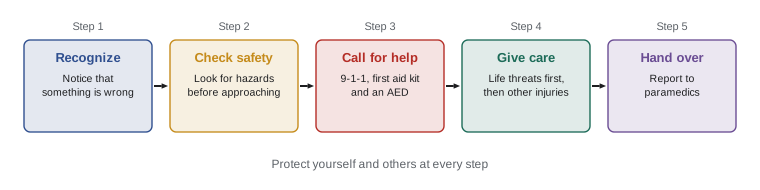
Some trainers add a fourth P: protect yourself and others. A first aider who becomes a second casualty helps nobody. Scene safety, infection control and knowing your limits are part of first aid, not optional extras.
What first aid is not
First aid is limited in scope, and staying within that scope protects both the casualty and the first aider. A first aider does not diagnose illnesses, prescribe or give medication other than in the narrow cases covered by training (such as helping a person use their own prescribed epinephrine auto-injector or inhaler, or giving naloxone where it is available and the first aider is trained), perform invasive procedures, or decide that a person does not need further medical care when the signs suggest otherwise. When in doubt, the right choice is to call emergency services or advise the person to see a health care provider.
First aid also differs from the treatment given by an occupational health nurse, a paramedic or a physician. Those professionals work under their own laws and scopes of practice. In some workplaces, especially large or remote ones, first aid programs include an occupational health nurse or an advanced first aid attendant. This course concentrates on what any trained co-worker, supervisor or designated first aider is expected to do.
Why workplace first aid matters
Workplace injuries are common. In 2022, Canadian workers' compensation boards accepted more than 348,000 lost-time injury claims, and many more injuries required only first aid. Most of those first aid cases are minor cuts, strains, burns and eye irritations. A smaller number are life-threatening emergencies such as heavy bleeding, crush injuries, electrical contact, falls from height or sudden cardiac arrest. A first aid program has to handle both: the routine cuts that happen every week and the rare event that tests everyone's preparation.
Good first aid also has business benefits that are easy to overlook. Prompt care for minor injuries reduces infection and complications, and so reduces lost time. Accurate first aid records reveal patterns, such as repeated hand cuts at one machine, that point to hazards needing control. Workers who see that their employer takes first aid seriously are more likely to report injuries early and to trust the safety program.
The legal framework
In Canada, first aid at work is regulated by each province and territory, and by the Canada Occupational Health and Safety Regulations for federally regulated workplaces. The rules set out how many trained first aiders an employer must have, what level of training they need, what supplies must be available and where, and what records must be kept. They usually scale requirements to three factors: the number of workers on a shift, the hazard level of the work and the time it takes to reach a hospital or medical facility.
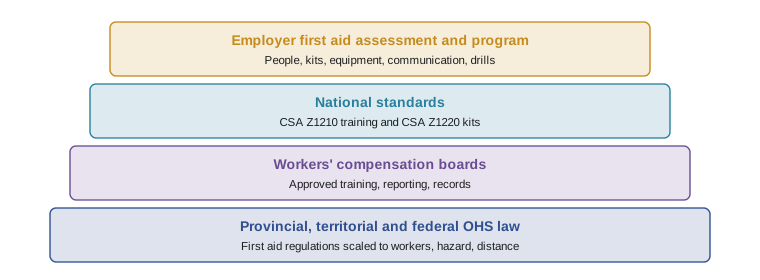
Two national standards now shape most provincial rules. CSA Z1210, First aid training for the workplace, sets the content and length of basic, intermediate and advanced first aid courses. CSA Z1220, First aid kits for the workplace, sets kit types (personal, basic and intermediate) and sizes. Several provinces have recently updated their rules to point to these standards: British Columbia renamed its attendant levels Basic, Intermediate and Advanced in November 2024, Quebec adopted a new first aid regulation in February 2026 that requires CSA Z1210 certificates and CSA Z1220 kits, and Ontario's WSIB program moved to CSA Z1210:24-aligned Basic and Intermediate First Aid courses in June 2026.
Employers also have duties to record and report injuries. Records of first aid given are valuable for prevention even when they are not legally required, and the distinction between a first aid case and a more serious injury matters for reporting, as Lesson 12 explains.
Good Samaritan laws and the duty to help
Outside work, people sometimes hesitate to help because they fear being sued. Every province and territory has legislation or legal principles that protect people who give emergency help in good faith. Ontario's Good Samaritan Act, 2001, British Columbia's Good Samaritan Act and Alberta's Emergency Medical Aid Act, for example, protect a person who voluntarily gives emergency first aid from liability for damages unless they are grossly negligent. Quebec goes further: section 2 of the Quebec Charter of human rights and freedoms gives every person in peril a right to assistance and requires others to help, either personally or by calling for help, unless doing so would put them or a third person at risk. Separately, the federal Good Samaritan Drug Overdose Act protects people who call 9-1-1 for an overdose from charges for simple drug possession.
At work, the situation is different. A designated first aider is acting as part of their job, and the employer is responsible for the first aid program. Workers' compensation and the employer's liability arrangements usually cover a first aider acting within their training. What protects a first aider in practice is acting reasonably: staying within their training, getting consent, calling for help early, recording what they did and handing over properly.
Consent
Before you touch a casualty, you need their consent. A conscious adult who is able to make decisions has the right to accept or refuse first aid. Identify yourself, say that you are trained in first aid (or that you can help), explain what you would like to do and ask whether they want help. Consent can be spoken or shown by gesture, such as a nod or holding out an injured arm. If the person refuses, respect the decision, stay nearby if it is safe, call emergency services if the situation is serious and record the refusal.
Implied consent applies when a person is unresponsive or so confused that they cannot make a decision: the law assumes that a reasonable person would want life-saving help. For a child, ask a parent or guardian if one is present; if none is present and the situation is urgent, implied consent applies. Respect cultural and personal preferences where you can, for example by explaining before you need to touch someone or by asking a co-worker of the same gender to help when that is possible and does not delay care.
Worked problem
Deciding what the first aid response must cover
A small fabrication shop has 14 workers on the day shift. Over the past year its first aid log recorded 41 cases: 26 minor cuts, 6 eye irritations from grinding dust, 5 minor burns, 3 strains and 1 crush injury to a finger that required hospital treatment. What do these figures tell the employer about its first aid program?
Show solution
- Calculate the share of each type: cuts \(26 \div 41 \approx 63\%\), eye irritations \(6 \div 41 \approx 15\%\), burns \(5 \div 41 \approx 12\%\), strains \(3 \div 41 \approx 7\%\) and the crush injury \(1 \div 41 \approx 2\%\).
- Identify the routine needs: the kit and first aiders must handle cuts, eye flushing and minor burns every week, so supplies for these must be well stocked and checked often.
- Identify the rare but serious needs: a crush or amputation injury, heavy bleeding or a fall needs a trained first aider on every shift, a quick way to call emergency services and supplies such as large dressings and a tourniquet if the hazard assessment supports it.
- Identify prevention signals: 26 cuts suggest a hazard to investigate, such as missing guards, sharp edges or unsuitable gloves; 6 eye cases suggest eye protection is not being worn or is unsuitable.
Answer: About 63 per cent of cases are cuts, so the program must be ready for frequent minor wounds and eye flushing, while also preparing for rare severe injuries. The log also points to cut and eye hazards that should be controlled at source.
Knowing your limits
A trained first aider is expected to do what their training covers and to do it well, not to improvise beyond it. If a situation is beyond your training, the best first aid is often to keep the scene safe, call emergency services, give simple care such as reassurance and keeping the person still and warm, and hand over to people with more training. It is also normal to feel shaken after an emergency. Lesson 12 covers support for first aiders after a serious incident.
Common mistakes
MistakeThinking an awareness course qualifies you as a designated first aider.
InsteadComplete an approved certified course with hands-on practice if your role requires it.
MistakeStarting care before checking that the scene is safe.
InsteadCheck for hazards first so that you do not become a second casualty.
MistakeTouching a conscious adult without asking.
InsteadIntroduce yourself, explain and get consent before giving care.
MistakeGiving medication from your own supplies.
InsteadOnly help a person use their own prescribed medication, or give medicines your training and workplace rules specifically allow.
MistakeTreating first aid records as paperwork with no value.
InsteadUse first aid logs to spot hazards and improve prevention.
Summary and key terms
- First aid is immediate care for injury or sudden illness until professional help takes over or the person recovers.
- Its aims are to preserve life, prevent worsening and promote recovery, while protecting yourself and others.
- Provincial, territorial and federal regulations set first aid requirements, increasingly based on CSA Z1210 (training) and CSA Z1220 (kits).
- Good Samaritan laws protect people who help in good faith, and Quebec imposes a duty to help a person in peril.
- Get consent from a conscious adult; implied consent applies when a person cannot decide.
- Stay within your training and call for help early when a situation is beyond it.
- First aid
- Immediate help for injury or sudden illness using simple techniques until professional care is available.
- Designated first aider
- A worker trained and appointed by the employer to give first aid at the workplace.
- Three Ps
- Preserve life, prevent worsening and promote recovery.
- Consent
- Permission from a capable person to give care, spoken or shown by gesture.
- Implied consent
- The legal assumption that an unresponsive or incapable person would want life-saving help.
- Good Samaritan law
- A law protecting people who give emergency help in good faith from liability for ordinary negligence.
- Scope of training
- The range of actions a first aider has been trained and is permitted to perform.
- CSA Z1210
- The Canadian standard for workplace first aid training content and levels.
- ANSI/ISEA Z308.1
- The US consensus standard for workplace first aid kit contents, with Class A and Class B kits.
- Handover
- Passing care of a casualty to emergency services or a health professional with accurate information.
Practice problems
Work each problem on paper first, then reveal the answer to check.
Name the three Ps of first aid.
Show answer
Preserve life, prevent worsening and promote recovery.
Why must a first aider check scene safety first?
Show answer
To avoid becoming a second casualty, which would make the emergency worse.
What does implied consent mean?
Show answer
When a person is unresponsive or cannot decide, the law assumes they would want life-saving help.
A conscious worker with a cut refuses help. What should you do?
Show answer
Respect the refusal, stay nearby if safe, call for help if it is serious and record the refusal.
Which course covers CPR and AED techniques?
Show answer
HSE-111, together with certified hands-on training.
Which national standard sets workplace first aid training levels in Canada?
Show answer
CSA Z1210.
Give two examples of medication a first aider may help a person use.
Show answer
Their own prescribed epinephrine auto-injector and their own asthma inhaler.
What three factors usually set the size of workplace first aid requirements?
Show answer
The number of workers, the hazard level and the time to reach medical care.
Why are first aid records useful for prevention?
Show answer
They reveal patterns of injuries that point to hazards needing control.
What protects a first aider in practice?
Show answer
Acting reasonably within their training, getting consent, calling for help, recording care and handing over properly.
Lesson quiz · 5 questions
Score 60% or more to complete this lesson.
Create a free account to save your progress, take quizzes and earn a certificate.