
HSE-110 · Lesson 8 of 12 · 25 min
Head, neck, spinal and eye injuries
Injuries to the head and spine are among the most serious a first aider will see. A blow to the head can cause bleeding inside the skull that does not show its effects for hours. An injury to the neck or back can damage the spinal cord, and movement of an unstable spine can make the damage worse and permanent. Eye injuries are common at work and can threaten sight if not handled well. This lesson explains how these injuries happen, how to recognize them, how current guidance has changed the way first aiders handle suspected spinal injuries and what to do for common eye and dental injuries.
Head injuries
Head injuries at work commonly result from falls, being struck by falling or swinging objects, vehicle collisions and walking into fixed objects. They range from a scalp cut to a skull fracture or brain injury. Scalp wounds bleed heavily because the scalp has a rich blood supply; they look alarming but are usually controlled with firm pressure. What matters more is whether the brain has been affected.
A concussion is a brain injury caused by a blow or jolt that disturbs how the brain works. A person does not need to lose consciousness to have a concussion. Signs and symptoms can appear immediately or over the following hours and include headache, dizziness, confusion, memory loss about the event, nausea, blurred vision, sensitivity to light or noise, feeling slowed down or foggy, and changes in mood or behaviour.
More severe brain injuries include bleeding inside the skull. Pressure from the bleeding builds up over minutes to hours and can be fatal. Sometimes a person seems fine after the injury, then deteriorates hours later. This is why anyone with a significant head injury needs medical assessment and someone to watch them.
| Red flag after a head injury | Why it matters |
|---|---|
| Unresponsiveness, even briefly, or decreasing level of response | Possible brain injury or bleeding |
| Repeated vomiting | Rising pressure inside the skull |
| Severe or worsening headache | Possible bleeding |
| Seizure | Brain irritation or injury |
| Unequal pupils, double vision | Pressure on nerves in the brain |
| Weakness, numbness or tingling in arms or legs | Brain or spinal cord injury |
| Clear fluid or blood from the ears or nose, bruising behind the ears or around the eyes | Possible skull fracture |
| Confusion, slurred speech, unusual behaviour | Brain dysfunction |
First aid for a head injury: check the scene and do a primary assessment; if the person is unresponsive, assume a spinal injury too. Call 9-1-1 for any red flag. Control scalp bleeding with firm pressure, but press gently around the edges rather than directly on the wound if you can feel a dent or soft area that might be a skull fracture. If blood or clear fluid comes from the ear, cover it loosely with a sterile dressing but do not block it. Keep the person still, monitor level of response and breathing, and record any changes. A person with a suspected concussion should stop work for the day, must not drive, should not be left alone and should be assessed by a health care provider the same day.
Spinal injuries
The spinal column protects the spinal cord, which carries messages between the brain and the rest of the body. Damage to the cord, especially in the neck, can cause paralysis or affect breathing. The mechanism of injury, meaning how the injury happened, is the best clue that a spinal injury may be present. Suspect a spinal injury after:
- a fall from height, such as from a ladder, scaffold, roof or loading dock, or down several stairs;
- a vehicle collision, being struck by a vehicle or being thrown from equipment;
- a heavy object falling on the head or back, or a crush injury;
- a diving injury or a blow that forces the head far forward, back or sideways;
- any significant head injury, or an unresponsive casualty whose injury was not witnessed.
Signs that suggest a spinal injury include neck or back pain or tenderness, numbness, tingling or weakness in the arms or legs, loss of bladder or bowel control, and an unusual position of the head or neck. However, a person can have an unstable spinal injury with few symptoms, especially if they are intoxicated, distracted by another painful injury or not fully alert.
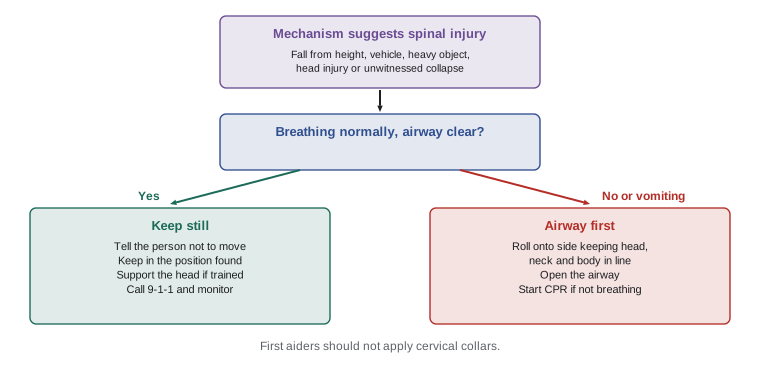
Spinal motion restriction: what has changed
First aiders used to be taught to immobilize the neck with a cervical collar and to keep a casualty rigidly still on a board. Research has shown that collars applied by first aiders can be uncomfortable, may increase movement of an injured neck, can raise pressure inside the skull and can make airway management harder, and that long periods on rigid boards cause pain and pressure injuries. Current first aid guidelines, including those followed in Canada and the US, therefore do not recommend that first aiders apply cervical collars. Instead, the emphasis is on spinal motion restriction: minimizing movement of the head, neck and spine.
In practice, for a person with a suspected spinal injury who is responsive, tell them not to move, explain why, and keep them in the position found unless they are in danger. Many conscious casualties naturally hold themselves still. A trained first aider may support the head in line with the body using both hands, kneeling at the casualty's head, until emergency services take over. Do not ask the person to move their neck to test it. Keep them warm and reassured, and monitor breathing and level of response. Move the casualty only if the scene is dangerous, such as from fire or traffic, or if you must to keep the airway open or give CPR. A person who is breathing but vomiting should be rolled onto their side while keeping the head, neck and body in line as much as possible.
Worked problem
Using the mechanism of injury
Three workers are hurt in separate incidents. Worker A slipped on a wet floor, sat down hard and now has a sore wrist. Worker B fell from the fourth rung of a stepladder, about 1.2 m, landed on their back and has neck pain. Worker C was knocked unconscious for a few seconds by a swinging hook and is now alert. For whom should you suspect a spinal injury, and what will you do?
Show solution
- Worker A: a fall from standing onto the buttocks with only wrist pain is a low-energy mechanism; assess and care for the wrist, but ask about neck or back pain.
- Worker B: a fall from about 1.2 m, over the roughly 1 m (3 ft) height that clinicians treat as a dangerous mechanism, with neck pain: suspect a spinal injury, tell them not to move, call 9-1-1 and support the head if trained.
- Worker C: a significant head injury with brief loss of consciousness: suspect both a brain injury and a spinal injury, call 9-1-1, keep them still and monitor for red flags.
Answer: Suspect spinal injury for Workers B and C. Keep them still in the position found, call 9-1-1 and monitor breathing and level of response; Worker A can be assessed for the wrist injury.
Eye injuries
The eyes are easily injured at work by flying particles from grinding and cutting, chemical splashes, ultraviolet light from welding, and blows. Most are preventable with proper eye protection, which is why eye injuries should always prompt a review of the controls.
- Loose particle (dust, a small chip) on the surface of the eye: do not let the person rub the eye. Flush with clean water or saline from an eyewash bottle or station, with the head tilted so water runs away from the other eye. If the particle remains, or the eye stays painful or red, cover it lightly and send the person for medical care.
- Embedded object or penetrating injury: never try to remove it. Do not press on the eye. Cover both eyes loosely, because the eyes move together, and protect the injured eye with a paper cup or similar shield taped around it without touching the object. Call 9-1-1.
- Blow to the eye: apply a cold pack gently without pressure for about 15 minutes; seek medical care for pain, changes in vision, blood in the eye or a cut on the eyelid.
- Chemical splash: flush immediately for at least 15 minutes, as Lesson 6 describes, and get medical care.
- Welder's flash (UV burn of the cornea): pain, grittiness and watering usually start hours after exposure. Cover the eyes with cool, moist pads and arrange medical care; do not rub.
Dental injuries
A tooth knocked out by a blow can sometimes be saved if it is replanted quickly. Hold the tooth by the crown, not the root. If it is dirty, rinse it briefly, for less than 10 seconds, with clean water or milk. Current guidelines suggest that a trained, willing person can try to place it back in its socket and have the casualty bite gently on gauze. If that is not possible, store the tooth in milk, a commercial tooth-preservation solution or the person's own saliva, never plain water, and get the person to a dentist or emergency department within an hour. Control bleeding from the socket with a folded gauze pad that the person bites on.
Returning to work after a concussion
Most people recover from a concussion within a few weeks, but returning to demanding work too soon can prolong symptoms, and a second blow before recovery can be very dangerous. Current practice is a gradual return to activity guided by a health care provider: a short period of relative rest, then step-by-step increases in mental and physical demands as long as symptoms do not worsen. Workers in safety-sensitive roles, such as driving, operating equipment or working at height, may need modified duties until cleared. First aiders and supervisors should record head injuries, encourage the worker to report symptoms that come back and avoid pressuring them to return early.
Ear injuries are less common but can occur from blows, loud blasts and objects pushed into the ear. Cover an injured ear loosely, do not plug it, and seek medical care for pain, bleeding or hearing loss.
Common mistakes
MistakeApplying a cervical collar to a casualty with neck pain.
InsteadDo not apply collars; keep the person still in the position found and support the head if trained.
MistakeLetting a person with a suspected concussion drive home alone.
InsteadStop work, arrange medical assessment and make sure someone stays with them.
MistakeIgnoring a head injury because the person seems fine now.
InsteadWatch for red flags over the following hours; bleeding inside the skull can develop later.
MistakeTrying to remove an object embedded in the eye.
InsteadShield the eye without pressure, cover both eyes and call 9-1-1.
MistakeStoring a knocked-out tooth in tap water.
InsteadUse milk, a preservation solution or saliva and get to a dentist within an hour.
Summary and key terms
- Head injuries range from scalp cuts to concussion and bleeding inside the skull, which may show effects hours later.
- Call 9-1-1 for red flags such as loss of consciousness, repeated vomiting, worsening headache, seizure, unequal pupils or confusion.
- People with suspected concussion must stop work, not drive, not be left alone and be assessed the same day.
- Suspect a spinal injury from the mechanism: falls from height, vehicle incidents, heavy objects, significant head injury or unwitnessed collapse.
- Current guidelines do not recommend cervical collars for first aiders; minimize movement and keep the person in the position found.
- An open airway and breathing take priority over possible spinal injury.
- Flush loose particles and chemicals from eyes, shield embedded objects, and save knocked-out teeth in milk or saliva.
- Concussion
- A brain injury caused by a blow or jolt that disturbs brain function, with or without loss of consciousness.
- Skull fracture
- A break in the bones of the skull.
- Red flag
- A sign that suggests a serious condition needing emergency care.
- Mechanism of injury
- How an injury happened, used to predict which injuries may be present.
- Spinal cord
- The bundle of nerves inside the spine that connects the brain with the body.
- Spinal motion restriction
- Minimizing movement of the head, neck and spine of a casualty with a suspected spinal injury.
- Cervical collar
- A neck brace; no longer recommended for application by first aiders.
- In-line support
- Holding the head in line with the body to limit movement.
- Welder's flash
- A painful ultraviolet burn of the cornea from unprotected viewing of arc welding.
- Tooth avulsion
- A tooth knocked completely out of its socket.
Practice problems
Work each problem on paper first, then reveal the answer to check.
Does a person need to lose consciousness to have a concussion?
Show answer
No.
List four red flags after a head injury.
Show answer
Loss of consciousness, repeated vomiting, worsening headache, unequal pupils (also seizure, confusion, weakness, fluid from ears or nose).
Why should someone stay with a person after a head injury?
Show answer
Bleeding inside the skull can cause deterioration hours later.
Name three mechanisms that suggest a spinal injury.
Show answer
A fall from height, a vehicle collision and a heavy object striking the head or back.
Should a first aider apply a cervical collar?
Show answer
No; current guidelines do not recommend it.
When may you move a casualty with a suspected spinal injury?
Show answer
If the scene is dangerous, or to keep the airway open or give CPR.
How should you care for an object embedded in the eye?
Show answer
Do not remove it; shield it without pressure, cover both eyes and call 9-1-1.
Why cover both eyes for a serious eye injury?
Show answer
Because the eyes move together, and covering both reduces movement of the injured eye.
How should a knocked-out tooth be stored if it cannot be replanted?
Show answer
In milk, a tooth-preservation solution or saliva, not plain water.
When do symptoms of welder's flash usually begin?
Show answer
Several hours after exposure.
Lesson quiz · 5 questions
Score 60% or more to complete this lesson.
Create a free account to save your progress, take quizzes and earn a certificate.