
HSE-110 · Lesson 6 of 12 · 25 min
Burns: thermal, chemical and electrical
Burns are common workplace injuries. Kitchens, welding bays, foundries, laboratories, maintenance shops, electrical rooms and chemical plants all expose workers to heat, flames, hot liquids, steam, corrosive chemicals and electricity. Most workplace burns are small and heal well with good first aid. Some are deep or extensive and need hospital care, and electrical and chemical burns can hide serious damage beneath a small mark on the skin. The single most important first aid action for most burns is simple: cool the burn with running water, quickly and for long enough.
How burns are classified
Burns are described by depth and by extent. Depth used to be described as first, second and third degree; today, health care providers more often use the terms superficial, partial thickness and full thickness, which describe how many layers of skin are damaged.
| Depth | Older term | What it looks like | Typical feeling |
|---|---|---|---|
| Superficial | First degree | Red, dry, no blisters, like sunburn | Painful |
| Partial thickness | Second degree | Red, blistered, moist or weeping, may be blotchy | Very painful |
| Full thickness | Third degree | White, waxy, leathery, brown or charred | May be painless because nerves are destroyed |
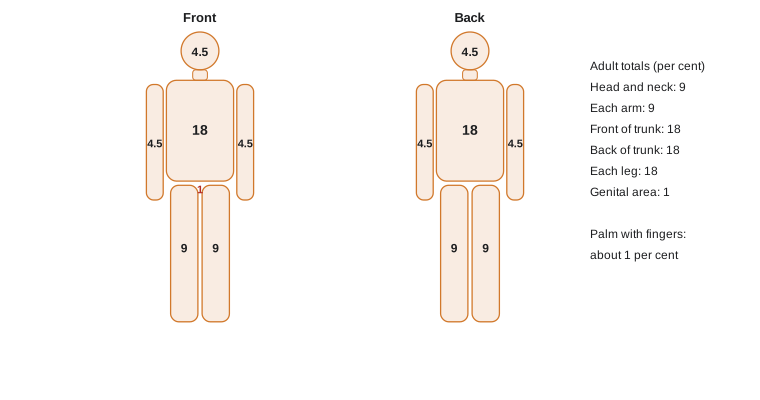
Extent is described as a percentage of the total body surface area (TBSA). Two simple methods help estimate it. The palm method uses the fact that the palm of the casualty's own hand, including the fingers, is roughly 1 per cent of their body surface area. The rule of nines divides an adult body into regions of about 9 per cent or multiples of 9: the head and neck 9 per cent, each arm 9 per cent, the front of the trunk 18 per cent, the back of the trunk 18 per cent, each leg 18 per cent and the genital area 1 per cent. Children have relatively larger heads and smaller legs, so the proportions differ. Superficial burns that are only red are not counted when estimating extent.
Worked problem
Estimating burn area
A worker's clothing catches fire. After the flames are out, you see blistered, partial-thickness burns covering the whole front of the right arm and about half of the front of the trunk, plus a patch on the left hand about the size of two of their palms. Estimate the burn area.
Show solution
- Front of one arm: an arm is 9 per cent in total, front and back, so the front is about \(9 \div 2 = 4.5\) per cent.
- Half of the front of the trunk: \(18 \div 2 = 9\) per cent.
- Left hand patch: two palms \(\approx 2\) per cent.
- Total: \(4.5 + 9 + 2 = 15.5\) per cent of body surface area.
- A partial-thickness burn of this size in an adult is a major burn: call 9-1-1, cool the burns, watch for hypothermia and shock.
Answer: About 15 to 16 per cent of body surface area. This is a serious burn needing emergency services and hospital care.
When a burn needs medical care
Call 9-1-1 or arrange urgent medical care for burns that:
- are full thickness, or partial thickness and larger than the casualty's palm;
- involve the face, hands, feet, genitals or major joints, or go all the way around a limb or the chest;
- are caused by chemicals, electricity, radiation or an explosion;
- come with signs of breathing problems, such as soot around the mouth or nose, singed nasal hair, hoarseness, coughing or difficulty breathing, which suggest airway burns from hot gases or smoke;
- occur in a young child, an older adult or a person with a serious medical condition;
- are accompanied by other injuries or by signs of shock.
First aid for thermal burns
Thermal burns are caused by heat: flames, hot surfaces, hot liquids (scalds) and steam. First, stop the burning. If clothing is on fire, the person should stop, drop and roll, or be wrapped in a fire blanket or heavy non-synthetic cloth to smother the flames. Move the person away from the heat source if it is safe. Then:
- Cool the burn under cool or cold running water, not ice-cold, as soon as possible. Current first aid guidelines in Canada and the US call for cooling for at least 10 minutes, and many programs and burn specialists recommend up to 20 minutes. Cooling is still worthwhile up to about three hours after the burn. If running water is not available, use any cool, clean liquid or a wet cloth that is re-soaked often.
- Do not use ice, iced water or ice packs, which can damage the tissue further and cause hypothermia. Watch for shivering, especially when cooling large burns or burns in children, and keep the unburned parts of the body warm.
- While cooling, gently remove rings, watches, belts and tight clothing near the burn before swelling starts. Do not pull away clothing that is stuck to the skin; cut around it.
- After cooling, cover the burn loosely with a clean, dry, non-stick dressing or with plastic food wrap laid lengthwise over the burn rather than wrapped tightly around a limb. This protects the burn, reduces pain and lets health care providers see the wound.
- Do not break blisters. Do not apply butter, oil, toothpaste, creams or other home remedies; they hold heat in, increase infection risk and must be scraped off in hospital.
- Keep the person warm and watch for shock. Give nothing by mouth if the burn is serious.
Small superficial burns, such as a brief touch on a hot surface, can be cooled and then covered with a non-stick dressing. Over-the-counter pain relief and soothing gels such as aloe vera are reasonable for minor burns at home, but follow workplace rules about what the first aid kit may contain.
Chemical burns
Corrosive chemicals, such as strong acids and bases (alkalis), cause burns that keep getting worse while the chemical remains on the skin. Alkali burns, from substances such as sodium hydroxide, wet cement and some cleaning products, are often deeper than they first appear. Check the safety data sheet and the label: section 4 of an SDS gives first aid measures for that product, and some chemicals, such as hydrofluoric acid, need specific treatment and immediate medical care.
To give first aid, protect yourself with gloves and eye protection. If the chemical is a dry powder, brush it off before flushing. Remove contaminated clothing, shoes and jewellery, taking care not to spread the chemical. Flush the skin with large amounts of lukewarm running water for at least 15 to 20 minutes, or longer if the SDS says so, using a drench shower if one is available. Flush eyes immediately at an eyewash station, holding the eyelids open, for at least 15 minutes, and remove contact lenses if they come out easily. Call 9-1-1 or poison control and send the SDS or product label with the casualty.
Emergency eyewash and shower equipment must be readily available wherever workers handle corrosive substances. In Canada, provincial OHS regulations require it where there is a risk of eye or skin injury from hazardous products, and most refer to the ANSI/ISEA Z358.1 standard, which calls for equipment that can deliver tepid water for at least 15 minutes and is reachable within about 10 seconds. Poison centres serve each province; the number should be posted beside chemical storage areas.
Electrical burns
Electrical contact can cause burns where the current enters and leaves the body, but the visible marks may be small while the current has damaged muscles, nerves and blood vessels along its path. Electricity can also stop the heart or cause abnormal heart rhythms, and the shock can throw a person or cause a fall. Every electrical injury needs medical assessment, even if the person seems fine.
Never touch a person who may still be in contact with the electrical source. For low-voltage equipment, switch off the power at the switch, plug or breaker if you can do so safely. For high-voltage lines, stay at least 10 m (33 ft) away, keep others back and call the utility and 9-1-1; do not try to move the line, even with a wooden pole. Once the power is off, check the casualty's response and breathing, start CPR and use an AED if they are unresponsive and not breathing normally, then cool and cover any burns. Lightning strikes are treated similarly; a person struck by lightning does not carry a charge and can be touched safely once the area is safe.
Other burn situations
Hot tar and asphalt burns are common in roofing and paving. Cool the tar with cold running water for at least 10 to 20 minutes to stop the burning; do not try to peel off tar that is stuck to the skin, because that tears the skin away. Health care providers remove it with special solvents. Hot metal, molten plastic and wax are handled the same way.
Sunburn is a radiation burn from ultraviolet light and is a recognized hazard for outdoor workers, along with long-term skin cancer risk. Move the person out of the sun, cool the skin with cool water or damp cloths, give water to drink, and advise medical care if there is extensive blistering, fever, chills or confusion, which may indicate heat illness as well. Ultraviolet light from arc welding can burn exposed skin and eyes in the same way.
| Burn source | Key first aid point |
|---|---|
| Flame, hot surface, scald | Cool with running water for at least 10 and up to 20 minutes |
| Steam | Cool as for thermal burns; check for airway burns |
| Acid or alkali liquid | Flush with large amounts of water for at least 15 to 20 minutes; remove contaminated clothing |
| Dry chemical powder | Brush off first, then flush |
| Hydrofluoric acid | Flush and follow the SDS; needs specific treatment and immediate medical care |
| Electricity | Make safe first; check breathing and heart; medical assessment always |
| Hot tar | Cool with water; do not peel off |
After any burn, encourage the worker to report it and record the cause. Repeated small burns at the same fryer, press or welding station point to a hazard that guarding, procedures or protective equipment should control.
Common mistakes
MistakePutting ice or iced water on a burn.
InsteadCool with cool or cold running water, not ice-cold, for at least 10 and up to 20 minutes.
MistakeApplying butter, oil or toothpaste.
InsteadCool, then cover loosely with a clean non-stick dressing or plastic food wrap.
MistakePopping blisters to relieve pressure.
InsteadLeave blisters intact to reduce infection risk.
MistakeFlushing a chemical burn for only a minute or two.
InsteadFlush with plenty of lukewarm water for at least 15 to 20 minutes, or longer if the SDS says so.
MistakeAssuming a small electrical burn is minor.
InsteadGet medical assessment for every electrical injury because internal damage may be hidden.
Summary and key terms
- Burns are classified by depth (superficial, partial thickness, full thickness) and by extent as a percentage of body surface.
- The casualty's palm with fingers is about 1 per cent; the rule of nines divides an adult body into 9 per cent regions.
- Seek medical care for large, deep, chemical, electrical or airway burns and burns on the face, hands, feet, genitals or joints.
- Cool thermal burns with cool running water for at least 10 and up to 20 minutes; never use ice.
- Remove jewellery early, cover loosely with a non-stick dressing or plastic food wrap, and do not break blisters.
- Brush off dry chemicals, then flush skin for 15 to 20 minutes and eyes for at least 15 minutes; check the SDS.
- Make electrical scenes safe before touching the casualty; every electrical injury needs medical assessment.
- Superficial burn
- A burn affecting only the outer skin layer; red and painful without blisters.
- Partial-thickness burn
- A burn extending into deeper skin layers, usually with blisters.
- Full-thickness burn
- A burn destroying all skin layers; may look white, leathery or charred.
- TBSA
- Total body surface area; used to describe burn extent as a percentage.
- Rule of nines
- A method of estimating burn area by dividing the adult body into regions of about 9 per cent.
- Palm method
- Estimating burn area using the casualty's palm with fingers as about 1 per cent.
- Airway burn
- Injury to the airway from hot gases or smoke, suggested by soot, singed hair or hoarseness.
- Corrosive
- A chemical that destroys living tissue on contact, such as a strong acid or alkali.
- Eyewash station
- Equipment that flushes the eyes with tepid water for at least 15 minutes.
- Entry and exit wounds
- Burns where electrical current enters and leaves the body.
Practice problems
Work each problem on paper first, then reveal the answer to check.
How long should a thermal burn be cooled?
Show answer
For at least 10 minutes, and up to 20 minutes, with cool or cold running water.
Why should ice not be used on burns?
Show answer
It can damage tissue further and cause hypothermia.
What percentage of body surface is the casualty's palm with fingers?
Show answer
About 1 per cent.
Using the rule of nines, what percentage is one whole leg?
Show answer
18 per cent.
Name three signs of an airway burn.
Show answer
Soot around the mouth or nose, singed nasal hair, hoarseness (also coughing, difficulty breathing).
What should you do before flushing a dry chemical powder?
Show answer
Brush it off the skin.
How long should eyes be flushed after a chemical splash?
Show answer
At least 15 minutes, or longer if the SDS says so.
Which SDS section gives first aid measures?
Show answer
Section 4.
How far should you stay from a downed high-voltage line?
Show answer
At least 10 m (33 ft), and call the utility and 9-1-1.
Why does every electrical injury need medical assessment?
Show answer
Current can damage the heart and deep tissues even when skin burns look small.
Lesson quiz · 5 questions
Score 60% or more to complete this lesson.
Create a free account to save your progress, take quizzes and earn a certificate.